
Translated material
Shakespeare Live
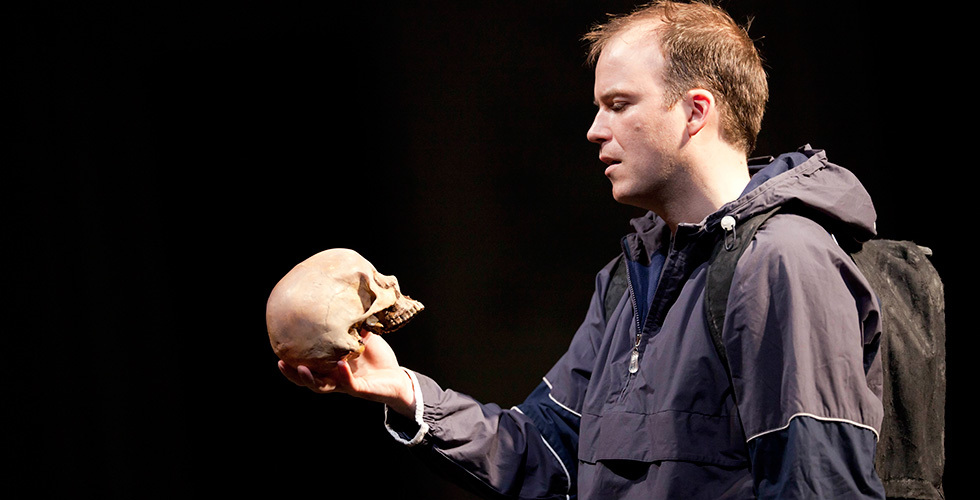
The new - for Russia the second in the row - the season of showing British performances on the screens of the world cinema is dedicated to the anniversary of William Shakespeare, and part of his program is therefore solemnly called the Shakespearean theater festival. It was based on the performances of National Theatre and the Globus (they can be seen now), the completely new Richard II RSC and Coriolan theater Donmar Warehouse are also promised (which should only take place the premiere).
Exhaustive information about the state of affairs in the English theater (and even about how it is customary to put Shakespeare) from the film program should not be expected from the film program: the modern British scene is quite diverse, and if in our ideas about it (as a purely commercial one - albeit in the very sublime sense), exclusively Jude Lowe and Endrya (Moriartyrty) of Scott in The new play in Royal Court, then this is nothing more than belated “translation difficulties”. But in fact, there, on the one hand, the tiny “Sam Wenanemaker Theater” opens (Jacobian authentic - up to candle lighting), and on the other, Katie Mitchell intends to put the “cherry garden”. And it makes no sense to draw up all this in the "Trend". However, those who once came up with the concept of showing “the best British performances in the cinema next to you” were never mistaken: just “the best” in this case means “universal”. That is, just such a theater where “Seneca is not too heavy and Plavt is not too light,” as stated in the play “Hamlet”. It is no accident that in this theater, Shakespeare is almost a nightly give. What could be more universal than the globe?
The Globus (now led by Dominik Dromgul) is considered a theater for schoolchildren and tourists. That's right - and they are also welcome guests there. Among others. Of course, the main aesthetic experience from the presentation in the Globe inevitably turns out to be the Globe itself with its unique internal device, an absent roof, a standing sinopter and circular lodges. But the way of arranging the performance in this theater is such that the ancient architectural effect is dramatic: the actors, deprived of the slightest illusion of the “fourth wall”, are thrown directly into the stalls of the stalls, and the characters lead dialogues with each other without exchanging the flirty apartments, but honestly and every minutely calling the public to witnesses and partners. To maintain artistic equilibrium, not to “shaking”, not to give the public to manage, but not to be closed in an arrogant (in this case, inappropriate) public loneliness - the task is not easy.
They often solve it in the oldest comedian - tirelessly multiplying tricks. In the “taming of the stability” of Toby Frow, the “twelfth night” Tim Carroll and “a lot of noise from nothing” Jeremy Harrin, almost everything is done so that the viewer is a little choked, absorbing one attraction after another, and does not interfere under the feet of the plot. Someone does this more inventively (like Carroll, whose disposal is Mark Reylens, playing Olivia), someone less, but in general, none of these performances even imply the interpretation of the Shakespearean comedy as a task. The infinitely beloved Stephen Fry comes out in yellow garters cross-sustained-and his vulnerable, middle-aged and tired Malvolio turns out to be a problem not only of characters, but also by the performance: his trepidable personal theater is completely deprived of the fierce fierce cruelty necessary here, and the 21st century, vainly asks for mercy in XVI. But they do not work with similar matters in the Globe. This is a theater for another.
Dominic Dromgul himself in Henry V is excellently aware of both the possibilities and boundaries of the unique theater, not without reason his choir is an actress playing a modest maid, and the famous prologue, who appeals to the power of the audience, she pronounces the intonations of the teacher-enthusiast. Yes, the local audience is this. But when Harry English (Jamie Parker) will need soldiers and he will take them directly from the stalls, in the new recruits near Azenkur there is no shortage. There will be no heavy “interactive” clowning, no special pathos, a few accurate gestures and response of the crowd - and the Shakespearean king again has someone to recall the “Day of St. Crispian”. The effect, in principle, is possible in the Globe Theater, granted originally. This theater "reformathes" the audience into a single whole. And the unchanging joyful Jiga celebrates another victory over Chaos.
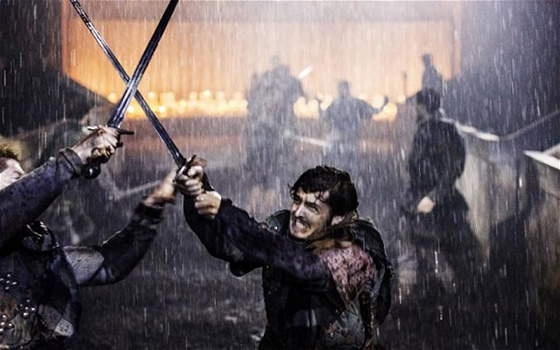 Theshakespeareblog.com "Macbeth" Kenneth Brana
An attempt to create a space is less archaic, but equally potentially responsive, in the version of Kenneth Brana turned out to be insolvent - like his Macbeth himself. Having placed the actors into a narrow passage filled with liquid mud, between the two spectator rows, the director “brought up” to the audience of murder and brawls, but not a tragedy, turning the play into a loud and empty provincial joke “from ancient life”. The “Heir to Olivier” has one problem-he is catastrophically, somehow even self-destructively banal.
The name of Nicholas Haytner outside England will probably never be as loud as the name of Brana, but there is nothing to grieve about. His versions of “Othello” and “Hamlet”, set in NT, look like “formal” performances of a large style, but replete with decisions in which the directorial handwriting is easily guessed - elegant, discreet and exquisite. The notorious “interpretation of the text” is not a harsh duty (or old -regime quirk), but a natural professional need. Accordingly, the maximum “pleasure from the text” - already stage - will receive those who are terribly important to find out why the gullible general killed his wife, why the prince of Danish and so on in the same spirit. Inadvertency in search of these answers - “as if thirst only grew up from thicken” - this is perhaps the only question that they do not ask in the National Theater. Because Shakespeare. This is unstitable.
“Othello” is an equally story about the Venetian Maurus and his failed lieutenant: Iago Rori Kinnir is no less important than Othello Adrian Leicester. In this Othello there is not the slightest flaw, it is beautiful on its own and invulnerable from the outside, it literally happy the Venetian republic with its service - except that the emphasized elegance and honeness of the manners will give out a stranger, and not the color of the skin. Iago and Brabanzio are the last secret racists in this prosperous, civilized, tolerant world. "I am black!" - This is not flour, it is anachronism, wildness, which cannot be believed in. But the perfection of Othello and puts him under attack: Iago is a person for whom the thought of the superiority of another is simply intolerant. A person who is used to measuring everything is absolutely everything - himself. The embodied ideal “IMHO” is in the most glaring absence of modesty in the key “x”. He is not at all devoid of advantages, smart, sensitive and terribly charming (Rory Kinnir does not make the task easier for the audience), but there is not suicidal, and there is no generosity behind him - and therefore he is inferior even by an enthusiastic boy Cassio. The rumor of Emilia’s infidelity (in the outstanding performance of Lindsay Marshall, it was she, and not Desdemona became a tragic heroine) acquires a fatal meaning here: Iago suffered secretly and could neither recognize his sufferings, nor talk to someone-the sobbing hotel says, including for him. Iago needs to humiliate the general, but it is no less necessary for him to say. It is interesting that the performance so sophisticated in thin, complex nuances is touching in the main thing: so why he believed why he killed? Well, how - such grief (Leicester plays - intolerable), such hellish torment that you are.
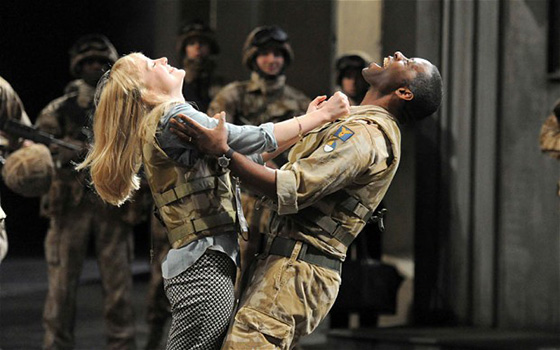 © ALASTAIR MUIR "Othello" by Nicholas Haitner
But the Hamlet Hamlet is unknown unknown - with all the external transparency of the performance, as if made entirely according to the directorial manifesto of Prince Hamlet (“Everything that is exaggerated is disgusting to the appointment of acting ...”). Rory Kinnir is irresistible in the main role - as was characteristic of the princes of the Danish of the past, when they were not yet driven with a denouement and did not execute the sinister “I know what you did in the fifth act!”. Hamlet Kinnir is the prince who hesitates. The notorious “Hamlet doubts” have nothing to do with it - this Hamlet has no doubt, he only comprehensively considers arguments. And he does not find a single one who would not tell him to go and kill. Everyone around, every character, any event, the very structure of the world repeats to him about the murder and shame for inaction - this is how his father tells, so he tells the duty, they expect this from him at court, there is an argument in the form of a warlike force -bomb and so on, and so on. The director does not make passes in the Shakespearean text, each time focusing direct orders. Hamlet himself is deeply convinced of the need for revenge, he longs for it, he has a knife (the prince walks four acts with a small knife - and only in the fifth there will be a rapier). Nevertheless, something stops him every time-something outside the logic, not controlled by reason or will.
Something for which there were not enough definitions in the whole giant Shakespearean dictionary. Others will call it the soul - and they will only partly be right: the “soul” here is listed in another church, the department, to the one that disposes of the posthumous definition in hell, the ceremonial at the funeral and other important, but daily practical meanings that do not have business. But some kind of metaphysical “quintessence” is present-you just have to look at the hero Rory Kinnir. And this world makes sense only until Hamlet is “hesitation”, fighting with itself. Recalling that it is not ashamed - not to kill. It’s not a shame - not to be able to get at the court and not obey the reasonable parental orders: the one who knows how to arrange and obey is the name of Laerte. It’s not a shame in the atmosphere of the universal massacre to inactive and engage in all nonsense like the theater - the “decisive” prince is the name of Fortinbra, and he is a born killer. It’s not a shame even in a terrible grief to keep my mind and continue to joke - it’s easy to go crazy, the one that did so was with Ophelia. Hamlet is a completely different play.
Among the many lovely directorial moves in this performance is unforgettable. In the finale, cautiously walking around the corpses in the Elsinore hall, there are ambassadors with a message about the death of the Rosencranz with Hildenster. "Whose mouth is we waiting for gratitude?" “Not these,” Horatio will answer. - When they could thank; / He never demanded their execution. " And he will instinctively shake Hamlet lying on his knees, urging his friend to laugh at a successful acuteness. But the prince is already dead. The shy, sad shadow of a friendly joke, which never found an answer - as a farewell song of the jester, is the best, if not the only possible, a gift for the anniversary of the Great Bard.