
Translated material
And the train goes ...
The New Times attended an exhibition of watercolors Alexander Labas in the museum. A.S. Pushkin
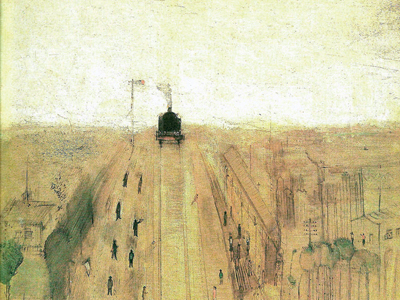
"Train from Moscow", 1928
| *N. Semenova "Labas", "Young Guard", ZhZL, 2013 |
A small exposition from the Museum’s collection is timed to the release of the biographical book about the artist*, the first thorough and at the same time popular study of his life and creativity. As a “highlight” of the presentation - both books and exhibitions - for the first time in the halls of the museum, two iconic paintings by Labas “Train from Moscow” and “The train is coming” will be presented. Their fate is unusual.
Loop
The artist draws the “train from Moscow” in 1928: against the backdrop of a luminous golden haze, a black train point appears, some kind of symbol of the unknown, or joyful-people meet a train with flowers, children launch an air snakes into the sky, or as a prejudice of trouble. In 1929, the picture was exhibited in New York, and there it was unexpectedly sold for the author. Labas was generally actively exhibited in the West - his paintings, directed to the future, coincided with the emotions of the Soviet state and were curious to foreigners.
Then, together with the “train from Moscow”, the painting “Dead Loop”, “Pitching on the Airpill”, “Passenger” did not return to their homeland. But the plot was the first to torment the artist, worried, and he decided to return to him after a while.
Alexander Labas recalled: “I remember then, near Moscow at the station, I examined the birch trunks, and at that time a train from Moscow was driving. The black spot that appeared quickly was approaching in a light pink steam sky; It suddenly seemed to me-both the rhythm and the color-somehow similar. This prompted me to solve the picture, and I enthusiastically wrote it; It really resembled the fresh color of the birch bark. I was very sorry that this picture went far from me and did not return. A year later, I tried to repeat it. Many comrades then believed that I succeeded, but it seemed to me that I could never do this. It turned out rather a new option or, rather, a new picture ... "" "
The accusation of formalism looks ridiculous. Labas was a realist seeking to convey the internal state of the hero
"
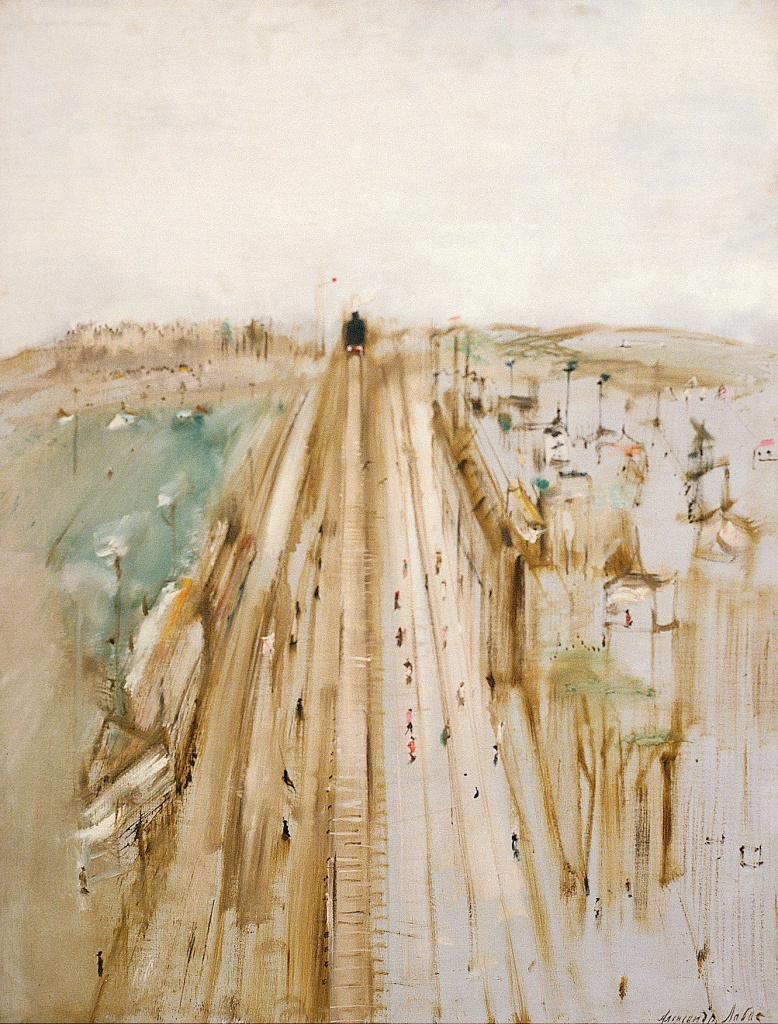 |
| "The train is coming", 1929 |
A repeat of the picture - “The train is coming” (1929) was acquired by the Russian Museum. The author’s doubts are clear. For all the similarity of the plot, from the second version of the picture, the contrast of the carelessness of the meeting, the solarity of the day and the alarm spilled in the impending era, disappeared. It was impossible to get into the same mood of the “impending black spot”. Alexander Labas never saw these paintings together, only vague memories remained about the first. And now both works are first displayed nearby. And the contrast is obvious.
Consistent formalist
Although Labas, like his friends in the art of Tyshler, Udaltsov, Drevina, Sternberg, was accused of formalism, this definition in relation to the artist looks rather funny. Fascinated by movement and singing in his paintings the elusive feeling of prostration into which a person sometimes flows inside a moving object, Labas was rather a consistent realist, striving to convey in painting not an external, but the internal state of his hero. “In addition to annoyance, the paintings do not cause him anything,” Polikarp Lebedev, the future director of the Tretyakov Gallery, in the article “Against formalism in Stalinist art”, wrote in 1936. Alexander Labas was lucky. At a time when many people around him were subjected to repression, he was saved in his life by some of his “Jewish God”. Yes, they stopped exhibiting it, but he took up the issuing work, went on business trips, and performed social orders. The mystic of the movement pursued him in life. At one time, Malevich also felt her when he considered his duty to visit the Labas workshop on every visit to Moscow. “About visiting my little master and about my work in the early 1920s, he (Malevich) told many then in Petrograd,” the artist recalled.
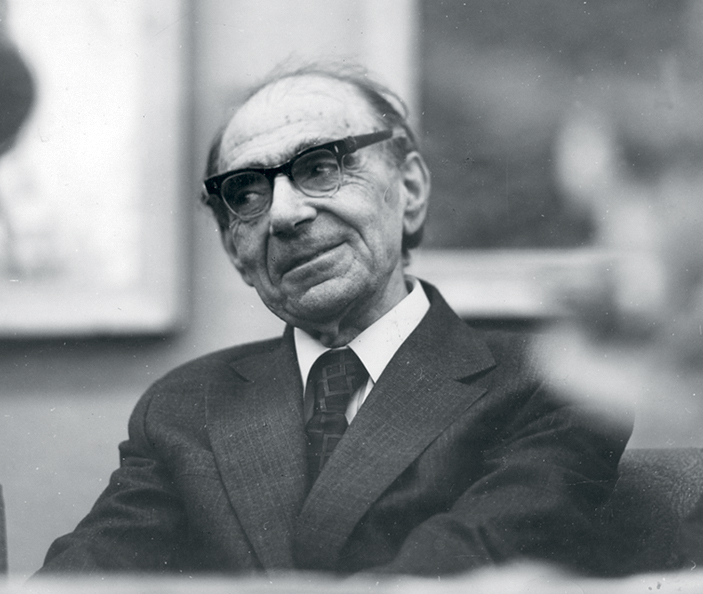 |
| Alexander Labas, 1976 |
It seems that the light, air work of Labas involves the same lightness and the author’s attitude. But Labas clearly knew the risks of his profession: “The artist’s work is dangerous. The artist must be hard and unshakable. And our artists were especially “caressed”, Malevich sat in prison twice, others languished in the camps for years and decades, like Shukhaev and Antoshchenko-Olenev, and many were shot, like a Drevina, professor of Vhutemas, and Semashkevich. There was such a terrible time: the artists were strangled, everything new in art was perceived in hostility. ”
A small exhibition at the Volkhonka gives the depth of gaze at the watercolor and the painting of Labas, which he dreamed about all his life, claiming that with every decade his work “it would be more and more understandable, but after 50 or 100 years they will call in full force, and everyone will see our time in them, which, it seems to me, rarely anyone felt like me ...”
Photos are provided by the Alexander Labas Foundation