
Translated material
: Let's change shots

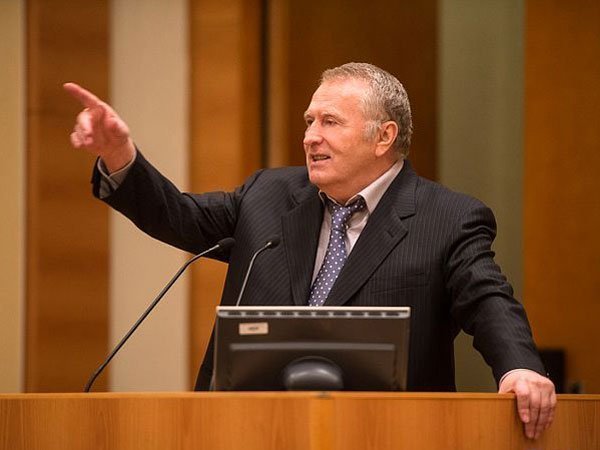 Vladimir Zhirinovsky Photo: ldpr.ru
 LDPR leader Vladimir Zhirinovsky is not old, he is superstar. At least in the eyes of the young party members to whom he spoke the day before. The event was called “All-Russian Meeting of Young Liberal Democratic Party Activists,” and the presence of two thousand delegates from all over Russia was promised in advance.
Vladimir Volfovich did not disappoint his fellow party members, nor did he disappoint the rest of the Russians. In particular, he criticized deputies who do not attend their workplace well. “We need to introduce the principle of rotation; for this we need an amendment to the law on the status of State Duma deputy. For example, six months have passed since the election, 10 people are lazy, and we are removing them, taking them off the list, so that there are those who want to work in the localities,” said the LDPR leader.
According to him, lazy deputies undermine the authority of not only the LDPR, but also the authorities as a whole, and the rotation of deputies is an excellent recipe for improving democracy.

The pathos of the Vice-Speaker of the State Duma is understandable - the audience was grateful. “The LDPR is leading a course towards rejuvenation. The party faction is the youngest in the State Duma. This is the youngest faction on a European scale. The youngest governor is from the Liberal Democratic Party. The youngest member of the Federation Council is from the Liberal Democratic Party. The youngest chairman of the State Duma Committee is from the Liberal Democratic Party. One of the priority areas of activity of our party is youth policy. There are Branches of the LDPR Youth Organization in all regions of Russia. The range of activities of the organization is quite extensive. The youth of the LDPR conduct political and social events, organize cultural and sporting events, and do charity work,” boasts the party press service. Who else, if not young party members, should talk about the importance of rotation and its speedy implementation?
There are, however, nuances. The struggle for attendance at plenary sessions of parliament is nothing new. At most one hundred people out of the announced four and a half hundred attend the meetings. And those attending meetings usually vote for everyone else. Video recordings of these “races” during the voting process are quite available - you can easily find them on the Internet.
This situation has come to the attention of the media more than once, and therefore parliamentarians know that there is a problem. They even tried to fight it - either in the State Duma or in the Federation Council, angry words were heard that truant deputies should be punished somehow. “Currently, parties do not have a mechanism to put pressure on absentee deputies. After all, exclusion from factions will only entail the loss of party affiliation, and not at all the deprivation of a mandate. We will soon introduce a bill to the State Duma that would allow the replacement of truant deputies with those who ran with him but did not receive a mandate. Thus, the leadership of the faction, noticing that a person did not attend meetings of committees and the State Duma for 20 days without a good reason, will be able to carry out a rotation and deprive the slacker of his mandate,” said LDPR deputy Maxim Rokhmistrov in an interview with Lifenews three years ago.
They also tried to call the senators to order more than once. “I propose to consider the possibility of deductions from senators’ salaries for meetings of the Federation Council, committees and important events they missed without good reason,” said Federation Council Speaker Valentina Matvienko just a month ago.
However, during one of the campaigns to increase parliamentary attendance a couple of years ago, the corridors of the building on Okhotny Ryad were filled with parliamentarians. And then one thing became clear - many deputies in one place does not guarantee an increase in efficiency. Deputies then complained that the noise from a large number of people interfered with normal work. And this is provided that not everyone made it, but about 250 people (out of 450 payroll).
 Photo: ldpr.ru
 The problem now voiced by Zhirinovsky also has a different twist: rotation of power is necessary. Only the rotation mechanisms work according to a rather random pattern and no coherent system is observed. Is it possible to solve the problem somehow mechanically, say, in the way proposed by VVZh? Unlikely.
Rotation of the deputy corps according to any principles does not achieve much at all - the legislative branch is the smallest of the branches and far from the most important (this is the way it is in Russia). That is, the opportunity to change all the deputies en masse is interesting to some people, but first of all, these are the heads of parliamentary parties, including Vladimir Volfovich Zhirinovsky. For the rest, whether deputies go to the Duma and change once every five years or more often is neither cold nor hot.
But the principles of personnel policy are a different matter and much more important. “In the Soviet Union, personnel policy was quite well structured; there were certain filters, stages through which people passed. I won’t hide that they were looked after - in the good sense of the word - by mentors, they led people - in the good sense of the word,” said the head of the presidential administration, Sergei Ivanov, recently. “It (personnel policy) was destroyed in our country, it needs to be revived, I don’t see anything wrong with it - no one has come up with anything better anyway,” he added. But for now the only dacha cooperative “Ozero” is in power, and in the Duma it’s up to who brought how much money to whom. Ivanov’s words, like Zhirinovsky’s words, remain a private wish, and not a principle. Because why rotation if everyone is already happy with everything?