
Translated material
Karamazovs and hell
“Well, where is the tin? What did you try to censor? " - the fans of the director Bogomolov asked perplexedly after the first pre -premiere shows of the new performance of the art theater, which was preceded by a loud theater scandal, instantly published in the top of Yandex.
I will answer right away - this is still tin. She is just not at all the same as the inquisitive mind of the Russian intellectual is used to looking for. The intellectual mind will recover brave races - to power, to the church, on public order, to the courts, the police and the constitution. And tin of this kind in comparison with the “ideal husband” of the same director, triumphantly going on the stage of the same Moscow Art Theater, really few in the “Karamazovs”.
As for tin of a different kind (sadomaso, gender shifts, necrophilia, homosexuality of all bad), it was served by Bogomolov so distant, so ironic and so, I would say, chastely, that only those uninhabited souls of domestic puritan, which would even seem to have pornography, even a fair idea of parsley.
Nevertheless, the Karamazovs are tin.
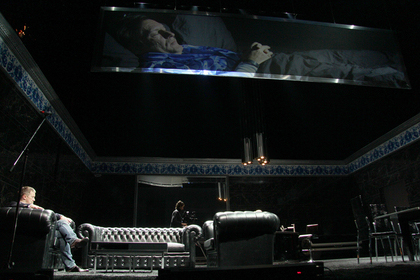
I’m not sure that she, which hid behind the superficial meanings of the production, is always able to discern not only blasphemers, but also enthusiastic admirers of the premiere. The performance is for nothing that Bogomolov does not offer us, as usual, a contamination of several works, but is concentrated exclusively on Dostoevsky’s novel - extremely redundant, oversaturated with images and spectacular twists. Its action takes place at once on the stage, in the hall, in the side lodges, on three plasma screens, where the ironic directorial remarks can also be read to everything that happens on the stage. But all this redundancy is not chaotic. In the cunning polyphony of the “Karamazovs” there is one leading topic. And she is not at all about power and not even about the church.
 © Ekaterina Tsvetkova
The most superficial layer of this multi -layer pie is the satirical narrative of Russian life (well, yes, about Russian - not about Norwegian, in fact). The city of Skototodrigonevsk, in which the action of the novel unfolds, becomes a source of simple jokes in Bogomolov, whose problem is too naked to take it seriously. In Skoto -Pigonevsk, everything is cattle - cattle cops, a cattle bank, a cattle TV. The sun never shines in Skototo -Trigonevsk, but Fedor Pavlovich Karamazov owns a network of solariums here. In the "idiot" of Frank Castorf, each of the characters sooner or later turned into an idiot and fought in the floods. In Bogomolov, each of the inhabitants of Skototorgonevsk sooner or later discovers something cattle in himself.
The second layer is the deconstruction of the text of F.M. Dostoevsky. He sometimes seems to be rewritten and decided by the writer V.G. Sorokin, although in reality all extrapolations belong here to the pen of the director himself, who boldly embarrasses with genres and styles and, as if experiencing his artists for strength, an endless change of theatrical registers. Artists, we must pay tribute to them, the test is withstanding with honor. They are all good here, but some - Victor Verzhbitsky (Zosima and Smerdyakov), Rosa Khairullina (Alyosha Karamazov) and especially Igor Mirkurbanov (Fedor Karamazov) - are good that it is time to talk about the new acting school Konstantin Bogomolov.
The performance begins in the spirit of a kind of meditative psychologism unfolding in glossy black space, but gradually they invade the flesh:
- The Russian chanson so beloved by the Bogomolov, and at the same time non -Russian rock: Mitya (Philip Yankovsky) and Fedor Pavlovich mutus each other under the hit “Parental House, began”, and Father Feofan (Svetlana Kolpakov) performs with a high female voice in the panachis “Show Must Go ON” ;
- Elements of a fair action: the story of Lisa Khokhlakova (Natalya Kudryashova) about a boy who chopped off all his fingers, and then also crucified him, is presented as a scene of the field theater and is an example of a naive, as a tear of a child, Russian anti -Semitism;
-Fairy-tale Morok: Alyosha-Ivanushka enters the kingdom of the evil sorceress Katya-Crimean (Daria Moroz) and pear in a kokoshnik (Alexander Child).
Here, not just erased the line between the high and low, then any boundaries are erased here. The kingdom of popes easily turns out to be a fabulous kingdom-state; In the Hollywood horror film that the owner of the Khokhlakova is watched by the owner of the Khokhlakova Bank (Marina Zudina), suddenly our domestic cop invades the carpet, and the passion suddenly flashed between the heroes turns into a chapter from a trash erotic novel (essay, of course, Mr. Bogomolov himself): we read it on the monitor's screen, while the heroes themselves are the heroes ourselves Sit motionless opposite each other. Disgusting in black, frog tones, the performance every now and then lets the rainbow with all the colors of the rainbow, so that later he will again plunge into hopeless black and end with a very eerie gignol.
All Dostoevsky’s supersnation style, bordering either a bad melodrama, then with a folklore fairy -tale, then with a criminal reading, is unequivocally spoiled on the stage. And the entire pathos present in the novel is reduced. According to the director, he is no longer possible on the stage (and therefore the artists of Bogomolov demonstrate here amazing for our habitable scene of the scene the detached manner of the game). But he is already impossible in life. He inevitably degenerates into unbearable falsehood. In the very first scene, this pathos falsity sounds in the words of the old man Zosima, who, in response to the mother of the mother of the death of her child, starts a conversation about the pure souls of those who go immediately to heaven, raising the eyes of grief. And this is an instructive theology at the site of elementary sympathy, this official Orthodoxy at the site of Christian love immediately introduces into the performance an easily predictable and not subtle to the very end of the anticlerical note.
But she is also only approaches to the main topic of the production. And this main topic is really the main one in Dostoevsky.
The Karamazovs are not about Russian life a performance, as it may seem at first. He is generally about life. About her mysterious movement. This performance is not just a fucker and postmodernist, it is also raised by a “Russian boy”, solving the final world issues. The map of the starry sky, according to the classic, was really fixed by Bogomolov. It is simply fixed by the atheistic consciousness that have come down to despair.
In an amazing way, this performance on Dostoevsky suddenly finds completely Hamletian motifs. Just as the Shakespearean tragedy is permeated by the images of smoldering and decay (grave workers, Yorik skull, gender at dinner at the worms, “oh, if this dense clot of meat!”), The whole performance of Bogomolov is spinning around the brave and perishable human flesh.
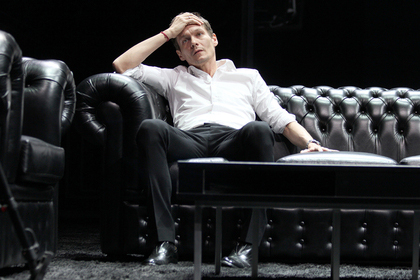
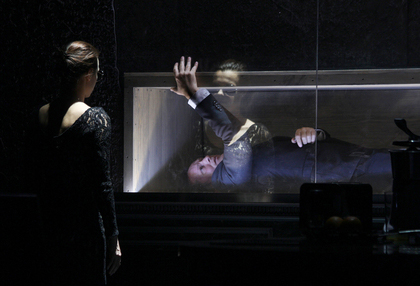
The decoration of the "karamaz" unequivocally resembles a crematorium. The horizontal solarium of Fedor Pavlovich in the blink of an eye turns into a coffin. The image of the crazy mother of heroes, not dead, but her husband in a psychiatric hospital in the Chermashny, was introduced into the performance. In a white sick leave, suddenly highlighting on a black background, a mother as if, in continuation to a fabulous theme of the performance, reads to the children of Ruslan and Lyudmila: “The Lukomorye’s oak is green ...”. And he finishes the sacramental: “Here is the Russian spirit. It smells of Russia here. ” The emphasis is focused on the last words.
The Russian spirit is the spirit of decay, decay, decomposition. And he saturated not only the social body of the country. He sprinkled everything at all.
Everything is stinking in the world. In this damn world, everything is stinking. The smell of decay and the smell of incense at Bogomolov are all the time mixed.
In his performance, it is important not so much that Zosima and Smerdyakov are played by one artist (far -reaching conclusions that can be drawn from this paradoxical identification are so obvious that we will not dwell on them), how much the director is returned to the episode of Zosima’s death, whose body contrary to the expectations of the smell even earlier.
Transfer on Scotch TV "Faith. Hope. Love ”illuminates this episode in minor details. The text of Dostoevsky is decomposed into the words of the host, correspondent, expert, pathologist. They are all talkative and talkative. Alyosha is also in the studio. When he is asked what he thinks about what happened, he suddenly breaks into a terrible dumb cry. Scary - as in Nabokov’s story “Ultima Thule” , where the hero is revealed to the hero. This is not just annoyance, it is some kind of terrible insight, which will then bring the hero to suicide. He will commit suicide with Bogomolov along with the painful Lisa Khokhlakova, turned into a play into Lisa-Very. In a black dress with a strong collar, the heroine shows us wooden pens and legs, also thirsting for earthly, carnal love. When Alyosha touches them, they will bloom, like a papal staff in the final of the Tangayzer. They blossom green sticky leaves. It seems that the director painfully loves these leaves, this material, carnal side of being. And, it seems, it is painful love for her, dying and rotting, that is the main reason for his despair.
 © Ekaterina Tsvetkova
The cycle of flesh in nature to the final reaches the climax. The word here is given to Zosima-Merdyakov. He will tell the secret of his birth. But moreover. He will demonstrate it to us. In a large pan, on which the “stinking Lizaveta” is written, some vile sticky liquid splashes. From it, Smerdyakov himself accepts the birth of the baby. The baby has a small mirror instead of a head, which reflects an adult hero, sending a fragile body of a newborn in the garbage dump, and itself dragging it into a black toilet. The toilet will then turn into the tombstone of Lizabeth of the stinking over the years of her life. We find out about the Smerdyakov himself that he is repenting, he will go to the monastery, but he will still freeze.
The Black Hamlet consciousness no longer just gives out the poetic "further - silence." It insists on a much more unpleasant: then a decay, a black hole, teeming with worms (here they are, darling, on a large plasma screen).
But this is not the finale.
At the end of Hamlet, immediately after the final replica of the protagonist, Foretinbrais comes to the stage. The point in the performance of Bogomolov is set by the appearance of the devil.
All Karamazovs are already dead. Fedor Pavlovich is killed. Dmitry admitted under torture in a crime and hanged. Alyosha and Lisa were thrown out of a great height. All of them rest next to Lizaveta stinking in units-unit. They all have different years of birth and one year of death - 1879. Only Ivan Karamazov lived to deep gray hair. And his meeting with the devil takes place at the end of his life. It was here, in the final itself, that the macabar picture of the world acquires the final frightening clarity of Bogomolov, and the last strokes were applied to the map of the starry sky.
It clearly follows from the speech of the feature that the movement of the world is one. And he himself is a devil. Drawer, damn ladder, damn worker. There are no other power, which makes the adhesive green leaves bloom. His efforts spin the earth and children are born.
He goes to the forefront and to the applause of the hall (and the hall is ready to clap his hands in our hands, hearing a slightly familiar melody) sings "I love you, life."
So the windows lit up
I walk from work tiredly.
I love you, life
And I want you to become better.
Literally every line of Vanshenkin, performed by a naive optimistic pathos, acquires a new, sinister meaning here. The world has one choice - between black non -existence and not divine, by no means, namely, a damn comedy, which we are all breaking through his scenario. The main characters of the novel are generally his native children, for both the devil and Fedor Pavlovich are played by the same artist - Igor Mirkurganov. And I admit, I do not remember on the modern Russian stage neither such a breathtaking game, nor such a grandiose stage polyphony.
 © Ekaterina Tsvetkova
I will not speak about how all these motives of the performance are woven into the context of the modern European theater and in general art. To do this, you need to write a separate article. Only I will finally allow myself a few more scattered thoughts.
1) From the Soviet era, hazing reigned in our theater. And who was only in the old and in new times did not become her victim. The fact that Oleg Tabakov is one of the best grandfathers of our domestic theater: generous, generous, wide (all that Kirill Serebrennikov wrote about him in his FB Post, is a pure truth) does not deny and justifies the widely known fact of widespread grandson. A large director has the right to make performances as he considers necessary. And certainly has the right to show them in the form in which he invented, at least in public runs.
2) In Russia there is a well -known saying "Do not take out the CRU from the hut." Its content seems wild to me. That is, how not? Maybe sometimes it is necessary? Otherwise, you have to live in this very hut, drowning in shit.
3) The Soviet theater, like the Soviet Church, has become a product of a compromise with the authorities. And this sin of Sergianism penetrated their perishable flesh. But the deceased MHT would be more expensive for me than the preserved Moscow Art Theater of the USSR. And the deceased church, as I understand now, only having died, could survive - to remain myself, and not turn into an obedient appendage of the state. It is time for uncompromising. It's time to tell yourself: death is better than Sergianism.
4) In the story about how Konstantin Bogomolov and the Moscow Art Theater quarreled, the details are not enough for me by and large. The result is much more important. For once, a performance appeared on our big stage, which I personally can imagine in the context of the most prestigious European forum. Let's just thank the Lord God for this, who, according to Konstantin Bogomolov, does not exist, but according to mine - he still has it!