
Translated material
The Pope Francis programs calls for the "deburist" Church
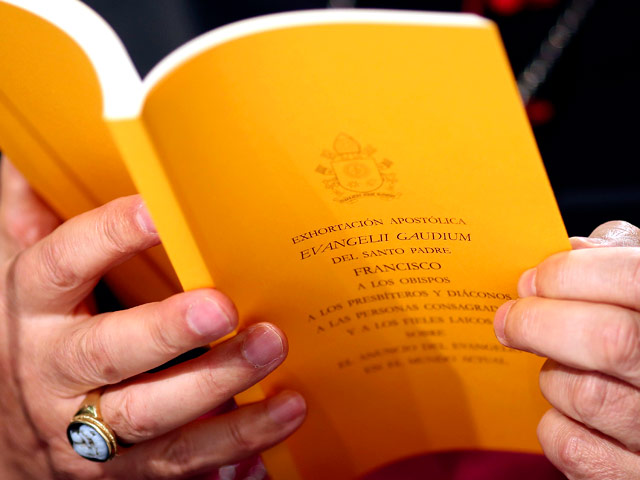
The Vatican distributed the apostolic appeal of the pope of the Roman Francis Evangelii Gaudium ("Joy of the Gospel" - lat.) - a software document that determines the ways of reform of the Catholic Church. In it, the pontiff advocated its radical update, “debit” and turning to the problems of the poorest inhabitants of the planet.
According to ITAR-TASS, in the appeal of the pope it is emphasized that the world economic system has become vicious, since it is entirely built on the "cult of money". The Pope urged rich people to sacrifice the poor.
The apostolic appeal is the most voluminous document signed by the Roman bishop for the entire history of Christianity: it has 220 pages. It is divided into five chapters, their content is determined by the following thesis:
1. The church must go beyond its own framework.
2. You should answer the challenges of today's world.
3. All baptized are involved in this update.
4. Evangelization is in the leg with development.
5. Life in prayer - the beginning of all beginnings.
According to the Saint Svyat Service, the pontiff spoke out against the "wild capitalism", called by him "New Tirania", urging the world leaders to actively fight poverty and inequality in their countries, to provide citizens with work, education and medical help.
According to Pontiff, the world has developed the wrong priority system. His indignation is caused by the fact that the death of the homeless does not fall into the news, and the change in the banking index by 2% becomes a sensation.
Round reforms
Pope Bergolo announced that in order to combat the injustices of the world, the Roman Catholic Church should concentrate on missionary activities based on mercy and compassion, especially in relation to poor people. He also stated that the structure of the Roman Church itself is too centralized, and he has like a pope of Roman re -excess of power and powers. The pontiff announced that he was ready to consider proposals in the field of decentralization of church structures and the deliverance of the Vatican from part of the current government. In fact, the Roman high priest expressed his readiness for the indigenous reforms of the institute of the papacy, at the same time condemning the "practice of consumism of the consumer society."
The appeal was the second after the encyclical by the trunk text of Francis. It summarizes the dream of the pope - a missionary and preacher - about the "poor church for poor people." It was this slogan that Jesuit Bergolo nominated from the first day of joining the papal throne. He personally leads an emphasized modest way of life and pays increased attention of the humanization of the church, urging Catholics not to put up with the injustices of the current world and help others. In addition, he repeatedly spoke out for the liberalization of intra -church relations and the position of the Church in society, its ability to "speak with people of all cultures and explain the deeds of God in the world."
One of the main sentences of the document is the readiness of the new pontiff expressed in paragraph 32 to change his functions, in particular, in the name of the unity of Christians, as well as a call to political leaders to conduct financial reforms in the spirit of ethical requirements.
Experts note the high poetic style of the Epistle in that part, which, for example, speaks of migrants, as a "serious challenge to the pastoral service of the church without borders."
Dad talks about the need to improve the status of Catholic bishopric conferences (in accordance with the Catholic Church Catholic Catholic Code - a collection of bishops of a country or a certain territory. - Note Newsru.com. ), In which "collegiality has not yet been implemented."
The new papal appeal, which mentions the "huge risks of consumism and individualism," observers have already called "historical." Vaticanists are convinced that it will cause the interest not only of Catholics. It is also addressed to those "who does not go to church." It also says in detail about the social doctrine of the Roman Catholic Church, it contains a warning against "irresponsible populism, which, limited to demagogy, does not solve the true problems of the poor." The message has a passage that is not devoid of mysticism that "if our mission does not bear fruit, the Lord, perhaps, will want to give a blessing in another place where we will never be about the existence of which we do not suspect."
Attentive readers also drew attention to the expressive philosophical phrase in the final part of the text, addressed to the modern world: "Only endless love can cure our endless sadness."
The new document of the Pope Francis will be studied in detail and comment on theologians and the public.