
Translated material
Friendly absorption
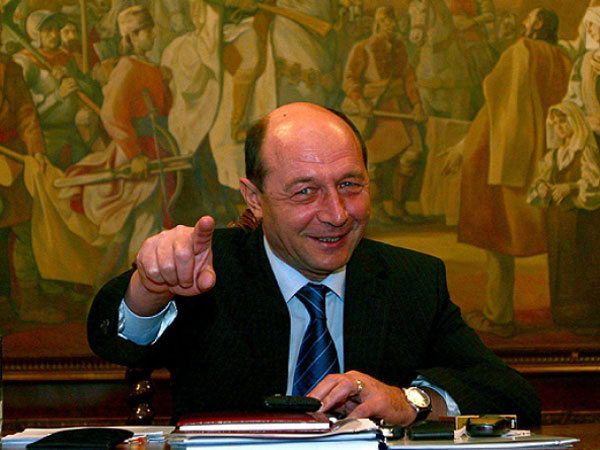
Romania President Trajan Basescu said that the country's new strategic goal should be to unite with Moldova. The previous two “fundamental projects” - joining NATO and to the European Union - have already been fulfilled.
The head of state is confident that Bucharest is able to implement a new project - more than half of the Romanians, according to hundreds of questions, are not against joining their country of Moldova. The case, I am sure to Basescu, remains small: to break the resistance of Russia.
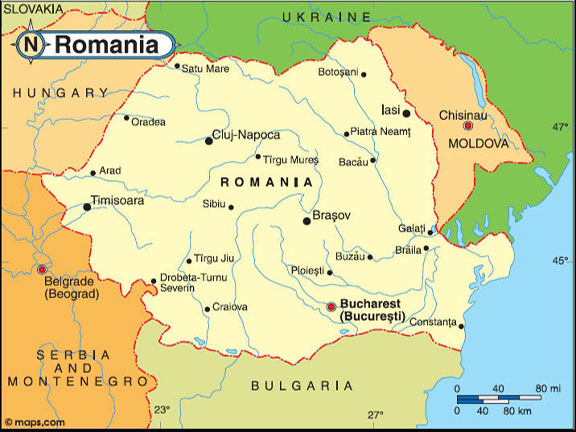 Modern Romania
Basescu admits that now it is not the most suitable moment for unification, it is necessary that the Unionist Wind “blew the unionist wind” in neighboring Moldova, but the president is confident that the unification of the two states will happen once, “because human blood is not a water”.
The president on the air of national television emphasized that Romania does not recognize the state status of the border with Moldova. Trajan Basescu said that after the expiration of his authority, Moldavian citizenship intends to receive in order to continue the struggle for the unification of the two countries from Chisinau.
Romania and Moldova are really united by general stories, general traditions and a common language. In the Middle Ages, on the territory of Romania and Moldova, there were several independent principalities called for simplicity “Danube”, which, as it should be state entities from the times of feudal fragmentation, then fought against common enemies, or attended with each other.
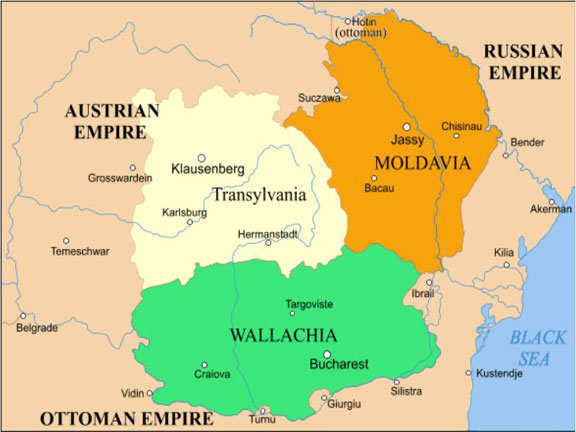 Romanian principalities. 1800
In 1812, as a result of the next Russo-Turkish war, which was almost unnoticed by the Napoleonic Wars, Russia departed the eastern part of one of the Danube principalities of Moldova, the interfluve of the Prut and Dniester, also called Bessarabia. For Russia, Bessarabia was so distant and wild that in 1820, when Alexander I needed to send Pushkin away from the capital for another fault, the choice was between this land, Siberia and the Solovetsky monastery.
At first, in the newly acquired territories, Russia established the Bessarabian region that preserved some autonomy, and in the middle of the 19th century transformed it into the province, that is, completely subordinated to the laws of the empire.
At the same time, two Danube principalities, the slaughter of Moldova and Wallachia, not without the help of Russia sought more and more autonomy from the Ottoman Empire. In the second half of the 19th century, the united principality of Wallachia and Moldova was formed, known since 1881 as Romania. The authorities of the new state initially set themselves the goal of uniting all the Romanians under their power. Then in Romania they carried out a language reform, instead of the Cyrillic alphabet began to use the Latinite - in the Bessarabia remaining under the rule of Russia, of course, no one was going to cancel the Cyrillic alphabet.
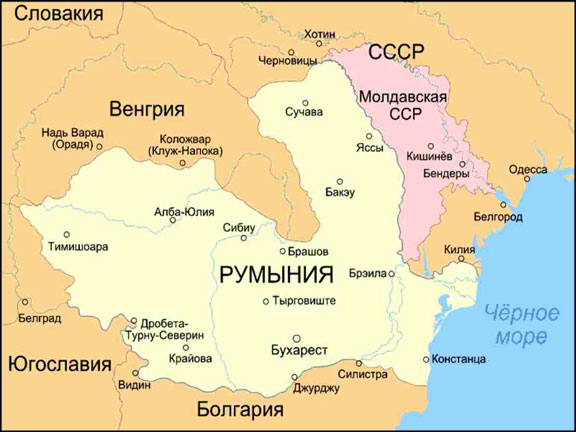 Romania map. 1941
A good chance for the implementation of Pankumin theories was introduced at the beginning of the 20th century. The First World War seduced all neighboring powers, so that the Romanian rulers managed to push the borders in almost all directions of the world. Austria-Hungary managed to grab Transylvania and Bukovina, from Bulgaria-South Dobruju, and Russia lost all of Bessarabia. The resulting state was called "Great Romania." Neither before nor after Bucharest were subordinate to such vast spaces. During the Second World War, Romania, as an ally of Germany, received the Dniester and South Bug, including Odessa.
The Unified Romanian state, which included modern Romania and modern Moldova, existed only 36 years, from 1918 to 1944. However, Romanian nationalists in no way gives rest to the very possibility of its reconstruction.
In the late 1980s and early 1990s, when it came to the collapse of the USSR and the appearance, respectively, independent Moldova, calls about the unification of the two countries sounded even in Chisinau. Moldavian writing was transferred to the Latin alphabet - which, in general, was a rather logical step, because Moldavian is rather not an independent language, but by the dialect of Romanian.
However, the Unionist sentiments were quickly subsided: the Russian -speaking Transnistria broke off the country, a small Gagauzia could also at any time refuse to recognize Chisinau power. The new leaders of Moldova did not want to share power with Romanian politicians, especially since the economic situation in neighboring Romania was not much better than Moldavian.
For President Romania, the announcement of a new national idea is quite logical: his country joined the European Union 6 years ago, in 2007, but the standard of living of the population leaves much to be desired.
The Romanians had clearly high expectations from entering the EU. It seemed that the country was simply offered to become rich in exchange for some structural reforms. A miracle, of course, did not happen. If in 2010 71% of respondents were satisfied with Romania's entry into the European Union, now about a third is gaining such ones.
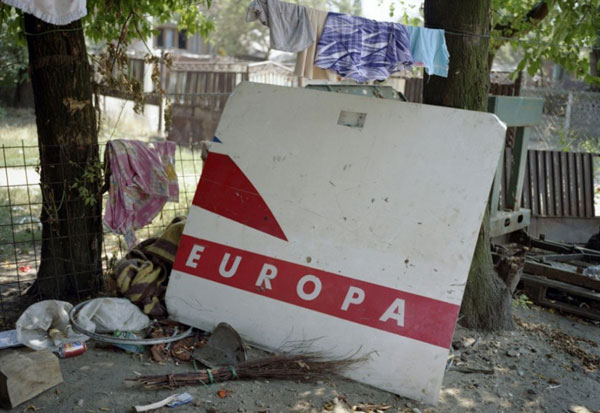 Provincial Romania
It even seems to some Romanians that wealth is pumped out of their country as from a colony. It also offends that Romania has not been let into the Schengen zone, which means that its citizens do not have full rights in other EU countries.
In the country, one of the highest levels of social stratification on the continent, the rich capital contrasts with poor regions, the political elite is constantly shaking corruption scandals, and the government is always trying to carry out the next unpopular economic reforms. In 2013, the birth rate in the country fell approximately doubled compared to 2000.
The Romanian gypsies, who are of little concerned about the rules of the Schengen zone, are constantly in oppression in other EU states, it is especially problematic to be in France and the Netherlands, from where they are often sent to their homeland. This allows the Romanians to blame European politicians of racism, albeit in Romania itself, gypsies are treated with some suspicion.
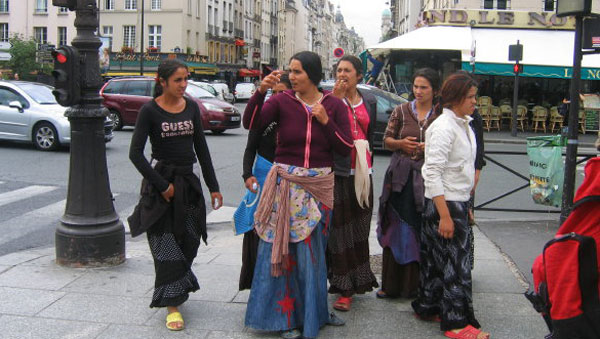 Gypsies in Europe. Photo: fwnews.ru
Despite the fact that the Romanians, on average, live richer than the southern and western neighbors on the Balkan Peninsula, it is customary to equal to the more wealthy countries of Central Europe - Hungary, the Czech Republic and Slovakia - and here the economic development of Romania is clearly behind. In addition, few people can delight strong social stratification and the gap between the capital and the regions.
Just such conditions - disappointment in hopes, dissatisfaction with life - are well suited for the emergence of a new national idea for which it is worth working. The only problem is that the unification with Moldova is unlikely to bring Romania at least something other than moral satisfaction. The border between the two countries is already open, the language is common, unless the teams at the European football championships are different. Yes, and Romanians want, contrary to hundredths, not at all unification with neighbors, but a calm and wealthy life - and for this you need to work, and not wash the boundaries of states.