
Translated material
Where the money comes and where do they run
November: USA, Europe, China and Russia. New New Times
November: USA, Europe, China and Russia
<figure> <img SRC = "https://archivarius-public.s3.us-west-2.amazonaws.com/RIMA/WEB/MEDIA/IMG/574F21EA7F4B20786945454F878B0C46.jpg"/> </figure>Sergey Aleksashenko, Director of Macroeconomic Research NIU-SWE, invited researcher Georgetown University, Washington, USA
USA

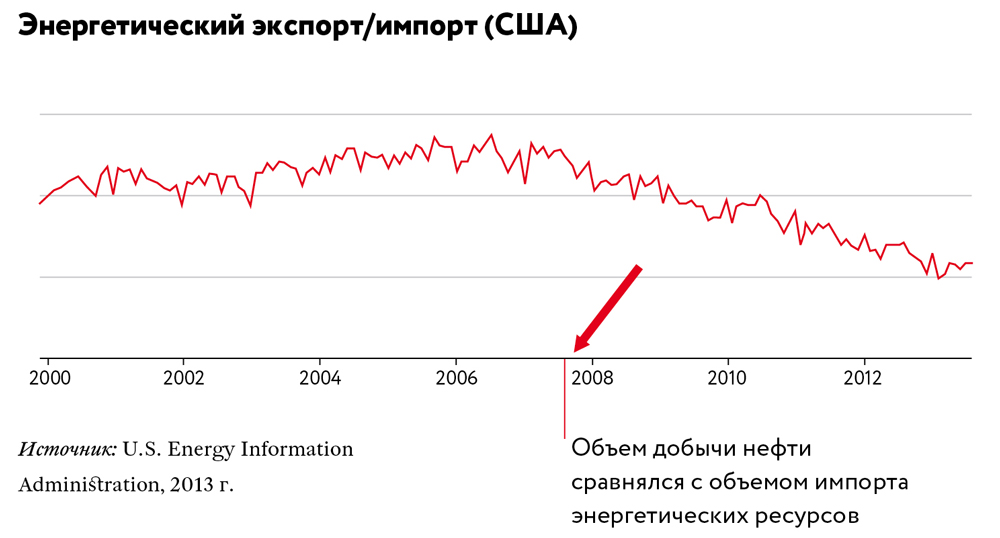
The most important economic event of November in America was the news that the volume of oil production in the United States since 1995 was equal to the volume of imports (see schedule). This happened thanks to the two factors: the technological jerk that allowed the production of shale oil, and the conscious encouragement of the activities of small and medium -sized companies in the oil sector, which accounts for about 40% of oil produced in the country.
Already today, America ceased to increase oil imports from the Gulf countries, imports from Venezuela were halved, four times from Nigeria; Five years later, imported oil will come only from Mexico and Canada. This allows you to keep prices for a reference in the United States WTI oil at a noticeably lower level than for the usual Brent to Europeans - about $ 95 per barrel versus $ 110 per barrel Brent. The rupture in prices is mainly preserved due to the existing legislative ban on export of oil and gas. American legislation prohibits the export of raw oil and natural gas; However, this ban does not apply to the export of oil and gas processing products. As a result, today the United States has become the largest exporter of oil products in the world, exporting about a third of imported oil in a processed form.
And although some companies have already received permission to export gas from the United States, the American administration will most likely limit this process in every way. Lower oil and gas prices (and, by the way, electricity) create powerful incentives for investment in the United States. Today, the country is implementing 275 projects with total gas consumption in the amount of 52 billion cubic meters. m per year. And these are new jobs and taxes.

Europe
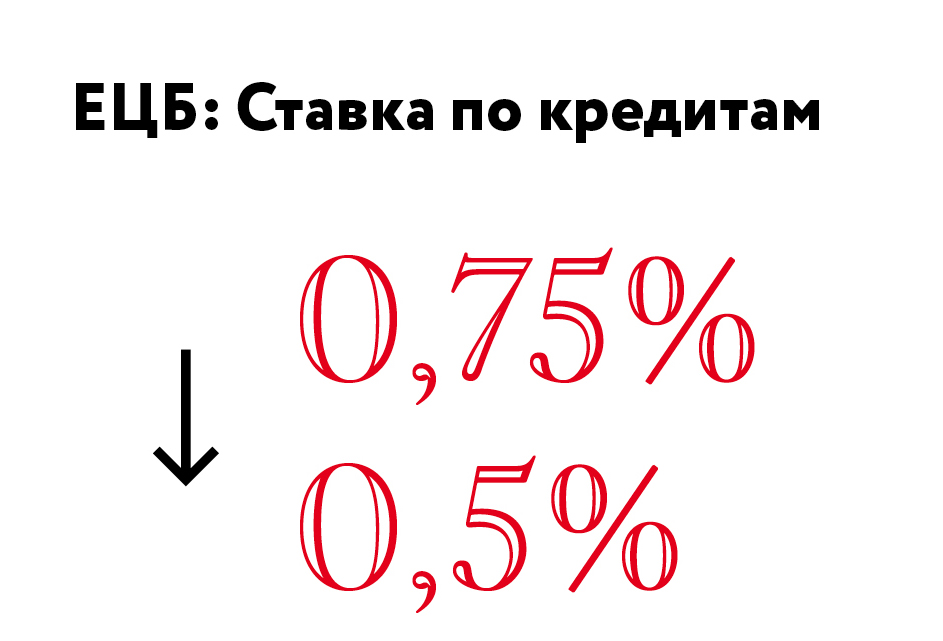
The European Central Bank (ECB) unexpectedly reduced the rate in its loans from 0.75% to 0.5%. This suggests that the ECB is concerned about both the growth rates of the European economy and the strengthening euro. Unlike the American Fed, the main regulator in Europe of the ECB does not carry out any systematic actions to increase the money supply, which, as it became obvious from the statements of the new Fed -Chairman of the Fed, Janet Yelen, will not be completed in the coming months. In this situation, a skew in the level of interest rates in favor of the euro created the basis for a further growth in the European currency course, which is not supported by European politicians. It is difficult to say whether the ECB can stop the strengthening of the euro, but it is undoubted that this plot begins to bother him.
China
The past third plenum of the CPC Central Committee proclaimed a new stage in economic and social transformations in the country. The new leader of China Xi Jinping noticeably strengthened his political position. He not only personally headed all the work on editing the final document of the Plenum, but also achieved the creation of the “Center for Management of Reforms” under his leadership.
The main thesis: the key role in the development of the economy will not play the resolutions of the party, but the market forces. The decisions on the gradual liberalization of deposit rates, and statements about the transformation of the Chinese yuan into a freely convertible currency, and formidable shouts to officials are connected with this - on the inadmissibility of state intervention in pricing.
But the victory of Comrade Xi was not unconditional: state -owned enterprises are called the most important element of the economy, and their reforms will go slowly; The thesis of the state of non -strategic sectors (for example, hotel business and real estate) did not sound. The decision was not made on the transfer to private ownership of land in the village: the land will still remain in collective property, although the peasants will receive the right to lay their shares. Perhaps the largest failure of Comrade SI is the preservation of the registration system (Khukou), which is significantly tougher than the Soviet registration, since it forbids immigrants from the village to buy real estate, cars, receive services of state education and healthcare systems. It is clear that in this way the Chinese authorities, on the one hand, limit the burden on the budget, on the other, they force people to save funds on deposits and thereby support the banking system. Until recently, the state determined tough corridors for credit and deposit rates of Chinese banks. Which gave banks practically guaranteed earnings (deposits rate at the beginning of this year could not exceed 3.25%, and the loan rate could not be lower than 6.25%), but at the same time inhibited the development of competition in the banking sector.
Of course, the decisions of the Plenum of the Central Committee of the CPC will not affect economic dynamics in the coming months, but they clearly outline the strategic line of institutional reforms in the Chinese economy: maintaining high growth rates and a sharp increase in living standards, and hence the solvent demand of the population.
"
Russia: for every 1% growth of GDP in 2014, you need a 2% growth in investment in 2013.
"
Russia
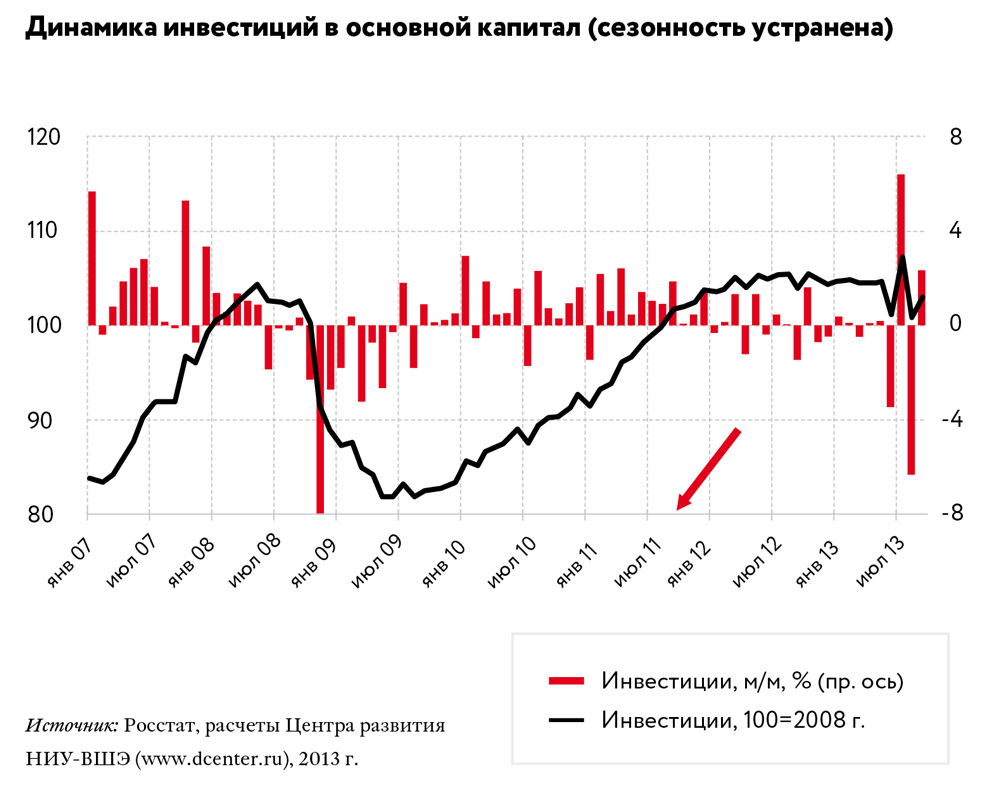
There were no good economic news in our country. GDP growth rates continued to decrease, dropping to 1.2% per annum in the third quarter. The industry stagnates, investments continue to decline. Of course, an inexplicable jump in agriculture in agriculture in October (26% per annum) can arithmetically raise the annual GDP growth rates to 1.5%, but the qualitatively economic picture will not change from this. The key reason for the slowdown in the economy is obvious to everyone: an unfavorable investment climate and the lack of protection of property rights. If you can safely answer the question about the future course of the ruble - “look at oil prices”, then you can also safely answer the question about future growth rates - “look at the growth rate of investment” (see the schedule below). According to our estimates, for every 1% growth of GDP growth next year, Russia needs a 2% growth in investment this year. Only now Russian capital prefers to escape abroad - according to the results of the year, at least $ 60 billion will flow from Russia.
The authorities can no longer fail to notice the deterioration of the economic state of affairs in the country. Evidence of this was the actual violation of the new budget rule, with the pomp announced a year ago - “super -planned” oil revenues this year will be aimed at financing current expenses instead of the reserve. It is already obvious that the budget situation will not improve even next year. Only the inclusion of clearly illusory income in the draft budget-2014, which even the Accounts Chamber doubts the realism, confiscation of 240 billion rubles of pension savings (which, taking into account 5%of the profitability for 20 years, could turn into 540 billion rubles), the reduction of investment investments and expenses for human capital in the budgets of all levels, and all this allows you to limit it to limiting it The budget deficit voluntarist is 0.6%.

Nesighted future
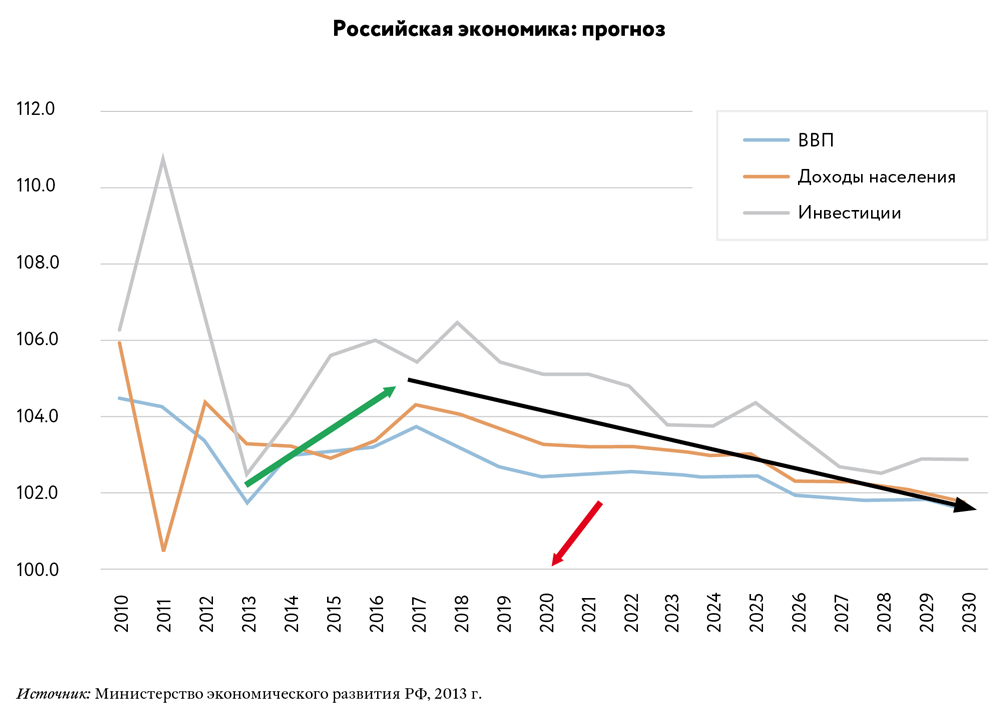
The forecast of the Ministry of Economic Development did not add special optimism (until 2030). Firstly, the ministry believes that the long-term growth rate of the Russian economy will be only 2.5%, which is lower than the average growth rate of the world economy. So about everyone there to “catch up and overtake” (under Khrushchev-the USA, under Putin-Portugal), from now on, to recall somehow indecent. Secondly, the basic scenario for the development of the economy is not innovative, which was such in the spring of this year and which involves a gradual diversification of the economy and the departure of raw material dependence, and inertial. In fact, the authorities thereby recognize the failure of its hopes for modernization, to the emergence of any innovative foci of growth. Thirdly, even this forecast, in my opinion, is super -ptimistic, since the average 2.5% growth is obtained from a combination of sharply increasing (compared to current) growth rates in 2014-2017. and fading pace after 2018. And the last. The forecast of the Ministry of Economic Development is based on the script, although not rapidly, but monotonously rising oil prices, which reach $ 164 per barrel by the end of the forecast period. And if we discount this “optimism” to the spread of the shale revolution outside the United States, on the implementation of plans for the development of the Iraq oil industry and to normalize the situation around Iran and the “discovery” of its oil and gas sector, then ...

Under the stamp "Secret"
When in March, Vladimir Putin announced that Elvira Nabiullina would become the new chairman of the Bank of Russia, the author’s reaction was dual: on the one hand, the country's new chief banker has rich experience in the Ministry of Economy, on the other, no in the field of the Central Bank is responsible. 250 days have passed. Result? On a trie.
No, there is no talk of some grandiose failures or strategic mistakes. But, let's admit, while life does not put complex tasks before Elvira Nabiullina. And those simple ones that she faces, so far they are not decided in the best way. In November, this was the examples of the license from the master bank and the scandal in the stock market associated with the quotes of the Tinkov-Credit Systems Bank and Mechel. The question is not in professionalism: in the end, the former head of the Central Bank Sergey Ignatiev is much more responsible for the situation with the master bank, and only the lazy does not speak of endless possibilities for an inside in the Russian stock market. Significantly more serious - the public side of both scandal.
In the modern world, the trust of society towards central banks is based on a large extent on how intelligibly, understandable and convincingly they bring to people their position and evaluation. And in all three situations, neither Elvira Nabiullina nor her deputies considered it necessary to talk with society. Moreover, in the situation with the “Mechel” the Bank of Russia with its public actions (the termination of the company’s securities to ensure its loans and the refusal of this decision every other day), the boat even more and expanded the possibilities for insiders.
Elvira Nabiullina has extensive experience working with Vladimir Putin. And of course, she only considers him to be his boss and, apparently, only considers it correct to explain his actions and decisions. For modern Russia, this is the rule of survival of the official. But for the modern world, this behavior of the head of the Central Bank creates a crisis of trust. And if there is no confidence, then capital runs from the country, and economic growth stops.
Photo: Vladimir Smirnov/ITAR-TASS