
Translated material
Triumph of pessimists
Ukraine - EU: What did Viktor Yanukovych won and won and
Instead of a preface to the Internet version
This is an ungrateful thing-to try to analyze the situation in the country at the peak of dramatic events, when literally at any time something can happen, radically changing the entire political alignment. This is what happened to the author of these lines - the following article was submitted to the New Times to publish in the “Paper Version” of the magazine on Friday on Friday, December 30, and just a few hours later everything changed. On the night of Friday to Saturday, the Berkut fighters - the special forces of the Ukrainian Ministry of Internal Affairs - with inadequate cruelty dispersed the demonstrators, mostly very young people, students and high school students who remained to carry a protest shift in the center of Kyiv, on the Maidan, as it is customary to briefly call the Independence Square - the very one where dramatic events unfolded in 2004 "Orange" revolution. Moreover, this demonstration was extremely peaceful, sometimes more reminiscent of something like a cheerful street disco - the corresponding musical accompaniment was also present there. And on this youth party of number, probably no more than a few hundred people, suddenly collapsed muzzle in full ammunition, destroying everything in their path, who did not even analyze who they hammer with rubber batons - boys or girls. In the hospitals of the city were dozens of victims, some with severe wounds. And then something happened that all these nine years after the “Orange Revolution”, which, on the heart, did not expect either power or the opposition. Last Sunday, December 1, the whole city went out into the streets. The entire center of Kyiv - Maidan, Khreshchatyk, European Square, neighboring streets and squares - was again filled with hundreds of thousands of people, as then - nine years ago. In Kyiv, a sense of revolution is in the air. What will happen next - no one knows, the situation will continue to change all the time. But I deliberately do not change anything in the following text, because all the latest events do not affect my analysis of what preceded them.
What to expect next?
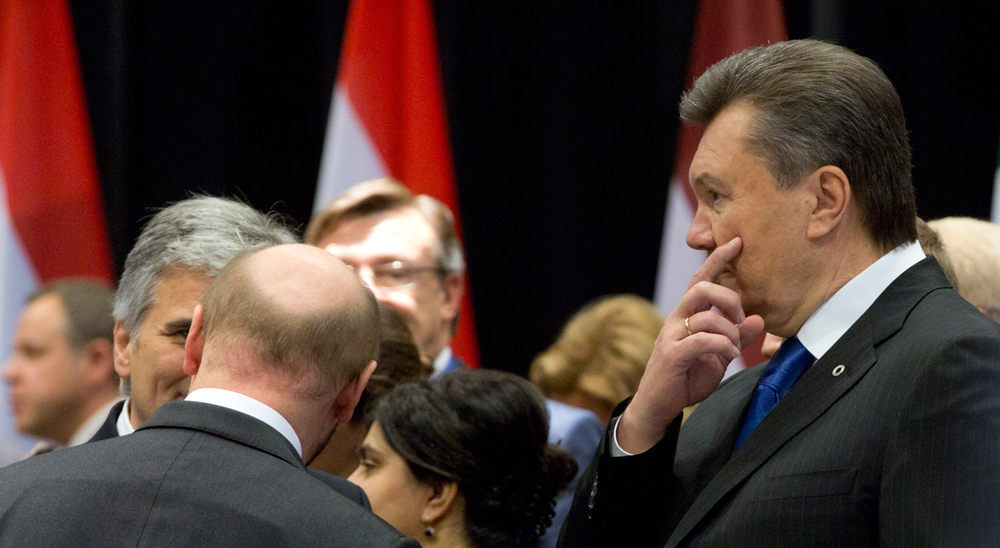
The summit ended with a deep disagreement between Kyiv and Europe. Vilnius, November 29
Optimists are shameful. The Eastern Partnership summit in Vilnius ended not just the refusal of Viktor Yanukovych to sign an association agreement (SA) with the EU - it ended, in fact, a scandal.
| *The organizers of the St. Petersburg G20 summit in September 2013 resorted to the same technique: the leaders of the Russian Federation and the USA, whose relations sharply cooled because of the scandal around Edward Snowden, planted on different sides of the table-not on Russian (although Russia was the hostess of the summit), but in English alphabetical. |
On the first day of the summit, on the 28th, Yanukovych rejected all the compromise proposals of European leaders, including immediately signing the agreement without resolving the issue of the fate of Yulia Tymoshenko. In response, the Chancellor of the Federal Republic of Germany Angel Merkel-one of those who, in a personal conversation, tried to convince the Ukrainian president not to postpone the signing of the SA,-refused the new round of negotiations with Yanukovych Tete-atte, which was supposed to take place on the 29th morning. And the hostess of the summit, the President of Lithuania Dalya Grybauskaite, generally made an unprecedented gesture: the press of the conversation with Yanukovych, made by the personal television operator of the head of Lithuania “is not for printing,” is heard in the press, - there you hear how Viktor Fedorovich refuses to sign the CA in a fairly rigid form. At the final ceremony of the summit from the Ukrainian president they shied away - even in the hall they put him aside. Many in Ukraine immediately remembered the episode from the distant 2002: then at the NATO summit they organized high guests in the French alphabetical order, so that then President Leonid Kuchma, who finally deteriorated relations with the Western leaders, end up at the table as far as possible from the leaders of the United States and Great Britain (in the English alphabet they would be nearby: ukine, UK, UK USA)*. And again, a similar public Afront. Between Ukraine and Europe, it seems, a protracted crisis of trust occurs.
Two hetmans
One of their main attractions of Kyiv is the equestrian statue of the hetman Bogdan Khmelnitsky, who in 1654 entered into an alliance with Moscow, which in the official imperial and post -Perman traditions began to be called the "reunification of Ukraine with Russia." As an idea of the authors of the monument - this is how the legend says - the bronze hetman was prompted by the hand with the macer to be indicated to the descendants towards Moscow. But the local guardians of Orthodoxy considered the believers offensive to the feelings that the Khmelnitsky horse would be turned backwards to one of the Kyiv shrines - the Mikhailovsky Cathedral. And they decided to deploy the monument so as to eliminate this indecency. As a result, embarrassment happened: the hetman has since indicated to the Ukrainians not towards Russia, but towards Sweden.
How can one not recall the subject of a dispute between many Ukrainian historians of the post -Soviet school: they say, the decision on the Union with the Moscow Tsar for Khmelnitsky was only a tactical course, and already three years later, in 1657, the old hetman agreed with the Swedes to fight against Poland, while Moscow, on the contrary, concluded a truce against the Swedes. And a year later, the Ukrainian Cossacks, led by the new hetman Ivan Vygovsky, opposed Moscow, and in 1659 they even defeated the Russian army in the battle of Konotop ... In any case, the monument to Khmelnitsky became a kind of symbol of Ukraine, always balancing between the East and West, now and then looking for short-term tactical unions with Russia, then with Russia, then with some third. by force ...
We must pay tribute to the current hetman Viktor Yanukovych - he also turned out to be a cunning tact. On the one hand, he managed to force many European leaders to sincerely believe that the signing of Ukraine CA is a decision. Moreover, he achieved significant concessions from Europe: what is the refusal of Europeans from the linking of the agreement with the liberation of Yulia Tymoshenko. Now, Europeans vying, they have been complaining that they overestimated the desire of the Ukrainian leader for European integration and did not expect such a harsh opposition from Russia and President Putin.
On the other hand, it turns out that Putin Yanukovych also outplayed tactically. Until recently, all well -informed persons in Kyiv converged that the Russian president was ready to take any steps towards Yanukovych - to provide financial assistance, to remove customs barriers, conclude new profitable transactions, and finally give a lifted discount on gas, support the 2015 presidential election - if only the Ukrainian colleague brought his country to the Customs Union. And not once later, but now. According to the well -known principle "In the morning money is chairs in the evening." But, apparently, Yanukovych flatly refused. And most importantly, he forced Putin to believe that he would really sign SA if he did not receive help from Moscow.
"
Yanukovych made Putin believe that he would really sign an agreement with the EU if he does not receive help from Moscow
"
It is clear that Putin in any case would continue to fight hard and stubbornly for Ukraine, even if she signed the SA. But what a blow would this event be for him! What a humiliation for a politician living in the neimpersky paradigm would be: to give Ukraine to the Poles, Swedes and Litvin! To come to terms with the fact that the border between Russia and the West passes about the same where it took place at the end of the 21st century!
And here Putin, it seems, could tremble, wave his hand and agree with Yanukovych - so be it, we will only provide help in exchange for refusing to sign the SA. What will be the size of Russian assistance, under what conditions and how it will be decorated - no one knows for sure yet. And few, in my opinion, paid serious attention to that passage from Yanukovych’s “software” television interview last week: he announced the need to update the basic agreement on friendship and cooperation with Russia, signed 20 years ago. And it is possible that this will happen before the New Year.
But does Vladimir Vladimirovich give himself to himself that his Ukrainian counterpart can treat the agreements achieved about the same as his predecessor Khmelnitsky - to the then Union with Moscow? And it will not turn out again once again towards the West - especially if he manages to achieve a re -election for a second term?
I remember that Putin once told reporters that on the way to work and back home, he listens to the records of lectures by the historian Klyuchevsky. But whether he is familiar with other versions of Ukrainian history, without the knowledge of which it is difficult to understand a lot in the “national characteristics” of Ukrainian politics and its participants, is a question ...
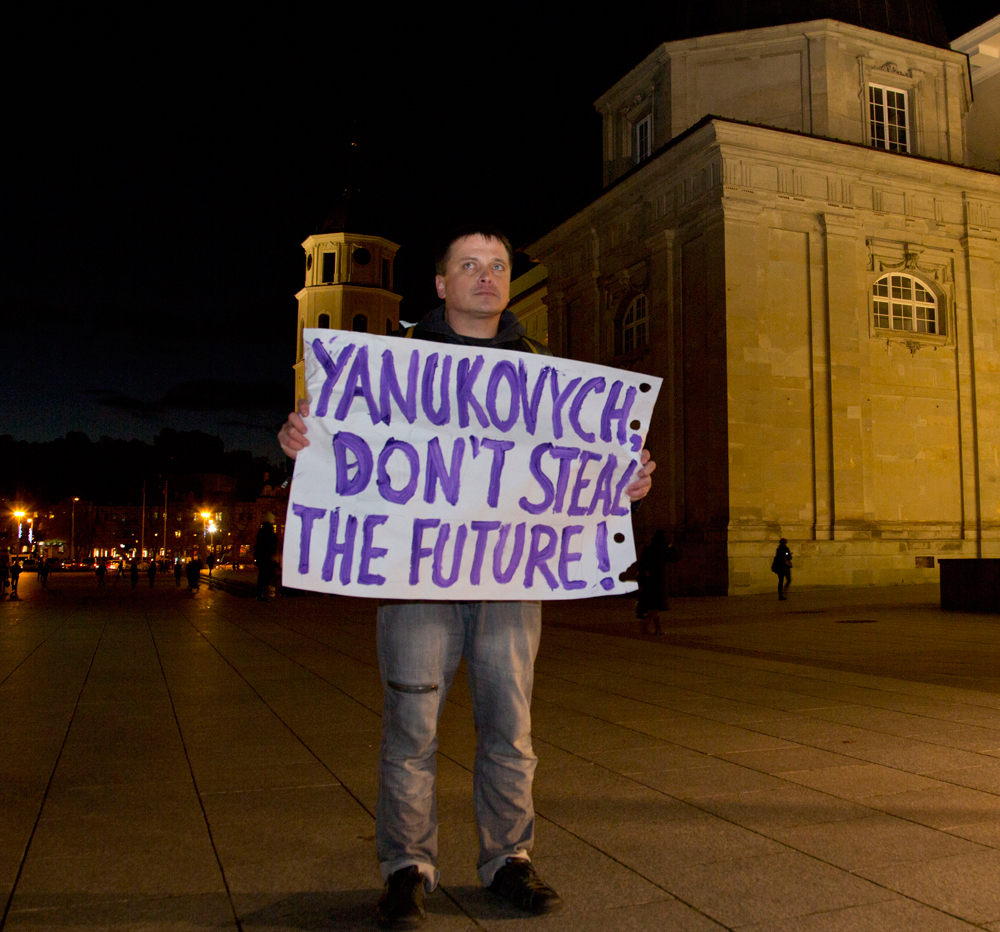
“Yanukovych, do not steal our future” - requires a resident of Vilnius, a solidarity with Euromaidan. November 29, 2013
The dream that was taken away
Tactically, Yanukovych also shifted the opposition, whose leaders were almost silk for the past three months and even declared, as the recent Politzek Yuri Lutsenko that Vilnius Yanukovych, their ally, must be supported. Thus, the authorities managed to temporarily bring down the intensity of the political struggle. But now she flashed with renewed vigor. And then a big question arises: how can he now win the same elections in 2015?
Judging by the current thousands of rallies on the streets and squares of Kyiv and other cities of Ukraine, the president is now a big strategic problem. In 2010, he defeated Yulia Tymoshenko in the second round of the presidential election, receiving about a million votes more. And these were mainly votes of voters living in Kyiv and other major cities of the country, the voices of representatives of the emerging average, or, using the newfangled term, a “creative” class. They considered that the promising stability and order of Yanukovych is less evil than a desperate populist and revolutionary Tymoshenko. For these people, European integration is a civilizational choice, a “blue dream” that they have now taken away. And they may never forgive Yanukovych. Moreover, the number of young people, students who have entered the Euromaidan, itself leads to the conclusion: in the next presidential election, young people, contrary to the usual, may appear in large numbers in polling stations. And this sharply increases the chances of such opposition leaders as Arseniy Yatsenyuk and especially Vitaly Klitschko.
"
The question arises before Yanukovych: how can he now win the elections in 2015?
"
But it is difficult to get rid of the feeling that now Yanukovych does not think about it at all. That he makes decisions on the principle: I will think about the unpleasant tomorrow. Perhaps he sincerely believes that he will be able to win in 2015, using previous techniques and technologies. But in a new situation, they may not work. For many reasons.
Firstly, over the past few years in Ukraine, the Internet audience has significantly increased, some researchers even talk about a small "Internet revolution" of local importance. Accordingly, the role of independent online media and especially social networks has significantly increased - primarily from the point of view of public control over the purity of the entire campaign.
Secondly, the activity of youth is a formidable warning of the party in power: only the traditional distribution of “gingerbread”-small increase in pensions and salaries of state employees cannot be won loyalty of voters.
Thirdly, after everything that happened in Vilnius, during the election campaign and the 2015 elections themselves, such a number of international observers will never have arrived in Ukraine.
Fourth, the opposition had a simple and intelligible slogan, uniting and mobilizing the protest electorate: to return the people a dream of European integration. Even if it's only a dream.
Intellectual vacuum
Perhaps the Ukrainian president, as is often the case with post -Soviet autocrats, simply believed in the inevitability of his success? Maybe he does not have all the information about the real state of affairs in the country? Remember Yeltsin in 1996, when at the very beginning he was simply under hypnosis of the reports of all kinds of security forces in his immediate environment, that he was all right with the rating and was provided with victory. Then there was one person, Anatoly Chubais, who - there are numerous witnesses to him - at a meeting of the president managed to get up and say hard, but without hysteria, so that Yeltsin heard him and believed him: “Boris Nikolaevich, you are deceived. In fact, your rating is no more than a few percent. If you do not change anything, you have no chance to win. ”
It seems to be not his Chubais next to Yanukovych.
However, there was one person whose name even in Ukraine knows few, and even more so in Russia, this is academician Yuri Lovenets. A completely non-public figure, an outstanding political scientist, the director, director of the largest research institute of the corresponding profile in Ukraine and at the same time a political consultant of extra-class, he was an unofficial political adviser to Yanukovych for many years and, according to eyewitnesses, almost the only person who, by default, had the right and, most importantly! - I was not afraid to object to the president, to lead a polemic with him, to speak unpleasant things in the face, to warn from mistakes. Yanukovych, if he did not obey him, then at least listened ... Two months ago, the leveng, one might say, died tragically - relatively young still, full of strength, a person died of fleeting cancer. Since then, knowledgeable people in Kyiv say: a feeling of intellectual vacuum appeared in power ... However, the authorities may not notice this. And even rejoices at how easier it became to work without these annoying intellectual opponents.
In any case, Ukraine enters during the political crisis. How deep and protracted it will be depends on many circumstances: how long the authorities will endure street performances of opposition citizens (if these speeches did not come to naught before, as happened in Russia); Will the current opposition leaders be able to lead these performances; How far Kyiv will go on a new round of “sworn friendship” with Moscow; how the West will behave; How the socio-economic situation in the country will take shape ... In the 16 months remaining before the presidential elections, the main plot lines of political life in the country will be twisted than in the Hollywood action movie.
PS
Late in the evening of November 29, when this number was surrendered, the news came from Kyiv: the live broadcast of the Tok show Shuster Live was interrupted by the show of the Russian series. This happened when opposition leaders Arseniy Yatsenyuk, Vitaly Klitschko and Oleg Tyagnibok appeared in the studio. Already with the chambers turned off, Savik Schuster said that this was probably his last broadcast on the TV channel. After about half an hour, however, the ether was restored.
Pirrova victory - otherwise you can’t call the result of a puzzling tactical combination, in which, it seemed, success accompanied the Ukrainian president. He seemed to outwitted Putin and Europeans, and Americans, and was about to make a profitable deal with Moscow, to get favorable Russian loans and loans that were not related to gesture conditions, which would help him urgently normalize the situation in the economy and significantly confidently feel on the eve of the 2015 presidential election. The President most likely continued to feed the Europeans-and supporters of European integration within the country in the invariability of the European choice in the future, the promises to sign it in the spring of next year, for example, at the Ukraine-EU Summit (and there would most likely be found there a new excuse to delay this). And now one wrong thing is the bloody acceleration of the opposition rally - and everything rolled into Tartarara. It may not have excluded the direct team to “wet” the protesters Yanukovych, that there was an “excess of performers”, but who is now interested in? Politically responsibility is on the president, and now all Yanukovych’s plans seem to collapse. In addition to grandiose street protests, there was a split in the elites. High resignations went, well -known politicians began to leave the ranks of the ruling party, a situation may arise in parliament when the pro -presidential majority is scattered. But will the President of Russia help Yanukovych when he saw how his power was swayed? Europeans also feel deceived - they have formed a grandiose shortage of trust in Ukrainian leadership. They can hardly return to the negotiating table in the previous compromise mood. The Americans, too, apparently, can tighten their position. On Sunday evening, Yanukovych through the mouth of one of the closest associates, the speaker of the parliament, Vladimir Rybak, suggested that the opposition sit at a round table of negotiations on the release of the political crisis. But the scope for the maneuver in these negotiations now narrowed its extremely. But everything could be different. Just imagine: the signature of the President under the CA - and he is almost a national hero, the first president in the history of independent Ukraine, who achieved a real result on the path of European integration. Yulia Tymoshenko - Callet in the Berlin clinic in the ambiguous status temporarily released from places of imprisonment. Maybe she could have avoided returning back to these places, but in the presidential election she could hardly take part. And how, tell me, would it be any of the opposition candidates to win in the next election with the president with such baggage? And one could still bargain with Russia - hardly Vladimir Putin would leave attempts to convince Yanukovych. But the President of Ukraine calculated his moves differently. Well, any chess player will tell you-the most powerful grandmasters most often lose their parties due to mistakes in the calculations.
"Businessmen did not ask ..."
How Ukrainian oligarchs relate to the abandonment of Kyiv from the EU Association
Andrey Kapustin, publicist and political scientist, Kyiv
Before Vilnius, the Ukrainian oligarchy did not hide his European integration intentions. Which, in principle, is understandable. On the one hand, a large Ukrainian business holds its capital in the West. There - real estate, yachts and fleets. Children study there. They rest and shopping wives and mistresses are resting there. In the same place, by the way (and not in Russia), a large business sees a market perspective for its production, since it has long been investing in EU countries.
As he sees another perspective, which promises a turn towards the Customs Union. Namely, the loss of the first positions in the list of Ukrainian Forbes in connection with the direct threat of the appearance of Russian “colleagues” on the site. Narrowing of the possibilities of trade with Europe and the USA. A decrease in the capitalization of what has profited and increased for years. And what is the most unpleasant - a direct threat that in the end their “charm” will be squeezed out to Kyiv by the Donetsk “family” - an omnivorous clan, at the head of which Yanukovych with his sons plus the narrow close circle of his environment. Where almost all today's oligarchs, with the exception of Rinat Akhmetov, have no direct access. Although Akhmetov has no complete security letter.
Will the Ukrainian oligarchs go into direct confrontation with the still strong Yanukovych? In Lobovoy - hardly. But the fact that there will be a search for baskets, where you can lay out eggs, does not raise doubts.
This, by the way, applies not only to a very large, but also just large business, which is much weaker from the appetites of the “family”. In this regard, the statement of the extremely cautious president of the Ukrainian Union of Industrialists and Entrepreneurs, ex-Prime Minister Anatoly Kinakh, who supported the “Orange Revolution” in 2004, is now a deputy of the Rada from the Party of Regions. On the eve of the Vilnius summit, Kina unexpectedly stated that the businessmen did not ask Yanukovych to postpone an agreement with the EU, on the contrary, "businessmen confirm the irreversibility of European integration, most of the business wants to Europe." What will cautious kina say now?
Photos: Virginia Mayo/Ap Photo