
Translated material
Folk money
The New Times has announced that from January 1, 2014 the publication will be funded for the money of readers and subscribers. Although for our print press market this case is unique, the practice of “folk financing” itself did not arise yesterday and became especially popular in the last 15 years in connection with the development of the Internet. The phenomenon has even a special term - crowdfunding
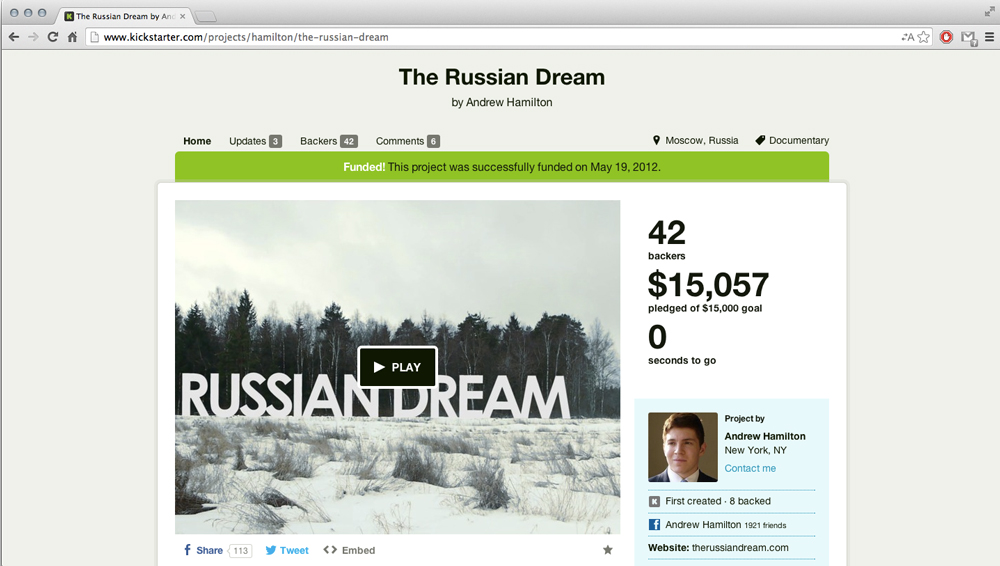
Internet platforms on which a variety of people collect funding for their projects
Every native speaker of the Russian language, for the first time hearing the word “crowdfunding”, is upset by its bulky disgusting and secretly hopes that over time, a more harmonious term is found in the Russian -speaking segment of the world network to designate this phenomenon. Alas, the laws of the development of the Russian language give little grounds for such hope. It is enough to recall what the French call the Ordinateur computer, the Germans - REHNER, Czechs - Počitač, Israelis - Makhshev. All these words are a complete semantic analogue of the English word computer and mean literally a “computer”. In Russia alone, this device, which over the past 15 years has managed to get to know the majority of the population closely, is called a borrowed foreign word that does not explain the appointment in any way. The same applies to webs, sites, files, servers, browsers, smartphones and playlies. And also - from other areas - to Marthader, Shprakhstalmeister, Catering, Clearing and Ekweering. So crowdfunding seems to preserve in Russian its clumsy imported name, despite the presence of quite pretty Russian synonyms like a “fold”.
Start
If you believe dictionaries and encyclopedias, the term “crowdfunding” is indicated by Internet campaigns to attract money from network users for the implementation of a variety of projects-from socially oriented and cultural to purely commercial ones. The first experiments of attracting “folk money” through the Internet - musicians, writers, filmmakers, creators of sites and computer programs - began 15 years ago in America and at least 10 years ago in Russia. So the phenomenon, strictly speaking, is not new - by Internet standards - neither for the West nor for us. It’s just that for a fairly long term, crowdfunding campaigns had only one model: a certain person or team (usually known to the public as its previous achievements) through his site or Internet Devil turned to readers, urging them to throw them to one or another future project. This is a completely working and reasonable scheme that has not lost its significance to this day, but there are no prospects for the scaling and building of the market.
"
For six years now, many Russian musicians, writers, artists and programmers have been gratitude in cash from fans
”I will explain the examples: the author of these lines collected 300 million rubles for the wards of the charity fund helped. Org, Alexei Navalny attracted 103 million to his recent election campaign, and Oleg Kuvaev, asking 100 thousand rubles to the new series“ Masyan ”, received 337.5 thousand and shot three episodes on them. At the same time, each of us turned to our already existing existing The audiences did not build anything joint, did not create any unified Russian co -financing market. A cinema, but also any kulibin from the Russian or American hinterland, which started the production of a complex mechanism.
Everything changed in 2009 with the advent of the American Kickstarter project. He was conceived as a global and universal crowdfunding platform, an intermediary between people with an idea and those who are ready to support this idea with a ruble. The creators had to solve a lot of technical and procedural issues, compose rules, introduce protection for the sacrifice, attach a payment system that allows us to make “conventional contributions”, which will subsequently be returned if the project does not gain the entire required amount.
As often happens with new industries, Kickstarter was not the first crowdfunding platform - just as Facebook was not the first social network, and Google was the first search engine. For example, a group of our compatriots living in California launched a similar Kroogi.com project two years earlier, and for six years now many Russian musicians, writers, artists and programmers have been gratitude in monetary from fans of their work. But Kroogi.com was twice a niche project: only in Russian and mainly about culture. And Kickstarter came to change the world - and the undertaking succeeded: by today more than 5 million people, money for 108 thousand different projects, of which 52.4 thousand have already collected all the requested financing, have already brought money through this platform. The most successful on this day was the project of the wrist watch, which raised more than $ 10 million - with a starting application for a million. True, there were not donations there, but pre -orders for the clock itself - at a price of $ 115 instead of $ 150 after the start of commercial sales. The variety of projects for which money is collected through Kickstarter is impressive: from computer games, books and films to genetic engineering and remotely controlled door locks. Every tenth film, which enters the program of independent American film festivals Tribeca, Sundance and SXSW, was withdrawn with the money collected by its creators through Kickstarter.
"
The revolutions of the world crowdfunding market in 2011 amounted to $ 1.49 billion, in 2012-2.7 billion, in the past year they are estimated at 5.1 billion
“As it always happens on the Internet, a successfully“ shot ”project gave rise to a large and variegated industry of similar and dissimilar sites. Some diligently copied Kickstarter to the smallest details, others sought to differ. They thought of such amazing forms of crowdfunding, which the creators of Kickstarter did not think of. For example, Crowdlending - a passing of personal The loan, where users are borrowed by a commercial percentage (rates depend on the current demand, offer and reputation of the borrower) The British developers thought of selling square meters of housing they erected by the crowdfunding scheme. The area is sold to virtual equity holders at the stage of the pit, as it is built, it is more expensive, and then the object is rented out, the sales of apartments begin, and meters are bought from equity holders at the price of finished housing. As a result, a person with five thousand pounds in his pocket gets the opportunity to put real estate, and the developer gets rid of the need to credit the banks at an offensive percentage.
Holy place
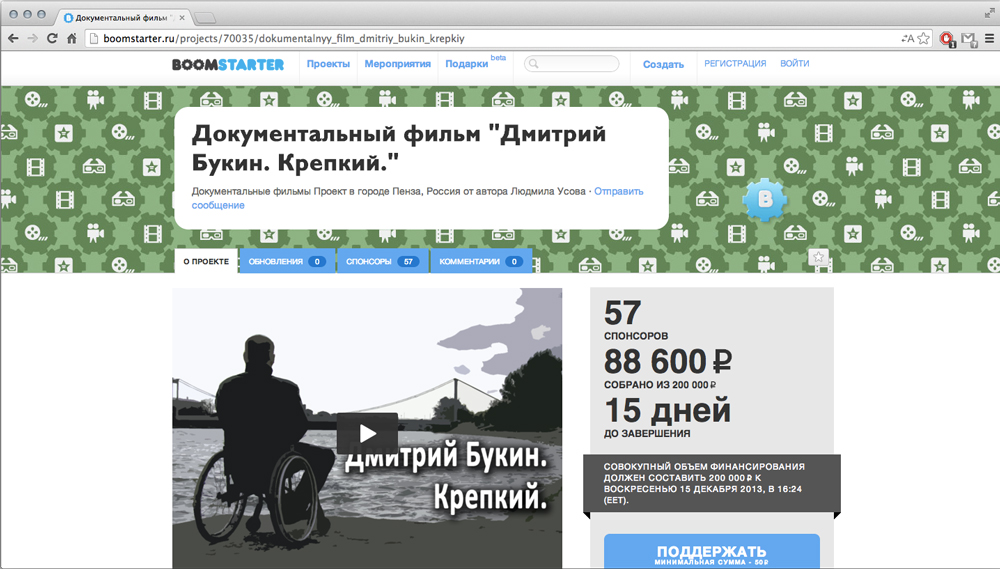
Of course, in Russia, not all forms of crowdfunding are presented: before the adoption of laws that would legalize our crowdlanding or crowdinvesting will have to wait a long time. There are very few chances that someday Kickstarter will come to our region: its expansion strategy is very conservative, until September this year it was represented only in the USA and Great Britain. But a holy place does not happen empty: in addition to the above -mentioned Kroogi.com service, Planeta.ru and BoomStarter are operating in Russia. The latter very strictly reproduces the rules of the American flagship: a project that collected less than 100% of the declared financing does not receive money. There are restrictions on the type of projects that can apply for support (not allowed, for example, charity). On Planeta.ru, the rules are softer: the threshold is half the declared amount, and there are no restrictions on the participation of philanthropists. For the first year of work, Planeta.ru raised 35 million rubles for her wards, BoomStarter - 25 million compared to $ 896 million, which Kickstarter collected by this minute, of course, not impressive numbers. But the Russian sites have everything ahead. Already today, the fees at Planeta.ru Viktor Shenderovich and Vladimir Mirzoev managed to attract more than 3 million rubles to the Petrushka television. The online publication COLTA.RU, which lost its history of two investors due to circumstances, which was not dependent on the editorial office, managed to establish financing for the release of readers through Planeta.ru. At the same time, BoomStarter, meanwhile, set the absolute Russian record to the present day to attract folk money to shoot a feature film: the historical film “28 Panfilovites” raised 3.2 million rubles ...
"
“Voting Ruble” often becomes the only way to influence a person to influence the surrounding life and express his civic position
"The revolutions of the world crowdfunding market in 2011 amounted to $ 1.49 billion, in 2012-2.7 billion, in the past year they are estimated at 5.1 billion. The main types of earnings on the Internet are several times ahead of the growth of Crowdfanding growth-both advertising and electronic commerce.
And the special value of crowdfunding for today's Russia is that the “vote of the ruble” often becomes the only person’s accessible person to influence the surrounding life and express his civil position. For example, when a couple of years ago, the FSB requested Yandex all the data on the sacrifice of the Rospil project and the movement of funds for their wallets, this caused a new avalanche of donations, although the entire required amount was already collected by that time. People went to pay money to show: we are not afraid. They did not hear such motivations for crowdfunding in his native America.