
Translated material
Philomale | Colta.ru
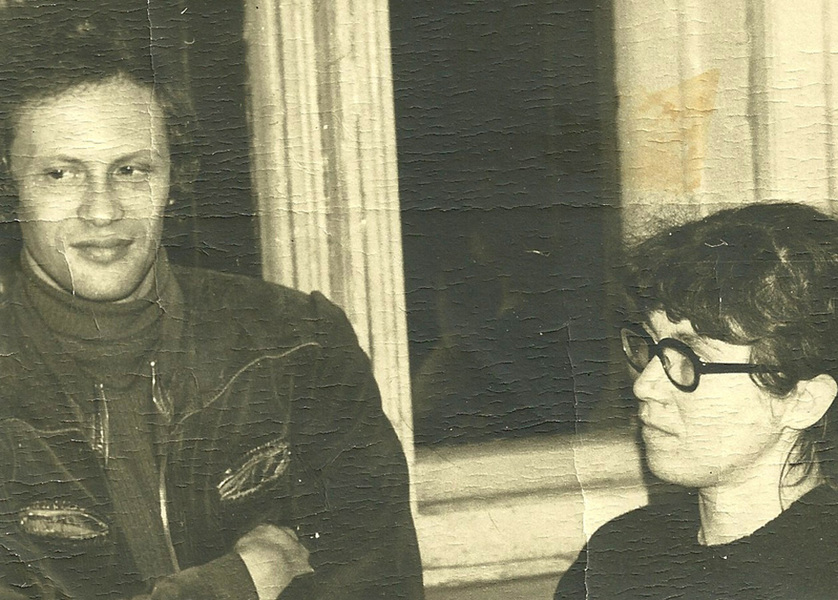
They say she died in a dream, propping her cheek with her fist. Poetess, human rights activist, underground, martyr. A friend in life and a sister in poetry, a heroic woman, a great citizen of her native country, and also - France, and also - her beloved Poland, and also the cities of Prague, whose freedom she went to protect on August 25, 1968 on Red Square.
We were introduced by Brodsky, whom we were friends then well. While in Moscow, my young friend made a gift: he sent a girl with a day train. A small sprout, a blunder-red, but curly, but curly and with an even more steep buckshot than him ... She appeared at night looking, there was nowhere to put her. I gave her my lining, and lay myself in my brother’s room, disturbing the nanny, who had a firmware there.
Fedosya did not even offer us breakfast, I took the girl from dissatisfied households to the pies, we finally talked and became friends, tight and good, for life. That was Natalia Gorbanevskaya. Starting to read poetry, she began to exist for me as a strong and stubborn poet, whose verbal work then, and always after perceived as a side walking nearby, side by side, with what you do or try to do it yourself. She read:
Arrow from onions, arrow from onions,
A shooter unfolded forward with his shoulder ...
The sculpture of Krishtof Shutro, whose exhibition shortly before, went through two capitals was instantly recognized. A romantic bronze archer with a torso, tense no less than a weapon in his hands, impressed me, but from Natalia he took and turned into lines. Subsequently, I recalled these verses and this bronze more than once, until I suddenly found it from the Hermitage window in the inner garden of the Winter Palace: somehow, without too much noise, the “shooter from the bow” settled there. But by that time I already knew not that the source, but an earlier, much more fresh and powerful embodiment of the same topic from another sculptor. In the album of Emil Antoine Burdel, I saw a “shooting Hercules”, and he became a model of sculpture for me, and the stroke moved and subsided, but the lines did not shur.
She complained about misunderstanding in Moscow, reached us, reached for us, to the “Ladoga school”, as she, by analogy with the English “Lake School”, called our quartet, and having heard my Madrigal Akhmatova “Another three and all the whole, / the dispatcher is aiming in the slot, / I will steal an electric train, / loaded with printed silver”, nearly not a printed silver. Seriously asked to take her into this hypothetical seven. Still not take it!
We went to acquaint with the still disgraced celebrity, but he was not in Komarov, she was just in Moscow.
Not in Komarov, not in St. Petersburg, so in Moscow Natalia was still represented by Akhmatova, and she appreciated her authenticity. Here is an Akhmatovsky review of her, addressed through me to everyone: “Take care of her, she is real,” is very perspicaciously noticed in the foresight of the Nataline civil exploits. Her self -portrait in verses has a full resemblance to the original:
Like the Army Army Soldiers,
Like an Andersen soldier,
I'm not in business. I am a poetry,
Sadly unable to lie.
Starting with “Listen, Bartok, / What have you composed ...” Her poems are full of music. At first, these were excerpts of symphonic streams - really like Bartok, Irmos, Nokturna and Wakes sounded for some time, and then the song began to be more distinctly. And she began to sing, like her long -standing predecessors, Russian Parisians of the first wave, about the most urgent - loneliness, love and death, inheriting the principle of a “Parisian note” - asceticism and restraint of the syllable, an intentionally muffled tone and complete rejection of all the lush, exaggerated, blessed. “Do not say red, do not say beautifully,” the poetess conjures her muse, and she speaks capaciously and cleverly.
She has a poem that draws with some kind of reliability the image of a trumpeter, faning his cheeks, "without understanding, / what is a speaker tongue is chopped off." Silence is a huge topic living in poetry for centuries, and a large artist inevitably rests against it with his consciousness. She called the famous Tyutchev exclamation "Silentium!" And the mysterious appeal of Mandelstam to return the word to dore harmony. This topic was affected by Gorbanevskaya. Moreover, she also introduced the original development into it, and its meaning lies in self -restraint, in a kind of spiritual circumcision of the language, that is, in other words, in the separation from it “excess flesh”, leading to the temptations of an uncontrolled word -prospecting, to an irresponsible, even poetic, chatter. The restraint and sobriety inherent in Gorbanevskaya affects one more side of her literary image - in a public position, which in “EXE G I Mon U Mentu M ” (in lat.) Never turns into the statue of the monument, does not rise above the pyramids, but, on the contrary, remains in human proportions, which does not interfere with its consciousness at the expanse of eternal and world topics. But there is no particular contradiction: its monument is not “more firmly copper”, like Horace, but, on the contrary, softer wax. In essence, he is wax, or rather, a candle, burning, while the mind and inspiration shine.
But in addition to the lyrical and reflecting principle in it, an indomitable public conscience was somehow very organically united in it. This led to the fact that at a critical moment of history, she entered another, desperate seven of brave men who performed with a impudent protest on Red Square at noon of a memorable day and year. Anyone who lived then remembers: Soviet tanks press liberal shoots in Prague, Jan Pajah burns himself on Vaclav Square, and we all, then bearing scoops, swallow the tears of powerlessness. Spirit, despair, shame ... And suddenly it died down with something life-giving: no, not all of us, there is still conscience, honor and hope.
Natalia Gorbanevskaya was liberated in February 72. Instead of prison, she was subjected to violent psychiatry. The Kazan specialist, where it was placed, was considered a particularly gloomy place.
Natalya began to run into St. Petersburg, and after my housing was formed, she stopped with me. I spent the night in the “guest” corner, for breakfast I either cooked oatmeal or fried eggs, I didn’t diversify our menu either. I had only two on -duty dishes under the conditional names “Varev” and “Pooh”. I do not disclose their recipes, because those ingredients can no longer be reached, I just ask you to believe that it was tasty and nutritious. One moment was remembered when suddenly - almost to tears - pinched his heart with pity. I brought the plate to put in front of her, and she suddenly grabbed the edges in the air, as if she probably grabbed “there” by the bowl during the distribution. She spoke little about these matters, such involuntary gestures said more. Nevertheless, I asked why she was in a psychiatric hospital, while the rest of the protest participants in the camp:
-Due to the fact that the nursing mother? Or - because the mother of two children?
“No, because of this they immediately released me, but at the end of the 69th they still arrested ... and Academician Snezhnevsky (that’s who will definitely burn in hell!) Diagnosed me with“ sluggish schizophrenia ”.
- What is it?
- This is a Soviet contribution to world psychiatry, Dimochka. Symptoms can be any. For example, I did not care about the condition of the children, although I took care of the state of the country in which my children have to grow. And this is qualified as the "nonsense of truth."
- Nightmare!
- Yes, a nightmare. Compared to the psychiatric hospital, the camp is a dream.
- Why?
- For two reasons. In a psychiatric hospital, firstly, there are firing medicines, from which you can’t dull, because otherwise-a punishment cell or even worse. Secondly-lack of deadline. They can hold out at least all their lives.
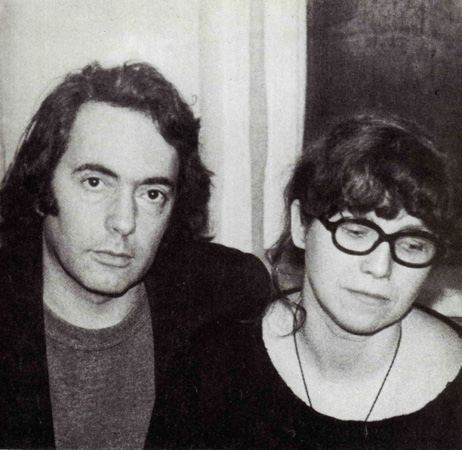 © Marianna Volkova Anatoly Nayman and Natalya Gorbanevskaya. Ser. 1970s.
In Leningrad, Natalya arrived by hitchhiking. Earlier, Naiman told me with cheerful bewilderment:
- Our Natalya is now the champion of the country in this sport!
I explained such vitality with the energy of the spiritual charge, which suddenly burst from the barred forced cure. This was felt even according to her poems, but another was guessed. She, of course, continued to survive, and hitchhiks were a convenient way to get away from observation.
Fortunately, the human rights activist in it did not defeat the poet, as I was afraid of that-her poems, still brief, were filled with tragic restraint. They expanded internally, space and depth opened in them. I heard a meditative dialogue with a non -emergency and living interlocutor, similar to what I ripened in me. And the measure of human confidence in her was such that I decided to tell about my own secret thoughts.
- That's great! You need to baptize you, ”she was delighted. “And I will be your godfather.”
- But we are peers ...
- It's nothing. This is quite allowed. I was baptized earlier, so I'm older.
And she set out the plan. First we go to Pskov (of course, hitchhiking) to one wonderful priest, and he will prepare me for baptism. Then we wave to Riga and on the seaside in Apshucims, where Tolya Naiman with his family, and from there to Moscow, will hold the country seasons, and there I will accept the baptism of another, no less remarkable, priest. I was satisfied with the plan in every way, I took a vacation, and we “hit the road”, as awkwardly, I would now put it in American.
The passage on the ways was not as bright as I expected, because of the harsh rules that Natalya stated at the last minute: not to chat with the drivers, only to answer questions briefly, but to pay-if she only asks. And so - “Thank you, happy path” and - from the cabin ...
But in Pskov he expected a surprise. The father really turned out to be bright. It was Father Sergius Zheludkov, a stable priest living in a house with his former parishioner, God -fearing, but also a fearless woman who sheltered a person who was obsessed, like our Natalya, "delirium of truth -care."
And the surprise was that they were visiting Nadezhda Yakovlevna Mandelstam, who came from Moscow. I don’t know why I was so surprised: she used to live in Pskov, where, by the way, I met her before. Probably, I was struck by the contrast between this sharp, acute in my tongue, a woman sitting in the red corner of the room, and with quiet prayed image, against which she smoked a white -fashioned one. It was Father Sergius who showed her the highest degree of respect, allowing you to smoke before the God. With her, we, of course, spoke about literature.
Father Sergius (Natalya simply called him Sergey Alekseevich) instantly disposed: simple, really clean, cheerful, open - no priestly importance or mystery ... Here he is instructing me, neophyte, what prayers need to be taught to begin with. And at the same time, church customs also criticizes in case - for example, tiring many hours of standing in the temple. Foreigners, they say, reproach us: "Russians pray with their feet." He even expresses completely controversial thoughts: about poetry, for example. Pushkin, they say, does not need to be a saint or even pious. If for inspiration he needs enthusiasm, excitement of the game, then let him be fond of. And we, priests, will pray for him ...
He joked, even said a joke about St. Peter. This gospel character, he most reminded me-the one who was the first to say:
- You are Christ, the son of God Zhivago.
And - look. And - the impulsiveness of temperament. Of course, he was a reformer, advocated a liturgical creativity, assured that the current liturgical canon was not always and exists in such a frozen form only by inertia, he would like to allow music in the church, and not just choral singing. He even played on an old sparmonium, showed how it would sound. It would sound great.
What superiors could like this? And not only to the authorities. Later I heard about him - mainly from the fierce conservatives.
But the most unusual idea about. Sergius was the “Church of the People of Good Volya”, to which, in his opinion, those who did not even suspect that they were Christians, doing good and following justice. He primarily attributed to such Academician Sakharov, reading him as, perhaps, a saint and a martyr.
He spoke Gorbanevskaya directly (referring to other participants in the protest on Red Square):
“You yourself may not know how much the act you have committed.” Indeed, in addition to all the obvious meanings for which you have so boldly performed, you have made other new victims not mandatory. Come out with you one hundred, two hundred people, they would only add suffering for themselves. And so - the protest is still expressed, the word says!
Once on the Petrograd side, two poets met on a fine May day. One of them remembered that on this day their Moscow peer and poet was born. Another cited the lines suitable for her from Zhukovsky: "Filomel is in a head, and a nightingale in Russian." They clung to her health, went to the post office and sent a telegram: "I do not exchange a melting filomel, we don’t exchange a drink, we remember Bobyshev Naiman."
Then she was still alive. And now Philomel will not sing to us.