
Translated material
Almost Cyberpank
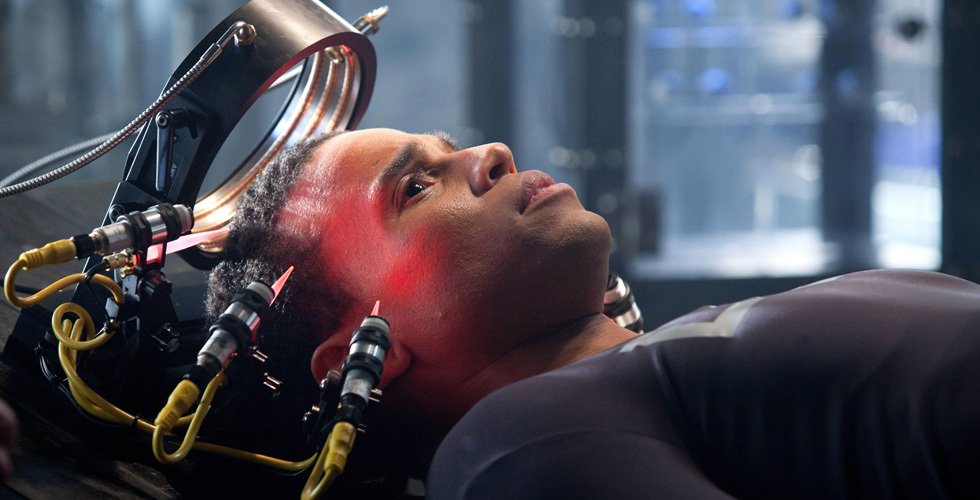
“Almost Man” is everywhere loudly announced as a successor to the “Running Blade”. Most likely, this happened against his will: the series, of course, would be more comfortable not to compete with Ridley Scott. But there are too many coincidences to resist the temptation to list them. The scene of both there and there is chosen a futuristic Los Angeles. The plot of the series is dated 2048, and the film is 2019. But the horizon of forecasting the future is almost the same: the “Runner along the blade” was released in 1982, and “Almost Man” in November 2013. Ridley Scott had a detective, who was hunting androids and doubting whether he himself is the end. In the series not two characters that do not understand their nature.
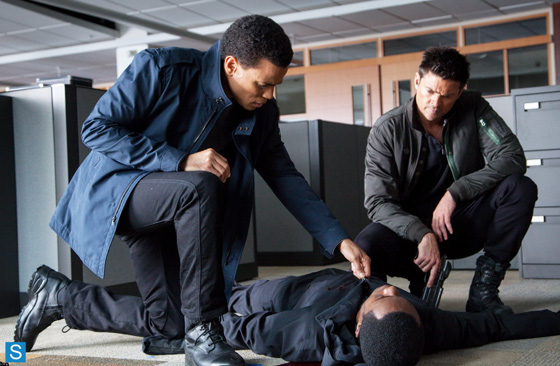
Police veteran John Kennex (Karl Urban), who was left without a leg during the assignment, masters the prosthesis and tries to return to duty. Colleagues unlocked him together: they say, psychologically is not ready and impressed with revenge. A robot-partner is assigned to him, but the hero of the Androids hates. He believes that if not for their computer pragmatism, his best friend would not have died in that shootout. In fact, this is self -deception: no one is to blame for the death of a comrade more than Kennex himself. Throwing the next annoying robot of the Assistant under the wheels of a truck, John writes out another partner-the defective Android Dorian (Michael or), who dreamed of becoming a man and was sent to the util for this. Relations from colleagues do not set. John is a cyberrasist, and Dorian does not always have enough tact: for example, he enthusiastically climbs into someone else's personal life. But a person and the car work together perfectly: they successfully hunt for DNA terrorists, save hostages and expose Albanian pimp, pulling human skin on sex robots.
From the “almost man” you should not wait for the artistic experiments of Sundance Channel , the psychological reliability of HBO or detective intrigues of the level of any of the Sherlock Holmes. The same criminals and the same criminals live here as in any American “procedural” series, which goes on large etheric channels. All the features of “almost a person” are in the fantastic instruments of crime and punishment, a high budget and a specific dramatic refueling.
 © Fox
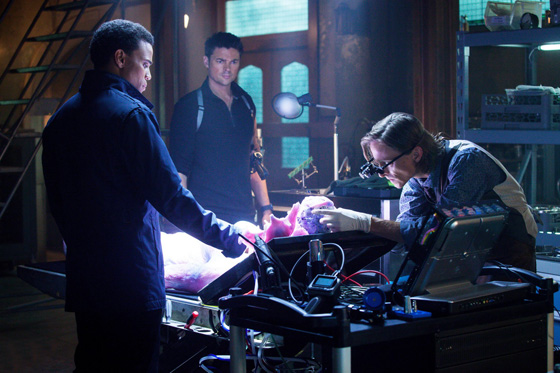
© FoxFirstly, there are many interesting gadgets. The bandits, so that they are not seen, apply a special spray to the skin. Terrorists develop a weapon that will only destroy the police. Thus, upon admission to the service, they make a special vaccine-this is what the virus uses it. A crazy engineer sits in a workshop similar to a morgue for robots for robots, who invent new abilities for android all the time. Drugs of the future are more dangerous - and more interesting - any existing in the present. Both the authorities and their opponents are experimenting with DNA.
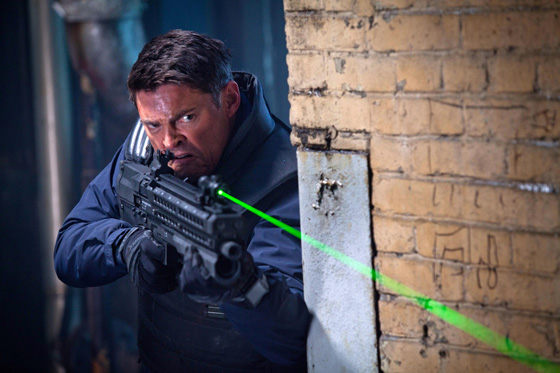
Secondly, the “almost man”, as they say, is richly made. Large enough for the TV stars are invited to the leading roles. Karl Urban played in the “Riddik chronicles”, “Lord of the Rings”, “Starting”, “Excellence of Bourne” and the film adaptation of “ Doom” . Michael or led his wife from Hank Mudie in the "prodigal California" and flashed in a dozen other good series. A shootout with terrorists, which opens the pilot episode, is not much inferior to such militants as the “human child” Alphonse Kuaron and the “fight” of Michael Mann. Where the directors of classic cyberpunk films let fog and turned off the sun to save on the decorations and special effects, the “almost man” draws a beautiful and majestic, although not too futuristic metropolis.
The antagonism of the heroes, finally, allows you to beat all kinds of social conflicts and pompous to instill in the viewer humanism. In each series, a heartbreaking catharsis happens: for example, Dorian escorts on the last journey a beautiful prostitute-Androide, which the court decided to “put to sleep”. In Los Angeles, household xenophobia flourishes, only instead of, for example, black citizens suffer from synthetic. The claims to the robots are the same as to illegal migrants: they take their jobs, do not understand themselves, are potentially very dangerous. But in the ecosystem of the series, this metaphor looks much more natural than, for example, the amazing monologue of Alexander Sklyar from the last Russian “Sherlock Holmes”, in which he complains about the dominance of Indians and Muslims in London and her Majesty's tolerance.
Cyberpank this year celebrates two symbolic anniversaries. Firstly, he, as an established term, turns 30 years old: the writer Bruce Betke came up with a successful definition of a fantastic pry. Secondly, 40 years ago, it was believed to be the first film in the genre-and not anyone shot it, but Rainer Werner Fassborder. His fantastic drama “World on the Wire” became the prototype of “matrices”: it also had a supercomputer, telephone boards for entering the virtual space and Smith's own agents.
Drugs of the future are more dangerous - and more interesting - any existing in the present. Both the authorities and their opponents are experimenting with DNA.
Outside of this context, “almost man” would not cost a big article. This is the next high -quality, high -budget and dramatic verified series, born in the Fox marketing department; No more, but no less. But at the same time, the “almost man” is a window of modern cyberpanus and an excellent occasion to talk about how the values of this genre have changed in 30-40 years.
To distinguish Cyberpunk from other fiction from the audience at one time taught art critic Lawrence Person, editor of the fantastic almanac Nova Express . In parallel with the essays writers Bruce Sterling and Michael Suenwick, he formulated the basic laws of the genre.
First of all, any cyberpunk production is based on the antithesis of the rapid technological progress of mankind and moral development that is strongly lagging from it. This discrepancy inevitably gives rise to chaos and allows writers to realize anti -utopian scenarios of the future.
This future itself must not be too distant and rather believable from the point of view of science. Classical fantasy is not constrained by the framework of technological logic - anything can happen in it. The only engineering thought in Star Wars, for example, was a hypothesis that in this universe they did not guess to invent a wheel. Cyberpank is forever tied to real technologies: its responsibilities include forecasting in the short term. Scientific inaccuracies are perceived here in hostility, so writers look at this minefield even less often than in historical novels.
The focus on high technology and low morals determines the list of basic topics of the genre. These stories are widely known. The conflict of artificial intelligence and man and the complexes of Pygmalion and Oedipus contained in it. Confrontation of hackers-swiftnesses and all kinds of systems. A bizarre combination of total control and complete anarchy. The inconsistency of the number of people on the overpopulated planet to their moral quality. The transformation of the society of individuals into an anthill (the word "cybernetics" means the management of systems), the birth of post -cyvivation, and the Babylonian mixing of cultures. Banal loneliness in the age of incredibly easy communications and social protest, finally.
 © Fox
© FoxOf course, conspiracy trillers and criminal detectives were the best interfaces for such plots. Large -scale militants are the estate of fantasy. Comedies - the lot of fairy tales. And the drama in Cyberpanka always involuntarily arose: its generator was hidden in the plow of the genre itself.
It would seem that more fertile soil for literature and cinema. The problem is that a slow-off bomb was buried in it-the catastrophic dependence of the genre on technology, reality and authors-lokomotiv.
The classic cyberpank popularized the large and clumsy philosophical concepts of his time - for example, the theme of “Japanification” of Western civilization already removed from the agenda. Modern cyberpunk does not fulfill such a mission, and cannot invent a new one. On the example of “almost man”, it is clearly visible that the educational function of the genre came to retelling the humanistic Maxim and a slight social satire.
The genre boom has always been closely connected with the progress of telecommunications, surveillance systems, banking technologies, medicine, computers and robotics. As well as with roaring economic reality-globalization, an increase in the power of transnational corporations, the emergence of charismatic billionaires-visioners. The modern cyberpunk was left without these sources of inspiration. In the “almost man” there is no brave, gloomy and brutal futuristic forecast of the “Runner along the blade”. Modern Cyberpank is a symbol of disappointment in technological progress, which has turned from a visionary into a consumption. “Almost Man” is the territory of ergonomic snow -white gadgets, the kingdom of feminine design and comfort.
In a classic cyberpan woman, anti -utopia was a natural environment of existence necessary for the moral ripening of heroes and sociological research of writers. There is no supercontlite and totalitarian regime in the “almost man”. Just some people, barbarians, interfere with other people, more prosperous, to enjoy the fruits of civilization. But it’s okay, the police and androids are already working on this problem.
 © Fox
© FoxIn their best years, both writers and directors enthusiastic about Cyberpunk were engaged in a common cause - a set of an array of ideas, from which a modern system of knowledge of the world was to be born. The “matrix” at one time tried to interpret, for example, with the glory of Zizhek. And William Irwin published the whole book “Matrix as a Philosophy”, at the best moments of which he was equal in Michel Foucault (at the rest of the moments, however, he was like Joseph Campbell with his “Hero with a thousand faces”). “Almost a person” (and any modern cyberpunk) avoids philosophical burden. But this series, using robots heroes, is trying to find what makes a person a man. Intelligence? Feelings? The tendency to make mistakes? It turns out that it is not easy to brush off the heritage of Isaac Azimov, even if you make a series for Fox .
Another reason for the decline of Cyberpan is that after the big writers (Philip K. Diko, William Gibson), large directors left him. In the eighties and nineties, the new artistic space, following the very countercultural Fassbinder, began to master quite systemic opposition from cinema. Among them are John Carpenter (“Escape from New York”), Ridley Scott (“Running Blade”), David Kronenberg (“Videra), Paul Verkhoven (“ Robot Police ”and partially“ Remember everything ”), Katherine Bigelou (“ strange days ”), Alex Poyas (“ The Dark City ”and“ I, I, the Robot ”) and the robot) and the robot) and the robot) Abel Ferrara ("Hotel" New Rose ""). In Cyberpanka, even Vim Wenders was noted, who shot “when the end of the world comes” - a digital poem about the relationship of cinema and dreams. And after the success of the “matrices”, even more respectable creators came to the genre for a while: Stephen Spielberg (“Special Opinion” and “Artificial Reason”) and John Wu (“Hour of reckoning”). Having implemented their visionary ambitions and not earned significant money, they gave the genre to the talented newcomers.
Technological progress, meanwhile, approached the predictions of the classics of Cyberpan. And the new literature with adequate futurology, capable of filling the gap between reality and the distant future, did not appear. As a result, some “on the hook” (2008) and “source code” (2011), formally as a cyberpunk, are no longer associated with their native genre and seem quite realistic militants. And “Ripper” (2010), “Time” (2011) and “Time loop” (2012), on the contrary, look like retrofantic, respectful stylization under the cinema of the long past days. Unlike these orphans, direct descendants will only disgrace famous ancestors. In the film "Throne: Heritage" (2010), the magic of technology was replaced by the magic of design. In “Remember everything” (2012) no one is flying to Mars: Cyberpank has become mundane. True, in 2014, another Verkhoven remake - Robokop will be released. There are more hopes for him.
In the meantime, it seems that Neo, whom they so desperately tried to wake up in the “matrix”, fell as well. In the interests of all science fiction - so that he woke up as soon as possible.