
Translated material
Libya: Arabic winter
Report from the country covered by chaos
From the representatives of Russia-in Rome, New York or Geneva-you hear every now and then: President Putin will “not give” Syria, because Russia has an example of Libya before his eyes. Two Russian citizens - Alexander Shadrov and Vladimir Dolgova - are not easier from this rhetoric. They are now sitting in a Libyan prison. They are literally in the literal sense of the word! - They sent their own Russian diplomats two years ago. In the country, covered by chaos, the prisoners are becoming all
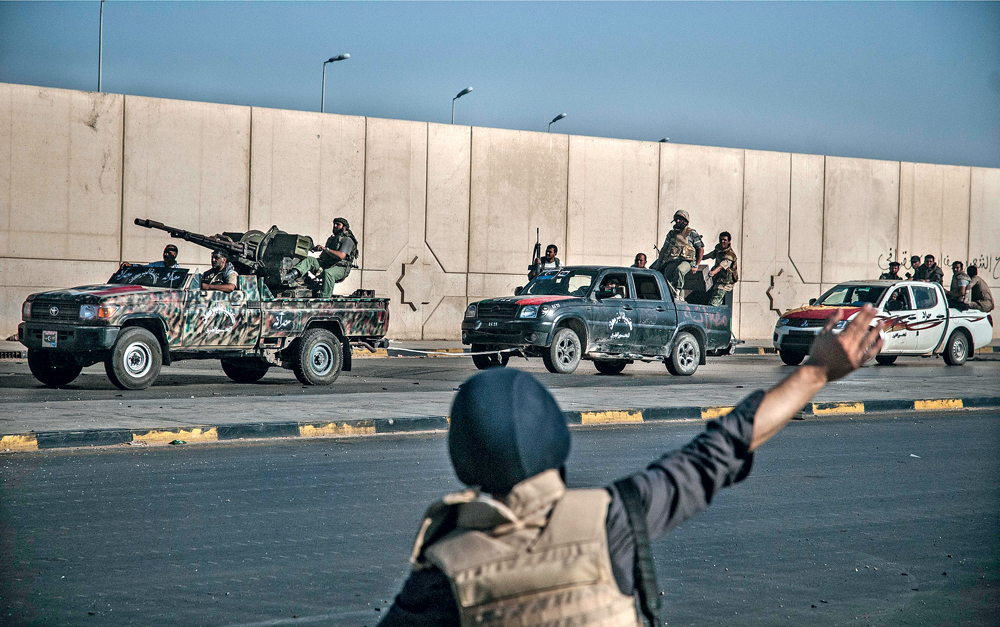
The rebels enter the capital after the departure of the forces of Gaddafi. Tripoli, August 2011
“I heard a story about these two Russians,” the lawyer Ahmed al-Muni nods, “it seems that they could not prove that they had arrived in Tripoli legally. In August of the year before last, when the Army of Gaddafi left here, all foreigners were immediately arrested without documents as his probable accomplices. ”
“Are you saying that they are oil workers? And I heard that they are mercenaries - a journalist named Mokhsen (refuses to name the last name), too, "a little aware." - They say they repaired tanks and armored vehicles for the Army of Gaddafi. There are no need to penetrate the oil workers here without documents from the territory of Tunisia, like them. ”
“These two took refuge in the Russian embassy,” an official from the Libyan Ministry of Information, the facts known to him, retells in a telephone conversation. - Then, when the Gaddafi regime fell, the guys from the “eagle battalion” (pro -government militia) found out about them, signed all the necessary papers in the transition council and went to the Russian mission: they said that these two needed to be interrogated as witnesses, and then they would be returned. Russian diplomats went towards. They took away, fired four times, and then left it at home ... "
For “aiding in the destruction of the people of Libya, Vladimir Dolgov received 10 years, Alexander Shadrov - a life sentence. Now the Russian Foreign Ministry took up the fate of Shadrov and Dolgova, deputies of the Russian parliament intervened - after the desperate relatives of the prisoners turned to them.
“I think they will be released,” the Libyan official predicts. - Russia began to ask for them very much. There are still nineteen Ukrainians and three Belarusians - their affairs are also asked to re -consider ... "
During the agony of the Gaddafi regime, Libya was really flooded by mercenaries of Slavic origin: under the contract they received from $ 10 thousand to $ 20 thousand per month. In addition to the Russians and Ukrainians, the Serbs also served in Gaddafi, and in the elite units - they said about them: "The warriors of the colonel." In 2011, in the refrigerator, one of the hospitals in Tripoli was found the body of a guy with blond hair and blue eyes. They said that he was a Russian or Ukrainian - there were no documents with him. The body was chopped, the bones were broken. The mercenaries finished their life - like carcasses in the butcher shop.
Gargur, the quarter of the dead
50 killed and 400 wounded - the result of a peaceful demonstration, according to which a group of militants opened a fluid fire. This happened on November 15 in Gargura, the largest quarter of Tripoli, occupied by militias from Misurata. The day after the Prime Minister Ali Zeidan, in an ultimatic uniform, demanded that all gangs be left to leave the capital. The population supported him.
A few days before, the militants from another group abducted the deputy head of the Libyan intelligence Mustafo Noah: he was simply pushed into the car as he returned from a working trip to Turkey. Previously, the Prime Minister Zeidan himself was also stolen - he had to return the checkpoints to the streets of Tripoli as a special order, as in wartime.
On the ultimatum of Zeidan, militants from Misurata replied that "they would leave Tripoli only to the next world," and the city itself, they say, "have not yet seen a real war."
The same thing happened last year in Benghazi. The second largest city of Libya, the heart of the 2011 revolution, now Benghazi is a stronghold of tribalism (tribal isolation) and separatism, a symbol of powerlessness of the Libyan authorities. In September 2012, the American ambassador Christopher Stevens died here as a result of an attack on the US diplomatic mission. Perhaps this was retaliation for the abduction of the Libyan field commander Abu Anas Al-Libi, suspected by the American military in relations with Al-Qaeda. After the death of Stevens Ambassador, Prime Minister Zeidan demanded that the militants leave Benghazi. And in response I heard ridicule.
“The government does not have power over armed people,” the dignitary already familiar to us from the Ministry of Information admits to us.
From rebels to generals
The real power in Libya today belongs to the militias who refused to disarm after the death of Gaddafi. Two years ago, they were called the "martyrs of the revolution", "liberators of the country" and "disagreed." Today, the same newspapers call them “criminal clans” and “militants”. Citizens of Libya have already understood: the war did not end with the death of Gaddafi. And the death of the dictator did not sow the grain of freedom and democracy.
The new Libya is not just similar to the old one, it is worse: instead of a 40-year-old dictate of one clan, the country received a chaotic system of hundreds of tribes warring among themselves. And not one of them agreed with the recommendation of the government in Tripoli to “delegate” their militias into the ranks of the Armed Forces. Moreover, the authorities received an answer, more like a threat: we destroyed Gaddafi, which means that we can destroy anyone. If earlier everyone was against Gaddafi, now everything is against everyone.
“Clans, tribal groups, Islamists, militants - no one wants to lose the extracted power. It is worth uniting them, at least for a while, and that’s all - the central government in Tripoli will remain an empty sound, ”writes Tripoli Post, comparing the current position in Libya with Iraq immediately after the war with the United States. And he continues: - the Gaddafi era, when everyone had a house guaranteed medical care and a free education affordable for everyone, has long been behind. New Libya is 30% unemployment and stagnation in the economy, it is destroyed institutions, it is a situation when law, order and safety do not even apply to the central quarters of the capital. ” According to the Minister of Economy Alikilani al-Jazz, "Libya is similar to a pilot circling above the ground, but not knowing where to land."
The number of Islamic groups exceeded 300: these are al-Qaeda branches, Salafite jihadists, mercenaries, chaders, former Kaddafi minions, armed with tanks, and dozens of small gangs. The total number of militants, according to some reports, is about 250 thousand people.
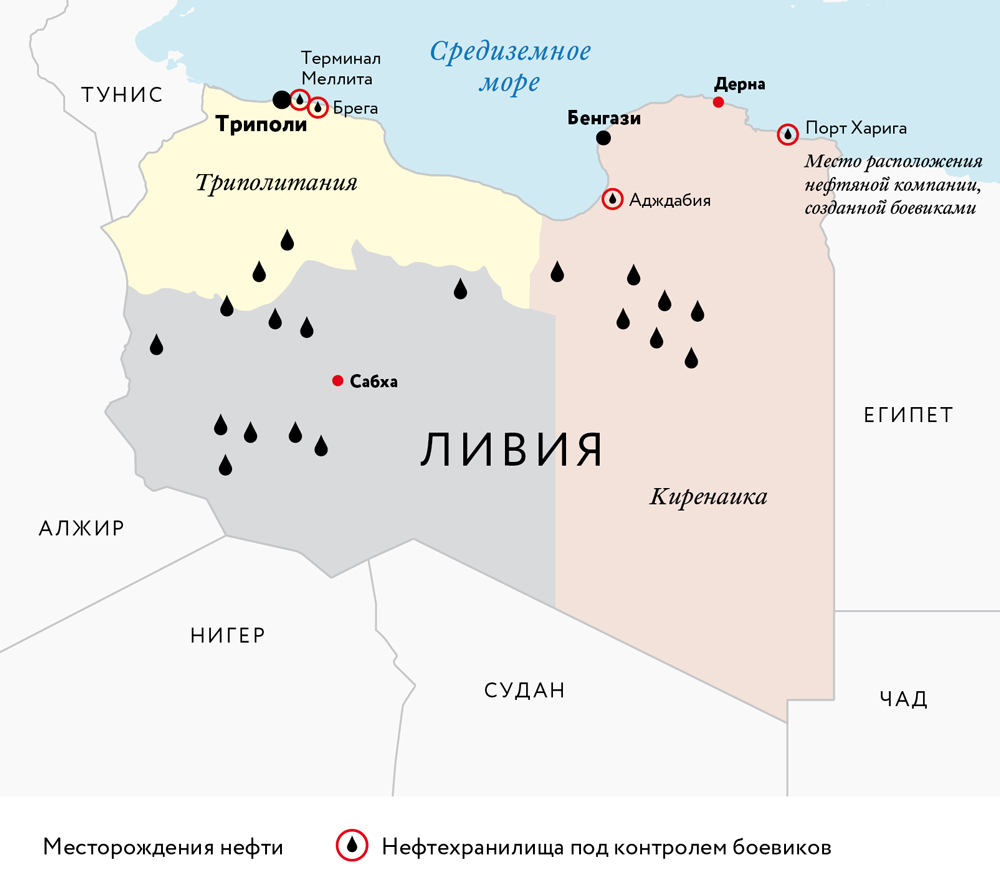
| *The eastern part of Libya, which includes four provinces - Bengham, Jebal Akhdar (Green Mountain), Tobruk and Addabia |
The “Martyrs Brigade on February 17” (this is the day of the beginning of the Libyan Revolution) has not yet been disbanded. In the past, she received funding directly from the Minister of Defense. Its 12 battalions still keep the entire combat arsenal and all the barracks of the Kirenaiki*under control. The non-unloaded “Martyrs of Abu Salim”, named after the prison, in which the dictatorship of the opposition Islamists, also partially consists of jihadist militants.
The Ansar Al Sharya Brigade, which is part of the international network of jihadists, maintains regular contacts with the “brothers” in Pakistan and members of the group of the same name, based in Tunisia. Its leader is Sufyan Ben Kumu, a former prisoner of Guantanamo, transferred to Libyan prison in 2007 and released in 2010.
The stronghold of the Libyan Islamists is sore, a town in the eastern part of the Libyan coast, 300 km from the border with Egypt. The laws established by the central authority do not apply here. One of the field commanders, Ansar Al Sharya, not without pride, told the author of these lines: "Real revolutionaries and full -fledged heirs of gained freedom are we."
This is true. It is they, not the central government, control what the increased interest of the old Europe of Europe is in oil wells. Brussels shock about the last bloody events in the Gargur quarter is partially caused by the fact that the riots led to interruptions in oil supply. Yes, Libya is still the largest supplier of black gold to Europe, although now, instead of the previous 1.2 million barrels per day, 450 thousand are mined here. The instability of the government in Tripoli threats Rome, Paris and Berlin, where they are now asking questions about the not yet adopted constitution in the country where the former ruler has been overthrown two years ago. ENI energy concern, the largest Italian investor in Libya before and after Gaddafi, is forced to take into account the location and movement of Libyan militants when analyzing a market conditions. The only risk that you can’t go to is the loss of oil. Therefore, Europe is increasingly pressing on Tripoli, which never joined the Mediterranean Union-a trade union created in 2008 with the filing of the ex-president of France Nicolas Sarkozy. But what can Tripoli can answer, even if the head of the Libyan government is not able to prevent his own abduction?
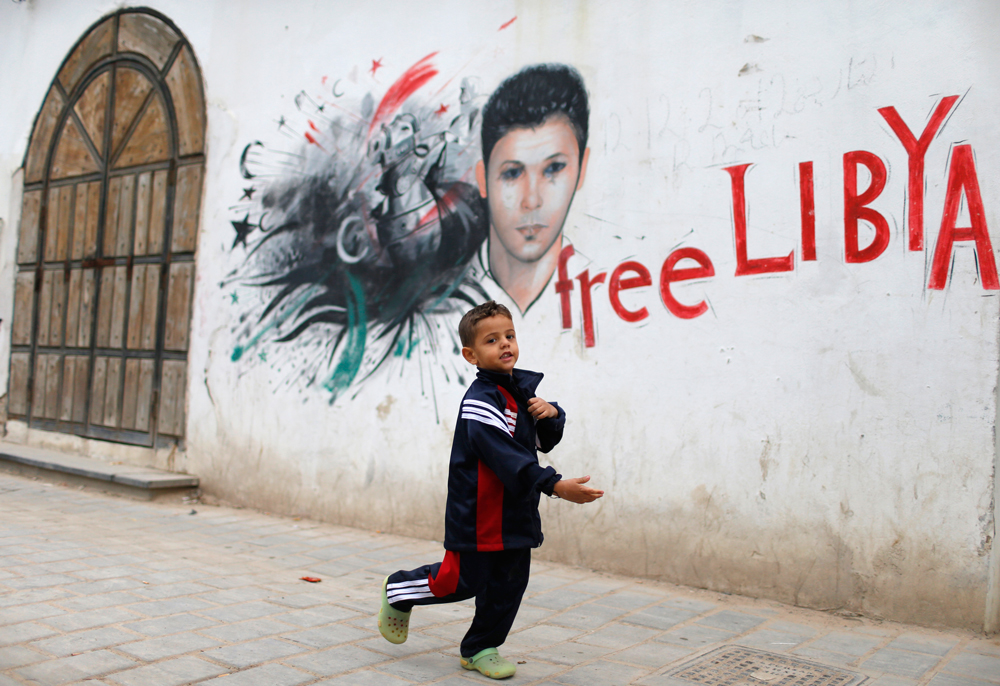
Tripoli, the old city ... and the "free Libya", as Graffiti says. November 2013
"Made in the USSR"
Libyan militants are armed with what remained after Gaddafi. The colonel loved to buy weapons in France, Great Britain, and especially in Italy. Gaddafi liked to invest in security. In 2004, he spent € 56 million in Italy, in 2005-€ 93 million, in 2006-€ 80 million.
After Italy, the leader of Jamahiria switched to Russia: in 2008, he set his tent in the Kremlin, where he promised the then President Dmitry Medvedev a protectorate of the Russian fleet over the Mediterranean Sea. In 2008, he purchased Russian weapons for $ 1.5 billion, in 2009-by $ 2.3 billion. Two years ago, Tripoli streets were strewn with weapons, instructions for which were written in Russian and Italian.
The colonel’s arsenal was 90% Soviet: Libya was known as a reliable ally of the USSR during the Cold War, and Russia agreed to modernize Libyan weapons. However, the UN sanctions adopted against Libya in March 2011 and supported by Dmitry Medvedev undermined a contract by $ 4 billion.
The Russian weapon purchased by Gaddafi ultimately was in the hands of interethnic Islamic groups operating in Syria, Mali and Yemen. The call "To weapons!" The Islamists heard in Chechnya and Dagestan - hundreds of Dagestanis and Chechens went to the Syrian Front. At the insistence of Moscow, Foreign Minister Sergei Lavrov arrived at the end of October at a meeting of the UN Security Council in order to “make sure that the weapons of the former dictator of Gaddafi are really in the hands of Syrian rebels. If so, a serious increase in sanctions against Libya will follow. ” But Tripoli already know that it was from here that the Katar military transport aircraft S-17 transported the former weapons of Gaddafi to Syria, where it fell into the hands of the Libyan and North African militants fighting here. Fauzi Bukathef, who had previously struggled against the Gaddafi regime, then the ambassador of Libya to Uganda, in a conversation with the magazine confirmed that the militants have been operating in this way for more than a year: “Yes, this is a manifestation of the solidarity of the Libyans and Syrians.”
But in addition to weapons, there is also uranium: more than 6.4 thousand kg hidden in the Libyan desert. After Russia officially turned to the UN Secretary General, Pan Hi Mun, with the call to take these reserves under control, the operation began on their relocation: now the Uranus belonging to Gaddafi is in a special storage in Sabha, the city in Libyan Sahara. True, there is one delicate moment: the storage is under the control of one of the groups, which is so far loyal to the authorities in Tripoli. Bye…
According to the IAEA, in the same place in Sabha, Libyan smugglers hid more than 4 thousand land -air missiles purchased by Gaddafi from Russia.
Nobody Earth
Today's Libya is a nooye land, a nursery of religious extremism, a transshipment point of weapons smugglers, an ideal shelter for criminal elements, slave traders and “militants of Allah”. The Libyans who escaped to Europe are forced to pay a ransom for relatives who remained in their homeland, so that they left those alone and life was given to them. Swers swim from the ports to the Old World, for the “travel” on which migrants pay $ 1-2 thousand. These “one -way trips” bring to smugglers living goods up to $ 500 thousand per day.
Even during the war, many Libyans and Africans from Black Africa were killed on suspicion of work at Gaddafi. The Islamists saw the “Dictator's minister” in every black African. Today, enmity between the Cyrenia and Tripolitania was added to all this - the eastern and western parts of Libya, which differ ethnically and culturally. They managed to unite only in 1951 under the banners of the Libyan kingdom, and then under the rule of Gaddafi. But today, the threat of decay again hung over Libya: at the end of October, the Bengham (Kirenaika) proclaimed autonomy consisting of four eastern provinces and the shadow government was formed. The central power can only contrast this with tired sighs ...
For those who, two years ago, celebrated the liberation of the country from tyranny, just look out the window to see the real state of affairs. “For some reason we are still alive. Maybe we still have to shed light on the truth, or maybe no one can do this, ”they say. And they refuse to call their complete names - fear is stronger than even despair.
“The request for democracy and the dream of it are still strong in society. Otherwise, you will have to come to terms with the idea that all the victims of the war were in vain, ”says 43-year-old Ahmed, a civil activist from Tripoli.
And here is the opinion of another activist, Hassama: “What is the“ Arab Spring ”? Why did she result in chaos? " Our interlocutor sees the abyss between yesterday and today. It is cooked in a cauldron of distrust, fatalism and humility. The Green Book (Muamar Gaddafi's programmatic work. - The New Times) is all that we knew about the world under Gaddafi. And then Libya exploded ... We all gave someone to the soul, some hand, some leg, some son, gave for freedom. And in the end, we live in universal horror. Was this a revolution? "
Photos: Michela Yakkarino, Ahmed Jadillah/Reuters