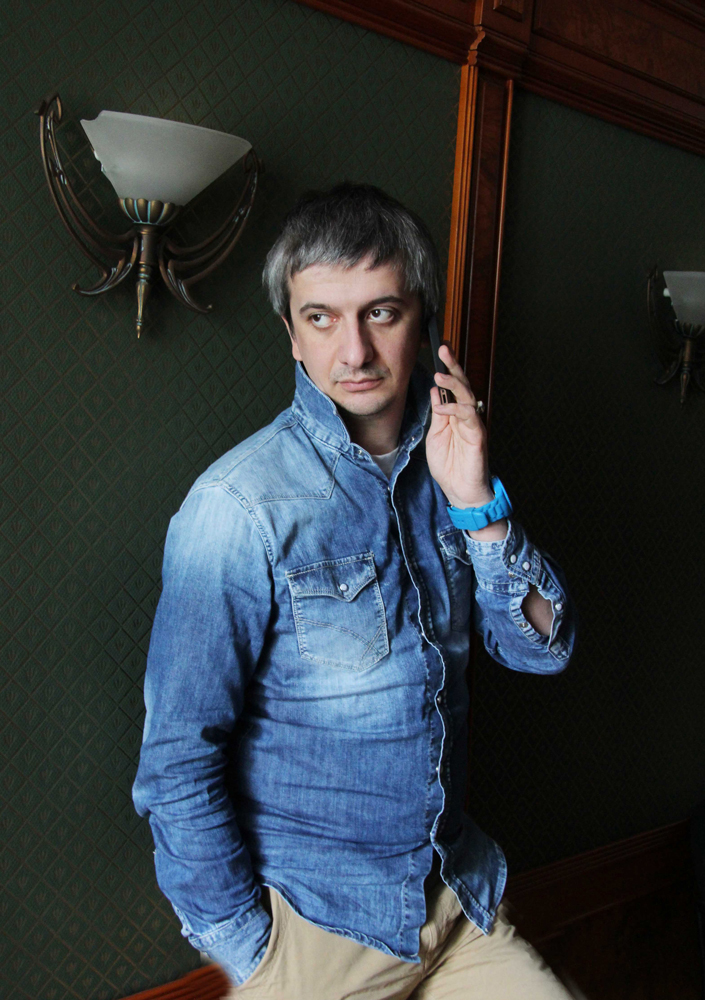
Ksenia Larina - About the scandalous performance in the Moscow Art Theater
Konstantin Bogomolov promised to arrange hell on the stage of the Moscow Art Theater and did it: his “Karamazovs” are deafening and merciless. Like a grenade launcher
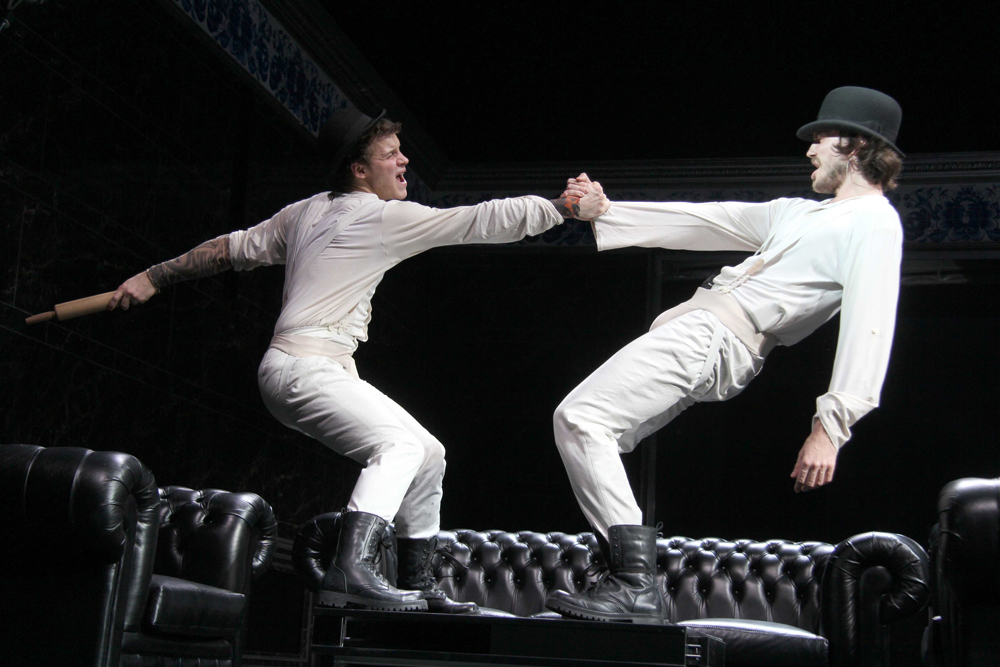
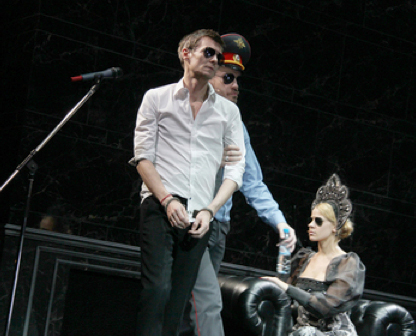
Mechanical cops - Danila Glassov and Maxim Matveev
At the Tabakov scenes (in the Studio Theater and Moscow Art Theater), Konstantin Bogomolov made ten successful performances in six years. The Karamazovs are the eleventh, the most difficult, most painful, most uncompromising, deepest, most powerful. This is an absolutely personal statement, striking in its confession and absolute ruthlessness in relation to itself.
It smells of Russia here
The “Karamazovs” can be called a discretion, and the scale of its defeat is uncontrolled-as the action of Napalm. The prose of Sorokin - a mixture of disgust and delight has such an impact on the reader. He himself is sitting in the hall on the first audience run and in his eyes his celebration, as if this novel was written by him. However, the director himself does not hide this internal co-creation: the Sorokinsky intonations are guessed both in stage techniques and acting extensions, in the credits, commenting on the effects on huge plasma screens, from short melodious remarks (“Mytenka drunk and went to kill the father”) to pornographic graphomaniac texts, with which he once began schoolboy Vova Sorokin. The titers popping on the screens and the Bogomolov’s traditional musical stage clips here are exclusively humanistic in nature: to give the viewer the opportunity to exhale in a minute to immerse him in the stinking bloody flesh of the performance.
It is difficult to watch the “Karamazovs” as if you are present at public autopsy in the anatomical theater. Sometimes it seems that a sweet cadaveric smell, the smell of rotting humanity, a gutted bag with guts and shit, is spread across the hall, in which naive fools amuse themselves with the hope of finding a soul and heart. And there is nothing there - except for lust, envy and animal cruelty. “Here is the Russian spirit! It smells of Russia here! " - the mother of the little Alyosha recites Pushkin’s lines, and her face involuntarily crooked.
Skototrigonevsk appears before us a kind of purge, which is worse than hell. There is neither time, nor night, nor morning, it never has the sun, eternal twilight and eternal debauchery reigns in it, women are used in it for lust, and children are for violence, crimes are commonplace in it, like sausages, and tortures are sweet and lustful, there is physical pain, torture and humiliation, there are a “new” person, there is necrophilia - there is a form of repentance and suicide - and suicide - and suicide - and suicide - and suicide is a form Ascension method. The hellish frying pan of Smerdyakov, on which he fries eggs (again the smell!) - this is the subject of a cult, priesthood, and trembling from this kitchen sterile everyday life.
Bed life
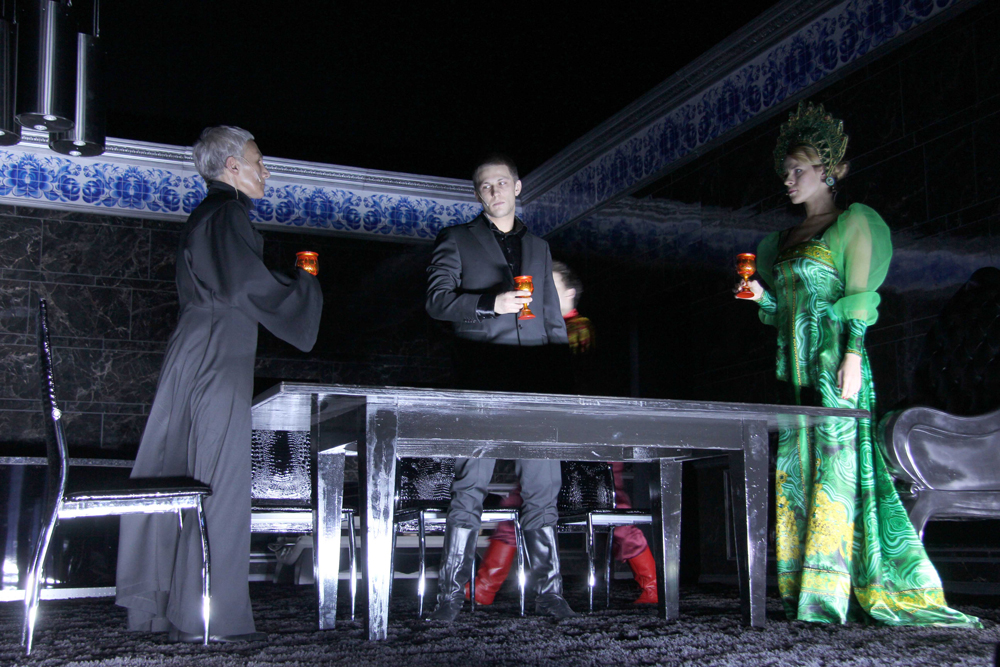
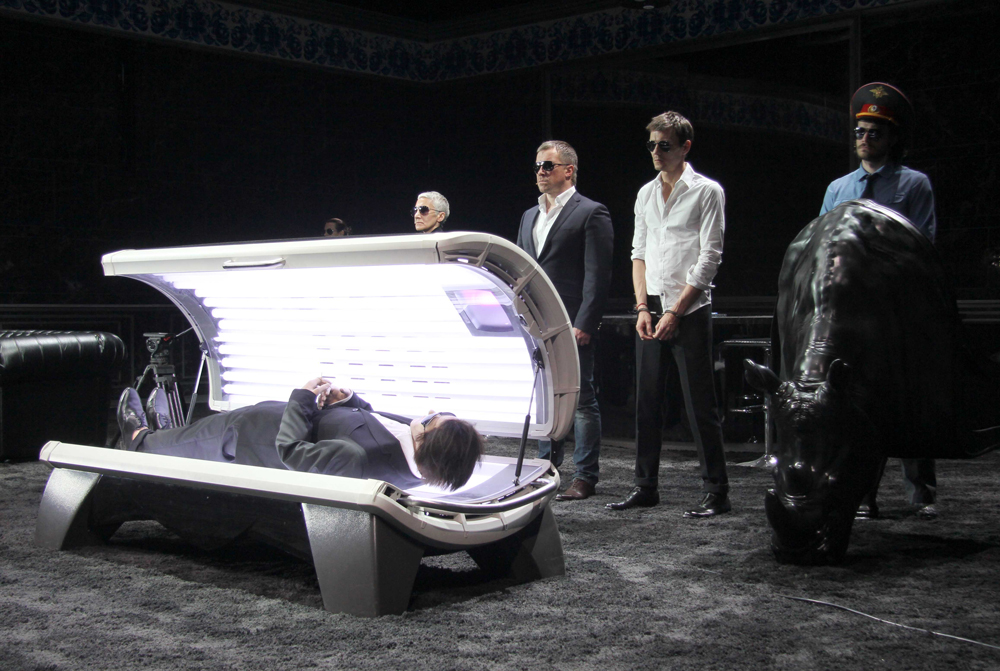
Skototrigonevsk is not much different from any modern Russian city. Here is its bestial TV with a direct broadcast of the funeral of the elder Zosima, the main event of which is a nauseous coder spirit that spreads the corpse of the deceased saint. Their cattle police officers, arranging orgies in the spirit of young people from the “Clothing Orange” (the famous film by Stanley Kubrick) and amusing each other with a rolling pin, and then, putting on a police uniform, eagerly rape witnesses and suspects, replacing a rocking with a bottle of champagne. The cattle hi-teema of the tower of the bestial oligarch Fedor Karamazov: marble walls with plasma raised from them, black leather furniture, a chair with a rhino muzzle, cocaine paths on a glass surface of the table, gold cufflinks, a colorful shirt, a homemade solarium in which it will be buried, and advertising throughout the city of Karamazov’s drinking houses. Communication without barriers. "
The cattle local b ** di - Grushenka and Katerina Ivanovna, - weaned from underwear and ready to copulate with anyone - even with each other. The cattle bank, led by Hokhlakova, who is exhausting from the loneliness, is the lack of sex with the viewing of the horror films. The local patriarchy is represented by the wife-like priest Father Feofan (Svetlana Kolpakova), instead of the “eternal memory”, heartily sung “show Mast Gow” above the tomb of Karamazov Sr..
There are neither portraits of leaders, nor icons, no flags in the play - none of what today would symbolize today, its dumbfounding relevance is expressed in intonation, in the choking atmosphere of universal decay, a triumph of immorality and fall.
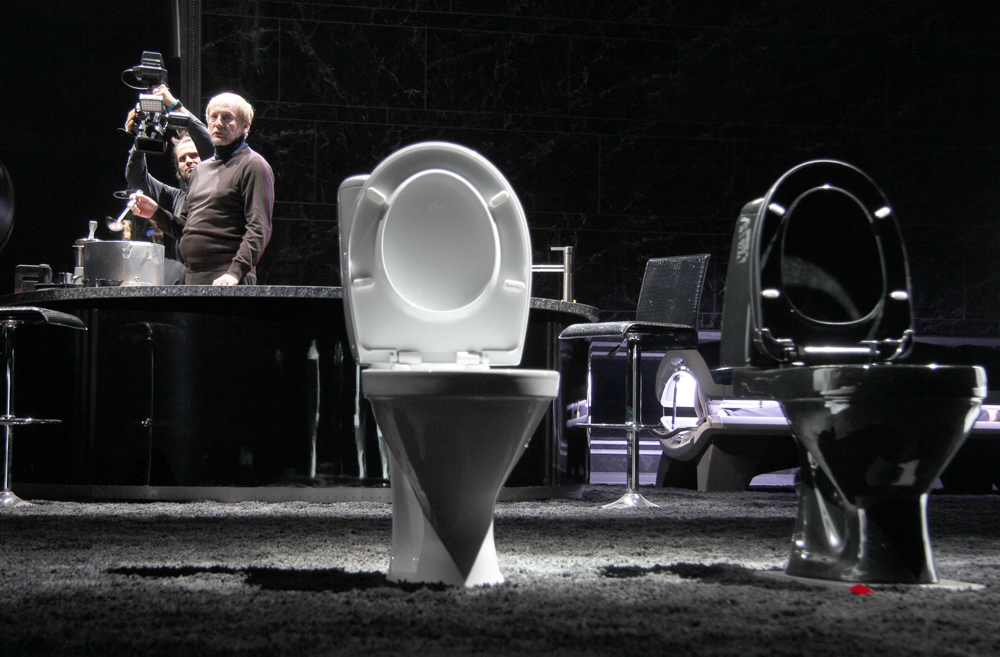
The elder Zosima turns into Smerdyakov (Viktor Verzhbitsky), Fedor Karamazov - a devil, and the family crypt of the Karamazovs grows up a string of the toilets in a public toilet, and the Blessed Lisa Smerdyakova, Smerdyakova’s mother, is fighting this toilet.
This performance, staged by the devil, is a mocking, punishing, not sparing neither old people nor children who recognize any taboos and no indulgences. In one of the videos, the smoked cops run to “arrest the devil”, the director of the Bogomolov himself in the dressing room opens the door to the apartment, and to the question: “Tell me, does hell live here?” - answers with a grin. And in the finale, the same feature will sample, growl, wriggling at the microphone, the immortal Soviet song "I love you, life!" - And she will suddenly appear in all her pristine disgusting form, like the deafening anthem of Satan.
Team
The maximum author’s theater of Bogomolova is inconceivable without the amazing artist Larisa Lomakina and without artists, in which the director discovers incredible depths. Fedor Karamazov and the devil - Igor Mirkurbanov, vicious, spontaneous, enveloping with his gloomy demonic charm - Lucifer, which turned out to be a jester. Ivan - Alexei Kravchenko, driven out, numb with his own baseness, exhausted by unbelief and cocaine. Alyosha is Rosa Khairullina, a boy-old boy with a gray head and dead black eyes. Mitya is Philip Yankovsky - a limp, lost teenager, requiring hell and pains for his thoughts, who accepts punishment with the whole being, with all the dozing passion in him. Dostoevsky, who regretted him, would be surprised by the directorial cruelty, but would accept: the last smile of Mitya, frozen in a loop, isn't that tears of the child? Philip Yankovsky turned out to be a fantastic artist-free, open, filled with a proprietary Yankovo irony and some charming wisdom. Maxim Matveev plays several roles here, the central character certainly became the Sendist investigator, a voluptuous maniac, with the same pleasure that substitutes his own ass and raping a stranger.
Dmitry Karamazov (in the center) - Philip Yankovsky, man in uniform - Maxim Matveev, Grushenka - Alexander Child
Marina Zudina did her best theatrical work precisely with Bogomolov (Arkadina - in “Chaika”, Trochykin - in the “event”). Her Khokhlakova is well -groomed, languid, ridiculous, stupid from loneliness, incredibly attractive, expiring by the juice of constant lust, who trade in vulgarity. Women of the “Karamazovs” have a single property - they are attractive and disgusting at the same time. It is precisely the same, who crossed the line of morality and shame, that Daria Moroz (Katerina Ivanovna) and Alexander Child (Grushenka) play their heroines.
There is nothing accidental in this work - therefore, all conversations about the possible contractions of the performance cause just physical pain to the director. Yes, Bogomolov of those directors who create problems for the leadership of the state repertoire theater. And the main one - he knows exactly what he wants, in him there is no longer a youthful throwing and an unconscious desire to shove into his work all abscesses of humanity. The Karamazovs are a performance of a large independent artist suffering and indifferent, capable of expressing his pain and pulling it out of others.
It is terribly sorry if this union - the artistic director and the director - will cease to exist. Because the Moscow Art Theater Oleg Tabakov is not only a quality guarantee, it is a flair on talent and trust in talent, it is a risk, excitement and fearlessness. And to whom it is not Oleg Pavlovich to know that these are components of success. Including commercial.
"Let my work speak for me" Before the run of the performance and immediately after the Internet, he was boiling with rumors: the leadership of the theater is displeased by the performance, too many frank scenes, Konstantin Bogomolov will leave the theater if his work is subjected to censorship. However, the pre -premiere shows took place without incident. The premiere of Karamazov is scheduled for December 5. Konstantin Bogomolov leaves for Warsaw for the production of Sorokinsky "ice". No comments - except those on his Facebook page. Konstantin Bogomolov November 26 And they served until 12 in the morning. And no one left. And there was a standing ovation, although there were no bow. And Volodya Sorokin told me such words that are proud. And I said: these are the best artists, this is the best artist, this is the best operator, these are loved and rooting for the Service Service, this is my best film. And I thought: do not be angry with stupid. It is more difficult for them now than you. Brothers! Thanks to all of the seven! November 26 I want to add more. I have no conflict with Tabakov. I am grateful to him for everything ... We had to talk with OP today. But the meeting did not happen. This is the theater. I can do spectacles in it. And in other matters there are people more skillfully. And Tabakov will remain Tabakov and my attitude towards him is unchanging and exceptional. November 26 The last two days before the pre -Oopolgim departure. November 26 The conversation took place and everything is fine. November 27 I am very exhausted. Very. But I'm very happy! November 28 I told myself: not to comment on everything that happened. Do not tell anything. I explained to me with an dear person. And whoever wants to - let him give it like a PR, an insidious plan. I don't want to answer. Let my work speak for me. I have people who believe me and believe in me. And it holds me. There are my loved ones. And this is my happiness.
Photos: Ekaterina Tsvetkova/Moscow Art Theater. Chekhov