
Translated material
To Russia for love
Hollywood and Stalin: Love without reciprocity (part 35)
Continuation of the series, start read here .On February 28, 1948, the American press announced a sensation: the day before, an employee of the US Embassy in Moscow 33-year-old Annabel Bukar filed a petition for a resignation. In her statement to the name of the ambassador Walter Beddel Smith, she wrote that the service in the embassy was incompatible with her current views, and reported that she intends to remain permanent residence in the Soviet Union.
There was nothing like this in American-Soviet relations until then: there were defectors among the diplomats, but only in the opposite direction-from the USSR to the USA.
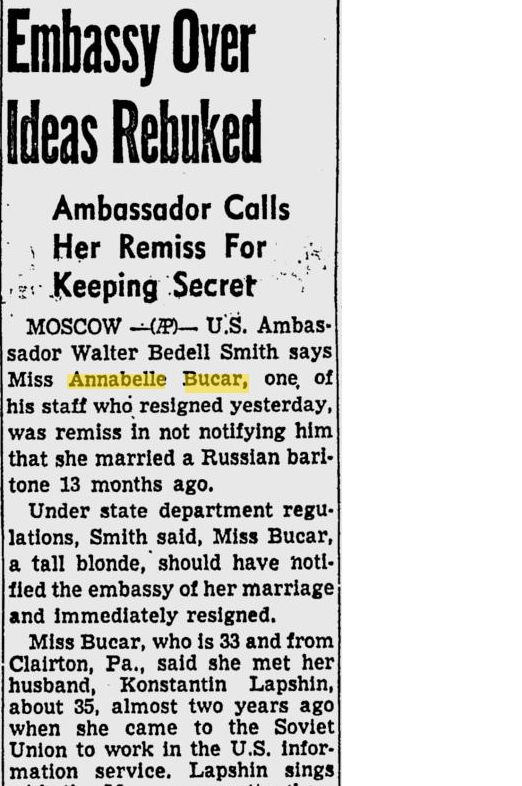
Annabell Bukar was born near Pittsburgh, Pennsylvania, in a large family of an immigrant from Croatia. During the Second World War, she served in the Directorate of the US strategic services - intelligence, subsequently transformed into the CIA. Since 1946, Bukar worked as a small clerk in the information department of the American embassy in Moscow. In particular, she took part in the publication of the illustrated monthly magazine "America".
At one of the diplomatic techniques, she met with the 35-year-old artist Operetta Konstantin Lapshin and fell in love with him. In his memoirs, “My Three Years in Moscow”, published in 1950, the Ambassador of the Beddell-Smith claimed that Lapshin “looked after every young, unmarried foreigner in Moscow”.
Under Stalin, diplomatic techniques, and even more so, could get acquainted with foreigners, only people who were clothed with special trust in the authorities. And since February 15, 1947, by decree of the Presidium of the Supreme Soviet of the USSR, marriages of Soviet citizens with foreigners were prohibited. The decree had retroactive force: all previously prisoners with foreigners were recognized as invalid.
Thus, Lapshin could marry Bukar only by special permission.
The famous author of detectives, the son of a military intelligence officer Eduard Khrutskiy, claimed that the marriage of Bukar was the operation of the MGB:
In 1947, our counterintelligence officers appeared an object for external observation and development.
A new employee of the United States, a pretty girl Annabela Bukar, arrived in the USSR.
After some time, it was found that she is an operative of the SCS (management of strategic services) - later this department will be renamed the CIA.
Our opera noted that the American lady is very not indifferent to Russian men. But Romanov did not work, since our men in a panic fled from a pretty American.
And they were right. Pleasure for the night, and the term is a quarter.
Annabeli personally took up the amorous affairs of Lieutenant General Reichman, one of the masters of operational combinations in the MGB.
He regretted a sweet American girl. In Metropol, at the reception, the soloist of the operetta of the handsome Lapshin was brought to her, and the novel began to develop with unprecedented power.
This information coincides with the information of American intelligence historians. In their writings, in connection with Annabella Bukar, the names of Generals Pitovranov and Reichmann (the first was the head of the 2nd head of the MGB, that is, counterintelligence, the second - his deputy), as well as the non -next performers - colonels Gleb Strokov and Boris Ivanov. In the intelligence language, such recruitment operations using an intimate connection are called a “honey trap”.
Konstantin Lapshin was really distinguished by an adventure appearance and was an excellent artist. Here is the record of the duet of Gloria and Scott from the operetta Yuri Milyutin “The circus lights the lights” performed by Tatyana Shmyga and Konstantin Lapshin.
Hollywood and Stalin: Love without reciprocity (part 35)
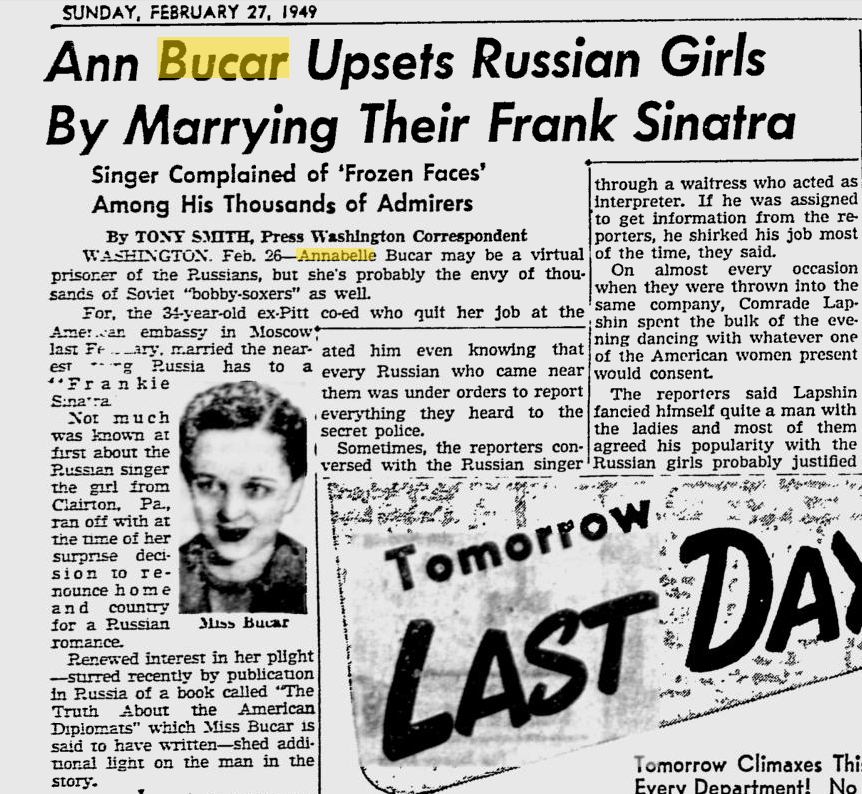
The Pittsburgh newspaper Pittsburgh Press wrote that Anne Bukar upset Russian girls - she married the Russian Frank Sinatra.
It is very likely that the MGB did not at all plan a legal marriage and the subsequent change of citizenship - it was much more profitable to recruit Annabell Bukar. It is true that her position at the embassy was small, but over time she could make a career. Soviet intelligence in such cases knew how to wait. It may well be that at first she did not realize that she was used for the purpose of espionage, and when she realized, she did not do without an internal struggle - it was not without reason that more than a year passed between the marriage and his publicity. Apparently, the counterintelligence officers managed to convince her that she, albeit ignorance or negligence, had already committed a betrayal of the United States, that in her homeland she was facing an inevitable long prison conclusion, and therefore, if not to be able to spy, she should remain in the USSR and make a secret obvious.
All these are just guesses, there are no exact information. It is also possible that Annabell Bukar ultimately acted in accordance with her beliefs. This is what she later wrote about the class abyss between her and other American diplomats:
Only when working in the State Department in Washington and the US Embassy in Moscow, I began to face young people, immigrants from wealthy families who grew up in an atmosphere of wealth and security and were as far from real life in America, like people with another planet. They belong to a completely different world than all of us, the rest, which make up the vast majority of the nation.
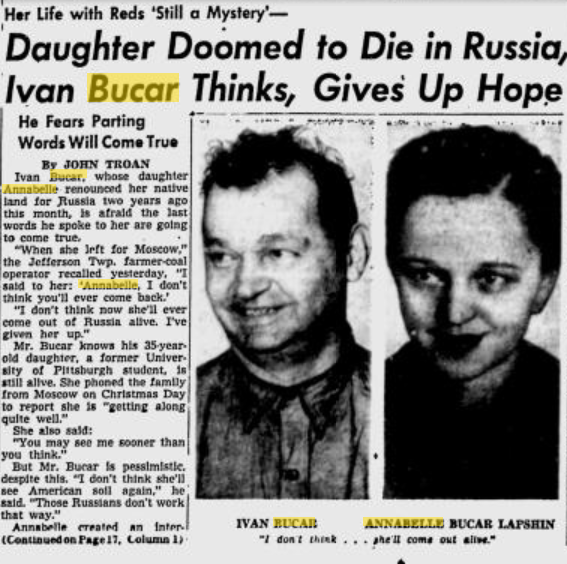
Annabella's father Iven Bukar reacted to his daughter’s act with gloomy irritation. He renounced her: “I will not let her return home and do not chill her with my daughter. I do not approve of its decision to become Russian and do not approve of Russia. ”
Annabell received Soviet citizenship. The newlyweds were given an apartment in the house on the embankment. Annabella began to work in the American edition of the Moscow Radio. Many regular listeners of the Voices of Russia remember her voice with a characteristic West Pensilland accent, reading the news report. In June 1948, the son of Misha was born at the Lapshins.
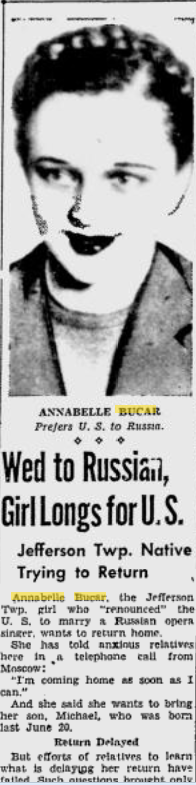
In January 1949, Pittsburgh Press reported that Annabell wants to return to America.
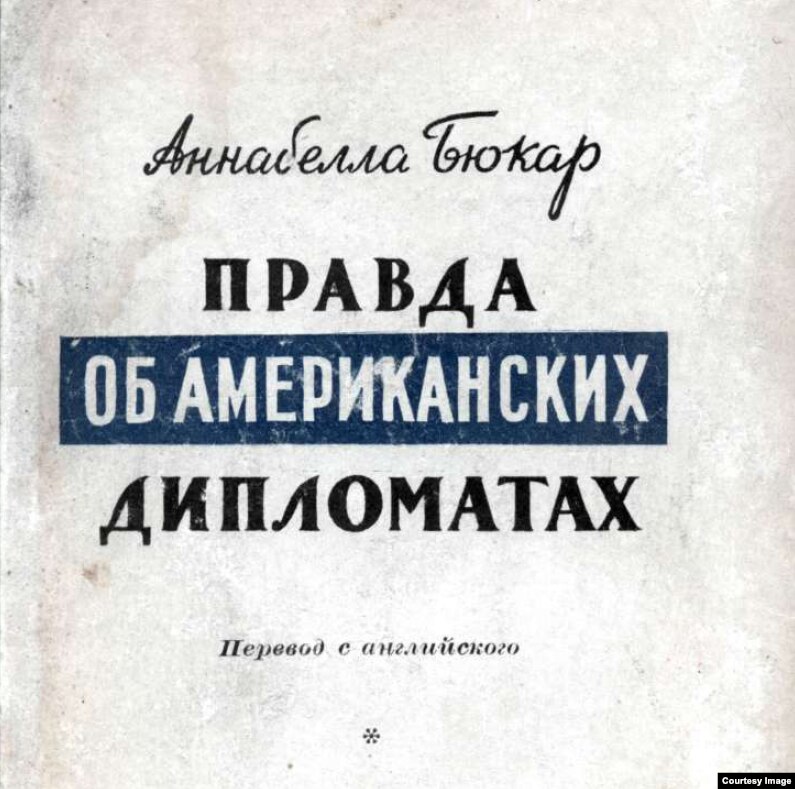
A year after her flight to the USSR, Annabell Bukar again fell into the news headlines: the Literary Gazeta publishing house was published by her book “Truth on American diplomats”. The first circulation of 10 thousand copies was sold so quickly that the employees of the American embassy did not have time to buy a single book. In December of the same 1949, the book was printed in a circulation of 300 thousand copies.
In the preface, the author denied that there was love with a motive that prompted her to change citizenship:
My enemies are looking for these reasons in my personal life, but this is completely inconsistent with reality. In fact, the reasons for these purely objective nature. I made my decision, making sure that the ruling now in the USA circles lead my homeland and with it the whole world to a terrible disaster.
Bukar told how, during her work in intelligence, her idealism came into conflict with the true goals of American politics. According to her, the United States never seriously struggled with Nazism:
I hate fascism with all the fibers of the soul, and it seemed to me that it was in intelligence that I would be able to fight against this plague best. Subsequently, I was convinced that, setting myself this noble task, I was at least naive. As you know, during the war, American intelligence did not conduct an effective struggle against fascism, and after the war it turned to complete cooperation with the former and current bodies of fascist intelligence and counterintelligence of Germany, Italy and Spain.
According to her, the leadership of American intelligence represented by General William Donovan perceived the anti -Hitler coalition with the Soviet Union as a temporary and forced measure:
During the war, Donovan and other leaders of American intelligence organizations considered allied relations with the USSR as a purely formal, forced and insincere phenomenon; They tried to play the difficulties and deprivations experienced by the Soviet people; They impatiently waited for the weakening of the USSR in the hope that after the war they would be able to put this great country on their knees. They suffered bitter disappointment.
The most gloomy colors she outlined the machinations of the “anti -Soviet clique” in the State Department, which refuels American foreign policy. Naturally, this click acts in the interests of Wall Street and its own benefit. At the Moscow Embassy, they established the “Inquisition Order”, the atmosphere of spying, fear and denunciation. Bukar from the words of his former colleagues talks about the “evil draws”, with which the “click” intimidated the newly -reached employees.
In his characteristics of the embassy “reactionaries”, Annabel Bukar is striking awareness of what they did in their former posts in other countries, as well as before her arrival in Moscow. It is clear that her modest position did not make it possible to get all this information, and then there was no Internet.
Almost all the key employees of the embassy, according to Bukar, are spies, “disguised as the diplomats” and nourishing “pathological hatred” for the Soviet Union. Moreover: their innermost dream is that the “current Government of the United States is replaced by an authoritarian anti -communist regime,” which would be clique to “uncontrollably pursue its policy”.
But that's not all. American diplomats in Moscow, according to Bukar, are speculators and scammers:
Almost every employee of the American embassy in Moscow, to one degree or another, is engaged in speculation either by illegal import of the Soviet currency, using diplomatic immunity, or by importing goods that are not taxed by duties: whiskey, cigarettes and others. They sell these goods with huge profit.
And finally, some diplomats differ in oddities in which it is easy to see sexual deviations:
So, at a costume evening, in the autumn of 1947, at the embassy, Durbrov appeared in a costume of a circus strong man - a champion in lifting weights - in a tight -fitting figure of a codes, painted along and across the corresponding inscriptions made by lipstick.
The American press retold Bukar's book without these yellowness details. The Ambassador of Beddel Smit said that the accusations of Bukar were deprived of any reason. Father Annabell said that he did not believe that his daughter wrote the book: "I think they used her name." Journalists accredited in Moscow reported that Annabell Lapshin was participating in propaganda for several days - he travels to factories and factories and tells the workers how happy they are because they do not live in the world of capital.
In February 1950, the Pittsburg Press on the occasion of the two -year anniversary of the escape printed a new interview with the relatives of Annabell.
And yet the family waited ...