
Translated material
Andrey Roiter: "I have never emigrated"
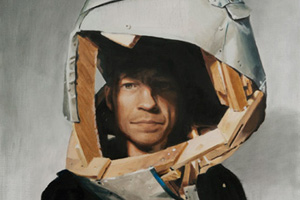
On November 27, the presentation of the Catalog of theOpen House exhibition Andrei Roter , the first such representative show of his work in Russia, which took place in the Moscow Museum of Modern Art (the curator of the exhibition - Irina Gorlova) took place. However, the catalog was not quite a catalog. Technically attached to the exhibition, he nevertheless talked more about the work of the Roter as a whole, and not about a specific exhibition.
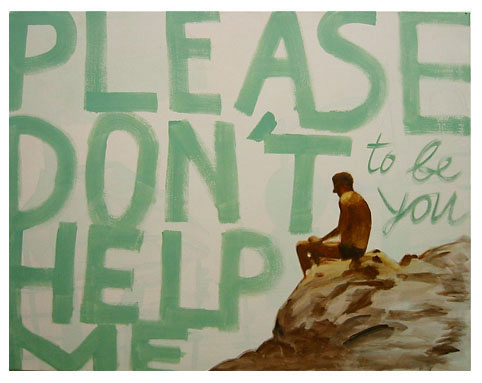 Andreiriter.com Andrey Roiter, “Please do not help me be you,” 2003
“Everyone praises, this is not quite what I expected,” the artist remarked a month ago at the opening of his exhibition at MMSI. He wanted to hear criticism, said that this is extremely important to him. His phrases were capacious, uttered with arrangement - exactly the same impression is created by his work. Not the most grateful thing is to use a comparison with speech, speaking of works of art, but we all do this from time to time - starting with the notorious "What did the author want to say?" (in one form or another) and ending with the “conversation O”. In the case of the Roter, these discursive metaphors are not so vicious, at least because his paintings and objects sometimes include texts.
Now another exhibition is taking place in the same MMSI, where there are many more words - "What did the artist want to say?" Yuri Albert (curator - Ekaterina Dygot). (I must say that Albert, as well as the Rooter living between Holland and the USA, is constantly moving in space - from Russia to Germany and vice versa.) The similarity ends, since the words play a different role in their activities. Albert's thought -out statements, the basis of most works. The phrases in his paintings are often signs of doubt, but this is a deceptive impression, there is no confusion in them, like Rotiere's. Andrei Roiter uses somewhere the scraps of thoughts that have seen from the conversations heard from the conversations. There are not so many of them, they are not so accidental, but their role should not be overestimated. The word nationality On one of the drawings to which the post-factor attributed the attractive pronoun My MY , indicates more confused-he wanted to say something about himself, began, hesitated.
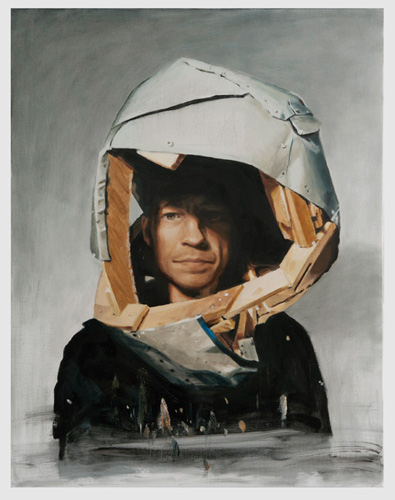 andreiriter.com Andrey Roiter, helmet, 2012
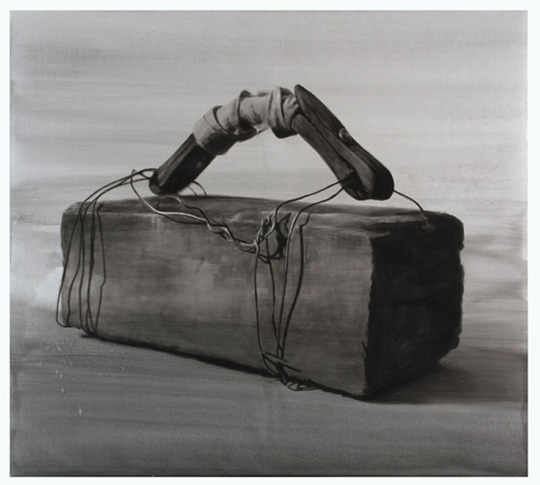
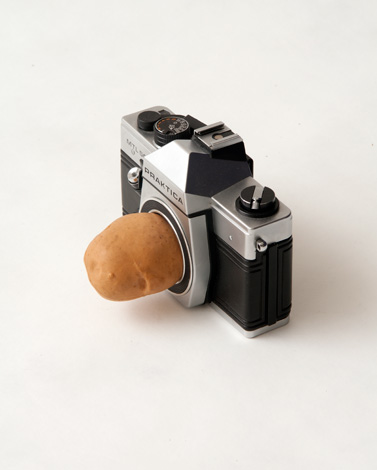
The artist Georgy Litichevsky wrote about Andrei Roiter that he “completely agrees with Dyushan, who defined the essence of artistic activity as collecting and at the same time (a kind of impending) added: what the artist is not able to get into the collection with his own hands.” Judging by the tangibly material images that Roiter puts in exhibition spaces, this is really collecting, but at the same time, as Litichevsky notes there, “the traveler's credo involves being light. And the collector is a spopy. Real collections do not fit in light baggage, in two or three suitcases. ” Perhaps that is why its suitcases - then holes, otherwise whole -frame; The cameras are turned into sculptures, as if they literally absorbed all the things that they shot on them. One of the cameras devours potatoes, and in the film camera there is a sudden apartment in several rooms.
This dialectic of gravity and ease is fundamental for Andrei Roter. He can literally abandon the attachment to the earth, refuting the law of universal gravity: in one of his videos, he rises from his chair and flies through the workshop. At the same time, his own body, especially his head, is capable of uncontrolled expansion and weighting - apparently, due to images, impressions, memories. Sometimes, special constructions are needed for this that expand this medium (head) important for the artist - because the human body itself is limited in resources and capabilities: that is why, as Marshall Mlyuen taught us, we have technologies that allow these weaknesses to get around. Such a materialization of “internal”, which seemed to be ethereal processes, which Litichevsky called “multiple imposition of psychology on optics” , Routor occurs entirely nearby. In this sense, this artist is, let’s say, a strong materialist that he cannot but rejoice in our overly spiritual time.
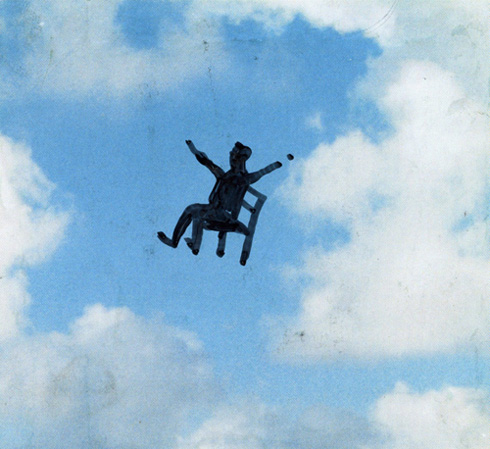 Andreiriter.com Andrey Roiter, without name, 2001
On the other hand, all these cameras and suitcases have long been closely related to consumerism, the consumption of things and images. Of course, the Roter’s work cannot be compared with the huge Louis Vuitton suitcase in the middle of Red Square , there is no scope and media hype. But the way he has chosen to talk about the materiality of the world, which rushes past the artist-traveler, is easily embedded in the flow of advertising products-you just need to add brands. However, in the same way, any other artist who is decided to fix the everyday life frozen in things. In conditions when any objects and especially their images are accumulated by the industry and sale of goods, this seems inevitable. However, Rooter on this subtle line - between the muttering of the “eternal” and the departure of the advertising industry - is still successfully balancing, moving from the exhibition to the exhibition, from city to city.
 andreiriter.com Andrey Roiter, Hand Man's Loach, 2010
***
Karina Tsurtsumiya talked with Andrei Roter.
- Why did you choose travel?
- Since childhood, I dreamed of traveling, I was very passionate about the idea of escape. When my life carried me abroad in 1989, I was not in the role of an emigrant, because I never emigrated and did not change citizenship, but as an endless traveler, and this became a topic for many of my works. We are talking not only about physical travel, but also about internal travel, when you begin to reflect on the topic of your past and future, to analyze the memory, so that my works are of poetic thoughts on the topic of endless journey.
 Andreiriter.com Andrey Roiter, “Potato Optics”, 2011. Courtesy of the Artist
- How much is the reflection on the theme of the Soviet past in the work of modern Russian artists?
- It depends on the age of the artist, and in each individual case the answer will be its own. The fact is that when I began to travel abroad, I was 29 years old. And if a person leaves at the age of 50, then, of course, he already has a different ratio with his past - he spent a different segment of life in a state of Soviet society. Therefore, the results are different: someone still reflects, such as Kabakov, on the topic of former Soviet life. For me, she was quite moved.
- And how are the domestic contemporary artists inscribed in the international artistic context?
-Some artists are inscribed quite successfully. The attitude to Russian art is now skeptical, although there is a lot of interest, curiosity for what is happening here. Interest in Russia will never disappear completely, but there are periods (for example, the period of perestroika), when the interest was very increased, even exceeded, and now it is reduced - this is due to political and economic processes, and with the fact that there are other active points in the world that people are interested in. Sometimes the problem is that the context of the Russian art scene has a specificity that is not read in the West, that is, there are references - linguistic, social, political. Or vice versa: when the artist addresses the already beaten, obvious post -Soviet poster iconography, they are triggered because the representations of Western audience are developed about what Russian art is. In my opinion, these works are not always successful, this is yesterday.
 Andreiriter.com Andrey Roiter, "Lie on the grass ...", 1998-1999
- You live in Europe and America. Are there any differences in artistic life in the West and in Russia?
- The differences are enormous. The differences between the American vision and the Russians, perhaps, are less than between European and Russian.
The fact is that in Russia and the Americans there are superpowers ambitions - this is manifested in the fact that people living in large territories feel like bosses. And there is naivety, unpleasant ambitiousness in this, but this is also similar between cultures. If we talk about Europe, which is territorially rather small and, like a layer pie, is filled with culture for many centuries, then the attitude to space, to nature, to a neighbor, ethical issues and elements of existence is completely different: there are few places, everyone lives very close to each other, and a completely different vision, attitude towards everything have been developed. When I come from New York to Europe, the difference is always obvious to me, even purely visually-people look different, dressed differently, others expressions are different. The difference is colossal. But if you come from Russia to America, then external parallels are a mass.
- Your early work is associated with the culture of squat. Is there an underground now in art?
- The underground always exists, but it is quite quickly eaten by the establishment and turns into a souvenir. However, people who are trying to be in marginal culture will always be present - both in art and in culture as a whole. I do not put them on some kind of podium, I do not think that this is the most important part of the culture, but in any rule there should be exceptions-this is a sign of a healthy culture.
 Andreiriter.com Andrey Roiter, "Information for Tourists", 1996
- The exhibition was attended by volumetric objects. In general, for Russian art, the theme of the object, things, like the topic of everyday life, are very important - it is enough to recall Ilya Kabakov and the problem of “bad thing”, “an unnecessary souvenir”. What is the function of a thing in your work?
-I consider myself to some extent the successor of the tradition of turning to a banal, recognizable, beaten thing-sign-whether it be a stool, glasses or a suitcase. I believe that in working with banality there is a certain difficulty, because they have already worked with this object many times, but there is always a chance to find an original, exceptional view of this thing - what Shklovsky called the “effect of excision” when the banality suddenly becomes interesting. This is not easy, but when the thing manages to revive in this way, it brings tremendous pleasure and a sense of euphoria. I would like to share this with the viewer, inspire him to see the world differently, violate the inertia of banal perception, which leads to boredom.
- To whom was your exhibition in Moscow addressed?
- Unknown viewer. I would like to meet a spectator whom I do not know, who, maybe, did not know and did not know about me. I am open to the new, I am interested in new territories. I approximately imagined how the people I know about this exhibition, but the new, young viewer is very interesting to me.
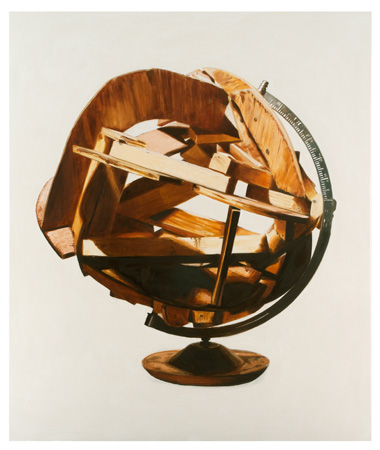 Andreiriter.com Andrey Roiter, Globus, 2011. Courtesy of the Artist