
Translated material
Alexander Terekhov says with Charles Levinsky
At the Non / Fiction Fair , a monumental Swiss program ended, in which there were readings, children's books, cinema and what was not there. We publish only a small part of the materials - evidence of what was happening there. We begin with the conversation of two literary luminaries - Alexander Terekhov and Charles Levinsky: about literature and much more.
Nadezhda Sikorskaya, editor-in-chief of the magazine and online publication "Our Gazeta": today we have two writers-Charles Levinsky and Alexander Terekhov, they read each other's books. I met them only today, and my first impression of both of them is modesty, that for writers the quality is rare. Charles Levinsky generally says that he is just such a home resident who dutifully fulfills all the instructions of the organizers of the exhibition. And Alexander Terekhov, having learned that Charles bought his book, said: “Why did you spend money? Let me return the money to you! ” Which, too, agree, you will not often hear from the writer. Therefore, it seems to me that these people had to meet. With great pleasure, I read the book of Charles Levinsky “Herron” and with no less pleasure - the review of Alexander Terekhov to this book. I absolutely agree with his analysis and with the feelings that this book caused him. We will talk about all this today.
Let us first give the floor to Alexander Terekhov, because it was he who, as part of the Snob project, was one of the first to read the translation made by Tatyana Nabatnikova. Maybe you will tell about him to those who have not yet had time to read the book.
Alexander Terekhov: As part of a wonderfulprogram arranged by Switzerland, Russian authors read books of Swiss authors. When I was asked what I want to read, I asked me to be sent a small story about love that a young girl with wide hips would write. A day later, they did everything - they sent me a novel on 782 pages, which is a human monologue in front of a gas chamber. I was very sad. But I must say that I really liked the novel. Usually, when you read books by responsibility, you are waiting for the moment when you can start it just turn over, obliquely. But this book made me read it from the beginning to the end, because the author is very unexpected and often cheating in the reader, forcing him to follow him. We recommend this book to read this book. A wonderful job that answers very important questions.
Russian writers are people of very different beliefs. But the idea to fly to Switzerland at someone else's expense will unite everyone absolutely!
What distinguishes real prose from fake? Real prose poses serious issues to the reader and solves them in a short way. In this sense, our guest, Charles Levinsky, is a wonderful writer, and his prose is a real prose. I also want to add that probably the book would not be so wonderful if it had not been translated by Tatyana Alekseevna Nabatnikova. I must say that when it comes to translations into other languages, the writer always has a dream for a woman to be a translator. And here is a wonderful woman, our guest was absolutely lucky, everything agreed in one.
So I warmly recommend this book! She made a deep impression on me. For me, the most important thing in this book was that a person burdened with culture very often misses the moment when it is necessary to save himself, it is necessary to kill someone for his salvation, and not so much passes this moment as he is not capable of this, and becomes a victim. I found this for myself in this book, you may find something else.
Here, in short, about this wonderful book!
Sikorskaya: Charles, you have not yet read Alexander’s critical article about your book, you just didn’t have time to translate it yet, but I think that you have already guessed from what you heard now that Sasha liked the book, so you can be completely calm. But you, knowing that he will write a review, hastened to buy a translation into the German language of his book “Rat”. Maybe you will say a few words about her?
Charles Levinsky: When I found out that my book would be translated in Russia and that the Russian writer would write a review of this book, I hoped that it would be a young, pretty blonde, but it turned out wrong. When I was looking for a book by Alexander Terekhov, I only found it in English and was surprised why it was still not transferred to German. As a rule, most translators are women, since they have more patience. And in order to translate such a big book as mine, you need a lot of patience. As a rule, close friendships are established between translators and authors, but we only met Tatyana. And I hope that we will translate five more books.
Sikorskaya: I hope so too. Speaking seriously, you both write on historical topics, both in the “Stone Bridge” and in “Herron” you took real stories about which there are different versions, and you gave your own. Why did you consider it necessary?
Terekhov: Prose, which is based on a really existing story, of course, makes a very difficult impression. I fought with myself, reading the novel "Herron", but still in the middle I climbed into Wikipedia to find out whether he was alive or not. I could not do anything with myself, I reproached myself that I had to wait for the final, but I did it anyway. And, of course, when you find a video in YouTube ... I will briefly tell the plot of the novel for those who have not read. This is a story about the director and actor Herron, who is located in the concentration camp, and he is offered to make a film to save the film about how well the Jews under Hitler in the ghetto lives. And in YouTube you can find an excerpt from this film, which was really shot, but not completely, and this makes a very difficult impression, because people look down at all frames, no one practically looks into the camera. That is, communication with real history is a mutually cruel thing, because you are not able to say little against the truth, but this truth also greatly changes your life, imposes a great responsibility on you. This is a very difficult thing, and few people take up this. Of course, it is very interesting to know how our guest decided to take up this topic.
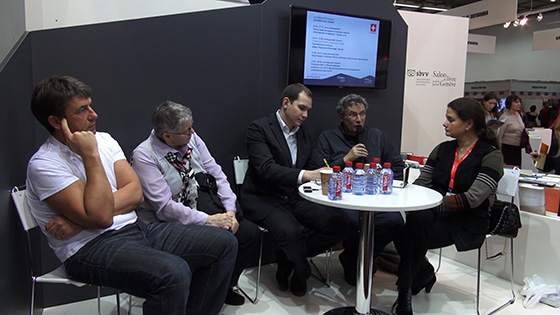 © colta.ru conversation Alexander Terekhov with Charles Levinsky at non/fictio No. 10
Sikorskaya: Why did you, Charles, really took up this topic?
Levinsky: When it comes to historical personalities, a lot is known about them - what songs they sang, what roles played. Much is known about their activities as public persons, but nothing is known about the personality, about a person. And when I wrote this novel, I tried to ensure that the public part of Herron's personality and private complement each other. It seems to me that it turned out here. Although Herron survived the tragic events, but in itself he was a cheerful and joyful person, and I wanted a trace of the joy of this person to remain in the book.
Sikorskaya: Alexander, did you feel this joy?
Terekhov: Yes, in contrast with the terrible world in which he lives, his vitality is clearly visible. It seems to me that we still have to ask our guest: what is the publishing fate of this novel in other countries? Is it published somewhere except Russia?
Sikorskaya: I read in French.
Levinski: The novel is quite new, and maybe it’s too early to talk about it, but it has already been translated into French, is translated into Dutch, Italian and Czech languages.
Sikorskaya: Before the meeting, we talked with Charles about whether the artist has a special role at the tragic moment of the history of the country's tragic moment. Charles believes that there is no, that, like any person, it does not depend on what kind of profession you have. But, as we know, in our recent history there were also tragic situations when people were faced with a choice, although perhaps not so literal - either you shoot the film, or go to Auschwitz tomorrow. But there was a risk to life. Alexander, what do you think about it?
Terekhov: Honestly, it also seems to me that in such tragic moments it is unlikely that creative people are capable of something ... After 10-20 years, they may not say something special, but not immediately. As Varlam Shalamov said, the camp experience does not give a person anything good, no benefit. And this book interested me because this topic is connected here with the life -lifting position of the author and the hero. Which decides, no matter what, to remain a person and a professional. In the end, when the hero made a choice - to shoot him this camp film or not, he decided to shoot only in order to once again be a filmmaker. It is most important for him to be at the height of the profession.
Switzerland is such a kingdom of naivety.
Sikorskaya: Alexander, and this was your first Swiss novel or have you already had some idea of the modern literature of Switzerland?
Terekhov: This was the first book that I read, but I honestly do not think that this is a novel by such a Swiss in the narrow sense, national. Still, this is a European novel. And I am still interested to know: is our guest for the first time in Russia? And what are his impressions about Russian people? People with evil eyes and thick noses?
Levinsky: I arrived yesterday, and I know that there is an airport in Russia, there is a railway, there is a radio station, there is a book fair and there is a hotel. I don't know anything more about Russia yet.
Sikorskaya: You said that you read a lot of Russian classical literature ... Do you think your expectations will be confirmed?
Levinsky: It seems to me that it is impossible to endure the experience of Russian classics to modernity. Because, I think, I will meet in Russia much fewer Oblomovs than the “rats”, about which Alexander wrote.
Sikorskaya: Do you have any questions to each other?
Terekhov: How do you assess the prospects of the Switzerland national team at the World Cup?
Levinski: The Swiss team will very proudly begin the performance and then immediately fly out. And what will happen to the Russian team, what do you think?
Terekhov: I think they will fly to Europe with one plane.
Sikorskaya: We are sitting here at the invitation of Snob magazine, which came up with this wonderful project - Russian writers write reviews of books by Swiss colleagues. Do you think that there will be its continuation in the opposite direction? And would you like to have such a continuation?
Levinsky: Critics have a drawback: they have to write too much to read books properly. It happens much less often that the authors evaluate their colleagues in the workshop. And I like it more when other authors are discussing me than critics.
Terekhov: As for whether there will be a response in Switzerland, I want to say that Russian writers are people of very different beliefs. But the idea to fly to Switzerland at someone else's expense will unite everyone absolutely!
Levinsky: There is another sentence: so that writers write reviews of their own books, and then we will be sure that the critic, the reviewer really read well, understood the book well.
Sikorskaya: More questions?
First viewer: I have a linguistic question. Swiss German - how much is it from the German language in Germany? And are there many German dialects in Switzerland?
Levinsky: We teach a literary German school, but no one speaks at home at home, everyone speaks in its dialect, and there are a lot of dialects in Switzerland. By the way a person speaks, you can determine the place where the person comes from, with an accuracy of 20-30 kilometers. Although it is 45 minutes from Zurich and Basel, there are completely different dialects, very different. However, in this novel I could not use the Swiss dialect in any way, because if you use it, then only Berlin, since Herron from Berlin. But when you write a novel about the Swiss family, of course, there will be a lot of Swiss dialectisms, and then the translators write very long I-miles and ask what I wrote there.
Second viewer: I would like to know: what percentage of your novel is based on actual data and how much did you think of? And what were your sources? These were libraries, some closed documents?
Levinsky: When you read this book, history and events that seem absolutely logical and correctly developing, most likely, invention. But if we are talking about the events of completely crazy, cruel and abnormal, it turns out to be true. About 40 percent of the book is based on real historical events. I must say that when the book came out, one elderly lady from Israel called me and said: “I knew Herron in Terezienstadt . How do you know that he was exactly what you described him? "
Sikorskaya: Alexander, your book "Germans" fell into the final of the contest "Big Book". Do you think it will come out in German?
Terekhov: One person wrote on Twitter what he saw in a bookstore in Israel a book called "Germans" and no one buys it.
Third viewer: I have a child’s question. Which of the Swiss writers are monuments in your country?
Levinsky: I must say that my country is not very distinguished by the desire to erect monuments to writers. More often, the monuments are erected by successful businessmen, industrialists. But there are, of course, several authors of the XIX century, who have monuments. This is Gottfried Keller, Jeremiah Gothelf, for example.
The fourth viewer: My friend Svetlana was this summer in Switzerland and showed me a photo of the house in which Lenin lived. And on the plate it is written: "The Fuhrer of the Russian Revolution." In the Russian mind, the Fuhrer is Hitler. Is there such a taste of negative significance in the Swiss language when they write the Fuhrer of the Russian Revolution Lenin?
Levinsky: In Germany, these connotations, associations, of course, would be, and no one would write that Lenin was a Fuhrer, would not use this word. And Switzerland is such a kingdom of naivety, and no one has posterior thoughts and even more so associations with Hitler.