
Translated material
Economist Andrei Blinov - About the EU and TS
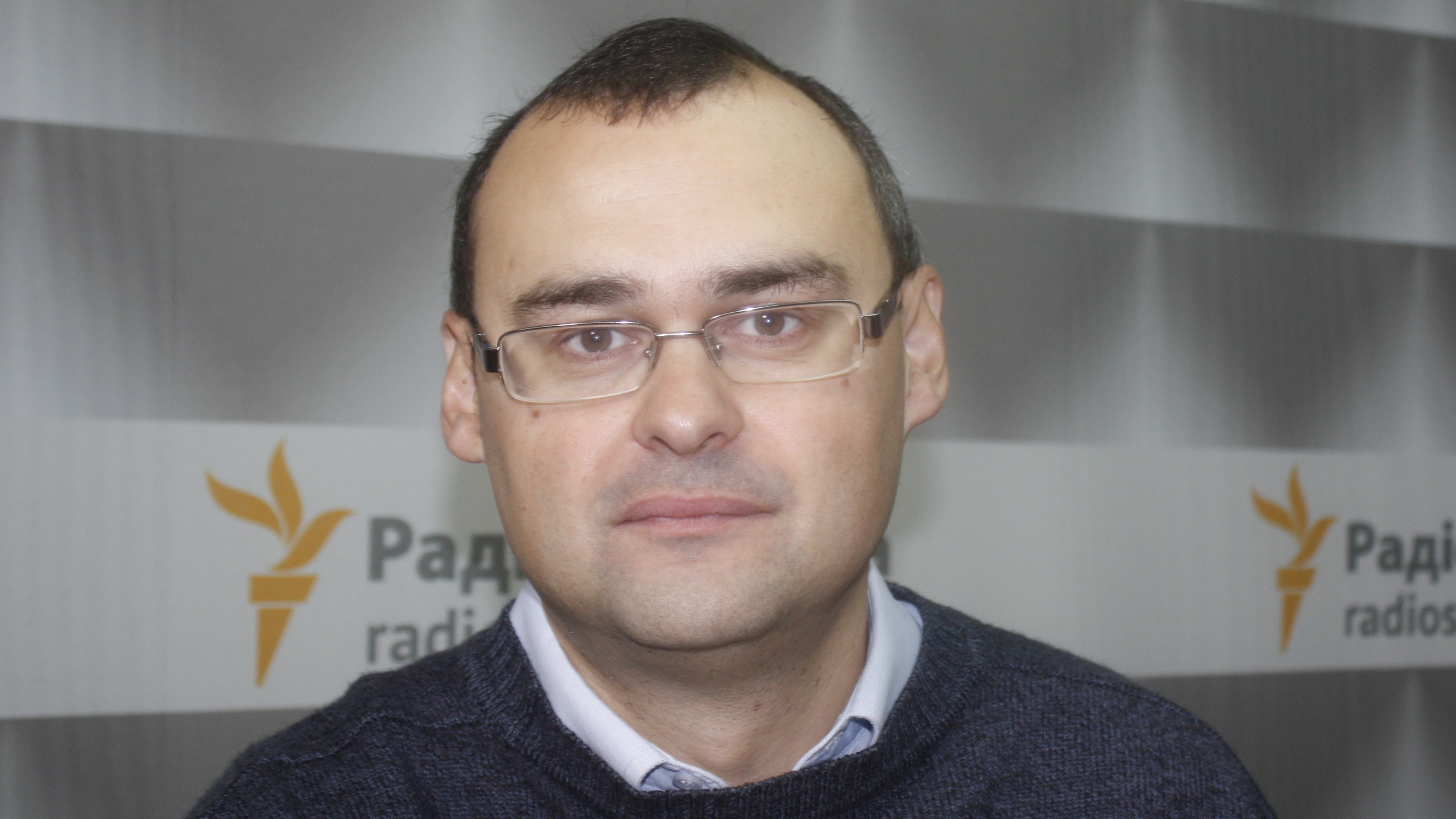
The Kiev economist, former editor-in-chief of the journal "Expert Ukraine" Andrei Blinov , answers Radio Liberty.
- Is it possible to consider the financial situation in Ukraine critical?
- In the short term, this is not the question. Ukraine has paid off almost the entire payment schedule for external debts of 2013. In 2013, we had a peak in external payments, more than $ 10 billion was paid, and the lion's share was the money of the International Monetary Fund, which, in fact, is associated with a significant reduction in the gold and foreign exchange reserves of the Central Bank. To say that Ukraine is now directly needed by money for the day after tomorrow or to close the financial year is not entirely true. Although the budget has some non-fulfillment, somewhere for 95-96 percent can be made by income, and, accordingly, it will be very difficult to finance expenses. Some social payments are held with delays; We are not talking about the most key payments like pensions, salaries to state employees or military, we are talking about various types of subsidies. For example, payments on the birth of a child may be delayed, payments for the maintenance of children may be delayed ...
- But the issue of external borrowings nevertheless is acute for Ukraine?
- Of course, because next year Ukraine needs to pay off about $ 6.5 billion, and again more than half of this amount is the IMF money.
- Is it true that Yanukovych went to China for money?
- Foreign visits of the leaders of states are often in essence of money for money. It is not necessary to lend or ask for alms. You can do it differently: get investments, get their money on a repayable basis. If in such a difficult situation the president decided to go to China, then it is completely clear that the conversation will be about a fairly large amount measured by billions of dollars.
- Today, the former Minister of Finance of Russia and the politician Alexei Kudrin, an analysis of the economic situation in Ukraine, published in the newspaper Kommersant to some liberalism and made conclusions disappointing for your country. He proposes to return to the idea of tripartite negotiations with Russia and the European Union and criticizes the Ukrainian government for the inconsistent of reform. Is this the right position?
- Despite the fact that Alexei Kudrin has long been not in power, it seems like in Russia a mildly opposition figure is considered in Russia, nevertheless he is a personal friend of President Putin, and, by and large, his assessment one way or another coincides with
To say that Ukraine is now directly needed by money for the day after tomorrow or to close the financial year is not entirely trueassessment of the official Kremlin. But the point here is not the assessment of the Kremlin and Kudrin. The situation in the Ukrainian economy is really worsening, and, I would say, it worsens rapidly. This is primarily due to loans, not with a payment schedule, and not even with the protests of the population. This is due to foreign trade. Ukraine is one of the most export-oriented or open economies in Europe. We have export is 50-60 percent of GDP. It is not only about grain, we are talking about machine -building products and a long list of other positions. The sweets and sweets, which are now talking a lot in Russia, in this list, in importance, only 11th place is occupied, more serious volumes of trade are hidden behind sweets.
And this is the main problem that the Ukrainian economy has encountered: we actually failed to get serious preferences from the European Union, but relations with Russia are greatly spoiled. Russia very clearly refers to agreements on the free trade zone of the CIS countries. And it is written there: it is impossible to have a parallel free trade zone with other partners who are not included in the CIS. There are also statements by the European Union that they also do not consider integration in both associations possible for Ukraine.
Ukraine sat on Tvpat. Ukrainian society expresses wide support for the idea of European integration. Partly, this support is so high because the pro -government media (and the government over the past year is very much through its pocket oligarchs, through the president’s family has entered the administration of many business media) actively promoted the advantages of paradise life in the European Union, including new members of the European Union. By and large, the government itself formed, as almost all economists say here, high expectations from the European Union. From the problems with unemployment, it was customary to dismiss problems with sales markets in recent months, referring to the fact that a person who speaks of such difficulties simply does not believe in the European idea and secretly wants to join the Customs Union.
- There is such a point of view that an association with the European Union - and this, as you know, is a huge document for almost a thousand pages - this is a death sentence for the Ukrainian economy. In particular, they indicate that if Ukraine tries to fulfill an enormous set of EU requirements for standardization and general bringing its economy in line with the laws of the European Union, then it will immediately go bankrupt. Is it really so?
- You see, neither Russia nor Ukraine can oppose the idea of modernizing its national economies. The problem is that in both countries, by and large, a rather large fragment of the Soviet economy has been preserved. For example, for some reason, we continue to consume three times more conditioned fuel per unit of gross product than this happens in countries-members of the European Union. This also applies to Russia, just in Russia, due to the great wealth of hydrocarbons, this process proceeds much less painfully. Nevertheless, we perfectly see how large corporations, primarily in the same Russia, invest a lot of money in energy efficiency. The question is to save on scale and, roughly speaking, the unit of manufactured products was in price and quality competitive with world analogues.
Our economies opened the world twenty years ago. There are transitional periods, and all, of course, are scared by transitions to the standards of the European Union. However
Both in Russia and Ukraine, by and large, a fairly large fragment of the Soviet economy has been preservedMany large enterprises are already working according to the European standard, many European standards have been introduced in Ukraine, as in Russia. Therefore, there are no big problems here. Another thing is that I doubt very much of the expediency for Ukraine of monointegration with Europe. Because if we develop trade relations only with Europe and at the same time we turn off the CIS countries, then we lose entire sectors of the economy. The European Union markets, for example, are needed annually less than 4 thousand railway wagons, and we have one of the Dnipropetrovsk enterprises for the Russian and Kazakhstan markets 6.5 thousand such wagons. Even now, in the conditions of a decline in production! And there are three more of such cars in Ukraine, powerful, and there are about a dozen of them. Where to supply their products to these enterprises if the eastern market is closed? It is clear that such enterprises will die.
And not only in car construction - both manufacturers of helicopter and aircraft engines, and manufacturers of various navigation equipment and equipment for the aerospace industry. Russia, making possible decisions on the introduction of trade sanctions against Ukraine, will make an exception for these enterprises, very strictly accepting parallel programs for the highest possible transfer of the capacities of such plants to its territory. Such a scenario, as far as I know, exists in the Russian leadership, and, by and large, this may have become one of the key arguments why Viktor Yanukovych still did not dare to sign the association with the European Union.
- It turns out that we are talking about the famous nightmare of reformers: radical reforms are associated with large social costs. But still, the problem of strategic choice sooner or later should be done. So how should it be done?
- Formally, we have an economic presidential reform program, which was adopted for 5 years of its mandate. By the way, the program is strong, surprisingly specific, with the criteria for achieving results and so on. There, in particular, many issues related to the debit of the Ukrainian economy, with a decrease in taxes, an increase in the efficiency of the collection of these taxes, control over their expenditure, and so on are spelled out. Another thing is that on all these issues, the Ukrainian government does little. Moreover, we continue very active relations with offshores, we strangely have the concentration of capital around the president’s family. The business and other press are trying to deal with these problems, for anything it is mercilessly pressed, or is simply bought up by the defendants of these very stories. By and large, in the dialogue about the Customs Union and the European Union, the question of traditional, not even radical, but normal economic reforms is completely shut. And they, by and large, are not held.
The choice in front of the country is as follows. There is a significant part of the population of Ukraine (these are mainly residents of the central and western regions), which advocates the European Union for two reasons. The European Union is an ambulance of visas, as for Moldova, these are expectations of a significant increase in the level of wages and social assistance, at least to the level accepted by the Eastern EU members. Another position is an unconditional entry into the Customs Union, the readiness of joining the Eurasian Union since 2015. That is, roughly speaking, the most close integration with Moscow, a kind of economic reintegration of the Soviet Union, its main units. The third position is an attempt to harmonize two
Ukraine must offer its partners clear guarantees that it will not manipulate "with the country of origin of the goods"Free trade zones. It just seems correct to me that such a statement of the question. Ukraine has a variety of nomenclature of export products, we have goods that can go well (for example, grain) to the Middle Eastern or European market, to the North African market, by the way, working largely from the patterns of the European Union, since there are many associative members of the European Union. On the other hand, there are the same machine -building products that, by anywhere in the former Soviet market,, by and large, is not in demand - not even because of its quality, but because of the standards and traditions. I believe that these two vectors can be harmonized, because there is no direct ban on working in two free trade zones. Ukraine should offer its partners clear guarantees that it will not manipulate "with the country of origin of the goods." Putin's “horror story” is clear: he does not want to receive duty -free European goods in the Russian market under the guise of Ukrainian.
- And is he right?
- Yes, in this he is absolutely right, this is normal protectionism, no matter how to relate to him. It was no coincidence that Russia was negotiating for the entry into the WTO for 18 years, defending fairly high duties. The same Ukraine joined the WTO on a milder conditions. So, Ukraine needs to choose a strategic vector. If the situation in Kyiv changes radically, then, perhaps, Ukraine will decide to negotiate with one of the two main partners without any particular assumptions. This is possible. But, frankly, this will not correspond to the national interests of Ukraine. When the political situation calms down, we will again return to the dialogue that we must simultaneously build a limited free trade zones with the West and the East, ”said Ukrainian economist Andrei Blinov.
Fragment of the final issue of the Freedom Time program
-

Andrey Shary
I.O. Regional Director of Radio Free Europe/Radio Liberty for Russian -Sound Content
Andrey Shary on Facebook
Sharya@rferl.org