
Translated material
Rent for rent
Why Ukraine is disappointed in the president
** How Yanukovych and his team stuck hope ** podpiska.newtimes.ru 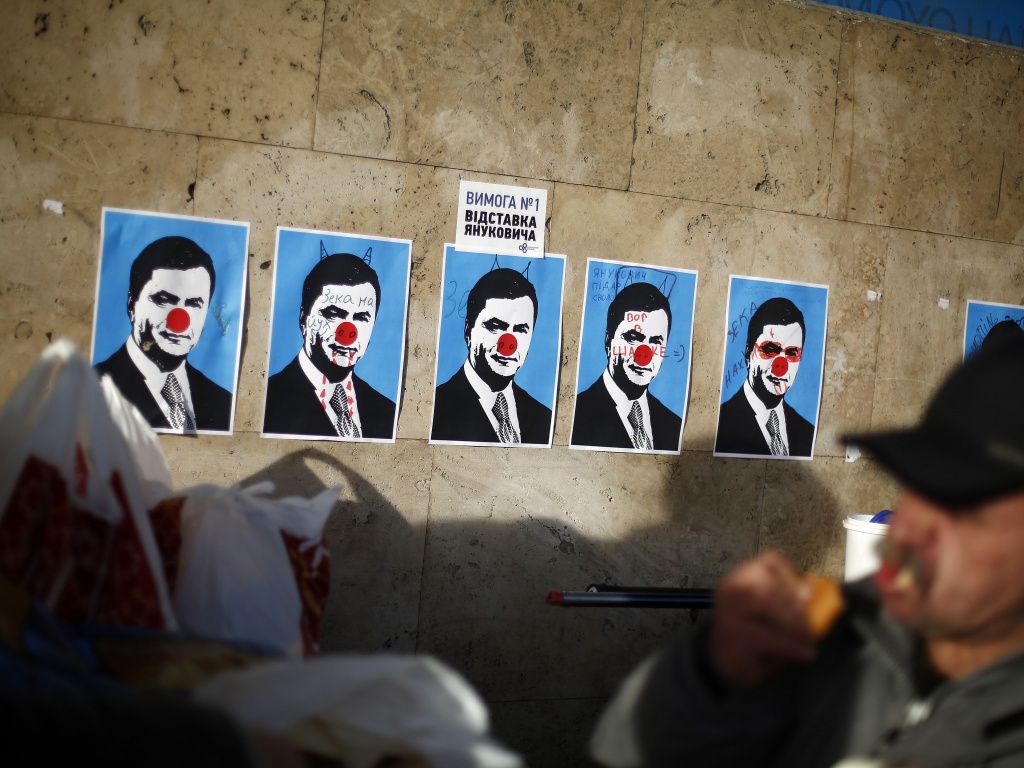
In the fall of 2010, the owner of the largest UMH Publishing House in Ukraine Boris Lozhkin explained to the author why - with all his innate shortcomings - the team of President Viktor Yanukovych is vital in the economic success of the country. Unlike Putin, the publisher explained, Yanukovych cannot count on oil and gas rent, so he will have to seriously carry out reforms. Another, the opportunity to return to the rapid growth trajectory-and the “Great Recession” of 2008-2009 turned into a 14.5% fall for Ukraine-simply does not exist.
These arguments sounded convincing. In the summer of 2010, the recently formed Government Yanukovych announced a large-scale reform program and signed the Stand By agreement with the International Monetary Fund (IMF), which provided for the allocation of $ 16 billion to Ukraine. Having drove Yulia Tymoshenko in the presidential election, Ukrainians showed to strictly ask the authorities for failures in the economy. A sound economic policy that provides good growth rate - this was the recipe for a successful first period of President Yanukovych.
But those who thought that Yanukovych would be guided by sound logic were mistaken. Rent, which allowed the regime to count on irremovability, was found.
Stationary bandits
In the first two years of Yanukovych’s presidency, the Ukrainian economy grew by 9.5 %. As it turned out, this was just a restorative growth after a deep crisis, which almost turned up in 2009 by the collapse of the banking system.
The investment attractiveness index, calculated by European business association, testified: serious problems are hiding behind the optimistic figures of the State Statistics Committee. In the fourth quarter of 2011, the index set the anti -record, falling to the mark 2.19 (for comparison: at the end of 2008 - early 2009, when the economy was in full swing, the value of this index was 2.21).
What went wrong in the first 500 days of Yanukovych?
A blow to the entrepreneurial climate was delivered on three sides.
In the fall of 2010, the Government curled up cooperation with the IMF. The stumbling block was the requirement of the fund to increase gas prices for the population. Subsequently, the contradictions of official Kyiv with the IMF only aggravated. The government resumed the inflating of state expenses and the breast became to protect the strict binding of the hryvnias to the dollar. An irresponsible macroeconomic policy has led to the unbalancing of the budget (the deficit in 2013 can reach 6% of GDP) and a significant deterioration in trade conditions (7.3% of GDP accounts for current operations).
Another blow to the investment climate was inflicted by corrupt groups of interests. The economic history of Ukraine will forever include scandals around the Lyvela importer close to the Party of Regions and the so -called Boyko Haniles. Livela managed to save 3 billion hryvnias ($ 375 million) with impunity on taxes and excise taxes in August-November 2010. The scam, named after the unstoppable Minister of Energy (in the current office, Yuri Boyko holds the post of deputy prime minister and is responsible for gas negotiations with Russia), was primitive: in 2010-2011, the Chernomorneftegaz state acquired two drilling platforms from intermediaries for $ 360 million cheaper. The final beneficiaries of both scams were never named.
But the most unpleasant events took place at the microeconomic level. In full swing was the redistribution of property. “Business under the blow,” the cover of Ukrainian Forbes for December 2011 reads. - The security forces push entrepreneurs into an arms "solved". Units dare to accept the battle. ”
"
Dmitro-GNAP-journalist assessment of the amount of Yanukovych looted by Yanukovych at $ 6.25 billion
"
The symbol of this period was the People’s Deputy from the Party of Regions Yuri Ivanyushchenko, about whom the author’s interlocutors in Kyiv and Moscow preferred to talk, lowering their voice. A fellow countryman and an old friend of the president were considered a “watching”, delivered by a new government in the south of the country. Ivanyushchenko, also known under the nickname “Yura Enakievsky”, ardently denied his involvement in the redistribution, but evidence of a few daredevils who decided to openly fight the authoritative-slic vertical, left no doubt: the average business encountered unprecedented pressure of tax authorities, police and prosecutors. The standard solution to the problem was the assignment of half the business in favor of authoritative people “in expensive costumes” (quote from the Forbes article).
And what about the oligarchs? Why did they put up with a deterioration in the business climate, which was beating on capitalization and their companies?
One oligarchs-and they include the richest Ukrainian Rinat Akhmetov (in addition to assets in metallurgy, energy and a dozen more industries, controls the Ukraine TV channel), Viktor Pinchuk (group of Starlightmedia television channels), Igor Kolomoisky (1+1 channel), Petro Poroshenko (5th channel) and the channel) and the channel) Dmitry Firtash (Inter) - it was a sin to complain: during the privatization, to which serious competitors were not allowed, Akhmetov was able to significantly increase their energy assets, and the group of Firtash formalized its control over the production of titanium and regional gas distribution networks. Pinchuk was not protesting with his hand: the son-in-law of the second Ukrainian president Leonid Kuchma, he himself did not disdain the administrative resource when creating his empire in the early 2000s.
Well, Poroshenko, one of the leaders of the current protests, demonstrated faith in the final triumph of the sound forces and in the spring of 2012 for a short time even became the Minister of Economics - they say, for the good of the country, even a reputation can be put on a context. Under him, Ukraine has para) Association with the European Union - the most ambitious in the history of the EU.
Paternalism for their own
In the winter of 2012, healthy forces seemed to prevail. They talked about redistribution of property. Ivanyushchenko fell out of Tabor. But in the vocabulary of observers a new word "family" appeared.
The elevation of a group of Donetsk businessmen and administrators began back in 2010. At the end of 2010, 34-year-old Sergey Arbuzov became the head of the National Bank of Ukraine. His knowledge in the economy and the theory of finance were more than modest (which was confirmed by his activity as the head of the Central Bank), but he was part of the near circle of the eldest son of President Alexander Yanukovych, who belonged to the latter, the All -Ukrainian Development Bank is headed by Arbuzov’s mother. At the end of 2011, the 30-year-old Donetsk, Alexander Klimenko, stood at the head of the tax service, and the Ministry of the Interior was headed by another native of Donbass Victor Zakharchenko.
The new economic policy coincided with the completion of the next political cycle: in the fall of 2012, elections to the Verkhovna Rada were scheduled. For the sake of the victory of the “regionals”, the government controlled by them relied on the growth of socialities and the tightening of nuts in the foreign exchange market. The budget deficit increased in 2012 from 2.8% to 4.5%, and a super -fierce monetary policy, aimed not to prevent the weakening of hryvnia, entailed a stop of lending and, as a result, a decline in the economy, which began in the third quarter of 2012 and continues to this day.
The “family” management of the economy led to which we started the conversation: the state budget became the main source of rent for the ruling group. Its expenses increased in 2012 to 49% of GDP (for comparison: in much more prosperous Russia, the government departments were equal to 37% of GDP). Machinations with public procurement, “Gosporta meter” during imports, centralized cashing operations - this is a gentleman's set of businessmen of a new wave.
The dentist by education, Alexander Yanukovych discovered the talents of the developer and carpeter. In November 2013, Forbes Ukraine estimated his fortune at $ 0.5 billion. The main brother of the chief tax authority Anton Klimenko turned out to be a successful financier: the Unison Group banking and insurance quickly overgrown with enviable clients from the number of oligarchs. But the most striking representative of the Mlado-Business Colations was 27-year-old Kharkov, Sergey Kurchenko, who is based on the state of the Forbes last year’s investigation, suspicious operations with liquefied gas and oil products. The other day, the correspondent magazine, owned by Kurchenko, estimated his fortune at $ 2.4 billion.
The fee for the “opening” of the presidential “family” of its rent was a catastrophic deterioration in the entrepreneurial climate and a protracted decline. Today, the most formidable for the regime is not even the Maidan, according to which, replacing each other, several thousand angry citizens run. The country celebrates the New Year without a budget, the Central Bank limits the operations with the currency, and bankers with horror recall the autumn-winter 2004, when the political conflict has almost ruined the banking system.
Who
A return to the status quo, which existed before the breakdown of European integration, is now impossible. The oligarchs, with silent indignation, leaving the “family”, already said their word: after the bloody night dispersal of protesters on the Maidan, the main television channels distanced from the government and show a more or less objective “picture” from the scene. The patience of the oligarchs was running out before the beginning of the Euromaidan. One of the Ukrainian billionaires in a conversation with the author once said that for the ugliness that “family” created, an electric chair is entitled in normal countries.
Multi -hundredth protests removed the taboo from many “dirty secrets” of the Ukrainian political economy. The journalist of Dmitro GNAP estimates the amount of Yanukovych looted by Yanukovych’s entourage at $ 6.25 billion. It will be very difficult for opposition politicians to explain the rebellious people to refuse to investigate the economic crimes of the regime. The political dialogue between power and the opposition promises to be very sharp.
How much does Ukraine need for happiness?
$ 160 billion - before the summit in Vilnius and Euromaidan, $ 3-5 billion - now
Until the Vilnius summit, the main argument of Kyiv against European integration was the EU unwillingness to allocate $ 160 billion, allegedly necessary for switching to European standards. Why so much - neither Yanukovych nor the Prime Minister Azarov explained. Their arguments came down to the fact that Ukraine is a “very serious country” and would not allow itself to behave with it, as with a frivolous one, promising some miserable € 610 million a year.
The “secret of the digit” undertook to reveal the director of the Institute for Research and Forecasting (IIP) of the National Academy of Sciences of Ukraine Valery Ghets, who has a reputation as a decisive supporter of the movement of Ukraine towards the Customs Union. Before the turn of the Ukrainian leadership towards the Kremlin, he was kept in the shade. But as soon as Yanukovych - Azarov canceled the signing of an agreement with the EU, the GETA immediately spoke.
As it turned out, scientists from his institute went to the indicated amount, at first adding all the costs of these purposes of Poland, the Czech Republic, Slovakia and Hungary, then dividing them by the average population for 1991-2013, and then multiplying the resulting figure by 45.5 million Ukrainians and another 1.5 coefficient (by 50%). The experts of the IPP explain the latest action by the “structural factor - the state of social infrastructure, the wear of fixed assets of Ukraine in comparison with the studied countries of Europe.” In Poland, says the GETS, the largest of these countries in terms of population, during the Association with the EU € 3.56 billion, it was required to restructure the economy, 1.4 billion - for structural reforms and 700 million - for the program for entering agrarian and rural development. And already during the period of membership, the costs of agriculture, according to a gyer, amounted to € 8 billion, 1.6 billion for the food industry, the modernization of transport infrastructure - 34.3 billion, in the field of environmental protection - 33 billion and in the field of justice and internal affairs - 391 million ...
As it is easy to notice, the lion's share of the amount voiced by the gyez came to protect the environment - that is, as many independent experts believe, on the most “suction” part ...
And on December 2, at the peak of mass protests in Ukraine, the First Deputy Prime Minister of Ukraine Sergey Arbuzov on the air of the ICTV television channel states that the previous calculations ($ 160 billion), it turns out, is “theoretical”: “We are talking about the re-equipment of jobs in Ukraine for the next ten years, that is, this is a pure theory. In September, I presented the calculations, 3-5 billion was enough for us - this is the amount that would allow us to launch the processes of modernization and start working. ”
In the resumption of negotiations by agreement, Brussels refused to Kyiv. Conclusion: it was necessary to count properly from the very beginning ...
podpiska.newtimes.ru
Photo: Reuters/Stoyan Nenov