
Translated material
A trap for the president
Is there a way out of the Ukrainian crisis? Round table in Harvard
For many, Kyiv’s decision to refuse to sign an association agreement and free trade with the European Union has become a big surprise. But, as Professor Margarita Balmaseda from Setton Hall University noted, Kyiv was by no means the first time to backward in the issue of agreement with the EU, which Russia does not like so much.
Viktor Yanukovych himself justifies his decision with economic pressure from Russia and the stinginess of the promises of Europeans. But what are the real reasons for refusing European integration?
podpiska.newtimes.ru
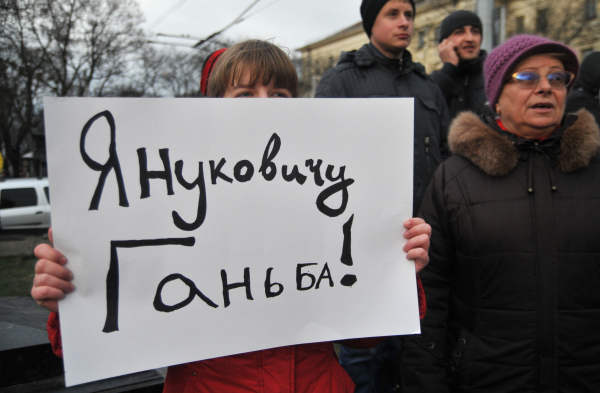
Girl with the poster "Shame Yanukovych" at a rally of supporters of European integration, area near the monument to Taras Shevchenko in Lviv on November 30, 2013
The premises of the crisis
Yanukovych could not allow Yulia Tymoshenko, to his largest political enemy, in prison, to go abroad to be treated. This requirement was one of the main EU. Nevertheless, having heard (a few days before the Vilnius summit) on the refusal of Ukraine to sign an agreement with Brussels, the Europeans softened the position, agreeing to sign the document regardless of how Tymoshenko’s fate formed.
At the last moment, Yanukovych demanded $ 160 billion from the EU - as financial assistance. These billions are not just an unjustifiable amount. They became a big surprise for Brussels, because negotiations about the association have been going on for several years, and as officials say in Brussels, there was no talk about such money.
Finally, when Kiev made a decision on the abandonment of European integration, political pressure on Ukraine from Russia, as well as the Moscow Trade War, which hit Ukrainian imports, played a role. Nevertheless, it is difficult to give an unambiguous answer to the question of how significant the Russian factor was in this dossier.
According to Professor Harvard University Timothy Kolton, Russia missed the opportunity to establish relations with Yanukovych in 2010: then, despite the refusal of Ukraine to join NATO and the consent of Kyiv to extend the terms of lease of the Black Sea Fleet, Moscow refused to make concessions on the issue of gas price. At the same time, unlike the Yeltsin period, the Putin policy in the Ukrainian direction is made behind closed doors. Relations of Ukraine and Russia became even less transparent than the relations of Russia and the USA. Now all decisions in Ukraine are the prerogative of Vladimir Putin personally. An analysis of what they are actually motivated is not easy. But it is known for sure: on the question of whether the efforts to retain Ukraine in the Russian sphere of influence are justified, there is no consensus among Putin advisers. (“Ukrainophiles” are usually guided by ideological and cultural motives, their opponents come from economic considerations.) However, this does not mean that Putin does not have their own views on politics against Ukraine. They are. According to Kolton, after 2010, Putin decided that any economic transactions with Kiev should be concluded as part of the Customs Union created in 2009. Today the TS is the Central Putin idea. He who convinced the president of her priority is incomprehensible, but most likely (Vice Prime Minister) Dmitry Rogozin, or (economic adviser to the president) Sergey Glazyev, (the VPK-Building VPK).
Putin did not receive what he wanted: Yanukovych did not promise him to enter Ukraine into the TS and still talks about the prospects for signing an agreement with the EU. However, in the light of the latest events in Kyiv, the possibility of Ukraine’s entry into the TS is preserved.
"
Is there a way out of the Ukrainian crisis - the reply was looking for the participants of the round table in Harvard University (USA)
"
It is likely that during the secret negotiations between Putin and Yanukovych on the eve of the decision to suspend European integration, the Russian president made a generous proposal that meets the economic interests of the “family” (persons related to Yanukovych personal and business bonds) and the pro -Russian lobby within the Party of Regions. As a result, this coalition outweighed the pro -European part of the Yanukovych party.
Kyiv made an application for the rejection of European integration on November 21. On the same day, mass protests began on the streets of the capital and West Ukrainian cities. However, their goals changed dramatically after at 4 o’clock in the morning of November 30 the police stiffly dispersed hundreds of young protesters who spent the night on the Maidan. The requirements of protesters were radicalized. On the Maidan, the cries of “Revolution!” Were heard.
On December 3, nine people from among those who allegedly arranged riots at the building of the presidential administration (December 1) appeared before the court in Kyiv. What kind of people participated in the attacks on the police (on Bankova Street) is still unclear. Most likely, we are talking about nationalist extremists and other radicals. However, random passers -by, which the police were roughly beaten, appeared before the “justice”. The detainees were refused the opportunity to talk with relatives and lawyers, and on December 5 they were sentenced to two months of arrest. If they are found guilty of calls for riots, then they face five to eight years in prison.
Crisis
The whole system of power, starting with Yanukovych himself, behaves as if nothing extraordinary is happening. Like, violence by the police will be investigated and cases will be transferred to the court, and work on an agreement with the EU will continue: as soon as we find a consensus under the terms of signing, we will sign it right away.
Nevertheless, some participants in the round table were of the opinion that such a denouement of the crisis-with a gradual giving protest, is impossible: the protesters do not agree to leave the streets and put up with the preservation of the status quo. Yes, Yanukovych could push the development of events according to such a scenario, donating several iconic figures in his environment, for example, the head of the Ministry of Internal Affairs of Zakharchenko or even Prime Minister Azarov himself. But none of the officials, not counting the retired head of the Kyiv police, was dismissed. Not a single investigation has begun on the facts of a police violence. Yanukovych and Azarov deny their involvement in the acceleration of the Maidan and do not recognize their responsibility for this.
According to many participants in the round table, the best and most peaceful decision would be the transition of a certain number of deputies from the Party of Regions (PR) to the side of the opposition in order to form the parliamentary majority, which could be resigned. PR as a party is ideologically very amorphous, it is based on regional identity and belonging to oligarchic clans, many of which are unfriendly to each other. Indeed, after some deputies from the PROSED to the side of the opposition after the brutal beating of the students, such a script seemed likely.
However, the vote in the Rada on December 3 on the issue of trust in the government failed by crossing out this script.
Decisions and threats
It seems that Ukraine has embarked on the path of a long and dangerous confrontation between the Maidan and the authorities. This situation can drag out not just for weeks - for months. And perhaps even - until the most presidential elections in 2015. And if by that time the crisis is not resolved, in 2015 we can expect serious mobilization against Yanukovych.
Since the authorities did not demonstrate the desire to compromise with the opposition, a violent finale cannot be excluded. Yanukovych can disperse the Maidan by force, but it will be an illusory victory that will lead to the international isolation of its administration and mass protests in the capital and other parts of the country.
Will Yanukovych go to use violence? Will his orders be executed? And will he be able to remain the president of the country if blood flows on his orders?
The best way out of the crisis for Ukraine would be constitutional reform and the transition to the parliamentary and president model: Yanukovych remains at the post until 2015, but with a smaller volume of authority. In 2004, it was such a constitutional decision that led to the resolution of the political crisis and the end of the “Orange Revolution”. A return to the parliamentary and presidential republic, canceled by the 2010 Constitution, could have arranged all the parties-except the one that was not used to share power. Yanukovych canceled the 2004 constitutional reform just in order to increase the amount of his authority as the president. And since he is thinking about the second period, he cannot be interested in limiting his power.
In addition, in order to carry out constitutional reform, the consent of 2/3 of the deputies is necessary or the creation of a special body - the constitutional assembly (if the Rada does not prevent this). Today it seems unlikely: PR and officials continue to support Yanukovych.
However, a lot can still change, and in the very near future. The ruling class can turn away from the president for the sake of constitutional reform. And paradoxically, it is the desire of Yanukovych to maintain power that can come out sideways to him.
Photo: Pavel Palamarchuk, RIA News
podpiska.newtimes.ru