
Translated material
Live "Travial
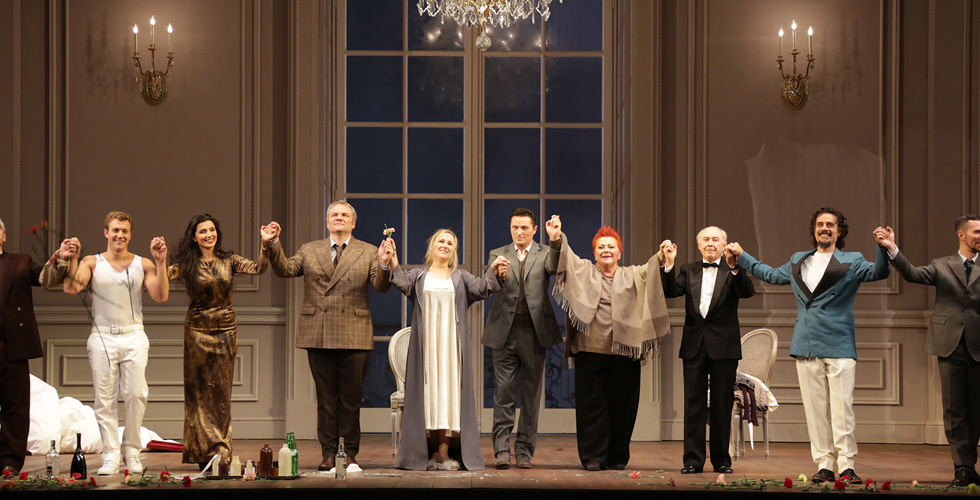
Last Saturday, the legendary La Scala Theater opened its new season - this is a significant event in the European cultural life according to the long tradition, on December 7, on the day of the patron of Milan, St. Ambrose. Dmitry Chernyakov, the director of the new “Traviata”, the most responsible performance of the anniversary Verdievsky year. Thanks to the broadcast of the Culture TV channel, the prime minister of the new production of the main opera director of Russia was able to see everyone who has a TV. Among them were Ekaterina Biryukova and Dmitry Renansky.
Ekaterina Biryukova: whatever one may say, you need to start with the audience “BU”, which ended the premiere. As I understand it, the audience of the Culture TV channel first heard the shaking, well -organized Italian “BU” live and not the fact that I understood it correctly. My mother, for example, considered that it is so customary to express approval with them. So it must be explained that this is such a special day, December 7, the opening of the season, actually a national holiday, Premier Klaka, a conservative electorate, increased xenophobic sentiments. The very combination - “Traviata”, Milan, the year of Verdi, Chernyakov - this, one might say, is planned “BU”, some black PR, without it, there is no real directorial success now (and rumors about the lines of opera theaters and new contracts that were lined up for Chernyakov have already reached out). This "boa" will remain in history. Although anyway, of course, the exit to the stage for it is like a scaffold. And there Peter stared, a Pole, a stranger, a tenor who was perfectly sang alfred and frozen, was already offended and wrote in his FB that he would now only go to Italy.
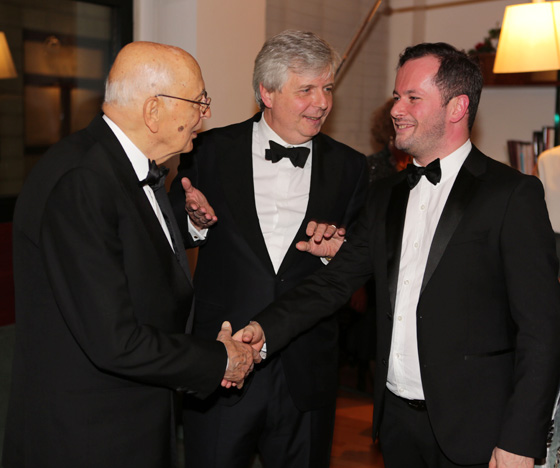 © Brescia / Amisano / Teatro Alla Scala Georgio Napolitano (11th President of the Italian Republic), Stefan Lissner (Theater of theater La Scala) and Dmitry Chernyakov
Dmitry Renansky: Here, in fact, there are a lot of important stories are affected, which is worth talking at the very beginning - so that it is clear where to move on. First, I need to say this: the broadcast of “culture” and the hype it provoked by it (in mine, and in your, I am convinced, too - this “travate” was discussed even by those people who were in the opera Theater in their entire life, well, at best, they finally recorded the status of one of the key cultural heroes of modern Russia for Dmitry Feliksovich Chernyakov. Now the premiere of Chernyakov (let even occur in the West) is the same significant, mandatory event for discussion and lighting, as, for example, the release of the new novel Pelevin or the premiere of the new film of some Zvyagintsev. Thanks to Chernyakov, the opera, for a long time remained perfect reservation, a protected zone, falls into the field of public attention and becomes the space of public discussion - let it go and gradually, even let the participants in the discussion do not understand too much what, in fact, is talking about. The broadcast of the Milan “Traviata” this last circumstance did especially obvious: to evaluate what we, in fact, could only be understood, only very well understanding the circumstances in which this performance was born - and which made it the way it is. I am completely convinced that such a performance Chernyakov could only put for La Scala and only for the opening of the season of the legendary Milan Theater.
As for the screams of “boo”, it is necessary to understand very well that Logionisti is in Italian for the category of the public, which we call class, there is a separate word - they sent their curses not only and not so much personally Dmitry Chernyakov. The main addressee here was, of course, the musical director of La Scala Daniel Barenboim, against the artistic policy of which (a lot of Wagner, a lot of modern music, many invited singers and conductors, a lot of regieoper , a little “original” Italian repertoire etc. ) Logionisti , so to speak, is a full-time, if not at every performance-a barely at every performance- Well, people have such a job. Tempered by the technique of Don Zhuan in the ex-en-conduct of Chernyakov, it is worth noting, it still got off: Emma Dante, who opened the Milan opera season in 2009, went a lot more.
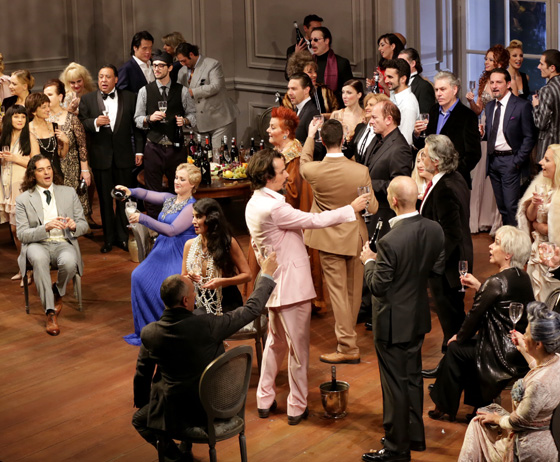 © Brescia / Amisano / Teatro Alla Scala Scene from the Opera Travate, D. Chernyakov’s production
I repeat: what the public of SCALA and the audience of the Culture and Mezzo television channels heard was an assessment of not only and not so much a specific performance - it was rather a reaction to the premiere of the theater as a result of a certain program implemented by the current leadership of Scala . Apart: what was it, interesting, to hear these cries to the new intensity of the theater, Alexander Pereira, who was present at the premiere: he is clearly not used to such, ahemist, an interactive, neither in ceremonial Zurich, nor even more of the stolen Salzburg-and meanwhile, he will soon have to take fire on himself as a barrenboy and the current one do today and the current one. SCALA quartermaster Stefan Lissner.
Biryukova: Well, yes. This is such a “December 7 effect”, ritual sacrifice, anger day. Probably, you can still have to come up with inventing stickers. The following performances can take place in a completely different way. I am flying to the second - here we will see. And about the “special performance for La Scala ” - I would not overestimate the external circumstances of his birth. That is, of course, some small correction of worms may, but still, but still his performances are not an clarification of relations with the public (which are now many directors), but first of all, clarifying relations with a particular party. And now he is now calmly, concentrated, extremely openly found out the relationship with the opera “Traviata”, one on one, as if nobody but him and her. And there was no. For me, this performance is a replenishment to the company from his Don Juan, Trubadura, Yenufa. For myself, I called this genre "psychological thriller."
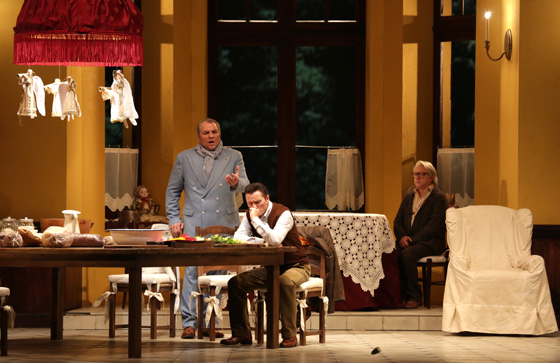 © Brescia / Amisano / Teatro Alla Scala Scene from the Opera Travate, D. Chernyakov’s production
Renansky: Here we, apparently, are quite seriously diverging in the assessment of the performance - but all the more interesting to talk about him, argue. For me personally, this premiere of Chernyakov is just out of his entire former creative path - it is too strikingly unlike the previous opuses of the director. At night after the broadcast (which I watched not on TV, but in the St. Petersburg cinema Aurora), exchanging impressions of what I saw with my colleague, we agreed that if this “grass” was shown to us blindly, without indicating the name of the director, it would be extremely difficult to attribute the authorship of the performance: it could be indicated by Chernyakov in this production. Frankly, such a “travate”-masterfully made, but completely conservative and, with your Katya, permission, spineless-could be attributed to many directors, but not to the author of the Novosibirsk-Parizh Macbet or Brussels “Trubadura” .
Chernyakov was in a situation that excluded the right to make a mistake.
I will return for a short time to the presentation of the context. I think no one will argue that the “travate” with her emphasized by the traditionalist stage language is the most, as Roman Dolzhansky, “dietary” from Chernyakov’s performances, accurately noticed in one of Facebook-Bataly. And it is quite obvious that this is done completely consciously. “Traviata” is a performance staged, if you like, one of the Big Guys of the World Opera Market, a director who has been scheduled for the end of a decade and who, shortly after graduation in Milan, flies to New York rehearse “Prince Igor”, one of the main premieres of Metropolitan this season Opera . The proposal to put the “Travate” by December 7, take up the creation of a key in the anniversary Verdievsky season of the performance of any director would put in a very difficult situation: the already increased attention to this work of the entire opera community is intensified by the difficult background of the relationship of the Barenboym and SCALA , the Barenboym and the Milan public.
Simply put, Chernyakov was in a situation that excluded the right to make a mistake that demanded the most unexpected, paradoxical gesture from him. And he made him. After the Berlin “Tsar’s bride” from Chernyakov, they waited for the most radical directorial interpretation of Verdi's score - and he circled everyone around his finger, instead putting a terribly conservative (and in the context of his own theatrical biography, and in the modern context of La Scala , who had seen a lot in recent years), in essence, a performance. The performance is frankly bourgeois, pleasant in all respects, in which little will irritate the average viewer, and even more so - the cream of the European public, gathered in Scala on December 7. It is clear that the notorious Logionisti was covered with urticaria at the moment when Alfred began to frantically shred the celery in the second act - but they were also Logionisti , they are laid down by the urticarian in status. But in general, as in such cases, the legendary professor of the Leningrad Conservatory V.V. Nielsen, this "grass" "is not able to offend you in anything."
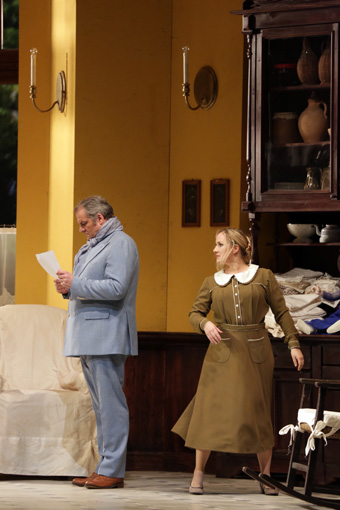 © Brescia / Amisano / Teatro Alla Scala Scene from the Opera Travate, D. Chernyakov’s production
I lead to the fact that I would not regard the production of such a “travias” not as the concession of one of the largest theatrical artists of our days, but exclusively as a political stern of a subtle strategist - which, by the way, was fully appreciated by the same Western impresario, who arranged a separate standing ovation behind the curtains. Giving tribute to the mind of Chernyakov-Politics, I cannot at the same time not grieve at Chernyakov-director, the presence of which in the "Traviata" is recognized only indirectly. Having written in the hearts after a broadcast on Facebook that, they say, the brilliant director turns into a conjuncturer, I, of course, got excited - but I really see the key content of this performance in a political game. Hand on the heart: in the semantic effect, “Traviata” does not withstand any comparison with Chernyakov’s past works, and the point here is not at all in the traditionalist theatrical language - in the end, and it could be told to the public something more meaningful. And now, Katya, I will ask you a question that tormented me throughout the broadcast, which I still have no answer to: what is this “travia” about? The review of any performance Chernyakov almost always begins with a retelling of how exactly the director pro -A -APPRISED this or that textbook plot or a score, which was wiped to the holes, but in the case of the Milan premiere, this conversation, in my opinion, is simply impossible. I tried in vain to monitor the stage text in order to isolate some kind of sorry, a super-unit from it, but I, alas, did not succeed. Perhaps I didn't understand something?
Biryukova: Well, how. Since the estate conventions are defeated in our time, and the consumption is treated, one problem topic remains in this opera - love. What is it? How does this work? Or skidding? What is the percentage of illusions, pretense, fear? Is it possible for a person to get out of his cocoon and get closer to another cocoon-or is it useless (there are literally a few points in the play when this step in the unknown is: for example, when Violetta is very much decided to write a letter to Alfred)? In Chernyakovsky-rather useless. All the same, everything ends in loneliness. And it is precisely this (and not Violetin death is not clear from what) is the result of the performance.
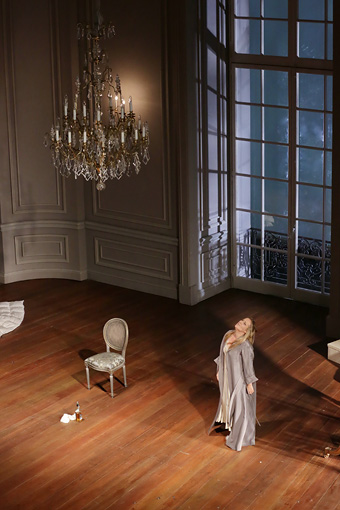 © Brescia / Amisano / Teatro Alla Scala Scene from the Opera Travate, D. Chernyakov’s production
Renansky: Yes, I thought in about the same direction - but only in the first act, more precisely, in its first half. There, the naked eye (and ear) was visible (and heard) quite a capital and at the same time filigree work, carried out with the performer of the title role: with all due respect to the wonderful singer Diana Damrau, she not only never worked on the stage as subtly as in the “travia”, but never as M.P. Mussorgsky, "meaningfully, did not intonate-which, of course, is to a very large extent the merit of the director. So, at the very beginning of the performance, the director sets the rules of the game: working on the territory of frankly traditionalist theater language, Chernyakov, as we might assume, wanted to re -intelligent the usual relations between Verdi’s heroes, pump such a psychological volume in them to get something fresh, living and meaningful, and not the vapoucum, which we usually get under the guise of “Traviats” productions. (Here, by the way, it is worth noting that this opera Verdi in the latest theater era remained a “opera for the singers” without becoming a “opera for directors”: besides the great Parisian performance, Christophe Martaler and inferior to him other opuses, but still impressive production of the Conquerful in Graz, it is difficult to recall other outstanding theatrical interpretations of the score.) Somewhere it was quite possible: let's say, completely mentioning, we say, completely mentioning. The line of the relationship between Violetta and the Annina turned from the maid into his head - what a surprise and what a blessing to see in this role the Great Maru Dzampieri!
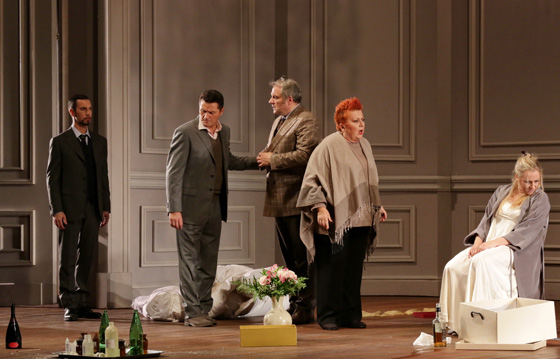 © Brescia / Amisano / Teatro Alla Scala Scene from the Opera Travate, D. Chernyakov’s production
But here is the problem: the plots set in the first act (for me during the first viewing, the tragic was most clearly sounded - and the completely corresponding to the letter, but the spirit of Verdi’s work is a motive associated with the fear of love uniting heroes) in the second and especially in the third act they did not sound, did not develop, remained unfinished, abandoned halfway. I understand that talking about the performance after one viewing is not quite correct, but it seemed to me that in this case we are still not talking about momentary losses, but about some kind of systemic mistake made by the director. I don’t know what you, Katya, will see in Milan at the next show, but in the second and third acts of “Travate” for the first time in the history of my own relationships with Chernyakov’s performances I had to seriously strain in order to understand something essential about the relationship between the characters, the further, the more difficult it was to subtract Chernyakov’s author’s attitude towards heroes, to the work of Verdi.
In the Milan “travate”, directing seems to be removed and allows the events prescribed by the author to occur exactly as they are spelled out in the libretto - without those dizzying interpretation turns that we are used to expecting from Chernyakov. It’s not in the bends, of course, the matter - but from the point of view of the substantial volume, from the point of view of the paradoxical and the subtleties of the theatrical comprehension of the musical text “Traviata”, in my opinion, is inferior to the director of the director. I repeat, all this has been done, it seems quite consciously, through a minus receiver-the director seems to say to the public: well, how, you expect some forms from me, but this time everything will be as you are used to-and Alfred at the right time will throw a pack of banknotes over his head (it’s good that he did not throw them into Violetta’s face). Surprisingly, of course, to read a abusive review in today's Corriere Della Sera : Chernyakova’s performance, in essence, with small modulations, retells the opera’s libretto-without any capital variations.
Biryukova: I will not hide that for me this performance was also not transparent at all. But we are watching Chernyakov’s performances not in order to get a quick pleasure, but so that it doesn’t let go for a long time. So it does not let go.