
Translated material
Yeltsin and Decembrists
What does it teach and cannot teach a textbook? The New Times continues to talk about teaching history at school
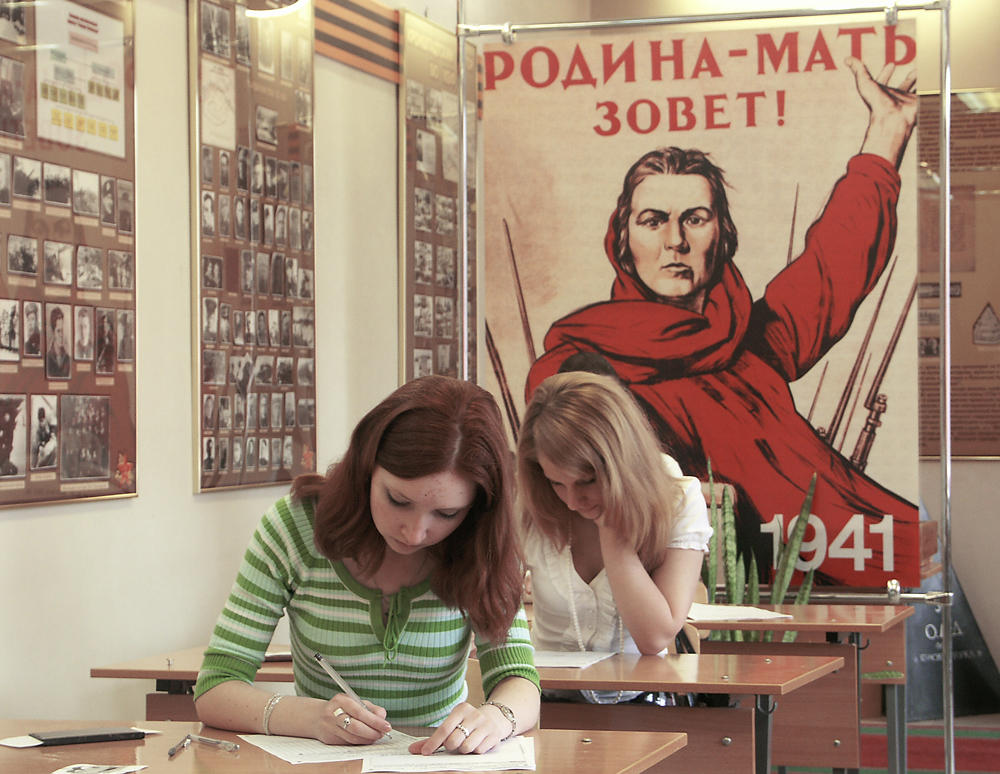
History lesson in high school. Leningrad region. 22 February 2013
| *No. 39 of November 25, 2013 |
Polls of high school students like the one who conducted The New Times*strongly excite the audience. It is interesting that the results are satisfied with everyone: the opponents of the exam (“That's what the exam brings!”), His supporters (“And without a compulsory exam in history - generally a khan!”), Apologists of a single textbook (“You see what confusion in the heads!”) And his opponents (“And now they will load the ideology and what we get and what we get?”) And the point is that these results are perfectly combined with these results are perfect Performances firmly settled in public consciousness.
The formula of phenol
There is a myth: the Soviet schoolboy seemed to know the story better. Yes, by the time of graduation, a graduate of the 70s remembered the average more dates and names than a graduate-2013. So not surprising: some of them - about Lenin and the revolution - settled down from kindergarten and primer. The author remembers well how, in his graduation, a history teacher at every (!) Lesson asked the question: “So in what year did the Great October Socialist Revolution happen?” The value of such knowledge is very doubtful: yes, with the help of a simple, funny and not quite censorship reception, those who had to take history to the institute for all life were remembered for the first Russian Marxist group “Labor Labor”, but ask us something essential about the Paul Axelrode, which was included in it-and what would we answer? The Soviet school was focused on the confenting of a certain amount of knowledge in every sense, and this knowledge still lies in the heads of generation 40+ for the most part by dead load: for almost 30 years I remember the formula of phenol, but I can’t say anything about the application of it even. Scary? No, it’s not scary: it will be necessary - I’ll look. The main thing is to understand that this is a chemical compound, and not an ancient Greek philosopher (remember: “Do not confuse Gogol with Hegel, Hegel - with Bebel, Bebel - with a woman ...”, etc.
Maure porridge
Many predictably recalled the famous Gubermanovskoye: "You can start any Morovoya porridge with the youth of the Gorlopanskoye, which is already a little confused with Trojan." There is no dispute, it is easier to manage an uneducated crowd. But the heart is on the heart, is it exactly on ignorance such porridge are brewed? The German people in the early 30s were quite educated, Nazism was not eaten by darkness, but by other sources. It is unlikely that anyone will argue with the fact that Hitler’s zoological anti-Semitism was not at all on deep knowledge (or, conversely, ignorance) ... In other words, knowledge of history seems to be-alas! - A very little effective remedy from another sliding in begging. “History is not a teacher, but an overseer,” wrote Veliky Klyuchevsky. “History does not teach anything, but only punishes for unacceptable lessons.”
"
It is impossible to determine by which textbooks he studied this or that of those who answered: all current school textbooks are approximately the same
"
Textbooks are not to blame
Putin’s decision to create a set of unified history textbooks for the whole country is implemented with energy that is clearly worthy of better application. The discussion about how the textbook affects the formation of the knowledge and views of schoolchildren has received a new impulse. I will disappoint (or, conversely, to calm) the supporters of the myth that this influence is great: it visible only in cases where the textbook is excessively ideologized (but there are no such ones now) or when something is simply not illuminated in it. By the way, this clearly looks at the answers of the guys to the question about the bourgeois revolution in Russia. The wording of the “bourgeois revolution” in modern textbooks is practically not found, which the answers were demonstrated. For the rest, it is impossible to determine the textbooks by which textbooks he studied this or that schoolchildren: all current school textbooks illuminate the touched topics in sufficient detail (excluding the question of Khodorkovsky and Lebedev) and do it quite carefully. All excesses and distortions are from completely different sources.
Unacceptable lessons
We will not fall into sacred horror from individual pearls such as the “opposite of Lenin” and “resolve the militants”. Here is the Ufa ninth grader “I read a book on history today” and remembered that Lenin’s “in my opinion, parents of a Jews”. What kind of book he read, who gave it or advised it, why did only grandfather's form lingered from all Leninians in his head (and then not firmly)? This is a question either to his parents, or to teachers, or even friends-consultants. Not to textbooks and not to the curriculum - that's for sure. Or here the eleventh grader from Ulan-Ude is sure that "the Soviet Union is loved because it was good then." Which of the girl’s environment could then be much better than now? Yes, to almost the entire Ulan-Ude, perhaps. And this will not beg any textbooks ...
| ** Poll "Levada Center", January 2012 *** Poll "Levada Center", December 2012 |
History is the discipline that the school teaches to the smallest, and in the largest - the surrounding society. The vinaigrette in the minds of schoolchildren, where Yeltsin can easily be in the neighboring era with the Decembrists, reproduces the public consciousness of the country as a whole. What do you want from the guys if 28% of their “senior comrades” experience warm feelings to Stalin, hostility - 23%, and 33% are indifferent **? And about the collapse of the USSR sorry half and does not regret a third of the respondents ***? Hearing on the one hand - one, and on the other, the other, reading Wikipedia in half with VKontakte, observing Leontiev’s TV between Malakhov and Mamontov, they cannot but get confused.
And this, oddly enough, is absolutely normal. Confusion inevitably arises in any person, as soon as the world begins to seem to him at least a bit contradictory (for most this begins at kindergarten), which he is certainly. And the further depends on the desire to understand. Those with whom it is present must be given tools and teach them to use. This, of course, is the task of the school. In those who do not have this desire, you need to try to awaken it. And it is necessary to work on this not only (and not even in the first place!) To the school.
Photo: Yuri sixth/ITAR-TASS