
Translated material
Amnesty ten times less
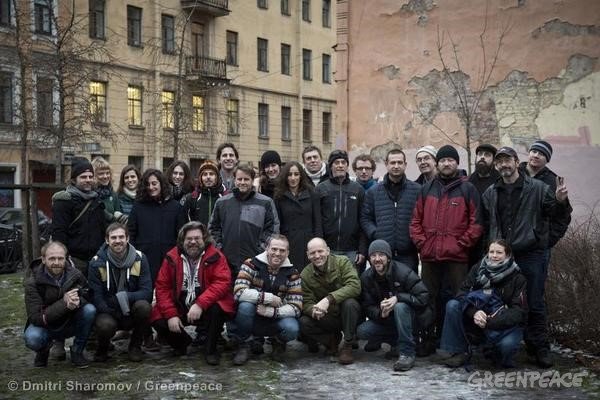
So, the project of the amnesty, introduced by Putin to the Duma, can already be read, and we can conclude that the amnesty will affect, in particular, convicted in the Pussy Riot case, Nadezhda Tolokonnikova and Maria Alekhina, all Greenpeace activists and members of the Arctic Sunrise team, detained in the Pechora Sea in September, as well as those accused in the “swamp case”, who is charged only with participation in the riots, allegedly taking place on Bolotnaya Square on May 6, 2012, or calls to them (of those who are now under trial in the so -called “business of the twelve”, amnesty will spread only to four - Maria Baronov, Vladimir Akimenkov, Nikolai Caucasian and Leonid Kovyazin; of those who expect a court - to Dmitry Rukavishnikov; Moreover, since the decision is subject to execution for six months, and Tolokonnikova and Alekhina remains to sit for less than three months, it is possible that they will not be able to be released before the end. In addition, the project of the amnesty turned out to be, as the lawyer Dmitry Agranovsky spoke on Twitter, “with a secret”, because it suggests that under articles on calls or participation in the riots (part 2 of article 212, part 3 of article 212), about hooliganism (Article 213) and for some reason about a violation by a person driving a car or other mechanical transport transportation The means, the rules of the road or the operation of vehicles that entailed by negligence causing serious harm to human health (part 1 of article 264) only convicts can be released. Thus, Putin confirmed what he was talking about at a meeting with the Valdai club members: he did not exclude the possibility of an amnesty, but said that “we must give the opportunity to simply bring all the necessary procedures to a logical legal conclusion” (although the law does not require the person subject to amnesty should necessarily wait for the sentence to the sentence).
In the “Twelve case”, Agranovsky defends Vladimir Akimenkov, who, according to the project, may be released in amnesty, and Yaroslav Belousov, who cannot be released in amnesty, although violence attributed to him has not been proven . (Another client of Agransky in the framework of the “swamp business” is Leonid Razvoszhaev, who is charged with the organization of riots, so he also falls under the amnesty of the NGA.) In a conversation with the ATS-Info correspondent, the lawyer admitted that the reservation about the fact that only the convicts had to wait, never before in the decrees of amnesty. saw. “And not only me,” he added, “I already spoke with a mass of different lawyers, including in the Duma. This is an amazing design, very strange, because it is clear that, probably, the amnesty was the result of some compromises. It is not clear to me what will happen to the Greenpeisers. Okay - our business has already been listened almost to the end. And with them it generally only begins. Will they also wait for their condemnation? "
According to Agranovsky, “this formulation violates the principle of equality of citizens before the law. It is simply incomprehensible to me in principle, why this reservation is made. In the amnesty, more difficult articles are also mentioned, and nevertheless, things on them are perfectly subject to termination. In general, the impression was that the amnesty was prepared taking into account the so -called “high -profile affairs” so that they would not fall under it or get minimally. And this is wrong, because there are no high -profile deeds or quiet deeds. There are cases examined by the court, legal or illegal decisions, and which one is loud, what is quiet - what's the difference? What if there is an interest in the press in the case, then people have guilty more from this? This is a strange criterion. "
At the same time, the lawyer does not lose hope that the project in the Duma will be able to improve: “Strictly speaking, it is still unknown that they will accept, because each faction has its own project, and all of them, as far as I know, eleven, will make amendments, so I do not exclude that this item will be corrected. I do not exclude at all that it may be the result of a legal or technical error - it looks painfully ridiculous. ” Agranovsky also hopes that an article on the use of non -hazardous violence in relation to a representative of the authorities (part 1 of article 318), which is incriminated by most accused in the “swamp case”, can still fall into the final text of the decision: “This is a crime of moderate severity. Almost all crimes of moderate severity fall under an amnesty. It is simply completely incomprehensible why it is excluded. In my opinion, you need to look at the categories of crimes, and not at who they are directed against. As if ordinary citizens should be less protected than police officers? It turns out that you can beat ordinary citizens - you are amnestied, but you can’t beat the police. This is unfair. I’m not talking about the fact that it has been so lately that the authorities have not been so much popular in our country to exalt it so much over citizens. ”
As you know, before Putin introduced a draft resolution to the Duma, he was presented with an option prepared by the Human Rights Council. According to the member of the Council, the chairman of the Agora human rights organization Pavel Chikov, “the draft Council for Human Rights touched on some estimates about 200 thousand convicts, and the draft entered by the president to the State Duma is almost ten times less. The convicts did not fall into the category of amnestied, who remained to serve the sentence of less than one year. Such a item was part of the draft council, and one can guess for what reasons this proposal did not pass: this is obviously due to Mikhail Khodorkovsky and Plato Lebedev. A large group of cases on unfinished crimes, that is, preparations and attempts, did not fall under an amnesty. This was also among the offers of the Council. It did not pass, because this would mean the release of the lion's share of convicts under articles related to the trafficking of narcotic drugs. This is a unique Russian story, when people get from six to ten years only because they allegedly tried to sell drugs to someone. It should be noted that almost 26% of serving a sentence in the colonies sit for cases related to drugs. There are many cases related to the attempt on fraud or giving a bribe - they also did not get into the project. ” The incriminated parts of the accused in the “swamp case” of part 1 of Art. 318, as the Chikov recalls, refers to crimes of medium severity, and the crimes of small and moderate severity, according to the Council, were subject to amnesties. Paragraph that amnesty under Part 2 of Art. 212, part 3 of Art. 212, Art. 213 and part 1 of Art. 264 only convicts are subject to the Council in the draft.
Unlike the Agrane Chikov, no hope for improving the project is not hoped for: "I think that the chances are zero."