
Translated material
The oldest musical instruments
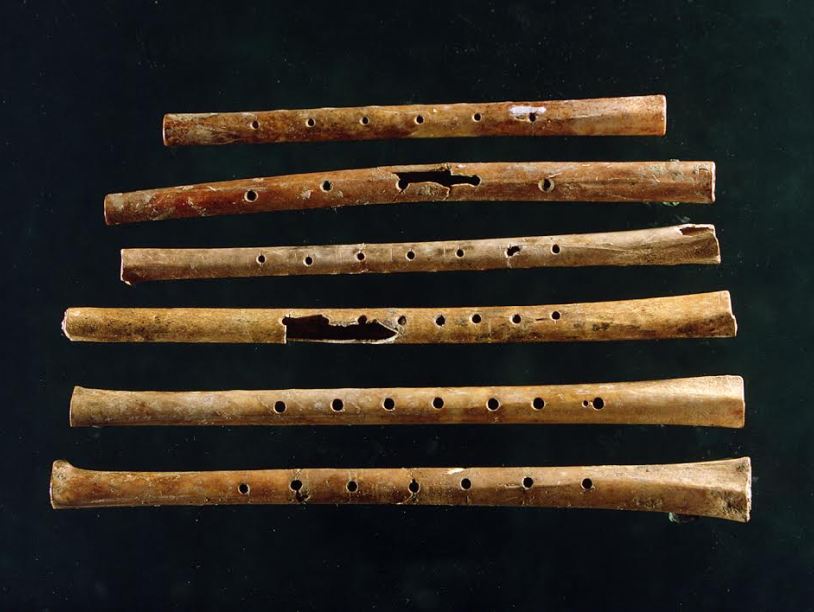
In one of the graves, excavated by Chinese archaeologists in October on the Neolithic settlement of Jiah (Henan province, 7000-5500 BC), three flutes made from the bones of the Japanese crane were discovered . The most ancient flutes are known in Orinagnic culture (Western Europe, 35-21 thousand years ago), but the uniqueness of the flute from Jiangu that it was possible to extract sounds and play several songs. This makes them the oldest, serviceable musical instruments in the world.
 Intellectual partner of the project
Similar finds have already been found in the graves of the inhabitants of Jiangh, but the flutes found in October 2013 are dated to the earliest period of the settlement of Jiahu (c. 7000 BC). The great surprise among experts caused an excellent degree of safety of flutes. In total , since 1999, 8 whole tools and fragments of even more than 30 flute were found in the settlement. The flutes are narrow brown tubes 20-22 cm long and 11 mm in diameter, the ancient inhabitants of Jiah made them from the elbow bones of the Japanese crane (Grus Japonensis Millen). On the tubes, 5-10 holes were made through equal gaps. The oldest (7000-6600 BC) flutes had 5 holes, which means that flutes were originally made on the basis of pentatonics , ladies, traditional for Chinese music of historical time, although it was previously believed that it appeared only during the Chewo dynasty (1122-256 BC). Between 6600 and 6200 BC The flute had 7 holes, and later they began to make a flute with 8 or more holes. The dynamics of the changes indicates that the inhabitants of Jiangu retained the traditional pentathonic system, but at the same time tried to increase the range of extracted sounds.
Archaeologists cannot come to a single conclusion regarding the use of the found flutes. It was suggested that they could serve as decorations to lure game. However, the most likely seems to be the hypothesis that flutes were used in shamanistic rituals. The fact is that in 1999, fragments of such a flute were found in the burial of the priest or shaman. The shell of the turtles with the inscriptions of the oldest hieroglyphs was also found there. Their graphics in many respects resembled the hieroglyphs of the Shana dynasty (1700-1100 BC). The main source of channel hieroglyphs is the inscriptions on the bones of sacrificial animals along which predictions were made.
Chinese pentatonics was based on an ancient magical tradition, in which each of the sounds received special significance. All this makes it quite likely the assumption that already in the Neolithic Jiah and Writing and Music were used in magical rituals close to traditional shamanism. The inscriptions on the tortoise shells cannot be read as a sentence, so there was a hypothesis that they are a map of the starry sky, which was supposed to facilitate the path of the deceased into posthumise. Since each note was under the control of a particular spirit, the execution of the melody should have propitted evil spirits and help the deceased to go through a meeting with them.
The settlement of Jiah , related to Pailigan culture , was discovered in the 1960s, but then archaeologists did not attach importance to the settlement, moreover, in 1979, local residents tried to build a reclamation dam here. The reason for this attitude was that over the Neolithic layer was a layer of the Han dynasty (206 BC - 220 AD). Systematic excavations began only in the 1980s, when archaeologists drew attention to the Neolithic layer, and since then almost every season brought unexpected discoveries. During this period , no more than 5 % of the settlement was excavated, the total area of which is 55,000 square meters. m., 45 ground houses, 370 semi -earthquakes and cellars, 9 pottering furnaces and many small artifacts made of clay, bone and stone were discovered.
Many findings in Jiah are able to largely change our ideas about ancient China. So, earlier we talked about the oldest alcoholic drink found in Jiah, which was a raised mixture of rice, honey and wild fruits. Inventory found in dwellings and burials indicates the beginning of social stratification. Lake Jia, the researchers located near the settlement consider the oldest place of artificial fishing. In addition, one of the most ancient evidence of the cultivation of rice was found in Jiah, and the researchers were surprised that the Payingsho culture, which belongs to the settlement of Jiah, was almost unknown, and the varieties that were cultivated in Jiah are genetically close to the drawing in the culture of Pentoussan (the lower Yangzi, 7500 - 6100 BC). Modern rice and rice of historical time does not go back to the Pentoussa rice, but to its wild ancestors known in the Yellowen Valley. Thus, Jiahu served as an intermediate link in the chain of borrowing of rice production from the Yangtze Valley to the Huanghe basin. Moreover, modern Chinese historians distinguish Jiah in an independent archaeological culture, which was under the significant influence of Zemon .