
Translated material
Short course: hard-box
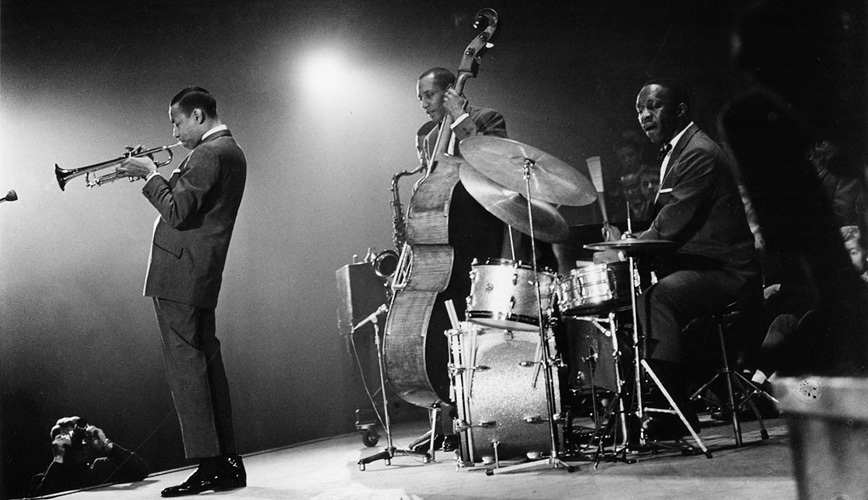
Colta.ru continues the encyclopedic series about the history of jazz: famous jazzmen intelligibly explain key concepts and phenomena from the history of the musical direction that changed the 20th century. We are talking about the period from 1940 to the 1970s-about jazz, which is commonly called "modern", or Modern Jazz.
1950s. Hard-bop
The reaction to the active introduction of academic music methods in jazz was the idea of returns to the “roots” of Negro music-blues and gospel (Kul-jazz musicians were usually white). This trend was expressed in the new style of Hard-Bop. As you know, the 1950s in America were characterized by an intellectual rise in various fields. Abstract expressionism was understood as truly American art. In turn, jazz, having deep traditions in American culture and at the same time being extremely progressive and modern, begins to attract the attention of avant -garde artists, writers and poets. Allen Ginzberg Poet-Bitnik wrote about jazz that “he was a model for the Dadaists, he was a model for surrealists, he was a model for Kerua, and a model for me, and a model for almost everyone in the sense that he was partly a model, and partly in a parallel experiment with a free form.” Such an understanding of jazz as an endless experiment without the damage of a certain original essence was present in jazz throughout its previous history and continued to remain in the next years.
Art Blakey & The Jazz Messengers - "Moanin '"
Drummer, percussionist, Chees Smith and these Arches, Xiu Xiu, Marc Ribot's Ceramic Dog
I met BOOP due to my first teacher of drums. I listened to a lot of art Blake then. I really liked his sense of rhythm and how vigorously and at the same time sophisticated he sounded. He possessed a very wide palette, did a lot of what other drummers later used - Filly Joe Jones or Elvin Jones. I’m not sure if he was the first to start playing trioli with his left hand - which Elvin Jones later picked up - but he was the first to have this technique. Alvin Jones also attributed to him the invention of Cross - Stick when they play on a rim of a small drum - what every drummer is now using. He used it a lot, played on the second and fourth shares, even quick triols. Miles Davis called this “Philly phrasing”, although, apparently, it was Art Blakei. Denis Charles, it seems, also adopted a lot from Art Blake. I clearly see it part of a single direction in comparison with what was before and after - especially if we talk about his own Jazz group Messengers . Take at least what they did with a barrel, using it to create a dialogue with a soloist in contrast to its usual supporting function in the swing era. I would call it a solo accompaniment. I was especially attracted by the version of this from Art Blake, because he could also use very bright colors that immediately striking. There are many such frantic moments in the most unexpected places on the records with Monk.
Yuri Chugunov
Composer, arranger, teacher
Horace Silver - "Song for My Father"
Hard-bop-this, in fact, was a venture of color musicians. They decided that Jazz took too much from European harmony. They began to simplify the blues, which Parker oversaturated with chords, returned to the traditional bluamantine and harmonic grid. It was also important for them what is called “Soul”, that is, music coming from the heart: in order to express their feelings completely, you need to be based on a simple harmony, where you can turn around. The most striking representatives are Clifford Brown, the Kennonbull brothers and Natserli. But all this is quite conditional. It is believed, for example, that Stan Getz is a kul-jazz, although he played with hot musicians. Art Blake was played by saxophonist Benny Golson, who is quite suitable for the classification of kul-jazz, etc.
The whole life of Mingus was a theater. What he invented was impossible to predict in advance.
Horace Silver, pianist, the head of the ensemble, wrote a very large number of topics, much more than Parker. Of course, he can be considered a composer. The composition " Song for My Father ” , for example, harmoniously very simple. Monk also has a lot of melodically simple topics, but suddenly there is some unexpected move that violates this apparent simplicity, adding a new meaning. Jazz dissonance is a special kind of dissonance, it differs from the dissonant of modern academic music and avant -garde. In jazz, she is more calm, despite some of her stiffness. At the heart of jazz chords are their original terrestrial origin, although the location of tones can be any. Therefore, even discordant chords sound quite familiar to the European ear.
Trubach, composer, Klezmer Brass All Stars
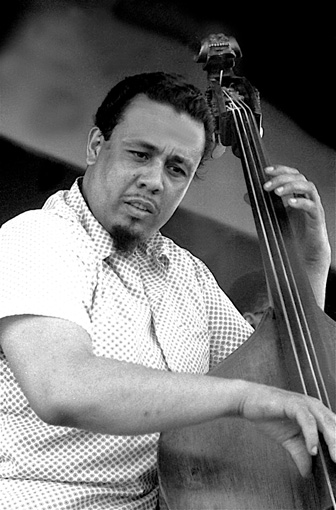 Charles Mingus, 1959
When people think about Mingus, someone imagines his game on the double bass, more people remember his compositions more people, but everyone thinks first of all about him as a person. His whole life was a theater. What he invented was impossible to predict in advance. At the same time, Mingus did not be ahead of his time, rather he was exactly in his time. The fact is that he was much more than what was expected from a black musician then. It was the time of the revolutionary movement of the African Americanites of the 1950s. If you imagine this movement, the movement of the Beatniks, what was happening in academic music-Varesis, the first electronic music-it becomes clear that the 1950s led to the revolution of the 1960s. So Mingus expressed the spirit of time.
Sonny Rollins - "St. Thomas "
saxophonist
I think every stage in the history of jazz played a revolutionary role. I do not think that Bibop was more revolutionary than any other period. The 1940s were a very rich time. Jazz then left the lead “romantic” language, Bibop simply reflected this emotionally tense time in Europe and America. But by its method, Bibop is no more significant than blues, swing or dixiland. The language of jazz was constantly developing, and each stage was based on the development of predecessors. It was impossible to start from the blues and go immediately to Free Jazz, jazz had to go through the evolutionary process. Bibop simply expressed his time of his time. Alt-saxophone was an ideal tool to express the aspirations of that generation.
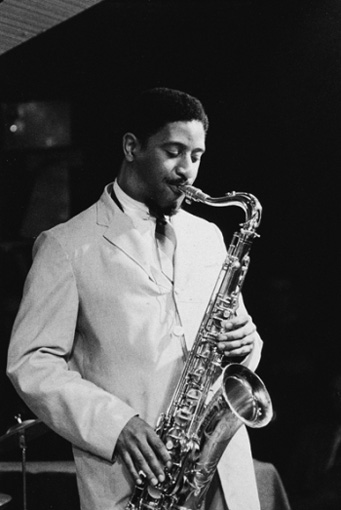 Sonny Rollins, 1956
Sonny Rollins took advantage of Charlie Parker and transferred them to a tenor-saxophone. I would not call him “Charlie Parker Tenor,” but he was his important follower, who “de Tenorized” the language of the jazz saxophone. The alt-saxophone was an ideal tool for expressing the ideas of bope, it was small, light and “flexible”. Sonny Rollins adapted this “flexibility” of the altum language of Bibop to the tonal and mechanical capabilities of tenor. I heard Saxophone Colossus ” to holes, it was my favorite album in Rollins.
Cannonball Adderley & John Coltrane - " Wabash "
Ned Rotenberg
Saxophonist, r . U. B. , Ned Rothenberg ' s Sync
In a small store of records on the outskirts of Boston, where I grew up, there was a small section of jazz. There I found LP Sonny Rollins, released by Prestige , which contained Saxophone Colossus ” and several more tracks with Prestige . There, I bought the re -release of Coltrain of Atlantic , which was called “ The Best of John COLTRANE " . On this plate were Giant Steps and My Favorite Things . Immediately after that I bought Forest Flower » Charles Lloyd. I listened to Coltrain's entry despite the fact that at first I did not like it. In the end, it was Sonny Rollins who turned out to be those whom I started copying. I think this was one of the reasons why what I started doing sounded differently, because then everyone copied Coltrane. He was more systematic, to copy his game it was necessary to do many exercises. On the other hand, having learned Solo Rollins, you only had this specific solo-due to its thematic approach to improvisation, it was not possible to use his phrases in other places. Honestly, it was much more difficult for me to listen to Charlie Parker's notes than Sonny Rollins, due to the high speed of the first. Somewhere in the same period, I purchased a “ Cannonball And COLTRANE ” , on which KENNBOLLLED EDERLI plays so amazing. Until today, I believe that Cennonball has promoted what Charlie Parker did as soon as I could.
John Coltrane - " Giant Steps "
saxophonist; Cactus Truck ; Dikeman , Van Der Weide , Kugel
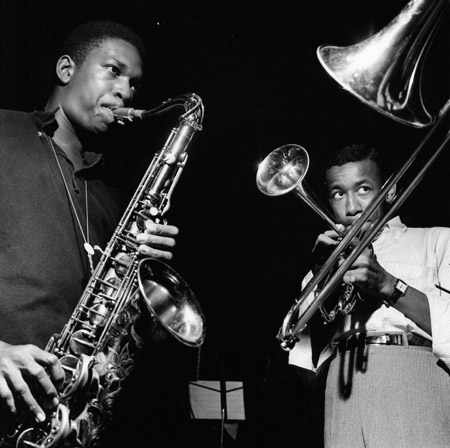 John Coltrain and Lee Morgan during the record "Blue Train", 1957
It's funny to watch Koltrane from the point of view of its individual periods. Despite the fact that much in his music has changed dramatically, it is interesting how some aspects of his approach to the game on the saxophone remained unchanged. For example, if you look at the "sound layers" on the album " Giant Steps ” and earlier things, you will see a very technical game with a huge amount of information per unit of time. His interest in the approach of Charlie Parker, the desire to play as quickly as possible, to further expand the vocabulary-I do not know another musician hard-bope, who would develop all this to the same extent. Perhaps the album " Giant STEPS ” is the pinnacle of a similar approach with its lightning -fast change of chords and harmonic gravities. Instead of the usual quarter-flint circle, Coltrain descends down the teles. He structured the composition with the help of toniki and dominant ligaments repeating in each tact. It makes it truly interesting that it contains, on the one hand, that are very familiar to any musician of the II-VI chord chain, on the other hand, you find almost every new tact in another tonality. Despite some formality of Solo Coltrain, it has an incredible charge of energy. The whole play is built on the balance between the search for these complex logical structures and the game "here and now."
Continuation follows: modal jazz.