
Translated material
The necessary part of the game?
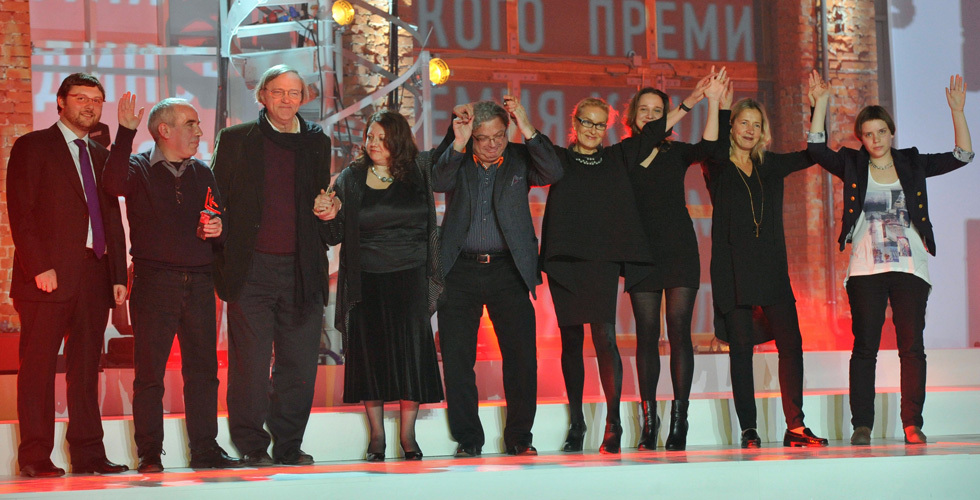
Since today, December 12, in the “Drummer” - a cinema, which, as in a fairy tale about the naked king, is not customary to call what he is - the award of the Kandinsky Prize, Colta will take place . RU decided to reflect on what it is-in the very manner of business.
The Kandinsky Prize is a mechanism that exists for the sake of its own self -replacement in the media. And this thought is as obvious as the fact that the picture is a piece of canvas stained with paints and placed in a frame. But many, out of quirks or for practical reasons, consider it necessary to continue to perceive this picture as part of the picturesque convention, that is, use it for its intended purpose and look at the rectangle enclosed in the frame as a window in the world. About the same meaning has an annual discussion of the details of the nominations of the Kandinsky Award. Because the world in the institutional frame of the bonus is as conditional as the landscape on canvas.
This world is partly connected with real processes in domestic art, but is connected with them indirectly, since it does not exist to understand them and not to maintain their functioning (if this happens, then as an accidental consequence). It is designed for the media view, and first of all, unprofessional (that is, not specializing in art), ultimately being nothing more than approximate, rudely knocked out by illusion. This is proved by the fact that it is difficult to find at least one, even very conservative, criticism who would consider an exhibition of a prize (that is, the choice of artists, works and a way of serving them) is actually representative. Perhaps expressing some conjuncture in relation to contemporary art at a certain level, but not indicative for what is actually happening in this world. Here we deliberately leave the barbaric idea for ethical brackets to choose the best among artists and give him money for it, which, as everyone knows, he will be more likely not to spend on projects, but on renting apartments, food and payment of other expenses. Although with the same success, one could arrange a beauty contest in a starving city and win bread cards.
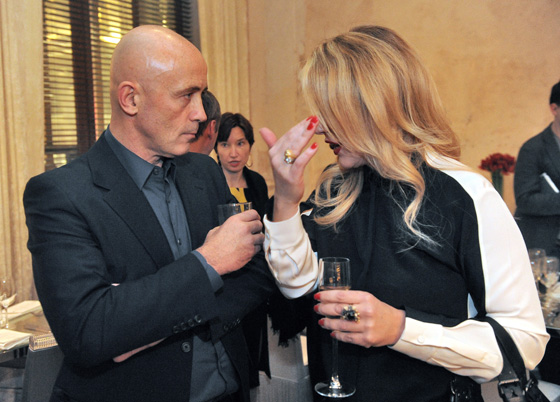 © Yuri Martyanov / Kommersant President of the Arthronika Cultural Fund Shalva Breus and artist Alexander Vertinskaya at a solemn dinner in honor of the laureates of the Kandinsky Prize in the Baccarat restaurant
Giving the annual exhibition cycle to captivate itself and, by calendar, taking the next event-premium-Kotoria-not-and-applies, the present-will, let's look at the prize as a car fixed for self-reproach. That is, let's talk about what the award is in the very manner of business (what it really is , the OpenSpace.ru portal wrote a couple of years ago). To do this, we will have to look at it not at all as the acting screw of the institutional art system that acts as the support of young artists, because in this case, the pre -orientation on the media says goodbye to the bonuses as the symbolic rent that we pay the capitalist for paying for our professional existence. On the contrary, by abandoning the idea of even partially “useful” the functionality of the prize, we will finally see in it the not-leading appendix of the institutional system, a dead end, Cul De Sac and at the same time the amalgam representation, which was strictly wiped towards the mass media, that is, the function of not support and development, but pure self-and-affirmation.
It is difficult to find at least one, even very conservative, criticism who would consider an exhibition of a prize (that is, the choice of artists, works and a way of serving them) is actually representative.
This is especially worth doing this because it is this year (since every time it has to be inventing what exactly this year can be special) for the first time belonging to the owner of the Shalve Breus, the magazine of Arthronika-the most loyal media mirror of the prize-will not write about the nominees of the prize, nor about its exhibition, nor about the winners: we know that the cycle of this publication, once and okay, is once closely and okay. Synchronized with the bonus cycle, was rude and forever interrupted by the hand of its own owner .
The culmination of the award is a presentation ceremony, an old -fashioned and bulky procedure, during which everyone, except who started it, feel a little awkward. This is right, because for the one who started it, it is in the ceremony that the entire symbolic increase is accumulated.
That is why all the mechanics are awarded to media and synchronized with their cycle. All of its artificially propagated stages, clumsily disclosed Saspens-an alternate announcement of the jury, long-list, short-list, opening the exhibition of nominees, the delivery procedure-are designed as the maximum number of information farms, which result in the maximum of publications. The course of the same series was the rental of the Shalvoy Breus of the Drummer cinema, which was supposed to be converted to the museum: so far this enterprise has led only to the fact that the famous monument of Soviet architecture serves as a platform for exhibitions of the award and an expensive tool for multiplying publications.
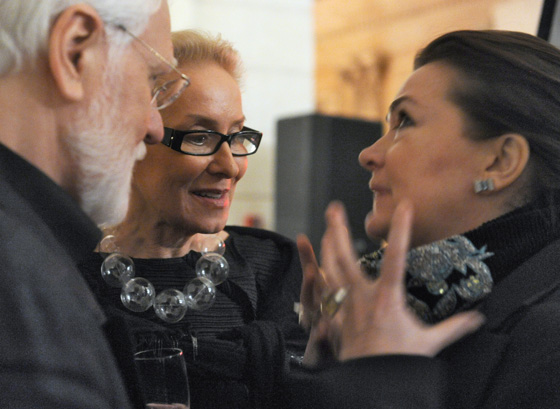 © Yuri Martyanov / Kommersant Director of the Moscow House of Photography Olga Sviblova and spouse of the president of Alfa Bank, Peter Avena Elena at a solemn dinner in honor of the laureates of the Kandinsky Prize in the Baccarat restaurant
Artists and observers are two necessary categories of stuffal characters that pedal in the media mass of the prize. They are not at all on opposite sides of the barricades (the old opposition evaluating/evaluated), and all together participate in the reproduction of this mechanism, which brings them a rather dubious benefit. It is interesting to look at the whole enterprise from their point of view.
Indeed, money is given to the prizes. Some artists even let them into further projects (wreaths, Osmolovsky). However, such money is not enough for a whole project, you have to resort to additional sources of financing (wreaths). But most spend them on everyday needs (Ryabova, Antufiev, Albert). It is more likely that young artists spend money just on a living (renting an apartment, workshop, food, clothes, household little things). However, money and senior artists live. That is, to do something new, even having received a bonus, is problematic. Or what will be done on her, strictly speaking, will not be new.
The largest amounts are in the framework of the prize by those from whom no one expects any development: a 40-thousandth bonus per project of the year is usually awarded to the character as predictable as possible, and this predictability is not universal (universal), namely the one that can be calculated as part of a specific discourse of the premium due to the tastes (or needs) of the owner, and possible laureates are not spinning in the lists of the prize. In one year (Albert, Osmolovsky, AES+F ). Moreover, there is no doubt about the honesty of the jury-just the mechanisms of choice (the composition of the jury, the composition of the expert council), all these filters as such are arranged so that, whatever one may say, the bonus exhibition continues to broadcast the idea of the status of art, its structure and form, which is inherent in the owner of the Fund, Prize and-once-a magazine.
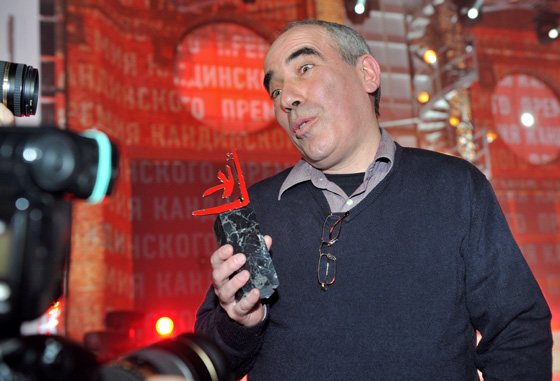 © Gleb Shchelkunov / Kommersant Artist Yuri Albert during the awarding ceremony of winners of the 5th anniversary Prize of Kandinsky
Naturally, artists are always happy about money, because they, as a rule, do not have regular income. But their views on receiving a bonus vary. Some, most often young artists (say, Nastya Ryabova and Dmitry Venkov) consider the money useful and timely, but the procedure for presenting with her pomp, which seems to them frustrating, imposing unpleasant duties that put them in an awkward situation. Someone (Ryabova) believes that the prize mechanism itself is inadequate and it would be much better to receive scholarship support, "1000 euros to each month." And the delivery procedure itself seems neurotizing and provoking not on development, but on a decline (Ryabova). At the same time, someone (wreaths) accepts the presentation as “the necessary part of the game”, “publicity”, without which the artist will be difficult to “do the following projects”. Others-and this is more often older artists-believe that the procedure for presenting the prize is useful and even pleasant. Yuri Albert, like Dmitry Venkov, believes that this is a necessary part of the artist’s career, but his assessment is painted more positively: he calls this not “part of the game”, but “professional duties”. In addition, like some other laureates, Albert considers the award of a successfully tired media platform, which makes it possible to speak in support of civil protest, and the opportunity to participate in charity (speaking with a thanksgiving speech, Albert supported the protests, and part of the money gave for the treatment of sick children). This is not the only case of expressing a civil position during thanksgiving (Diana Machulina).
Regarding career assistance, the readings also vary. According to many laureates, the award does not help the artist in an international career (as wreaths, Ryabov, Albert), but can help something in advancement in the local context (according to Dmitry Wenkov, he admits that his laureatism somehow contributed to the fact that he was invited to the Media Forum exhibition, as well as in the main project of Moscow Biennale ). Obviously, the prize can help very young artists: all the students of School Rodchenko automatically submit their projects automatically for their projects. For them, it can be the first breakdown of forces.
As for the “other side”, that is, the observers (they carry out the necessary connection between the award machine and the media machine), for them the Kandinsky Prize is one of the purest examples of alienation of critical labor. The modernist idea is still preserved that the critic is “free” to express his opinion, even negative. In reality, he only supports the existence of a reproducing media being reproducing and, along with the rest, participates in the creation of surplus value. Of course, this applies to all periodic exhibition events, but the Kandinsky Prize with its somewhat awkward and intrusive PR here is the perfect exhibit.
The 40 thousandth prize for the project of the year is usually always awarded to the character as predictable as possible.
This was most related to the arthronics closed with the scandal (the employees tried not to pay compensation, the finished number was not printed, everything happened suddenly, etc.). Of the six annual numbers, the magazine wrote about the Kandinsky award of at least four, and in the room that was at the time of the exhibition and presentation, there were even two materials about the award. These materials were certified by employees who worked for the prize. The obligation to write materials about the bonus was transferred from one author to another, since writing about the bonus twice in a row seemed exhausting and uninteresting task. A significant part of these materials was written under pseudonyms. Sometimes they were written collectively or finished (text-compilation). Such an unwillingness to write under his own name was also characteristic of freelance authors, because, taking up this task, each journalist understood that he could not be frank in his text to the end - after all, the magazine and the prize made up an organizationally single organism (although formally the magazine always tried to maintain at least some independence). At the same time, one cannot say that one of the journalists was dishonest, flattering or entirely engaged-each time the author solved the problem of how not to make a hack and still remain honest with himself. The magazine existed long before the prize. But gradually, as the premium develops and with the advent of the exhibition site in the “drummer” (more precisely, with receiving it for long-term lease), the magazine, apparently, began to be perceived by the owner precisely as part of the “press about the award”, and unjustifiably expensive and large-readable. This was probably one of the reasons why the magazine as a way of self -replacement of the owner and representation of the award was closed: the Drummer space turned out to be a more effective media for the owner than the magazine.
But even those who write for numerous sections of the culture of “non-Affilled” publications authors who can afford to “scold” the prize (it is not important from what positions: someone considers it not spectacular enough, someone is too spectacular and “bourgeois”, etc.), are not fully free. They are not free, even when they express their negative opinions regarding the picture that they saw in the border frame: after all, all opinions are ultimately part of the publicity, the “press” that rotates the flywheel of the prize serial. They want it or do not want it, observers will write about her, because for this it exists.
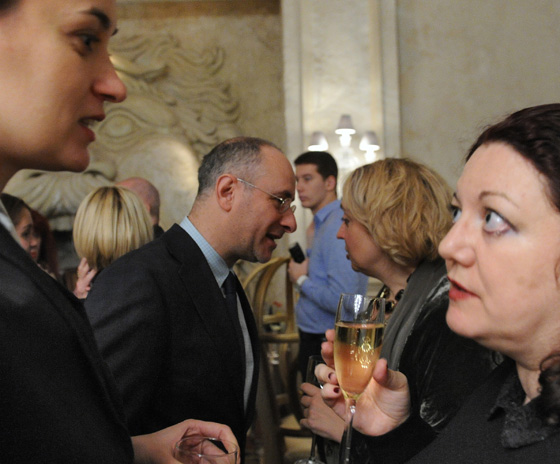 © Yuri Martyanov / Kommersant General Director of Sotheby's Russia and the CIS Mikhail Kamensky, art critic Catherine Dgo and art critic Alla Rosenfeld on a solemn dinner in honor of the laureates of the Kandinsky Prize in the Baccarat restaurant
A cursory survey of observers who illuminated or will illuminate the bonus reveals the state of extreme fatigue and pessimism they experience about this event (and, in particular, its sixth in the account of release) and their duties. First of all, this applies to the announced materials that are made before the opening of the exhibition and which the authors write, not seeing it, forced, thus, to build the editors of the “main intrigue of the bonus”, focusing exclusively on the columns of names in shorts and long long longers. Some critics describe their feelings from writing the announcements of Kandinsky award as “a complete abstraction with scraps of ideology” (critic who wished to remain an unknown).
Critics describe the attitude to the need to write an overview of the next issue of the prize as “professional” (Gulin, Ledenev, Tolstov), which can be interpreted as an expression of the same alienation from the event of the exhibition as such. If two years ago, Ekaterina Laigot wrote that it was not the work of critics or works of artists at all, but just the opposite - “the prize is gradually alienated from its owner ... and from the“ richness of the rich ”... may eventually turn into a real institution”, now, after the scandalous acceleration of “arthronics” and several completely ineffective tastes of the owner, exhibitions in the exhibitions. The premises of the “drummer” (which, by the way, was forbidden to call a cinema in the magazine’s materials), it becomes clear that the forecast was excessively optimistic, although some vague benefit for students of Rodchenko’s school can still be seen.
Some critics express a desire to write about the prize as an “expert assessment of the situation and cut of the situation” (a critic who wished to remain an unknown), but state that the Kandinsky Prize “does not perform this function”. The banality of the jury and the expert council makes critics to state “the banality of the choice and the non -estate of assessments or just to express banality again, reproducing a limited set of comments, since AES+F and Bruskin are a completely meaningless choice that has to be simply stated” (a critic who wishes to remain unknown). Many critics express joy in connection with the fact that this year they will not have to write an overview of the exhibition and ceremony of presenting the prize, which will save them from participating in the reproduction of a meaningless mechanism of self -pronouncing, alienating the work of critic, artist’s art and symbolically legitimizing capital (Naplyenko, Novozhenova).