
Translated material
What is ancient Rome?
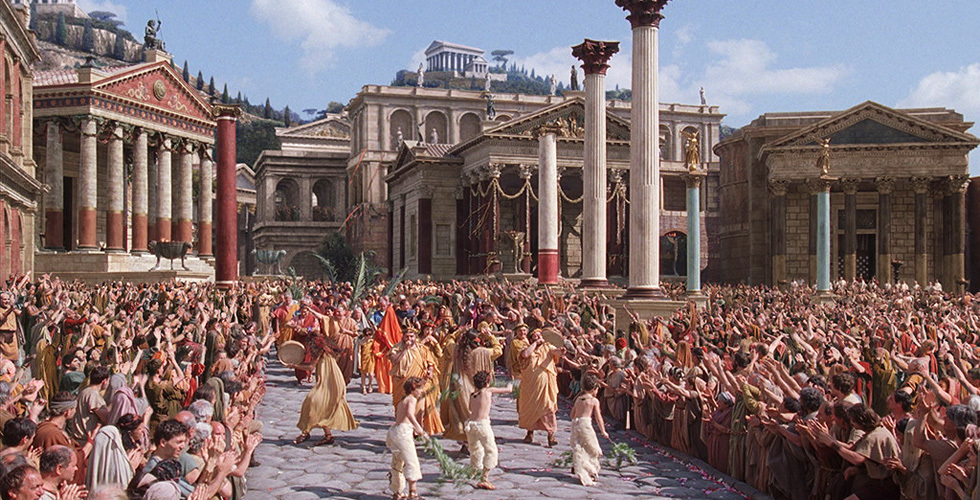
Colta.ru continues the heading "Likbez" , in which experts share with us their views on the fundamental concepts and phenomena of culture and history. The author of the book “Here was Rome” Viktor Sonkin, laureate of the Enlightener Prize in 2013, talked about what the problems of the inhabitants of Ancient Rome are similar to the problems of modern Muscovites and what are different.
- To begin with, let's clarify: what ancient Rome will we talk about and who were the ancient Romans?
- To talk about anything ancient Roman in general is a meaningless thing. The history of ancient Rome - as it is traditionally customary to understand - has more than 1200 years. Yes, Roman civilization has retained internal identity during this time (and later), but in the view of the majority of ancient Rome, this is two or three centuries at the turn of our era, the era of the late republic and the principal (the word “empire” is also not quite accurate, because the empire as a colonial expansion into distant lands was under the republic, and there was no single-person reicing of one person-with reservations-with reservations-with reservations-with reservations-with reservations-with reservations-with reservations-with reservations-with reservations up to Diocletian). Therefore, we will speak mainly about the "classical" ancient Rome; It’s just that you should keep in the mind that there were quite a few ancient Rims.
Demographic study of antiquity for obvious reasons is a dream discipline. Even the population has to be calculated by indirect signs (although the Romans conducted regular censuses called Census , we do not know exactly what methodology and principles their calculations were based on). The qualifications covered the entire state, and in the city of Rome we have data from grain (grain was distributed to almost everyone), from which it follows that in the era of the principle (“early empire”) the population of Rome could reach up to a million people - only in the 19th century London again overcame this bar.
Ancient Rome was a globalized consumption society.
The structure of the population is also difficult to determine. Rome was a hierarchical society where slaves were at the lower steps, then freedmen, then free citizens; Free, in turn, were also divided into classes depending on origin (for example, into patricians and plebeians - however, in the historical era this division was already purely symbolic), from the merits of the ancestors (on “noble” and “new”) and so on.
What was the social composition of the population of the city, it is also quite difficult to say. Obviously, Rome was unique and that people from all over the inhabited world flocked there. It was a very globalized consumer society that used products and goods brought from everywhere, from Britain and Portugal to Persia and China. At the same time, the Romans were fanatically in love with the idea of antiquity and “paternal customs”, even when reality with her did not contact at all. In this paradigm, a Pahar-warrior was an ideal citizen (preferably in one person, as a dictator of half-breed times, a zincinnat, called up for public service directly from a plow). In general, with understandable reservations, the population of Rome was similar in composition to the population of the capital of a modern agrarian-soldered state: many officials, many lawyers, a lot of maintenance personnel (including slaves), many merchants and intermediaries, relatively few people engaged in production (although, of course, craftsmen were), and there were almost no farmers.
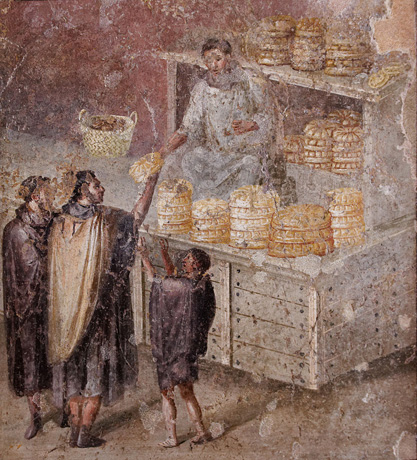 Ancient Roman fresco depicting a bread shop in the house of a baker in Pompei
- One Kremlin official recently stated that Moscow does nothing. And what the inhabitants of Rome were scolded for - for luxury, pampiness and idleness?
- Of course, for all this.
- And how were things with migrants?
- Talking about migrants in modern terms is quite difficult, since it is difficult to divide slaves (initially, as a rule, captured during wars) and free labor migrants. As the city grows and his life, the need for qualified labor grew, and many such needs (including highly qualified work: educational, medical, etc.) could only provide immigrants from the Greek East. Near the Port-Majore Square, a huge tomb of the baker has been preserved; This baker has Roman priority and nomenus (first and second names), Mark Virgil, but the Greek claw - Eurisak. So the freedmen usually acted, taking the names of the former owner, but retaining their own foreign name as a clan.
The poet Juvenal claimed that everyone who leaves the house without compiling a will is insane - after all, at any moment, anything can fall on his head.
It is important to understand that Roman xenophobia, apparently, was not racial: the Romans remembered well that their people developed in the melting cauldron of various Italian nations. The attitude towards the Greeks (and the Hellenized inhabitants of the East, who were also “Greeks” for the Romans) were twofold: the Romans despised them for prying, treachery and tendency to deceive, but appreciated intellectual achievements, as well as Greek literature and art. Many emperors were upset by the Romans - Adrian could chuckle over the Spanish accent, but it never occurred to anyone that a foreign origin made him less suitable for the rule.
- Has it reached the conflict?
-The proportion of migrants of non-dedicated origin, according to scientists, is unlikely to ever exceed 5%. But in situations of social tension, they could suffer - they were expelled or, as in the midst of the second Puni war, when the existence of the state was under threat, executed demonstratively. Obeying the oracle, the Romans were buried alive on the forum of two Greeks and two Gauls - and this despite the fact that the war was with the Carthaginians! But such measures were rare and short -lived.
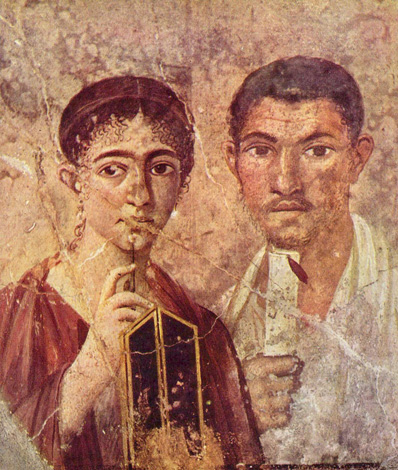 © Museo Archeologico Nazionale di Napoli Portrait of the baker Terentia Neon and his wife. Frescoes from Pompeye
- The eternal problem of any city is utilities. Even in Vladimir Putin, as we recently found out, rusty water flows from the tap. How was things in Rome?
- The water pipelines were excellent, worked for the entire population, and the average Roman spent a lot of water daily - to this level of consumption in developed countries reached only in the 20th century. There were public toilets throughout the city, because in apartment buildings there were only convenience houses for residents of the lower floor. Toilets were provided with running water and sometimes even heated seats. Terms (public baths) were also free (or very cheap), by the way, just like gladiatorial battles and chariot jumps.
- That is, they did not pay for water?
- For water in public use - fountains, wells - no: the water was a public property, but when there were no aqueducts (and later), the water bodies dragged water from the tiber, and it was necessary to pay for their services. But if someone wanted to conduct a drainage into his personal house, it was necessary to receive a special license and pay for this, and this was not transferred by the right to inherit. At the same time, there was a black market for illegal drainage, with which there was a constant struggle.
Roman xenophobia, apparently, was not racial.
In general, oddly enough, Rome was a large extent Welfare state . For example, in the era of the Early Empire, not only the Romans, but all the Italians no longer produced enough grain to feed themselves - without export from Sicily and from Egypt, Rome would have extinct from hunger. The grain was distributed according to the state subsidy. These populist measures brought Italy agriculture to a full decline, but it was not possible to restore it: people were used to free bread.
- Both the bread is free, and the water supply is good. But the Romans complained about something?
- Well, people, and the townspeople especially will always find what to complain about. Moreover, for the poor, bread was free, and everything else was quite expensive, and examples of obscene wealth caught my eye constantly-how could not be exposed. Plus crowding, dirt, stink, epidemics, corruption again, debauchery.
- And what did they consider depraved?
- In Mikhail Leonovich Gasparov, it is said about this: a sharp increase in living standards creates leisure time in people and new ways to conduct it, and the older generation does not understand these new methods and traditionally interprets them as debauchery. We ourselves survived such an era (strictly speaking, we are worried), and the Romans also had to go through it. On the one hand, all sorts of gladiatorial fighting, chariots and other cruel games, the spread of brothels; On the other hand, the rapid development of literature and art, the invention of Katull’s love, the development of Greek poetic forms from Horace, the “science of love” by Ovid, the epic of Virgil is a consequence of the same historical processes.
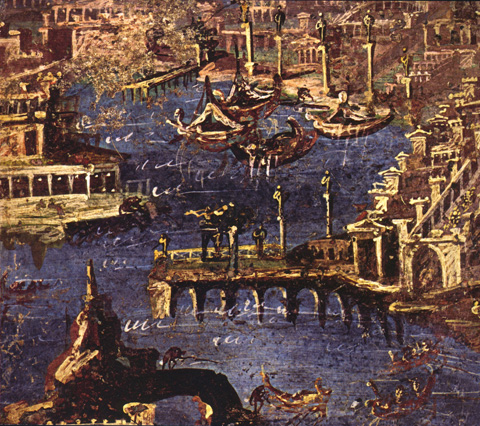 Ancient Roman fresco from stabiis depicting a coastal city
- But, probably, there were no traffic jams?
- There were no traffic jams in Rome and other cities of Italy, because the movement was mainly on foot. According to the law of time, Julia Caesar, who was then repeatedly confirmed and changed, the carts in the city were prohibited, with the exception of those that performed socially important functions - the supply of building materials and so on. And people of the middle and higher class used the services of porters (both for themselves personally and for their things, if there was a necessity).
- Almost like a restriction on the entry of trucks to Moscow in the daytime. And how is the "cars with flashing lights"?
- In Rome, there was a ban on wearing military weapons and on the presence of armed soldiers within the borders of the city (with the exception of the triumph ceremony) - of course, in the late imperial times, he was no longer observed so strictly. And in the republican era of senior officials, the bodyguards were accompanied by the more than the more important position: the consuls were 12, for the dictator-this is not in the sense of the “usurper of power”, but the crisis manager, who, according to Roman laws, was chosen to solve a specific important task for a strictly limited period-24). The lictors had a bunch of hard rods, the so -called fascia (hence the word “fascism”), and an ax; But they had the right to wear an ax only outside of Pomeuria, that is, an official and sacred city line. For example, virgin vestals could use horse transport within the city, but in general there was no such practice.
- Was Rome a dangerous city?
- Crime in antiquity was very high, but at the same time, in historical sources, violent death is, as a rule, either death in battle, or political murder, or suicide, or the result of state terror (proscription). Several cases of the times of the late republic are known when the political struggle was poured into the confrontation of gang groups (history with Claudius and Milon), but it seems that such dangers were mostly aware of ordinary people, and therefore there are not many descriptions in the literature.
For example, virgin vestals could use horse transport in the city.
After the bloody century of civil wars, under August, in Rome, several power structures were formed at once, engaged in public security in peacetime. These were: the Praetorian Guard-the emperor’s personal bodyguards (that is, something like the FSO), city cohorts-the armed parameded police (riot police) and, finally, the guards, Vigiles , which performed the functions of fire teams and the police, mainly at night. True, at night in Rome it was very dark, and they had little work. The scope of responsibility of these three groups was intersected. Apparently, with the strengthening of the role of the state in private life, the security of citizens also increased.
- as well as the level of corruption ...
- Yes, this problem was also relevant, and well -reflected and enduring. In the republican times, officials in elected positions did not receive salaries, moreover, they were often forced to fulfill their duties at a personal account. Since it was often very resource -intensive affairs (construction and maintenance in the order of public buildings, roads, aqueducts, etc.), many went bankrupt. On the other hand, the opportunity to make important decisions, including those in which a lot of money was involved, created a very corruption environment. Cicero, for example, launched a powerful campaign against the Sicilian governor of Verres, which served as an important impetus for his oratory and judicial, and then a political career. On the other hand, often the accusations of corruption were brought against corruption fighters - we are also familiar to us a familiar practice. So they did in time immemorial with Mark Manley Capitolin, who once saved Rome from the Gallic invasion. Moreover, he was supposed to condemn the national assembly, and he always pointed to the Capitol - they say, look that I saved for you. Only when the meeting was postponed for city walls, the senators managed to pushing their decision.
The bribery of voters, while the elections had real importance, was also common. The administrative resource was used by influential politicians willingly. Suetonius gives notes that Caesar sent to tribes (this is something like an electoral district): “The dictator Caesar is such and such a Tribbe. I bring to your attention such and such, so that from your choice he received the title he carefully. ”
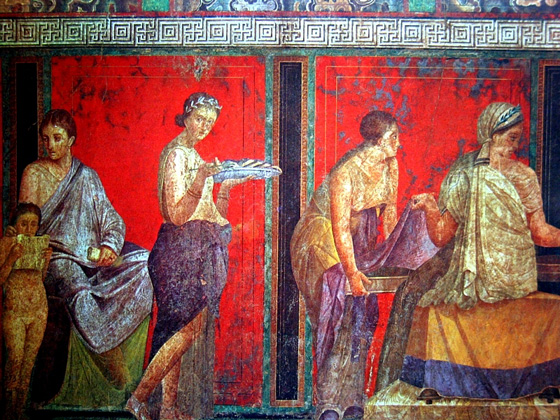 Frescoes of Villa Mysteries
- Were there scandals, as with the dacha Yakunin?
- The most famous Roman villa, probably, is the villa of Emperor Adrian in Tivoli, about her is described in detail in my book. But the emperor seems to be laid in rank. There were scandals with provincial governors who robbed their subjects and expropriated works of art. Some brightest archaeological finds of the 20th century are statues found in the sea - apparently, evidence of the massive robbery of Greek cities and the movement of cultural values to the West, to Italy.
- It creates that there are no urban problems that we know, but there were not to the Romans. Maybe ecology?
-With garbage harvesting, the situation was not very-in the absence of any slender system, residents of city apartments often threw out liquid and solid waste from the windows. The large corps of laws prohibited this (which indicates that the prohibitions were ineffective) and assigned fines for violations. Sometimes I had to delve into the details: if something was thrown away by the slave, who is responsible for this-he himself or his master? And if a guest? The poet Juvenal claimed that everyone who leaves the house without compiling a will is insane - after all, at any moment, anything can fall on his head.
At the same time, the Romans, in general, was in the environmental consciousness of the Romans - in particular, they seem to be the first in history to use natural features in construction, for example, to place the hot rooms of the baths so that they were heated by the sun (and accordingly fuel could be spent less). What happens to the ground during its exhaustion was also well known (at least on the example of Greece, which also almost completely depended on grain supply, but not from Egypt, like Italy, but from the Black Sea colonies). Nevertheless, the Romans often brought whole biotopes to complete exhaustion: for example, the current deserted landscapes of North Africa, from where the Romans drove animals for circus games in huge quantities - this is partly the result of their activity.
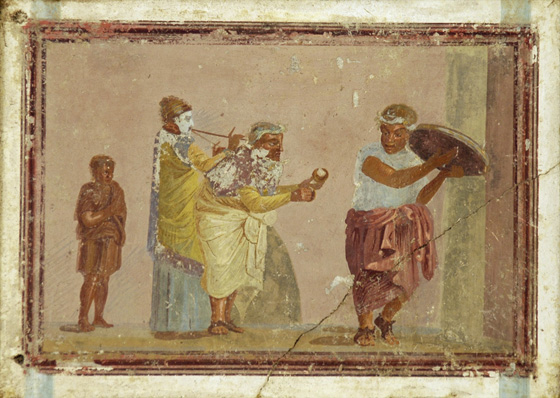 © Museo Archeologico nazionale di napoli vagrant musicians. Frescoes from Stabiy
- A little about entertainment. Bans (this is the form of leisure), theatrical performances, battles, jumps ... something else, which is less known?
- There were still athletic competitions, gymnastics (from the Greek word “naked”), when the young men ran racing, jumped with dumbbells and so on; For this, a whole stadium (from the Greek “stages”, a measure of length) was built under Domitian - it was not preserved, but its shape has been preserved, this is now Piazza Navon. But these were Greek in the origin of entertainment, and they did not take root in the West - just like in the Greek East with less interest they treated gladiatorial battles.
- What about city neurosis?
- We were also well acquainted, and in the works of poets and writers the thought constantly sounds about how happy those who live a peaceful rural life, far from the worries and troubles of the big city. At the same time, their imagination was drawn, of course, not the life of a notzer or a small farmer, but rather a summer resident, and this ideal was put into life: throughout Italy, estates (“villas”) were scattered, many rich people had more than one-for example, somewhere in the hills of Umbria or Etruria (current Tuscany) and on the coast of the Neapolitan Gulf. But few retired to the estate to rest, city life, like today, did not let business people out of their arms.
In general, the problems of citizens are a rather universal thing. The Roman authors, especially the satirical poets, can find complaints about almost everything that modern Londoners or Muscovites complain about. Pliny the Younger in one letter describes his dislike for sports in such expressions that if you replace the races of chariots with football there and place some snobbing intellectual on Facebook , no one will notice anything strange. Разница между нами и римлянами в довольно непохожих системах этических и мировоззренческих координат, но ее трудно проиллюстрировать на примере повседневной городской жизни. В сериале «Рим» канала HBO , в целом скучноватом, эта «инакость» римской жизни и римского мышления показана довольно хорошо.