
Translated material
Mikhail Groman: "The artist must be a little more responsible"
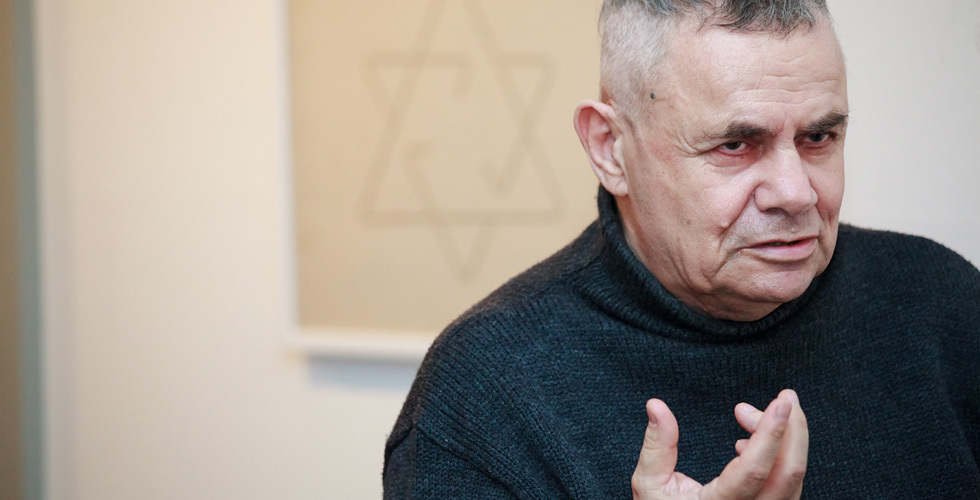
In the Moscow Museum of Contemporary Art in Ermolaevsky Lane, the Grobman: 4 Exhibitions project , organized by the Museum, together with the Embassy of the State of Israel with the support of the Jewish Museum and the Center for Tolerance and the New Literary Review Publishing House. The project is dedicated to the work of the Russian-Israeli artist Mikhail Grobman (born 1939). The curator of the exhibition is Lyol Kantor-Kazovskaya.
Sergey Guskov: You have as many as four exhibitions in Moscow ...
Mikhail Grobman: In fact, five. Four exhibitions - on four floors in the building of the Moscow Museum of Contemporary Art, used to be a house on Zholtovsky Street, now there is Ermolaevsky lane. Another separate small exhibition “The Graves of Mikhail Comban” is in the Tolerance Museum, there will be 16 works. This is such a story - as if I had been killed, destroyed.
As for “4 exhibitions” in MMSI, each is something special. One talks about the 1960s, the second-about the Leviathan group, which was created by me in the 1970s in Jerusalem, the third-about the 1980-1990s, and, finally, the exhibition “After Art”-to the question of what art is today, after all the perturbations and ups and downs that have occurred with it over long years.
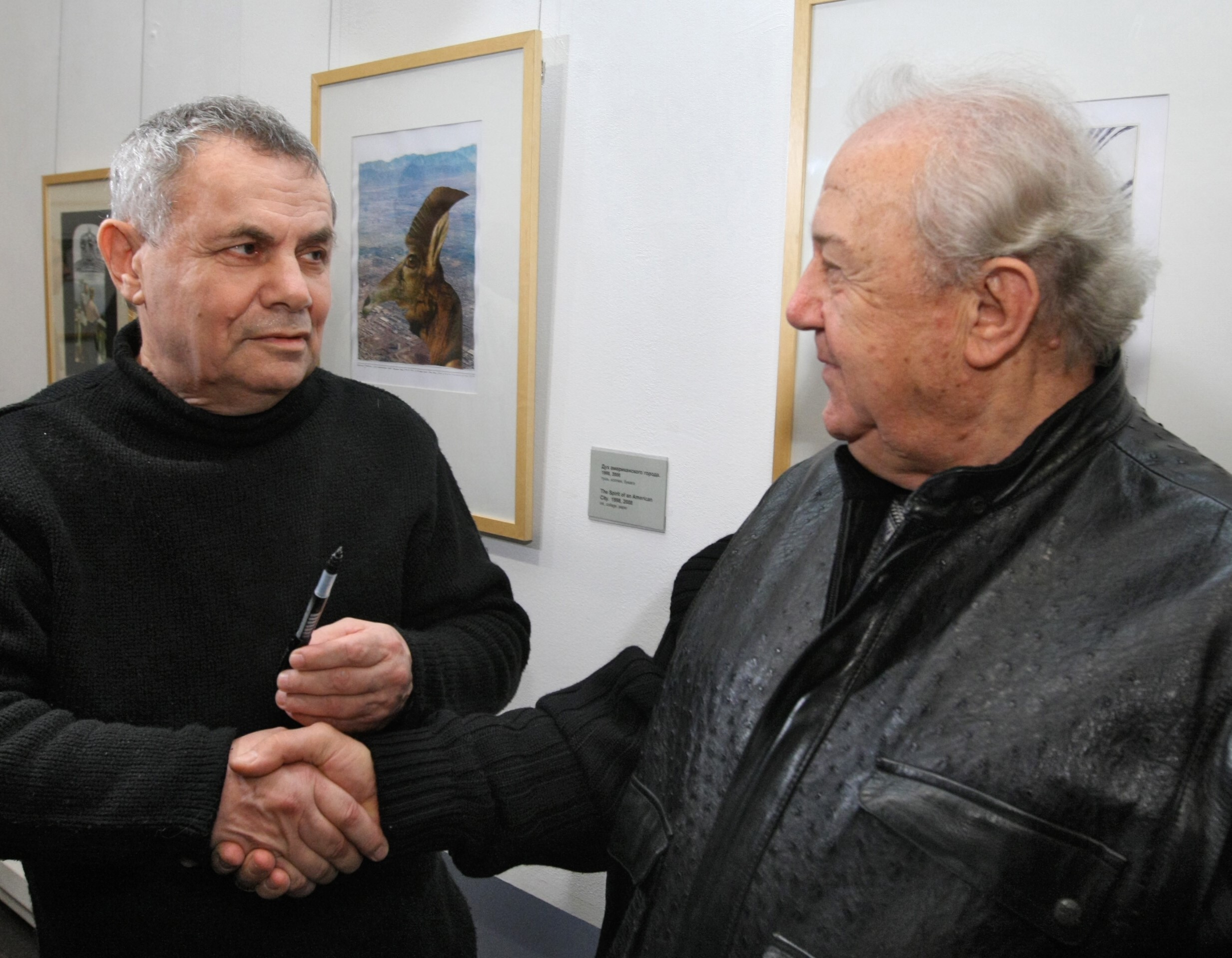 © Vasily Shaposhnikov / Kommersant Mikhail Grobman and Zurab Tsereteli at the opening ceremony of Mikhail Grobman’s exhibition “Metamorphoses of the Collage” as part of the III Moscow Biennale of Modern Art, 2009
Guskov: And for you this is the first so large exhibition in Russia in a long time?
Groman: In general, I had a rather large exhibition in the Russian Museum (in 1999. - Ed .), Then - three years ago - also in MMSI, only in another building, in Petrovka , as part of the Moscow Biennale. So from time to time I get into some kind of tornado, who carries me over the seas and fields and throws me out for the second time in my native Moscow.
One of my first exhibitions in 1965 took place in the same building in Ermolaevsky Lane. Then it was called the house of artists, and the exhibition space was only on one floor. Young artists were shown there, I was also a young artist then. And I made an exhibition-response-such experimental exhibitions were made for one evening, a large number of people came and discussed work. Randomedly there were three artists there, each with his own separate exhibition. I showed such works as the “Grave of the Jewish Soldier”, “Babi Yar” ... You yourself understand how it was perceived. In addition, there were many things there, then it was very difficult with this, no one yet understood. Any deviations - to the right, left, up, down - were considered a shoot. They did not know yet what to do with it. Everything that was not realistic remained behind the brackets.
Antonina Baver: “4 Exhibitions” is a retrospective? I heard you refuse this word. And why - after all, the project covers several periods of your work?
Gromman: There was an idea to show that part of the work that is unknown here. Since 1971, when I left, the connection was lost. I would like to show the audience at least something. Nobody saw the works that I did in the 1980s or as part of the Israeli group Leviathan.
Baurean: By the time you left the USSR, an art environment has developed around you from your friends - the same second Russian avant -garde that you are talking about. Was it difficult to switch when being in Israel? What environment was there? Was it necessary to build an excess of an art community again or did you integrate into something existing?
Gromman: You need to know the situation. I remember Moscow in 1971: the sun, a rather favorable autumn weather. Moscow seemed empty - although there was friendship, there were meetings and relations. This is a property of that period, I mean the second Russian avant -garde. Only somewhere in 1974 new artists appeared, who later become famous: Komar and Melamid appeared, all the new art in Moscow. But I have not found any of this. Therefore, when I left, I had a feeling of emptiness. What I called the second Russian vanguard ended its time, having completed its function, and in Israel, on the contrary, there was a heyday in art, exhibitions, and performances. From Israel, we naturally expected a new life, a new space. I believed that I would come to Israel, I will have an exhibition in the Central Museum. I did not suspect that only the artist who was already old and moldy could do in such a place: he painted-painted, represents the past stage.
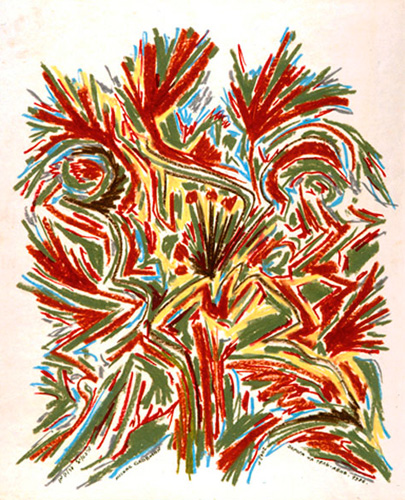 Mikhail Groman. "Road to Tel Aviv", 1986. Paper, oil pastel. 67 x 56
Moreover, with all the stupidity of my expectations, what should happen to me in a new place, the most important thing is what has already happened. We made an exhibition at the Tel Aviv Museum. Even before I left Moscow, I had a block of publications in a variety of Western magazines. The famous John Berger wrote an article about our group, it was reprinted around the world. I remember I came to the director of the Tel Aviv Museum to show my works. I noticed that he had magazines on his table with our publications - mine, Yakovlev, Kabakov, Yankilevsky. Although almost no one knew about our company then.
Artists began to come from Russia then, and they were all conservative. As a result, when they found themselves in the field of view of Israeli artistic life, they naturally could not rise above trade in the gallery. It was a serious problem. Russian art, because of its unsuccessful representatives, was immediately in a very unfavorable position. It was necessary to prove that no, not entirely, not all of them. I had evidence - in the sense that I gave a lot of lectures. I had the opportunity to bring to Israel part of my collection of Russian art, so I could show what real artists in Moscow are doing. The matter ended that twenty years ago the exhibition “From Malevich to Kabakov” was shown in the Ludwig Museum (and thus built a line from the first to the second vanguard. - Ed .).
I brought my conceptual work with me from Moscow. Among them was a collage with Stalin, made in 1964. These works could not be put up in Russia. Later in the Ludwig Museum there was one exhibition, there I had a hall with these critical works. The Germans neatly translated everything, although there was an obscene vocabulary. In the Russian Museum at the exhibition, which took place some time after that, the same works did not go through censorships-already a new time. Catalogs are still stored in some warehouse. And I am very close to folk art. I was generally brought up in a working village, close to common people. Holidays, booze - all that is supposed to. For me, obscene vocabulary is the life of the people.
When I moved to Israel, the conceptual art in the form in which it existed did not interest me: I thought how to create new Jewish art - far from all sorts of shagals and the kitsch into which everything then turned. Many do not know, but in America there were then artists who were looking for new ways in the development of Jewish art. This just approached my ideas, but they were far away, there could be no particular contact. Everything had to be created on their own.
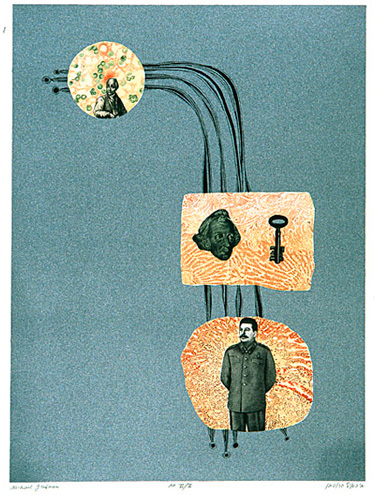 Mikhail Groman. "Generalissimus", 1989. Lithography (at the work of 1964). 76 x 56
Guskov: At the Bergen Assembly, we saw the work of Rosen Roy and the group “buried alive” in which you and Irina took part. How do you coexist with the young generation of Israeli artists?
Gromman: Sometimes we work together, do something. The work that you are talking about was first shown in Tel Aviv. They also painted the exact copies of my works - you entered the dark room, and the work of the tomb of the tomb shone.
Irina Vrubel-Golubkina: It was at the large exhibition "Cargo-Culture" . Max Lomberg was a curator, and mainly Russians participated in it.
Roi Rosen, video of the group “Buried alive”: Historical joke #2, with the participation of Mikhail Grobman and Irina Vrubel-Golubkina, 2013
Gromman: For me, there was never an age problem, this is a matter of relations. I did not run from my youth to old age or from old age to my youth. I am quite satisfied with my 74 years and continue to work.
Baurean: You left for Israel for obvious reasons: you had a bad relationship with a decaying Soviet regime. You probably monitor what is happening in Russia now. What is your attitude to the current Putin regime? Would you emigrate now, being a young artist, or, conversely, would you somehow work with the current Russian reality?
Grobman: Many people who come from Russia to Israel look extremely pessimistic at what is happening in Russia. I’m not that a big optimist, I am a pessimist myself, but I think that Russia's potential is still huge. It is difficult for me to imagine that all this disappears somewhere. I expect a large surge in art in Moscow - for a simple reason: everything flocks to Moscow. So all over the world-in America, everyone is striving in New York, etc. I expect interesting things that will happen in Russia.
As for political troubles, it is completely clear: the state is now working abnormally, there are a certain number of officials and party people who categorically oppose and scold in every way, even all these arrests ... But if we look objectively, for the long-long centuries of the existence of Russia there was no such situation-at least relative freedom. I do not say in defense of what is happening in Russia, I do not justify anything, but the times of Khrushchev and Putin’s times are two different situations. The very fact of the persecution of artists is important. It is difficult to say that repressions are useful for artists, but nevertheless, the fight against nobles, with those who are in power, is definitely useful for artists.
An important point: very few in Moscow are engaged in a revision of borrowings. What is happening in Russian art and was happening 10-20 years ago is a borrowing. This is such a game moment, a game of events. I do not accept this position. In my opinion, the artist should be a little more responsible for what he does. In recent decades, we have been taught: what the artist does is art. In fact, this is, of course, absurd, because it is a denial of art in general. Art should not be a game.
For example, a guy who pinned his eggs to a paving stones . A lot of such things have been done - the destruction of oneself. But in the West it all existed many, many years ago. In Russia, there was a lag for many years in this area, all this actionism and what happened with the Malevich picture -this is not the thought, freedom or courage, except for one thing: I did something successful. The position of destruction is a rather vile position.
When today they are trying to create an event, you need to calculate all coming circumstances. Your personal involvement is important, otherwise you just repeated - no power. But again, I think that to close their mouths, to make people be silent - it is difficult, almost impossible. Only Stalin could do this, but then there was a total destruction of people, they shot in packs. But if there is no such situation that a Chekist can come and arrest you, this means that still more or less normal, there is an opportunity to work.