
Translated material
K.S. Lewis in the corner of poets
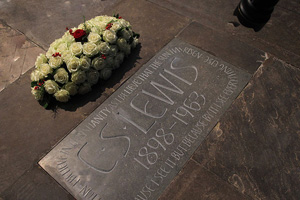
On November 22, the 50th anniversary of the death of Clive Steapleza Lewis, the scientist, the writer and apologet, the author of the famous “Chronicle of Narniy” turned 50. The central event of this anniversary, widely celebrated around the world, was the grand opening of a memorial plate with the name of Lewis in the corner of the poets of the Westminster Abbey. The philologist and theologian, who was not too serious about his literary experiments, turned out to be along with the best poets and writers of England-apparently, apparently, well-deserved. Nikolai Epple was present at the ceremony.
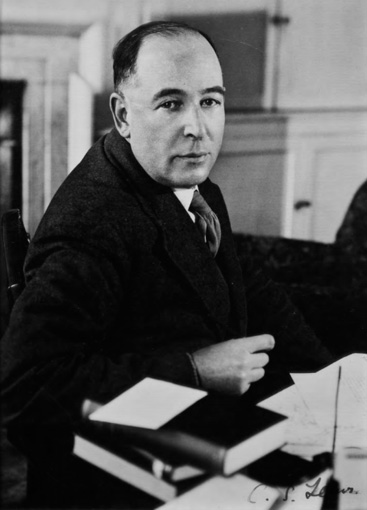 hthq.org.uk Clive Steaples Lewis
The corner of the poets is one of the examples of the flowering complexity of British culture, the pantheon of authors recognized by the national treasure. The first poet, buried in the southern limit of the abbey (in fact, it is called the corner) was Jeffrey Choser (1343-1400) - but not at all in recognition of his poetic merits. He simply was in the royal service and lived in the neighborhood. The hall of glory for poets and writers of England became the southern limit only a few centuries later, and so popular that in the 17th century Ben Johnson had to be buried while standing. In the last one and a half centuries in Westminster, they almost do not bury, preferring symbolic memorials to real tombstones.
The decision to open a new memorial sign is personally made by the rector of Westminster-this is something like a prize in literature according to the version of the Anglican Church. However, this decision is always preceded by a public discussion, and it is not at all as predictable as it might seem. For example, in 1995, the name of Oscar Wilde, not only was an immoralist, but also a Catholic, in the corner of the poets. On the other hand, the humble P.G. Woodhaus was refused this honor, although many influential people spoke in his support, including the Queen Mother (at the beginning of the war, Woodhaus spoke on Berlin radio, and this was considered by cooperation with the Nazis). The corner of the poets is replenished once every few years - for the last time the plate was opened in 2011, in honor of the poet Taed Hughes - and this is always a big event. In the case of Lewis, the initiators were two - the abbot of the abbey, Rev. John Hall, and Oxford philologist and priest Michael Word, the author of the extremely curious book that the seven chronicles of Narnia correspond to the seven lamps of medieval cosmology.
Lewis, like Tolkien, was surprised to observe the growth of his popularity, believing that a couple of years after his death they would forget about him. This is one of the few cases when historical and literary instinct has changed him.
Lewis is a rather atypical inhabitant of the corner of poets, but that is his case more remarkable. In his youth, he considered himself the hope of English poetry, he quickly realized that he had overestimated his abilities. Two poetic collections published under the pseudonym turned out to be quite weak, and the rest of his life Lewis extremely carefully printed his poems. (But he did not stop writing, in the collection of poems that published after his death there are brilliant examples, and the translation of the first two books of “Aeneid” recently discovered in notebooks is quite comparable with the best of the well -known translations.) Also, not everything is simple with the writing of Lewis. Today he is known primarily thanks to the "chronicles of Narnia." They come out in million circulations, they are based on Hollywood films, but Lewis himself did not take them too seriously and did not put in any comparison with the works of his friend and like -minded Tolkien, who, as it had recently found out, proposed nominating for the Nobel Prize. Lewis was primarily a scientist, and literature was for him the subject of study, and not the sphere of exercise of his own creative abilities. His composition was rather a scientific fun, in any case, he himself treated him like that. The “Space Trilogy” - in essence, the retelling of the “lost paradise” of Milton and Arturov’s legends under the guise of science fiction fashionable in those years, and the novel “So far we have not gained faces” - the Christian arrangement of the myth of Amur and Psyche.
First of all, Lewis was a historian of literature - his books on medieval allegory, Milton or the medieval picture of the world are still included in the lists of compulsory literature for specialists. It was in this capacity that he gained fame in the late 1930s, when suddenly he began to speak with popular exposures of theological issues-which turned out to be unexpectedly in demand. Among the most famous apologetic treatises are “just Christianity”, “suffering”, “love”, “letters of Balamut”. Lewis, like Tolkien, was surprised to observe the growth of his popularity, believing that a couple of years after his death they would forget about him. This is one of the few cases when the historical and literary instinct changed him: the circulation of his books continued to grow, and after 50 years he was awarded the memorial with Choser, Milton, Spencer-the authors that he studied.
 © Westminster Abbey
The main stars of two-day celebrations were the two most striking and authoritative Christian intellectuals of today's England-Rowan Williams, a former Archbishop of Canterbury, and now the rector of the Cambridge Modlin-College, where Lewis, and Alistair McGrat, the theologian and the polemist, was taught mainly by the work of the natural. Theology ”and disputes with the chief British atheist Richard Dokins. English intellectuals are disciplined and well -understanding in marketing: by the anniversary date, McGratus released as many as two books about Lewis - a voluminous biography and a collection of essays, Williams - a thin, but remarkably deep book about the theology of Narnia with an excellent epigraph referring to Witganstein: “What should not be discussed, about it, about it. Compose children's fairy tales. ” McGrath acted “Hedliner” by a mini-conference, held on November 21 in the Church of St. Margarita next to the Abbey, and Williams-solemn worship, during which the memorial plate was opened.
The theme of the conference was the mystery of the popularity of Lewis's books, which to this day do not lose their reader. The speakers were unanimous: the reason for the effectiveness of the word Lewis was his ability not to separate the work of the mind from the work of imagination, to represent Christianity not as a naked idea or a bright and inevitably facilitated image, but as a single whole, a kind of Christian myth, close to Tolkien's myths. Hence, another important difference from numerous and far from so successful attempts to explain Christianity to contemporaries follows: Lewis does not try to adapt to the audience. On the contrary, one of his main ideas is a reminder that God should not approach our optics, it may very well be that he has his own, and our tricky issues can suddenly turn into a meeting. The historian’s skill is adjusted to the studied era in order to correctly read the monument, the ability to free himself from cultural-historical egoism Lewis translates into theology. Violence over the picture of the reader’s world, exactly what the authors of all kinds of adaptations are most afraid of, in Lewis is a source of unexpected and joyful discoveries. Tolkien even had a special word for this, of course, Greek - Eukatastrophe , “good shock”.
 © Westminster Abbey
And therefore, it looked quite logical that the leitmotif of worship was philology and asceticist the next day. After the introductory anthem, performed by the choir of the Westminster Abbey, and the voice of Lewis himself sounded the temple. In the only preserved record of his radio expert of the 40s, of which in the end it turned out “just Christianity”, he spoke about the secret of the personality. The fact that in spiritual life, just like in literature and art, only by abandoning concern for originality, you can become truly original, only abandoning yourself-really gaining yourself.
This principle permeates all his life, from top to bottom. Give yourself - and you will gain yourself. Mount your life and you will save it. Determine your vanity, your most secret desires every day and your body - in the end, give every particle of your being - and you will find eternal life. Do not hold anything. That which has not died in you will not resurrect from the dead. You will look for “yourself” - and only hatred, loneliness, despair, anger and death will become your destiny . (Per. N. Traumberg)
The best confirmation of the said was the anthem, which the choir performed at the end of the service. The poem, written “on the table” and never published during the life of Lewis, was put to music specifically for this case - and turned out to be a model of excellent liturgical poetry.
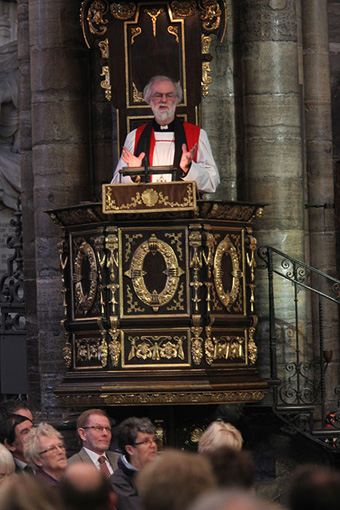
The sermon read by Roween Williams was also philological. He spoke of virtue of respect for the language. Attention to the language in Lewis's books is a sign of attention to reality, the opposite of which is the Babylonian mixture of languages from the apocalyptic scene in the final of the “Merzeli power”. Distortion, scolding the language - and lies as one of the manifestations is an extremely effective way to deceive yourself, hide from yourself, while a meeting with God involves gaining yourself.
 © Westminster Abbey
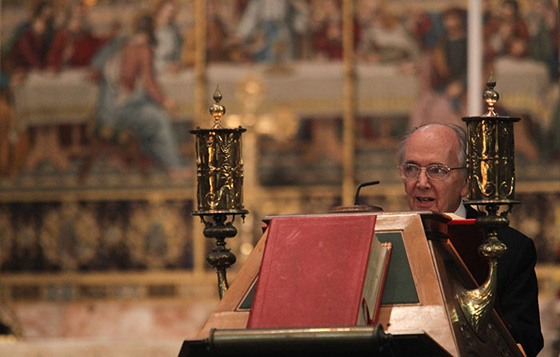
After the excerpts from the prophet Isaiah and the Messages to the Corinthians, who were read by the last Cambridge student of Lewis and the professor, who today occupies his department, the adoptive son of Lewis Douglas sinful read the final of the “last battle”, the final part of the “Chronicle of Narnia”. Perhaps this was the strongest moment of worship: it seemed that the concentration of literature in the air reached the maximum, and the border between the worlds suddenly became permeable, as in the books of Lewis. In the middle of the Gothic temple, from the walls of which the poets and writers of antiquity carefully looked at what is happening, who looked like a fidel of Castro, or to Chuck Norris, an elder in tall boots and with a large pectoral cross, looking out of a leather jacket, read about how the divine lion says to the children: your earthly adventures are over, you are dead, you are dead, you died now Now the most interesting begins. “The academic year is behind, the holidays have come. The dream is over, here's the morning. "
And while he said, he was less and less like a lion. And what happened next was so beautiful that I could not write about it. For us, this is the end of all stories, and we can honestly say that they lived happily ever after. But for them it was just the beginning of a real story. Their whole life in our world, all adventures in Narnia were only a cover and a title sheet; Now finally the chapter one began the Great History, which not a single person on earth read; Stories that lasts forever; Stories in which each chapter is better than the previous one . (Per. E. Dobrokhotova-Maikova)
It would be difficult to choose the best fragment for such a case. But in addition to the connection with the posthumous life of Lewis's books, there is another, less obvious and more amazing logic here. The last scene of the Narn was read in the place of the service where the gospel was to be read. But the replacement, rather risky, if it was a deliberate replacement, looked completely justified. And the point is not only that the lion is “Narn” is a transparent allegory, and this whole episode is an easily recognizable reminiscence of the Gospel of the Gospel of John. For millions of readers, Lewis really turned out to be the boss of the gospel in the form of a fairy tale, myth or accurate image, the surprise of which made the effect of recognition only more piercing and joyful.
 © Westminster Abbey
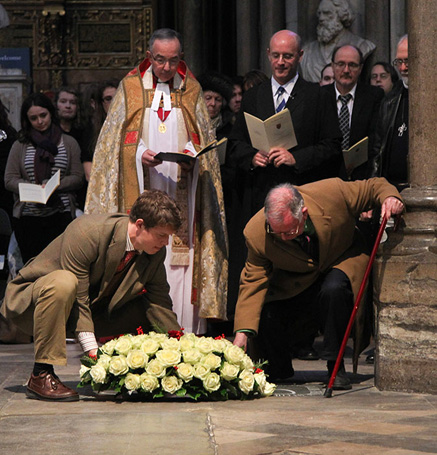
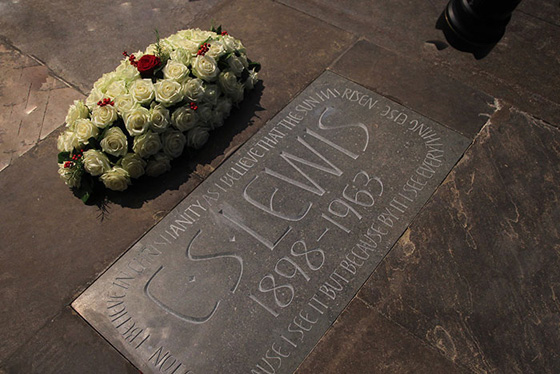
After reading, the arcessor of Lewis Walter Hopper laid a wreath on the stove with the name of the hero of the occasion. Sixty -four white roses - by the number of years of Lewis’s life, seven branches of the Ostolist - according to the number of books about Narnia, three branches of rosemary - according to the number of books of the “Space Trilogy” and one red rose - tribute to Lewis's studios in the field of medieval literature. Symbolism that does not cut the eyes against the background of the medieval color of the cathedral and historical and literary-the whole service.
Words carved on stone - a quote from Lewis's essay “Is poetry theology?”: “I believe in Christianity, as I believe that the sun has risen. After all, I not only see him - thanks to him I see everything else. ” These words are another example of the Lewisian method. Being unconditionally bright and convincing, they are a paraphrase of comparison of the divine good and the sun from the Platonic "state". It is very noteworthy that in two days, repeatedly quoting these words, no one recalled their original source. Lewis is not in vain called a brilliant translator of Christian theology in the language of modern culture: perhaps the most important thing in the art of the translator - to make the translation make the impression of the original text, does not look with tracing paper. Lewis does not try to be original, he draws his images and thoughts with a generous hand from the history of European philosophy and literature, but he does it so that old meanings come to life and quote him, far from always recalling his sources. Apparently, this is how culture acts. This is what Virgil had in mind when he said that it was harder to steal a verse in Homer than the Palica at Hercules; This is difficult, but the result of such a theft is Eneid. The whole history of the posthumous popularity of Lewis is the best evidence that this principle does not stop working.