
Translated material
The greatness of repentance
Willy Brandt is a mirrower chancellor. On the 100th anniversary of birth
During a visit to Warsaw in December 1970, the Chancellor of Germany Willy Brandt committed an act that was destined to remain in history forever: he knelt before the monument to the heroes of the Warsaw ghetto. December 18 marks the 100th anniversary of the birth of an outstanding politician

Willy Brandt (1913–1992). Stuttgart, Germany, 1970. He took over all the pain and all the shame of his people. He cut it on the living, so that his people rose from sorrow and humiliation, ceasing the self -destructive lawsuit of greatness. Remaining an ordinary person with all the weaknesses, he enjoyed power, as a child who is childishly establishing the rules in his sandbox. He was generous, for the old political values lost meaning. And he was right. The world reigned in Europe. The one we know today. Once, in the late 90s, the outstanding German intelligence officer Marcus Wolf told the author of these lines: “Sometimes I was ashamed before Willy Brandt.” No, then it was not only about women who, until the very last days of Brandt’s stay in power, was supplied to him by agent Stasi and at the same time the Chancellor's referer, the captain of the GDR GDR Gynter Guillaume (and this was truly an iron trump card for any blackmail, since many meetings were recorded on a tape recorder and went to East Berlin), and not only about hundreds (if not thousands of) secret documents that fell into the hands of the enemy. Marcus then said amazing: Brandt "did not consider opponents to be opponents." That's what the question is! That's what the power is! It seems that the Soviet slogan “Peace - Peace” Brandt understood literally. And even the fact that he accepted the political responsibility for his referent-spy and, when the scandal broke out, resigned, made him as a result the winner. “Before the exposure of Guillaume, we considered him (agent) to work with our great success,” Marcus Wolf writes later, “but on May 6, 1974, when Brandt resigned, I regarded this as the greatest defeat.” The gift of the visitor with the top of Brandt is his eastern policy. Under him, the Germans officially recognized the inviolability of the borders established as a result of the Second World War, in particular, the border along the Oder - Neis. They forever refused to use force or threat to use it with the aim of returning the territories where they lived for centuries. The 12 million of these Germans after 1945 were brutally expelled from their native places, regardless of the degree of personal support for each of them of the Nazi regime and the participation of Nazi crimes (almost 2 million of them died during these shares). A quarter of a century after the war, until 1970, the Government of West Germany claimed that the legally German Reich exists within the 1937 borders. (The author has a 1969 publication atlas, where the Kaliningrad Region and the Poznan Voivodeship are designated as territories “under the control” of the USSR and Poland.) To sign such an agreement as the Moscow 1970 Moscow, which completely changed the political landscape of Europe and the threat of a new war, which all German politician, had to have not just courage - he had to have a gift of a midwife. It was necessary to frankly tell the millions of their compatriots that they would never return to their homes. And to say so that compatriots understand and accept this. Brandt turned to the Germans from the capital of the USSR: “We are not losing anything other than that have long been lost. We have the courage to open a new page in history, primarily for the good of our young generation, which has grown in the world and is not responsible for the past. But it should also share the consequences of the war, because no one can avoid the fate of their people. ” "
It was Willy Brandt who stood nearby with Helmut Koley with the proclamation of a single Germany on October 3, 1990
"Herbert nicknamed Willy events that fell to the share of this man, would be enough for many: climbing from the very bottom to the political peak, struggle, persecution, exile, betrayal, spy passions, women, alcohol, political revival ... illegitimate, he did not know his father, and then he almost did not communicate with his mother. He was given the name of Herbert and the name of his mother. To himself, Ludwig Frams, a passionate social democrat, who told the grandson about the ideas of Augustus Bebel. The SDPG witnessed the desperate fights of the “front of the front”, the Nazi Democratic groups, after the capture of power by Hitler, the party sends Herbert to Norway on the night of April 1, 1933. Soon he moved to Oslo. Herbert Fram is 19 years old. He accepts the underground nickname Willy Brandt. Surprisingly quickly mastering the Norwegian language, works in the Norwegian Workers' Party, studies history, writes articles for party and trade union newspapers. Much impressions of him. In Storting (parliament), deputies are not sitting in parties, but in regions, conservatives near the socialists. Political opponents are not sworn enemies at all. So, after more than 30 years, he will sideways work on the post of head of the Ministry of Foreign Affairs with Chancellor Kurt Gorg Kisinger, who once had a member of the Nazi party, and his colleagues will be the right-wing politician Franz Jozef Strauss and former communist Herbert Venus. *Examples of the Great Coalition - Government of the CDU/CSS and SDPG in 1966–1969 and 2005–2009. "Big Coalition"* in Germany is one of the political know-how Brandt. The near circle will cease to be a pass to power for him. A decisive turn to democratic socialism occurred at Brandt in Spain, where he went under a stranger to the name as a journalist and where he met George Orwell. In Barcelona, he witnessed Stalinist terror when the leaders of the free anarchists and the Poum Left Party were arrested and shot. Brandt himself miraculously escaped his arrest. Then there will be illegal work in Berlin, and after the occupation of Norway - in the underground there. Then the flight to Sweden, where he will create a press bureau of Norwegian resistance.

Agent Stasi Gunther Guillaume (right) was introduced into the Willy Brandt apparatus as a referent. He accompanied the chancellor on all trips, including the pre -election (in the picture). 1974, the attempt on morality after the war Brandt abandoned Norwegian citizenship and returned to Germany. Brandt did not want to be the Ober-Burgomist of his native, but provincial Lubeck-he needed Berlin. With him he will survive three crises: the Berlin blockade of 1948-1949, when Stalin cluttered the Western sectors, trying to cure former allies from hunger and cold. Then an “air bridge” was organized, according to which almost 2 million tons of cargo were transported to the besieged city. West Berlin is perzed (electricity was turned on for two hours), but did not give up. Already being the ruling burgomaster, Brandt harshly opposed the Khrushchevsky ultimatum of 1958 on “demilitarization”. He is invited to New York, where the press has already christened him “Mr. Berlin”, and the inhabitants of New York, standing in front of the Town Hall in the pouring rain, show him an enthusiastic reception. And finally, August 13, 1961: the beginning of the wall. With despair, Brandt sees that Europe and the USA do not react, as if nothing was happening. 20 hours will pass before the first jeeps appear on the border, 70 hours - while the first notes of protest are handed in Moscow. Berlin is thrown by the West and Adenauer without help, and only the words remain Brandt, but they are clear and energetic: “Berliners! The USSR implemented its plan. What happened is an attempt on the moral of the German people. ” Pay attention to such an alien politician the word "morality". Brandt in powerless anger appeals with a letter to US President Kennedy. From the point of view of the norms of diplomacy, this was an incorrect act, but it was fully consistent with the mood and those fears that reigned in West Berlin. The head of the city, despising all diplomatic decency, reproaches the head of a powerful power: “Berlin needs more than words. Berlin expects political actions. ” Kennedy's first reaction is annoyance. But then he sends the vice president to the western Berlin and directs the combat group. Finally, Kennedy decides to come to the city himself, and on June 26, 1963, he makes historical speech in front of the Schöneberg Town Hall, in which the Ich Bin Ein Berliner - “I am a Berlin” became a cult phrase. "We know the day will come"
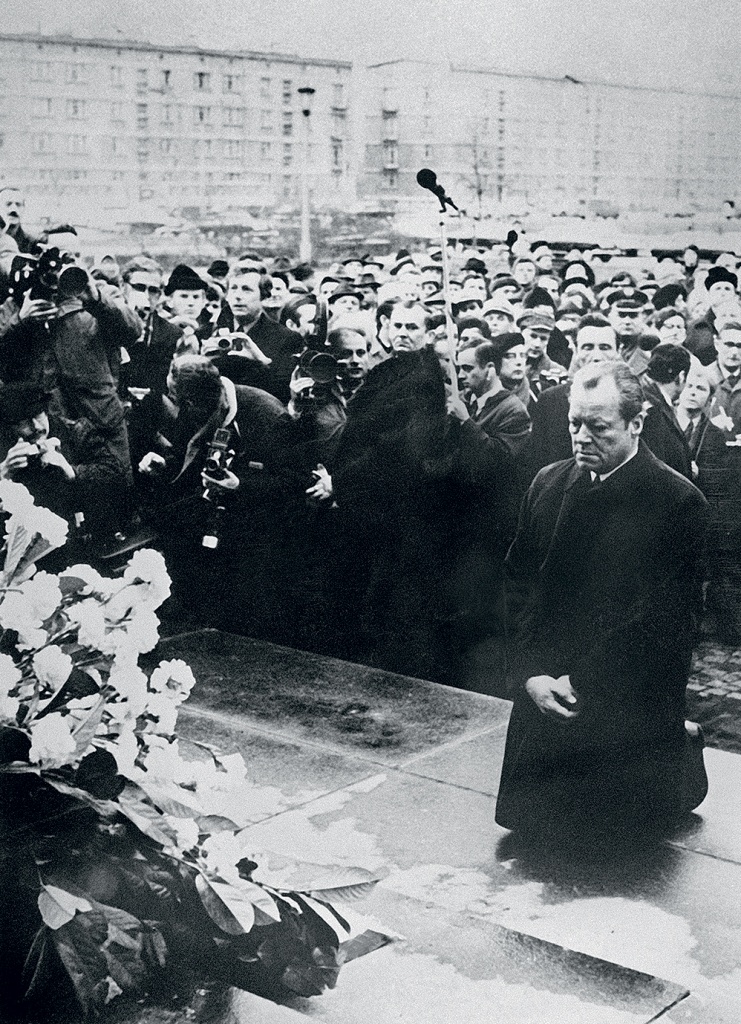
Willy Brandt at the monument to the heroes of the Warsaw ghetto. On December 7, 1970, Brandt almost the first to understand the traction of the German people to reunite. “We know the day will come,” he said in August 1961 at the burned Reichstag before a giant demonstration of 700 thousand Western Germans, “when the Brandenburg gates will not be more than the border. We pray, we urge, we demand: open the gate! ” In the late 80s, this call, addressing Gorbachev, will repeat Ronald Reagan literally. Having become a federal chancellor in 1969, Willy Brandt finally realized the fateful turn in the life of his country. He pronounces one of his brilliant phrases: “If a person like me, a person with my biography, was able to become a Chancellor of Germany, then this means that only now Hitler finally lost the war.” But a few years ago, plunging into the abyss of endless drinks, he complained that "an emigrant could never become a chancellor." Brandt rejects political taboos and is found in Erfurt with the head of the Government of the GDR - a country that before him in Bonn tried not to even be called by name. The ice was broken. “Brandt made it clear to us,” said Henry Kissinger later former Secretary of State, “that the reunification of Germany has the highest priority for him.” But for this, at first it was necessary to end the non -recognition of the GDR and establish relations with the eastern neighbors - Poland and Czechoslovakia. This could not be done without recognition of the indestructibility of the boundaries. But this was the Strategy of Brandt: he accepts the status quo inside Germany in order to change it in better times. It was Willy Brandt who stood on his right hand from Helmut Kolya at the Reichstag building when the united Germany was proclaimed on October 3, 1990. He stood in the same place where 29 years ago he called for opening the Brandenburg gate. But he committed the act, which brought him the Nobel Prize of the world twenty years earlier, in December 1970, during a visit to Warsaw: Chancellor of Germany Willy Brandt knelt before the monument to the heroes and victims of the Warsaw ghetto. “I did what people do to express what is impossible to express in words,” he will write later. In the same way, in the Israeli memorial to Vashem, he reveals the book of psalms and reads aloud: “... we committed sins and crimes. Merciful God, forgive us ... ”If someday the Russian president (not necessarily the current one) will kneel in front of the Solovetsky stone or at the passing Novocherkassk plant, then it will be safe to say that the new Russia was born. As new Germany was born with the help of Brandt. For this is the greatness of repentance. Photos: Roger Viollet/East News, Bundesarchiv, AFP/East News