
Translated material
Bow for the holiday
What remains of the project of "wide amnesty"
The presidential amnesty in honor of the 20th anniversary of the Russian Constitution disappointed those who were waiting for her behind bars. And even more - those who prepared it
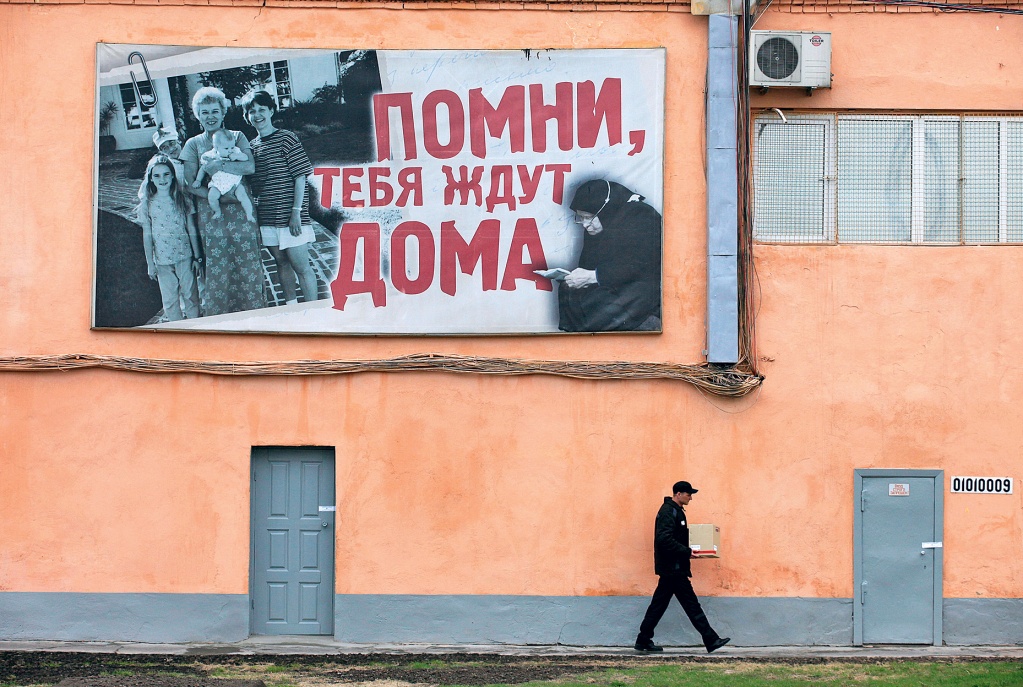
Poster on the territory of IK-17 in the Krasnoyarsk Territory. May 14, 2013
Evgeny, a former entrepreneur, is serving a deadline for an economic article (159 of the Criminal Code of the Russian Federation, “Fraud”) in one of the colonies of the general regime of the Ryazan region. According to the amnesty bill, which Vladimir Putin introduced to the State Duma on December 9 and which the chamber will consider before the end of the week, will be released by crimes of small and moderate severity, up to five years in prison. But in Eugene, the news of this causes only a smirk: “This is not an amnesty, this is a clowning ... In our colony is 1800 people. Every day ten to one-eighteen is released every day: who is at the end of the deadline, some by parole. So we calculated: on this amnesty, we will have only five or six people-those who usually “call in” to the zone are positioned-simply because they feed and warmly ... ”
Metamorphoses
The conversation about the “wide amnesty” for the 20th anniversary of the Constitution first went at a meeting of Vladimir Putin with members of the HRC on September 4. In total, since 1991, 16 amnesties have been held in Russia. The last large -scale amnesty - 200 thousand people were released - announced in 2000.
Putin put the term for human rights activists: to transfer the finished draft amnesty to the Main Legal Administration of the Presidential Administration (GPU) by October 15. Human rights activists met on time: they transferred the concept of amnesty and the landing project to the Kremlin lawyers. At the same time, the members of the HRC agreed not to allow leaks in the press. Of course, there was a lot of conversations, the public was interested in whether the defendants of resonant affairs would fall under the amnesty - Pussy Riot, Arctic Sunrise, “Swamp business”, whether she will affect Mikhail Khodorkovsky, Plato Lebedev, Evgenia Vasilyeva, Alexei Navalny, Peter Officerov. Moreover, only 464 people fell under the summer “economic” amnesty of 2013, of which only 50 came out of the lattice.
“The president instructed us to develop the idea of the liberation of those who have not committed violent crimes that entailed grave consequences for life and health. And we followed this concept, ”the retired judge explained The New Times, a member of the HRC Tamara Morshchakova. “What we wrote and what is included in the State Duma is completely different projects.”
"
“This is the small“ bone ”that is thrown to society in order to slightly mitigate disappointment after the coop of amnesty in July”
"
According to Morshchakova, an amnesty, on which after human rights activists worked in the GPU, is more like a tool to resolve the issue in relation to specific persons: "Lawyers from the presidential administration not only did not accept our project as a basis - our proposals did not find any reflection in the final version at all." Why? According to Tamara Morshchakova, human rights activists and lawyers from the GPU understand the goals of the amnesty in different ways: “For them, this is a bow for the holiday of the Constitution. With the help of an amnesty, we wanted to solve important tasks related to the reform of the prison system. ” Such reform is impossible without a decrease in the prison population, Morshchakov clarifies.
The head of the end of the amnesty has changed with the fact that in the final version, the head of the HRC Mikhail Fedotov also agrees. But he explains the metamorphosis as follows: “Not only we influence the president, he takes into account the wishes of different people, including public opinion. Recent sociologists' surveys indicate that amnesty is unpopular among the population. ”
Olympic decoration
In July 2013, the Public Opinion fund conducted a study regarding the amnesty of convicts on economic articles. 26% of the respondents replied that they were against, 12% - considered that the amnesty would entail more negative consequences than positive ones. The Maisky survey of the VTsome also confirms the version of Fedotov: 36%-against the business aspect, 33%-for 31%-found it difficult to answer. Regarding the wide amnesty, sociological surveys have not been conducted at all.
“Probably, these figures were shown by Putin by his lawyers,” said Andrei Babushkin, a member of the HRC. “They could convince the president that on the eve of the Olympics, a large number of people can worsen the criminal situation.” The result was a decorative amnesty, not substantial. ”
Grandmother does not trust Grandmother with sociological surveys. He believes that in society about the amnesty, there is actually a consensus: “The fact that the law enforcement system is imperfect and the number of judicial errors is growing is increased today by human rights activists, and inhabitants, and jailers, and even investigators. One of them told me the other day: “I’m going to the court here, I think they will give me a force for two years. They gave five - horror! "
| *The case of riots on May 6, 2012 on Bolotnaya Square in Moscow is considered in the Zamoskvoretsky court of Moscow. |
One way or another, “horns and legs” remained from the project proposed by the HRC, Babushkin admits: only “hooligans” are released on resonant matters and “who took part in the riots”. Whereas in the project developed by the HRC, the amnesty of the “bedspread” and the first part of Article 318: “Application of violence in relation to power”. There we are talking about violence that is not dangerous to life and health. If this composition of the crime entered the final project, then almost all the defendants in the “Twelve Affairs”*would be released.
Maidan factor?
But only the results of sociological surveys played a role in developing a final, narrowed amnesty version? Andrei Babushkin admits that the recent events in Ukraine influenced the decision of the president: “At the meeting on December 10, Putin said in Novo-Ograyevo: we cannot free those who attacked the police. They will not understand us: tomorrow we will call the police to the rescue, but she will not come to our aid. ”
It is possible that Putin was impressed by the events in Kyiv, where by that time the confrontation between power and the protesting people was undergoing for the third week. There were fierce clashes of protesters with the police, there were detained, but the Maidan nevertheless continues. Therefore, they could judge in the Kremlin, the Ukrainian authorities showed weakness and indecision. But Russia must be secured from Ukrainian infection-there will be no amnesty to the “swamps”!
"
"It is obvious to me that we are dealing with a situation where politics traces the right"
"
However, the head of the Institute of Human Rights, Valentin Hefter, disagrees with Grandmother: “If the Maidan really influenced the“ Richtovka ”of the project, then“ mass riots ”and“ hooligan ”would be excluded from the amnesty. According to Valentin Gifter, the presidential version of the amnesty is “that small“ bone ”that is thrown to society in order to slightly mitigate the disappointment that inevitably arose after the chicken of the amnesty in July.”
The human rights activists are also outraged by the fact that under the presidential project, police and jailers convicted under the 286th article of the Criminal Code (“Excess authority”) may be released. This article, as a rule, is given to those who are attracted for beating or torture of under investigation and prisoners.
"Yes? And I don't think so "
In the final version of the amnesty, a politician prevailed - to the detriment of law, lawyer Henry Reznik believes: “It is obvious to me that we are dealing with a situation where the politician is violating the right.”
Reznik draws attention to the fact that, according to the December amnesty, the girls from Pussy Riot come out and the affairs of Greenpeace activists are being closed: “It is clear that for the authorities this is a good opportunity to keep their face. After all, to recognize your mistake for these two cases, widely known not only with us, but in the West, power cannot. So they chose a compromise option. ”
In the initiation of both cases, the lawyer recalls, initially there was political motivation - after all, there was nothing to plant in jail Pussy Riot, only administrative punishment could threaten them. And it was impossible to judge hooliganism activists-there is no corpus delicti: “It is impossible to terminate the case for the lack of corpus delicti, this is equivalent to admit that their arrest is a political action not backed up by any legal norms for the authorities. This is where the amnesty turned up! "
State Duma deputies have already stated that they would support the presidential version. Human rights activists hoped to convince deputies so that they change some provisions of the bill. So, for example, according to the project, after the publication of the amnesty, only the already convicts will be released immediately, and the rest will have to wait for the court’s sentence. But human rights activists are sure: it is necessary to terminate cases at the stage of investigation and court. They also propose to exclude such a norm as depriving an amnesty of “malicious violators of the regime”. “The penalty in the colony is given for any offense and can do it on purpose so that a person does not go out ahead of time,” explains the head of the HRC Mikhail Fedotov.
How many people can go through amnesty is not very clear yet. “According to the certificate from the FSIN, which was sent to us in November, very small numbers are obtained,” says Valentin Gifter. - Together with conventionally convicted and under investigation, about five thousand people can be free, or even less. No more than two thousand will come out of the colonies. ” Here you have a "large -scale amnesty" ...
It is said that at a meeting with Putin in Novo-Ogravo on December 10, one of the human rights activists approached the president and said in his hearts: “Vladimir Vladimirovich! Such an amnesty is a shame for our country. We will all be ashamed of all then. ” Putin looked in surprise, raised his eyebrows: “Yes? And I don't think so. "
He turned and moved away from the daredevil, expressing a seditious thought.
Photo: Ilya Naimushin/Reuters