
Translated material
The former Duma
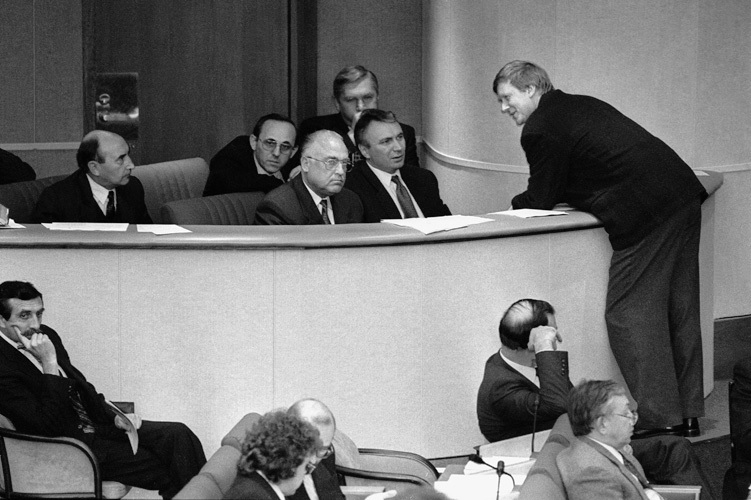
The corner of the deputy
The first state Duma of Russia for some time resembled a communal apartment from old Soviet films: screams, the struggle for survival and the eternal shortage of square meters. After the October shelling of 1993, the White House was severely damaged, smoked and not accepted for placing parliament there, so immediately after the election, the Moscow City Hall took several floors and the meeting room in the former SVA building at the very end of Kalinin Avenue, at the exit to the Moscow River (now the Square of Free Russia). No one, except the chairman, had rooms. On the ground floor there were partitions that created the illusion of individual rooms. It’s good if everyone had enough chairs - there were practically no one here, so the deputies were literally written on the knee for six months. What later began to be called "kuluar showdowns" occurred right here - in front of everyone. However, a few months later the same scenes with fists and dragging each other by the hair could already be observed in the meeting room on Okhotny Ryad. Everyone mainly went to work on foot: before the resettlement in Mitino, where two houses were allocated for them, the Duma lived near Kalinin Avenue - in the hotels Mir, Moscow and Russia. In 1994, the State Duma chairman Ivan Rybkin, along with the mayor of Moscow, Yuri Luzhkov began to look for a more spacious building for parliamentarians. A variety of options were discussed - in particular, deputies were proposed to move to the complex of buildings on Vernadsky Avenue, where the Academy of Public Administration is now. However, as a result, the building was chosen on Okhotny. Ivan Rybkin says that one evening Luzhkov came to him and asked how he was looking at the former building of the USSR State Planning Commission, to which, if necessary, the mayor promised to join the neighboring house in St. George Lane. “We immediately went with him to the Okhotny series, examined all the halls, went down to the basement, where it was huge, on the chest, a puddle of wastewater, in which feces swam. I then told Yuri Mikhailovich that it seems that it would be necessary to resettle a house in Georgievsky Lane, which at that moment occupied several organizations - one building was clearly not enough. Thanks to the personal assistance of Boris Yeltsin, everything went quickly and painlessly. Everyone was settled in new offices with even greater convenience than before, and the Moscow association of the Federation of Independent Trade Unions of Russia generally received a mansion. So we solved the problem of moving, but encountered the need to repair the building, especially the basements. This process dragged on for a long time: I remember on December 22, 1995 I made a farewell speech at the last meeting of the State Duma of the first convocation, and at this time the pumps pumped out the last drops of the fecal puddle. By the way, all the equipment that we installed then works regularly. ”
Questions of everyday life
At first, the Duma did not even have its own accounting - since only two years were allotted for her work, it seemed too troublesome to spend time on economic issues. Then, in the Presidential Affairs Management, a special account was opened for them, which received salaries of all employees of the lower house of parliament. The chairman of the State Duma of the second and third convocations (1996-2003) Gennady Seleznev says that the speaker’s salary was 50% more than the ordinary deputy - not 10, but 15 thousand rubles, but everyone has the same pension, regardless of who held which position. The system of deputy privileges has never changed significantly and to this day remains the same as in the first years of the Duma: an office apartment, attachment to clinic No. 1 on a Sivtsevo hostility, the opportunity to buy a preferential ticket to one of the sanatoriums of the Presidential Affairs Management, a free ticket in the business class of the plane and the train throughout the country, service in business rooms Call service car. True, some deputies recall that at first they had to go to work on special buses that took the Dumans in the rake and took it to the Okhotny row, and delivered back in the evening. Ivan Rybkin recalls: “I, as a chairman, went on the Volga, although many of my colleagues have already traveled to Mercedes and other foreign cars. A guard always sat ahead of the driver, I am alone in the back seat. And all - no more escorts. I know that Vladimir Filippovich Shumeyko traveled in the same way (since January 1994 - the first chairman of the Federation Council of the Russian Federation, in accordance with his position in 1994-1996 was a member of the Security Council of the Russian Federation. - Ed. ), Sergey Alexandrovich Filatov traveled even more modestly (in 1993-1996 - the head of the presidential administration. - Ed. ), I am not talking about the Chairmen of the Constitutional, Arbitration and Verkhovna and Verkhovna. ships that generally lived very, very modestly. The private security was responsible for our safety, although access to the Duma was free, even in 1994-1995, when a war was already in full swing in Chechnya. And today the passage to the building is so difficult that it resembles an absurd theater - they may not even miss their own, if you forget the pass, not to mention outsiders. The first parliament was representative in the literal sense - he represented the interests of people, and not a pile of bureaucrats, as it is now. People could at any time come to us for an hunting series and chat with any deputy, maybe because half of us was elected in single -mandate districts and the responsibility to people was higher. ”
On December 22, 1995, I made a farewell speech at the last meeting of the State Duma of the first convocation, and at this time the pumps pumped out the last drops of the fecal puddle.
During the work of the Duma of the second convocation (1996-1999), parliamentary television and parliamentary newspaper were created. Gennady Seleznev, the initiator of the “parliamentary hour, believes that the federal media were far from always objective and sought to“ pinch ”the deputies as painfully as possible. Photographers, recalls the speaker, specifically chose such angles that the deputy in the frame looked like an idiot, an adapprop into his nose. “I remember once in St. Petersburg at the inter -parliamentary assembly in the Tauride Palace I left the front doors to the car, and a man lies under the car. I ask - what happened? And he replies: “Nothing. I am a photographer of Kommersant, here I am looking for the right angle.” We laughed together, but it seems that he still caught me. ”
Laws and orders
The state Duma of the first convocation was elected on December 12, 1993 and, according to the transitional situation, worked for only two years. The elections were held according to the mixed system: out of 444 deputies, 225 were held in the general Federal constying district and 219 in single -member districts. Despite its short existence, the first Russian parliament of the New Age turned out to be perhaps the most effective in history. Its chairman Ivan Rybkin recalls: “Two-thirds of the legislation by which modern Russia lives (civil, criminal, criminal procedure, land, water codes, etc.) was accepted precisely in these two years. Why? Yes, because half of all deputies of the State Duma of the first convocation had scientists and titles. Not stolen, like most of today's parliamentarians, but well -deserved. Among the first deputies there were many political scientists, economists and, most importantly, lawyers, so they could write laws themselves without resorting to the help of experts. This is very accelerated by the process. In addition, from the structures of the presidential administration, where many former people's deputies of the USSR and the RSFSR worked, we were delivered a large portfolio with legislative developments. My first deputy was Mikhail Alekseevich Mityukov, convinced Gaidarovets, who conducted all this work, heading the commission of legislative assumptions. Then everyone worked energetically. ”
The Civil Code is one of the main documents adopted at this time. For most countries, including Russia, this is essentially the second, economic, constitution. The Duma say that the code was accepted in a heavy setting of rigid disputes of all fractions and deputy groups (according to the results of the December voting of 1993 there were eight, later five more were added. - Ed. ). As a result of long discussions, all amendments were finally adopted, and the text of the Civil Code was agreed (only the Communists voted against). But Rybkin is still offended by colleagues: “The Civil Code has been developed by deputies of the First Duma. Only a few pages regarding international relations were adopted in subsequent convocations, and already completely different people who had nothing to do with the writing of this law, received the State Prize for it. So, I admit, I’m ashamed to those who really developed this document, primarily before the recently passed away by Sergey Sergeyevich Alekseev, Vladimir Borisovich Isakov, Sergey Mikhailovich Shahrai, Vladimir Semenovich Martemyanov, Vladimir Alexandrovich Tumanov and many others. ”
I went to the car, and under the car lies a man. I ask - what happened? And he replies: “Nothing. I am a photographer "Kommersant", here I am looking for the right angle. "
The deputy of the State Duma of the first, second, third, third and fourth convocations Vladimir Ryzhkov regrets something: that at one time they did not adopt a law on the transparency of power. “If such a document appeared, citizens would have the right to request information about the activities of any stateganese and any official. Maybe then we would escape the monstrous corruption that we have now bred. But this law was never adopted. In general, in the 90s, not a single law gained 400 votes, as it is now. This was impossible, because the government did not have the majority in the first and second Duma, so that every step was given with blood. Although comic and dramatic was often mixed. The funniest story happened when the bladder of the deputy Andrei Makarov influenced the course of Russian history. We then voted for the adoption of the Land Code, but he noted one voice - it was 226, and 225 deputies voted. All because Andrei Makarov, at the most inopportune moment, went to the toilet. When he returned to the meeting room and found that he had missed everything, he offered to hold a second vote, but the Communists blocked this proposal. As a result, the Land Code was adopted after many years, already under Putin. ”
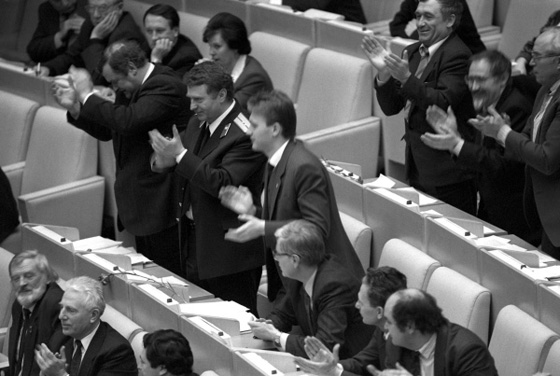 © RIA "Novosti" Deputies of the State Duma welcome the announcement of the amnesty at the meeting of February 23, 1994.
But perhaps the most important historical decision adopted by the State Duma of the first convocation was the decree on amnesty. Here is how Ivan Rybkin recalls him: “For us it was a very difficult story. Then it never occurred to anyone to ask permission from the president, because the amnesty is traditionally the prerogative of the parliament. We prepared a decree on amnesty together with Sergey Nikolayevich Baburin and Sergey Mikhailovich Shahrai. It was assumed that participants in the events of August 1991 and October 1993 would fall under it. Shakhrai proposed to include a memorandum of consent in a package with a resolution that would put an end to the non -subsided internal political hostility, and vote for everything at once, but Yeltsin was categorically against it. Then Sergey Nikolaevich Baburin went to the Prosecutor General Alexei Ivanovich Kazannik (the same people's deputy who gave way to Boris Yeltsin when voting to the Supreme Soviet of the USSR), and he introduced this document into effect with his prosecutor's decree. On voting day, all prisoners were released. Only the Army General and the Commander -in -Chief of the Ground Forces, Valentin Ivanovich Varenikov, who wanted to be justified by the court, did not accept the amnesty, which soon happened. After this story, Yeltsin did not talk to me for a month, and when he cooled a little, he said a phrase that I will never forget: “Ivan, they will not give you life - neither political nor human.” And he turned out to be right: in the State Duma of the second convocation, these people were in the majority, and other forces have already come to power. ”
Place for discussions
In the 90s, the State Duma and the Federation Council were powerful political bodies, which truly influenced what happened in the country. “The deputies were uncomfortable people who interfered with many. That is why Galina Starovoitova, Sergey Yushenkov, Yuri Shchezhikhin died. Today's deputies do not bother anyone, because nothing depends on them, ”the former employee of the State Duma apparatus sighs.
The parliament in the 90s was super-industrial, the journalists who then worked in the Duma pool recall. Reporters with cameras sat on sofas near the meeting room, catching the exit deputies. “The dining room and the smoking room were common, all that journalists learned about our work, they found out there. We did not run from the press, like the current deputies. The meeting room was closed for journalists only under Boris Gryzlov. Then the parliament ceased to be a place for stormy discussions, turning into a score, which often happened in the mid-90s. In general, only the first Duma was wildly wild - there emotions splashed over the edge. And the second and third convocations - it was a serious professional world -class parliament. Of course, there were found fricks like Marychev, but it was already a passing nature, ”says Ryzhkov. Artem Tarasov, a State Duma deputy of the first convocation and the first Soviet millionaire, calls the first Duma of mediocre and unprofessional and how confirmation of this gives an almost anecdotal history. Once, a deputy Sergei Yushenkov decided to conduct an experiment: as far as the people's chosen ones are aware of their own actions. He initiated the law on earthquakes in Russia and independently wrote it according to a well -known template: with a detailed description of the problem and tasks. This bill was carefully examined on the first reading, then at the second, after - in all the Duma committees, during this time a bunch of amendments and additions were made to the text. And only when it came to the third reading, Yushenkov went to the rostrum with the words: “Gentlemen, are you crazy? What are you adopting about the law? How can you seriously discuss this nonsense? ” The experiment was a success - and the bill went to the garbage basket.
Once, a deputy Yushenkov decided to conduct an experiment: as far as folk chosen ones are aware of their own actions. He initiated the law on earthquakes in Russia.
The same Tarasov recalls how the delegation of the seven of our deputies once drove to London - all the communists are completely. After official performances in the English parliament, the receiving party proposed a rich cultural program: museums, theaters, opera. But the Duma instead of the theater went straight to the grave of Karl Marx, having amused their British colleagues. Arriving in the cemetery, our delegation was struck by the imagination of the custodian there - they were the first officials to visit the grave of Marx in ten years. But much more curious it was to observe the communication of Russian and English parliamentarians. Tarasov says: “When we compared the six hundred years of English parliamentarism with what was happening in our Duma, it reached the ridiculous. For example, once one of the deputies asked British colleagues, what was their regulations. Those did not even understand the question - it could not have occurred to them that the deputy could be stopped when he speaks. In the British parliament in the order of things, to speak from the rostrum for several hours. Another comparison: we adopted 30 laws a week, and our British colleagues - 8 per year. Comments here are unnecessary. ”
From fragmentation to "unity"
The deputies of the first and second State Duma were still quite distant from the Kremlin, since they were more dependent on regional elites, party leaders, commercial structures and their voters than from the presidential administration. But the nature of the parliament was gradually beginning to change. If in 1993, unexpectedly for everyone in the elections, the LDPR won (it was then that the writer and publicist Yuri Karjakin uttered his famous phrase “Russia, you fooled!”), In 1995, the Communists were already taking the first place, and the Duma received an openly opposition color. Political scientist Dmitry Oreshkin is convinced that it was precisely due to the fact that in the 90s people were in parliament with diametrically opposite views and values, it was difficult for them to manipulate. “The first two thoughts were the place where people learned to engage in politics, build alliances, work within the framework of the law. For example, there was an attempt to declare the impeachment Yeltsin-for this it was necessary to agree with someone, to take on certain obligations. The attempt failed, because she was opposed by the pro -elcan forces, but she testified to a serious internal struggle, which now almost had no remaining. By the way, it was then, in the 90s, people who are still actively functioning so far came to politics: from Zhirinovsky to Ryzhkov. ”
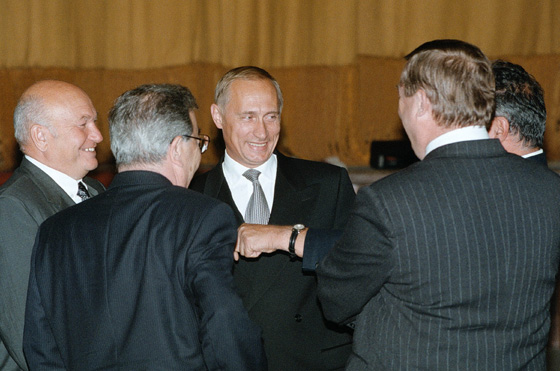 © Дмитрий Духанин / Коммерсантъ Мэр Москвы Юрий Лужков, экс-премьер Евгений Примаков, директор ФСБ России Владимир Путин и спикер Государственной думы Геннадий Селезнев, 1999 г.
К 1999 году сформировалась так называемая партия губернаторов «Отечество — вся Россия», лидерами которой были Юрий Лужков и Евгений Примаков, их поддерживали региональные мастодонты Шаймиев, Рахимов, Аушев и другие. Именно туда уходили корни нового старого класса номенклатуры. Логика была проста: экономика должна быть рыночной, а власть — бюрократической. Таким образом, к концу 90-х сформировался новый класс — союз бизнеса и бюрократии, партии не ценностей (вроде КПРФ), но конкретных интересов. Тогда же началась работа по вытеснению коммунистов с политического поля и сращиванию партий «Отечество — вся Россия» и «Единство» (контролируемой Березовским), которые чуть позже образовали «Единую Россию». При этом, объясняет Орешкин, «Единство» растворило в себе партию бюрократов, потому что ссориться с региональными элитами было нельзя. «Путин, с одной стороны, ввел их в политическое ядро “Единой России”, а с другой — начал обживать их боярскую вольницу внизу, на территориальном уровне, в частности, ввел федеральные округа. То есть Путин, опираясь на бюрократию, выстроил консенсус элит, уничтожил коммунистов и политическую конкуренцию. Именно после этого Дума превратилась из живого и мощного политического органа в собрание безликих болванчиков».