
Translated material
Theses about the esher
The Moscow Museum of Contemporary Art has opened an exhibition of Mauritsa Cornelis Escher. It would seem that this artist has long become a bank of illustrations for book covers and magazine articles, dictionaries in psychology and esoteric treatises-is there anything else in it?
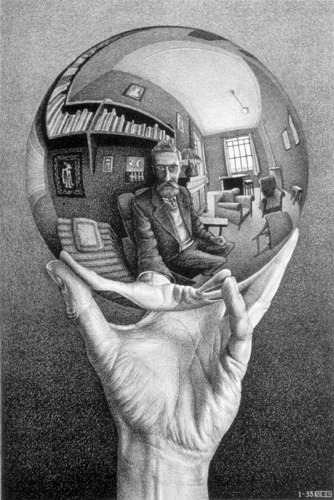 Hand with a reflecting ball, 1935
1) The central theme of the works of Mauritsa Escher is his own skill in the schedule, his own manual work in the situation of “art after the loss of craft”, using the expression of John Roberts, the modern Marxist art theorist. By this expression, Roberts refers to two consequences of the industrialization of society: on the one hand, criticism of the bourgeois fetishism of the object of art, carried out from the inside of the art of the XIX -XX centuries, on the other hand, a change in the status of art in the era of the overproduction of images, in the era of technical reproduction and ultra -production. This implicit paradox of Escher's work is to emphasize skill when art refuses skill - not just an external condition for his work. This paradox is rooted in the core of its aesthetics, it is a hidden premise and correlate all other paradoxes that the Esher in an obvious form presents the viewer.
 Still life and street, 1937
2) The topic of technical repetition is congenital in the art of Escher, but this is precisely his topic, and not the reality gravitating over him: technical reproduction as an external fact Esher turns into an object of his work, subordinates it to manual craft. For example, for the work of the “reptile”, the Esher moved the figure of the lizard made of plasticine on the table and each time redrawn it in a new perspective. As a result, a series arose like mechanically reproduced figures, in which, however, a semblance of life is awakened by the will of the drawer, which returns back to its source - a sheet of paper with ink.
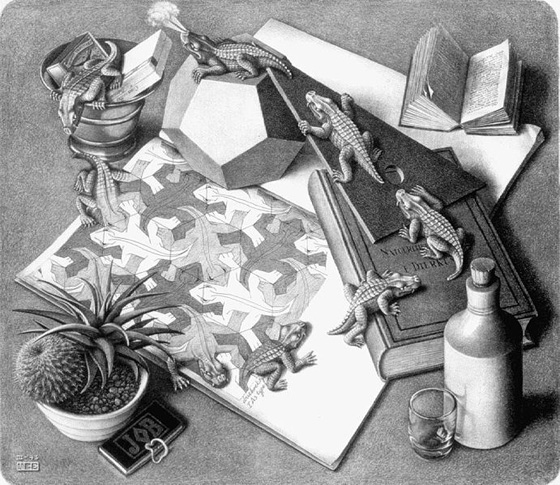 Reptiles, 1943
3) Another topic of Escher reflection is the topic of accuracy: dry, somewhat frostbitten accuracy of a pattern, which turns from a well-aimed ability to display reality, from the accuracy of organic feeling a la albrecht Durer into the accuracy of a mathematical drawing, calculation. Escher's illusionism seems to captivate the viewer with his fantastic reliability, but at the same time demonstrates his work, his technical skill - that is, he exposes himself as the fruit of the abstract mind.
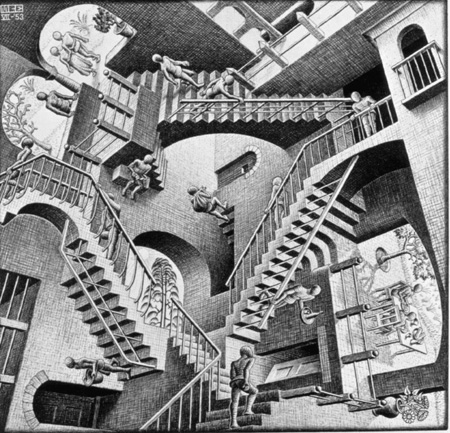 Relativity, 1953
4) Asher directly quotes the works of Renaissance and Mannerism in his art: he draws the Cathedral of St. Peter and himself in a glass ball in the spirit of a self -portrait of young Parmijanino. But the Escher pedaling of skill with all its retrospectivism and conservatism leads it into the field of impossibility: everyone knows Escher impossible buildings and unusable geometric figures. This occurrence of the impossible in Escher is always a consequence of an attempt to think the world with a closed, complete and whole, which the world of the Renaissance culture seems today. But in order to achieve fullness, you need to make a paradoxical gluing, close the stairs to yourself, and always instead of the desired sphere, the tape of Meobius is obtained. This fiasco can be interpreted as the experience of the logic of modernity, the logic of the New Age, striving for imaginary perfection, but incapable of achieving it and making this inability to have his nerve, the source of his life. It is this impossibility that is the point of the emergence of Escher in his art as the subject, the point of presence of the artist in the work. On the other side of the mechanical perfection of the work of Escher there is a subject of skill, the author as a manipulator who chuckles at his own obsessive traction for completeness and over the audience desire to trust the image.
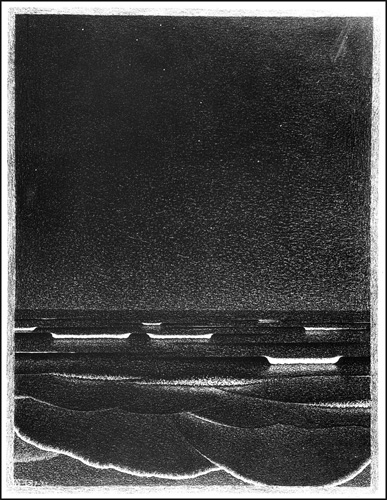 Fluoresing Sea, 1933
5) So, what the Esher does in a situation where the avant -garde criticizes skill by abandoning it is the extraction of skill by means of skill itself is exposing a virtuoso graphics by means of virtuoso graphics itself, and a statement of accuracy by means of accuracy itself. This isolation of a graphics medium on itself is illustrated by the Escher series of metaphors, the basis of which is the already mentioned tape of Mobius: for example, these are “hands”, drawing each other.
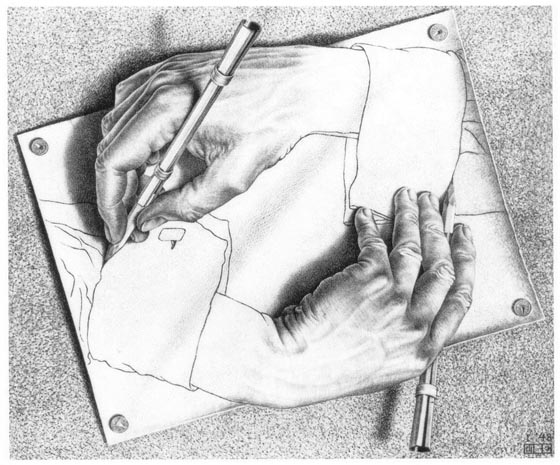 Drawing hands, 1948
6) Asher suffered from Nazism and fascism: he was forced to flee from Mussolinian Italy, and his teacher, graphic artist Samuel de Meskita , was as a Jew sent to Auschwitz, and Escher managed to save only one drawing, on which the trace of the German boot remained. Immediately after the war, Asher participated in the exhibition of artists who refused to cooperate with the Nazis. But his political position in no way can be called activist. In some ways, it resembles the position of the writer Thomas Mann, also a lover of crystals and transformations of inanimate nature live and vice versa: the fairly part of his novels “Magic Mountain” and “Doctor Faustus” are devoted to these metamorphoses. The narrator in the last work is the Doctor of Philosophy Serenus Zeitblom, a man with the mentality of the 19th century, a homegrown but ethically persistent humanist, the heir to the former German culture, in the core of which, to his horror, has grown the monastery of Nazism. There is something in the esher from the zeitblom - but also something from the main character of the novel, Adrian Leverkun, a virtuoso composer who concluded a contract with the devil. Asher looks at the heritage of the previous humanistic culture, but its obligation, its unity no longer seems obvious, and the attempt to glue the world together always turns out to be a purely artificial, requiring sophisticated skill: in the works of Escher, the theme of several independent worlds, reconciled only in the engraving of the author’s calculations.
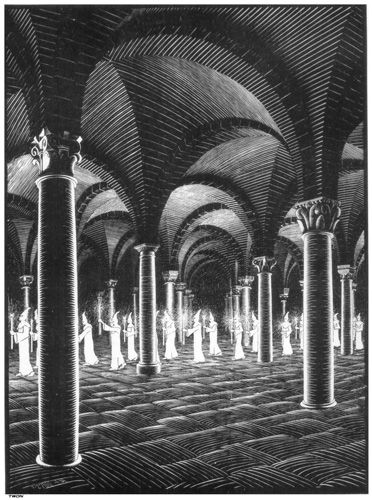 Print procession, 1927
7) Esher was never a radical-neither political nor artistic, he never sought to frapping a system of art or art market. His art was socially and commercially in demand, he also engaged in design and completed a number of advertising orders. However, despite the Escherovsky conservatism of forms and a seductive tendency to hoaxes, which today allows his work to appear on the covers of dubious books on parapsychology, the logic of his method cannot be completely put into circulation to the world of capital. It contains too stubborn autonomy, too sophisticated isolation on itself. Esher carefully thought out his ivory tower, closing all the possible exits from it to themselves, and only intelligent sarcastic laugh is heard from the inside of its defensive system.