Date
Author
Наталья Джанполадова; Никита Татарский
Source

Preserved copy
Translated material
The narrowness of amnesty
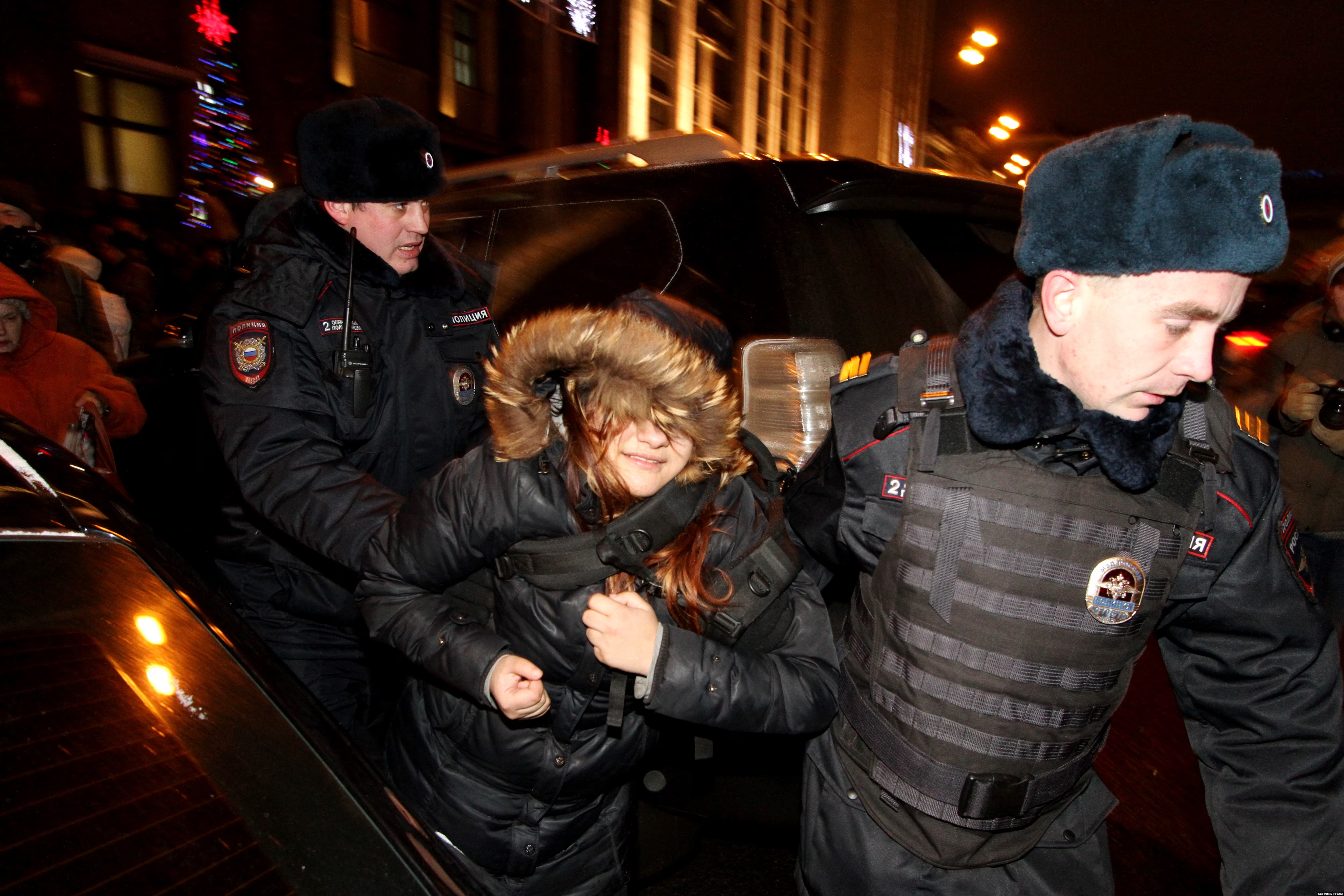
Activists went to the State Duma demanding to expand the amnesty, which should be accepted before the end of the week
In Moscow, at the building of the State Duma on the evening of December 16, civil activists conducted an action with a demand to expand the amnesty, which in the near future plans to accept the parliament in honor of the twenty years of the constitution, so that it touches those whom human rights activists consider political prisoners.

Activists went to the State Duma demanding to expand the amnesty, which should be accepted before the end of the week
The text of the copyWidth PX Height PX
The url has been copied to your clipboard
No Media Source Currently Available
0:00 0:03:02Dozens of people gathered for the action. Several people were detained.
Activists are unhappy that the amnesty, most likely, will not affect the former owners of the company Yukos - Mikhail Khodorkovsky and Plato Lebedev , oppositionist Alexei Navalny and Pyotr Officerov, convicted in the Kirovles case. As follows from the project introduced to the State Duma, the articles on which they are accused are excluded from the number of those that amnesty extends.
“This is a popular gathering that does not require any approval, although, of course, it is difficult to explain to our police,” says Nadezhda Mityushkina , a member of the political council of the Solidarity movement. - The gathering is scheduled for today precisely because tomorrow in the Duma the issue of amnesty will be resolved. As far as we understand, the project of the amnesty that is now submitted, such that the amnesty is far from wide. In fact, none of the defendants in the “swamp business” will come out, Mikhail Khodorkovsky, Platon Lebedev and many others will come out. But the amnesty will affect the police who mocked the detainees. Today's way out is the last attempt to remind the authorities that it is wrong. This is an absolutely peaceful action. People understand everything. Neither posters nor any symbols should bring to it. I think that the Duma does not solve anything at all, and we have very few chances for some success. But for me this does not mean that you need to sit at home and not go anywhere. This support is very important for the guys and everyone who is sitting, to everyone who is unlawfully condemned, - Nadezhda Mityushkina believes.
State Duma Chairman Sergei Naryshkin did not exclude that the decree on amnesty would be adopted on Wednesday, December 18. As expected, the next day it will be published in the government media, after which he will enter into force.
The State Duma Committee under the criminal law on December 16 approved the draft amnesty in connection with the 20th year of the Russian Constitution and recommended that the deputies accept it. According to the document introduced to the Duma President Vladimir Putin, the amnesty will affect those who are convicted of cases of crimes of small or moderate severity not related to the use of violence. An amnesty also applies to minors, disabled people, elderly, pregnant women and women with minor children. The Duma does not exclude that the decree on amnesty can enter into force before the end of this week. The human rights activists criticized the preparing project, considering the amnesty not wide enough: most likely, it will bypass the defendants of high -profile affairs.
Deputies intend to consider the draft amnesty in two readings, and not in one, as previously planned. According to the head of the State Duma committee on criminal law Pavel Krasheninnikov, in the final version the document may be adopted on Wednesday, December 18. Consideration in the first reading is planned on Tuesday, December 17. In general, the project of the amnesty turned out to be not as wide as it was originally promised, says Dmitry Gudkov, deputy of the State Duma. He developed a number of amendments to the document that he plans to make when discussing:
- Crooks, criminals who have been convicted for up to 5 years inclusive, for example, under articles as "non -personal spending of budget funds," fall under the amnesty. It is amazing that the police and police sadists who applied violence against citizens get here. Remember the district police officers, which tortured a person from under champagne to death in Kazan. We will prepare an amendment so that these people do not fall under an amnesty.
He was flushed with a policeman, tore off his helmet, that is, those actions that do not cause any damage to life and healthAll political prisoners should fall under the amnesty, but they do not fall. For example, Udaltsova and Razvoszhaev are judged under the article "Organization of Massion Riots". But many experts believe that on May 6 there were no riots at all. Udaltsov and Razvozhaev did not apply any violence against representatives of the authorities. I am categorically not satisfied with the fact that only convicts fall under the amnesty, and the amnesty does not apply to suspects and those people who are under criminal prosecution. We will insist on the inclusion in the amnesty of part 1 of Article 318 - this is "the application of violence to representatives of the authorities who are not dangerous for life and health." Roughly speaking, he began to stop with a policeman, tore off his helmet, that is, those actions that do not cause any damage to life and health. In addition, the project has a item that actually crosses out an amnesty: according to him, the administration of prisons and institutions of the penalties, they receive the right to decide on their own who to release and who is not. Those people who, for example, violated the order in places of deprivation of liberty, have been recovered, they are not subject to amnesty. You perfectly understand that if tomorrow they do not want to amnesty, for example, Tolokonnikov or any prisoner in the case on May 6, the prison administration will simply make a corresponding decision.
- In your opinion, it is precisely such a text of the amnesty that was written specifically to exclude from it the defendants in high -profile criminal cases, to whom the attention of human rights activists is riveted?
- It is difficult for me to answer this question, because the logic is incomprehensible to me. An amnesty must perform certain tasks. For example, it should reduce a significant number of prisoners and improve the international image of Russia on the eve of the Olympic Games. If we have people who are recognized as international organizations as "prisoners of conscience" will remain in prisons, then for public opinion this amnesty will not mean anything. They will come out or not - is a certain political marker. According to the FSIN estimates, about three thousand people will be amnestied, this is not a wide amnesty. Then it is not clear why this noise was needed if the political prisoners do not want to release. To amnesty Serdyukov and all other policemen? But then this amnesty is for crooks and police sadists, and not for citizens and political prisoners.
Dmitry Gudkov hopes that at least part of the amendments prepared by him will be adopted. Human rights activists and civil activists criticized the proposed project of amnesty: most likely it does not fall under it, most of the defendants in the “swamp case”, since they were charged under the 318th article related to violence against representatives of the authorities. And to those who are charged only under the 212th article-“Participation in the riots”-most likely will have to wait for the sentence. At least, the text of the project published the other day some lawyers participating in the "Swamp process" published.
On December 16, in the Nikulinsky court of Moscow, where the case is being considered, after a week break, hearing resumed. Participants in the process continued to interrogate witnesses of protection - direct participants in the action on May 6, 2012. In particular, the court questioned the girl of the defendant Andrei Barabanov, who spoke about his detention. In addition, he was the witness who said that he saw how police officers beat the defendant Sergei Krivov. Interrogations of witnesses continue.
The member of the Pussy Riot group, Maria Alekhina and Nadezhda Tolokonnikova, can be released ahead of schedule for two years, said Girls Lawyer Irina Khrunova :
-Tolokonnikova falls under the project of the amnesty, which is now entered into the State Duma, by two signs: the first-as a woman with a minor child, the second according to Article 213, since the 213rd article was included in the amnesty project. The imposition of the penalties has nothing to do with Tolokonnikova, because the project says that the amnesty does not apply to convicts who were collected in the form of a premises in the penalty area. Tolokonnikova has never placed in a penalty area during a sentence serving. Therefore, on the issues of recovering it, this item has nothing to do with it. Purely theoretically, the State Duma can change the amnesty project, so it is to say whether Tolokonnikov and Alekhin come to an amnesty, so far prematurely, let's wait until Wednesday.
Nadezhda Tolokonnikova , who has been in the UFSIN specialist in the Krasnoyarsk Territory since November, may stay there until the end of his term - until March 2014. This was reported by RIA Novosti agency with reference to the representatives of the FSIN. The lawyer Irina Khrunova does not comment on this information and hopes that her client will still be able to be released under an amnesty. Another member of the Pussy Riot, Maria Alekhina, is serving a sentence in a correctional institution in Nizhny Novgorod.