
Translated material
Life as literature
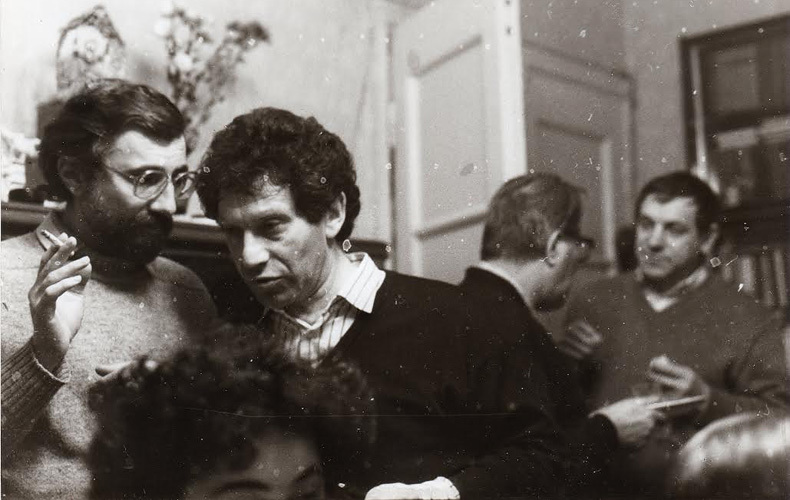
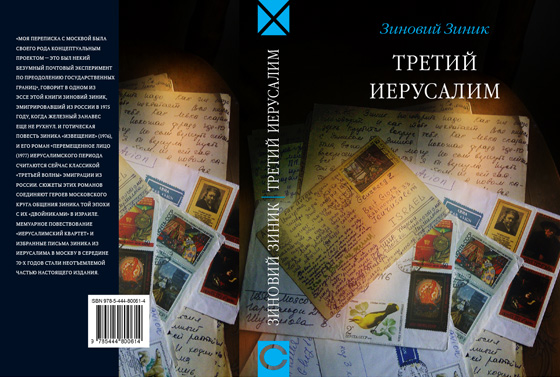
Gleb Morev : In the UFO there is such a section - "Book as an event." The release of some book is noted not by an ordinary review, but by a certain selection of materials, several reviews or discussion. And I propose our conversation to be considered a publication in such a heading, the reason for which was the way out in the same publishing house of the “UFO” book by Zinoviy Zinynia “Third Jerusalem”, which, with its composition, thickness, monumentality, is formed, formed, structured, marks the completion, if possible, canonize a certain layer of recent culture. The layer from which this book grows and which is simultaneously reflected. The modern reader, say, the people of my generation, who were not part of the rather narrow circle of acquaintances described by Zinic, learned about the existence of this cultural layer post -factum - from the actual prose of Zinica, from yours, Misha, memoir essays and articles dedicated to the second, unofficial, culture of the Soviet era. It seems to me that it would be interesting, taking advantage of the output of Zinican’s book, try to understand, reconstruct what kind of circle that was not only was and left, but continues to resonate in literary texts.
Mikhail Aizenberg : I think you need to build on the book and move from it to this problem. First of all, I want to say that the appearance of this book was quite unexpected for me. This is some kind of huge brown volume, such a brick, and not simple, but more, of those that were in use until the eighteenth century. Such a brick in theory should lie at the base of some kind of archival massif. But this impression is actually deceptive, because Zinican's book is absolutely not archival. And her thickness also amazes because all the texts, with the exception of the essay, are written in a very short time-one and a half to two years. And this confirms the contagious explosive nature of everything that happened then. That is, this is not a brick book, but some kind of decorated explosion, and emotional and literary. And it seems to me that the main explosive fuse inside this book is a letter. And the fact that they are finally published, I consider the event wonderful, very relevant, important not only for our circle life and history. There is something that we really realize only now. Although the special value of these letters was felt and then, it was such a bestseller for a narrow circle.
Elena Shumilova : Yes, so we reprinted them then. And [Pavel] Ulitin, and [Alexander] Asarkan, and the rest without any persuasion gave me the letters and postcards received. And since we were regularly gathered, they were already read simply, one might say, in chorus.
Aizenberg: It's not even that we regularly gathered and read these letters, and we specially gathered precisely in order to read them! And this became some ritual. And the ritual is a cementing substance for the formation of a special kind of community like internal society, they, as a rule, are formed on the basis of such small rituals.
MOREV: Where does this epistolary structure come from? Just out of biographical circumstances, from emigration, the need to communicate in this way? Or were the prerequisites for this before leaving?
Aizenberg: There were definitely such prerequisites, and two lines were connected here. Firstly, Zinik has a wonderful phrase in one essay that emigration creates the illusion of a ready-made novel. That is, emigration is already literature. But there is another side, so to speak, a prevention. The fact is that before leaving, Zinik did not write novels at all, but such, relatively speaking, Ulitin's prose based on various kinds of transcripts. And I think that it was this experience, transplanted to new soil, that gave such a cumulative effect. It turned out not just letters, but a novel in letters. Its underlining and openness to the continuation is not a defect, but a special literary quality, an additional degree of freedom.
Lev Smirnov : This is what is important here. Then, after all, they left with the feeling that everything, already forever. It is even hard to imagine now. And I think that Zinik had such a feeling that everything is broken and can be told from scratch. He believed too seriously that everything was really chopped off forever, there was nothing behind this, and began to explain everything again - on behalf of all and for all teachers. They are no longer anyway, they are somewhere scattered to dust, but they need to tell, there is a whole world here! Now I will tell you what it was there. That is, his material is actually the material of the witness.
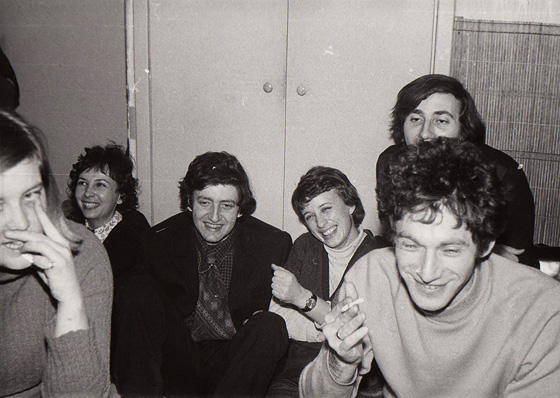 © Semen Faybisovich Last Thursday on the Preobrazhenka at Zinika, 1975. In the picture, the right to the left: Zinovy Zinik, Mikhail Aizenberg, Elena Shumilova, Valery Semenovsky, Nina Petrova, Disa Khastad
Morev : It is significant here that Zinik, having moved and in a sense with the past in the baggage and at the beginning of a new life, at the start, acts as a witness. He realizes what he witnessed as a certain value that needs to be conveyed. Here it is interesting what he witnessed. Some names arise immediately, with half a turn: Ulitin, Assarcan. They still in many ways remain some ciphers for the general public, magical sounds for a uninitiated person. It is necessary, in my opinion, to decipher what the value of this certificate consisted of what it consisted of.
Smirnov: The fact of the matter is that Zinik applies his cipher on our ideas about everything. Maybe for literature it is exciting, but for me there is a mystery here - how to read it, how to abstract from the original source?
Morev : In this book, the author himself gives the reader a key, deals with deconstruction of his own constructions, because these letters - a real text with real names - are adjacent to the text of a fictional one. That is, here in one volume are united by multi -junk and diverse things. I wonder where such an author's idea comes from?
Shumilova: Not quite an idea, it just happened. Everything went from letters, they set the genre. Immediately after the departure of Zinica, letters began to come, I collected and reprinted them. This big Tomina lay with me, less than half entered the book. Moreover, these are letters of only one year. I have long been rushing with the fact that this should be published, back in the 90s. In 1975, I did this exclusively for myself, for us. And in 2005, I scanned them and sent Zinika ... I knew that the value of these letters is such that I should not keep them on my table, and they should be published. And I persuaded Zinika to make a book and in the comments on the letters to state a bunch of all sorts of intersecting stories. But he proposed to take his books of those years, which were actually written by letters - “Notification” and “Motion”. So it all happened. However, when I read all this as a separate book, it became clear that young readers simply would not understand much of that life. Why there are so many topics around the brands, there are so many texts, what are phone calls to Israel, when we took off ten rubles each, ordered a conversation in advance and waited for us to be connected and connected at all. This happened too. These are also the plots of the book - calls, brands ... I suggested explaining Zinika to explain this. I argued for a long time, but one way or another, Zinik wrote, explaining what and why. Here, in fact, the book has developed. We offered her to Irina Prokhorova, and she immediately responded to us.
Smirnov: I'll add it yet. Already after some time, Zinik began to work on the BBC, which for us was some status of a very definite supervision, a distributor of assessments. And I remember - either I retold this [Julia] Daniel, or he he heard, but I remember how Daniel suddenly smokes a cigarette from the wrong end, because I heard the wrong words that he was ready to hear.
MOREV : Radio as a medium.
Smirnov: Exactly. BBC then was the voice of some kind of absolute. The Voice of America affirmed something with heavy accents, with feedings, and the BBC had an absolutely neutral tone.
Shumilova: And Zinik had wonderful programs!
Smirnov: Absolutely, yes. In general, masterpieces, I think. In those years, the BBC with these names was generally exceptional.
Aizenberg: But this is the next period, Zinik London. And we are now talking about the first one and a half years after his departure.
Shumilova: Yes, in the book only the Jerusalem period is Zinica. I repeat, the book was first planned as Jerusalem letters, but overgrown with novels and essays, and, as it seemed to us, the “Jerusalem quartet” naturally entered there about Lenya Ioffe. Previously, it always seemed to me that asarcan, Ulitin - this is the main thing for Zinik, but after reading the letter already in this life, I realized that the role of Leni Ioffe was absolutely equal. Then I did not understand this, and when I was preparing a book - it was a discovery for me.
MOREV : It is interesting that the Israeli period Zinika was very short -term.
Shumilova: Two years, yes. And such a concentration.
Aizenberg: And this huge book, 800 pages. Some, we will not point out a finger, have not written so much in our entire life, but here is such a brick.
Shumilova: He left for England in 1977, already publishing these two things and having written much more.
 © New Literary Review
Aizenberg: Having returned to the book, I want to say that she was remarkable for some very advantageous and unusual, even innovative, structure. She seems to have two persons - letters and prose. There is also an essay, but this is just a frame that explains something, it is not included in the main structure of the book. In general, almost the main theme of Zinika is the theme of the double, the original and a copy, the teacher and the student, and so on. Here this is additionally manifested by a double and dual structure, when it all depends on what you are addressed to, which face you look at. If you look at prose, then letters become an explanation and commentary. But if you turn to the letters, then it is precisely the prose that becomes a comment. And this, it seems to me, is some very interesting thing in a purely literary sense.
Shumilova: And even in philological.
Smirnov: Zinika had a super-priority of such universal professionalism with a guide to those writers whom he read in English. That is, on the one hand, an orientation on intellectual writing and prose, and on the other, and, as it were, at the same time as a bestseller.
Morev : Was this focus on the bestseller relevant for him in the USSR?
Aizenberg: No, I do not remember anything like that.
MOREV : Here he wrote, as I understand it, texts far from any idea of bestsellers.
Aizenberg: Absolutely.
Smirnov: I mean his idea of writing, the image of the writer ... He constructed the image of the writer, and for him it is important, in my opinion, to talk about himself as a writer, to explain his works, to analyze his texts. By the way, many Western writers have this, mostly English-those that Ulitin constantly read, and this cult was somehow transmitted to Zinica.
MOREV : But what could be further from each other in a social sense than Ulitin and English writers? If I understand you correctly, you think that the ideal model of the writer for Zinik was an “English writer”. And what role did Ulitin played, who is not at all like any English writer? Or am I mistaken?
Smirnov: But these writers came to us from the presentation of Ulitin, as if from his hands. These fresh books were then mined by any means, even through the farmers. This is also visible in the prose of Ulitin how one gets to us, then the other. Suddenly there was a rumor that it was possible to drag something from the American exhibition, and I was just going to it, and Ulitin says: “There is a“ quote book ”there, look that this may be something like that ...” I went to the exhibition, I got to this “Book of Quote”, but it turned out to be riveted, nailed with nails. It turned out to be such a folioch, God forbid, it was impossible to carry it away. Ulitin lived with this literature in general and English, first of all, and the French. It came from him, we all heard this in his monologues ...
Aizenberg: And I somehow think about letters. So I said that their value was obvious right away, but their special significance became clear to me only recently. So what is this meaning? In that it seems to me that Zinik in such an epistolary form continued the existence of his prefabricated point, his “Thursday”. He thus supported some established order, the existence of a certain circle, an internal society that had already formed by that time. How he formed - I do not know, because I entered the already created circle and ritual, which was mainly wound up. Although Zinican, too.
MOREV : Describe this society before Zinican leaves, what was it?
Aizenberg: In practice, these were regular meetings on Thursdays in the room, and then in the apartment of Zinika and Nina, his wife. It was not the first journalist in my life, but the difference was very felt: it felt that Thursday was not just friendly gatherings, not a party. There was significantly attended by some kind of vital and educational component. Some school is a survival school that does not imply a loss of dignity. And it was the discovery of this microsocium itself, some special cell with its air that could be breathed.
Shumilova: It was not possible, but it was necessary. It was impossible to live without it.
Aizenberg: Yes, it is necessary, because there was no other. Zinika fell the role of the collector in this matter, so his departure was simply a disaster for this circle, not so small. And for a long time and not easy to add up. It seems to me that with a half of my subsequent close friends or good acquaintances, I met Zinik. Including quite unexpected, for example, Pavel Lungin, not to mention Lena Shumilov, Valery Semenovsky, Melamid and Komar, and so on. All this was felt together as a certain small universe, quite branched. For example, Aichehenwalds are generally a separate circle and a special style of existence. Or Assarkan's acquaintances from the magazine "Theater" and so on. All these are people from different places, but they converged on Thursday, creating a new level of communication, already more open, not closed. And this connection at once ceased to exist. But with his letters, Zinik once continued for a while the atrial existence of this circle. That is, even purely technically. It began with the fact that we began to exchange his letters, then we began to meet regularly in order to present these letters to each other and read them. And so gradually, already in a new situation, the former ovary began to appear, and this led to the fact that “Thursday” appeared again, already on new grounds. And life began to continue.
Shumilova: The connections were recovered.
Aizenberg: And these letters were the first connection. It was unusually important to us, and we read them excitedly.
Morev : That is, with these letters, Zinik, having left, managed to preserve his role as a communicator here.
Aizenberg: That's right! This was his main idea - having left, stay. And he still remained, one way or another for those long years he remained among us.
Shumilova: Actually, he remained forever, because he or a kind, but he always existed with us.
Morev : Here are two figures - ASARKAN and Ulitin - stand out, of course, during a conversation about this circle, which united Zinica around him both here, in Moscow, and then through letters, already abroad. What was their role in your Moscow life, with Zinik and without it? This, it seems to me, is a separate topic.
Aizenberg: With Zinik and without Zinica, these are two different eras, they have a different style of existence and different laws according to which everything was built. For the first era, it is very characteristic that I just did not see the streetin for a long time. I already went to Zinica for Thursdays, I seemed to know everyone, but a year and a half or two I only heard about Ulitin, and I met him in the 72nd year.
Smirnov: He was generally a recluse, even did not approach the phone.
Aizenberg: Yes, he was generally a recluse. Lenya Ioffe, I remember, told me that the main person “they” does not show, “they” hide the main person (laugh) . Some existed "they."
MOREV : In principle, a bright very phrase that convexly describes the situation. That is, there was a feeling that, if there were no street, and these "them" would not be?
Aizenberg: Maybe, although such a feeling was with Lenya - people from the periphery of the Asarkanovsky circle. For Lena and Leva, this, of course, is not so. For Zinica, probably too.
Smirnov: This is very simplified. Even the reference point is difficult to find here, it is much deeper than what we are talking about now. The point where the whole format grabs ... For example, I saw these people before, long before Zinik recognized Ulitin, and Misha, but there was still some layer that could become the source of this phenomenon, really unusual. Maybe there were many such worlds, in the writing environment, too, everyone calls some miracle people around which everything is there ... In the early prose of Ulitin, some source is read, this is the year of 1954, 1955, that is the very origin. But it is pointless to try to reconstruct this in a few words. In this case, we do not know the source, and the end point as if appears for everything. And this is a problem - to master it. We see only the final point, or rather, see the one who set the point. This causes thoughts, raises the question before us, to those who survived. Is it necessary to make some kind of effort or is it too late and everything has gone? Because people were really big, these three or four people, they really ...
Shumilova: And what are four? Asarcan, Ulitin ...
Smirnov: [Alexander Yesenin-] Volpin. Вольпин вообще поднял все правозащитное движение, с него все началось. Весь этот дух свободы, он же с него начался.
Айзенберг: Вот ты, Глеб, спрашивал, кто какую роль играл. Мне кажется, техника образования такого микросоциума — именно техника — это ритуал, ритуализация жизни, но в основе подобного ритуала обязательно должно быть что-то очень важное, скрытое, может быть, даже тайное. И вот, говоря очень приблизительно, именно такую роль играл Улитин. А придумал ритуал Асаркан. Вот придумал, как все сделать, чтобы это стало жизнью. А Зиник придал потом этому ритуалу игровой какой-то, легкий и радостный, праздничный характер.
Шумилова: Да, Зиник все это превратил в праздник.
Айзенберг: И это было дико увлекательно. «Четверг» — это была радость какая-то невероятная! Счастье жизни.
Шумилова: И Зиник в этом смысле был виртуозен.
Смирнов: Добавлю еще свою некоторую ложку дегтя (смеются) . Дело в том, что «четверг» Зиника был не первым кружком. Вообще они спорадически появлялись — эти места, где можно было общаться. Просто встречаться без всего, без всякой идеологической нагрузки. Какое-то время таким местом было кафе «Артистическое», потом возникли такие вечера по воскресеньям у некоего Яника Кагана, где как раз Улитин и Асаркан бывали постоянно, они очень ценили его, это был круг людей, по-настоящему близких между собой. Я могу сказать, что настоящая литургия была именно там.
Вечером я приезжал с работы, и мы с Зиником сидели на веранде, все обсуждали. И в какой-то момент он стал уговаривать меня вместе с ним писать авантюрный роман «Вышка».
Морев : Здесь прочитывается очень стройный сюжет. Зиник — человек, который в каком-то смысле приватизирует мифологию, одновременно являясь и ее фиксатором, текстуальным творцом. Поэтому в круге описываемых им людей, входивших в это сообщество, естественно, возникает некоторая ревность. This is understandable.
Шумилова: Это где ревность?
Морев : Вот в словах Льва.
Смирнов: Минутку, ревности здесь нет никакой!
Шумилова: Кстати, Яник в зиниковских письмах фигурирует довольно часто.
Смирнов: Я имею в виду только хронологию, больше ничего. У Яника собирались начиная с 1957 года, и это был ближний круг. Там были еще Юдифь Матвеевна Каган, его тетка, филолог, Юрий Айхенвальд. Это все был один круг — интеллигентская верхушка, очень близкая к филологическим, академическим слоям.
Айзенберг: Юдифь Матвеевна — дочь Матвея Кагана, который дружил с Бахтиным…
Смирнов: Да, она очень влиятельной была, ее все даже побаивались.
Шумилова: Ее не все побаивались.
Смирнов: Ну, в каком-то таком смысле — «что будет говорить княгиня Марья Алексевна»…
Шумилова: А, это верно.
Морев : Читая Зиника, ты ощущаешь, что это шурф в какую-то реальность, уже из сегодняшнего дня для нас не прозрачную, и мы говорим как раз о том, что это была за реальность, можно ли ее как-то локализовать, описать…
Шумилова: Она уже локализована, но как ее объяснить…
Смирнов: Я добавлю еще. Так получилось, что его тексты — это шифры чего-то огромного, по которым надо…
Шумилова: Диссертации писать.
Смирнов: Ну, как иероглиф какой-то на раскопках изучать. Мы вдруг понимаем, что за этим целый язык, а не просто значок. То, что тянется за книгой, — это действительно много и сильно. И я думаю, что Зиник это сам осознает. Больше того, у него это все присутствует, и он как бы извиняется за свое желание это приватизировать. У него в интонации все время есть такое.
Если уж использовать слово «ритуал», то эти последующие кружки — некоторая уже профанация, расширение какого-то изначального ядра, интимной такой интеллектуальной жизни, которая была в какой-то момент, недолго, год или два, вот у Яника. Параллельно она была у Айхенвальдов, но [Юрий] Айхенвальд был все-таки такой педагог и литератор, там было как-то более широко. И в этом смысле ключевая фигура, которая, собственно, все это вела, организовывала все эти места, как бы пробуя, где это может получиться, здесь или нет, такое само по себе блуждающее место — это и был Асаркан. Он организовывал такие места, а потом, когда они слишком профанировались, слишком расширялись, он все бросал и бежал от них. Это тоже очень упрощенно, на самом деле все сложнее. И вот в какой-то период он к Зинику перешел от Яника, потому что, с одной стороны, Зиник жил на территории современного филиала Большого театра…
Шумилова: Копьевский переулок, дом Яблочкиной. У Зиника была там в коммуналке комната, место очень удобное, и все туда сходились. Асаркана устраивала эта территория, он всех туда сводил.
Смирнов: Он как-то увидел, что довольно удобно, комната большая, можно…
Морев : Рядом с «Артистическим»?
Шумилова: «Артистическое» — это было дальше, за углом. Но «Артистическое» кончилось к тому времени.
Смирнов: И собирались днем, по-моему.
Шумилова: Ну, мы все время там болтались, днем, вечером, туда-сюда…
Смирнов: В общем, какое-то время даже днем. Потом Зиник получил квартиру на Преображенке, переехал…
Шумилова: Но он в 1970-м переехал, а мы здесь начали с 1967-го клубиться.
Смирнов: Они тогда еще учили иврит коллективно. После урока иврита приходили другие люди, потом третьи. It was a crazy house! Год 1969-й, по-моему.
Шумилова: Да, 1969-й.
Айзенберг: Мы познакомились с Зиником на «субботах» у Владимира Шахновского, еще такое было предприятие, Иоффе и Сабуров его инициаторы. Но я его просто там видел несколько раз, а получше мы познакомились, как раз когда вместе изучали иврит, в частности, вот в комнате у Зиника.
Морев : А Зиник, когда уехал, знал иврит уже?
Айзенберг: Да, блестяще!
Шумилова: Он вообще очень талантлив к языкам.
Айзенберг: Он и английский хорошо знал, а иврит почти в совершенстве. И вот однажды, когда урок уже закончился и все уходили, Зиник мне вдруг говорит: «Ты не хочешь задержаться, еще посидеть?» Ну, я, понятное дело, охотно задержался, а через полчаса пришли Алик Меламид с Катей Арнольд и Лена Шумилова. Тогда я Лену и увидел в первый раз. Она эту встречу не запомнила, видно, очень глубокое впечатление я произвел на девушку (смеется) .
Меламид с Комаром что-то написали, я принес это в редакцию. А в редакции был такой Кантор Карл Моисеевич, философ, который курировал всю философскую политику «Декоративного искусства». И он-то сразу понял, что там подвох.
Смирнов: У меня сложилось такое впечатление, что именно в этой комнате у Алика Меламида зародилась идея соц-арта. Дело в том, что я ему предложил что-то написать в журнал «Декоративное искусство», который занимался всем прикладным искусством, в том числе наглядной агитацией. А я тогда только начал работать в этой редакции, и меня кинули вот в этот жуткий угол — наглядная агитация, оформительское искусство — разберитесь, мол… И я, встретившись с Аликом Меламидом там, в этой комнате, предложил ему что-то написать про наглядную агитацию. Я тогда всем предлагал, Мише предложил, он написал о Баженове. [Семену] Файбисовичу предложил, он тоже написал, но очень сложный текст. Вот и Алику предложил, и он жутко схватился за эту идею. Я думаю, что у него уже было что-то такое в голове, и он это начал развивать. Я даже обалдел, потому что для меня наглядная агитация — это было что-то такое ругательное, пошлое, невразумительное, а он как пошел объяснять, что на самом деле это настоящее искусство, давай-ка я напишу, и все. И они с Комаром действительно что-то написали, я принес это в редакцию. А в редакции был такой Кантор Карл Моисеевич, философ, который курировал всю философскую политику «Декоративного искусства». И он-то сразу понял, что там подвох.
Шумилова: То есть он отсек это?
Смирнов: Да, и так презрительно... Сразу увидел там провокацию. Но тогда я впервые услышал от Алика и Комара эту идею, что наглядная агитация — это и есть настоящее искусство, настоящая правда… Не могу сейчас это воспроизвести, но они мне столько наговорили тогда!
Шумилова: Ну, Алик — только начни, включи кнопку, и тут же тьма идей!
Айзенберг: Вы заговорили про Алика Меламида, и я вспомнил одну, на мой взгляд, вполне занятную историю. Летом 1974 года Зиник с Ниной и дочкой Риточкой жили у нас на даче. В таком сарайчике, флигельке. Вечером я приезжал с работы, и мы с Зиником сидели на веранде, все обсуждали. И в какой-то момент он стал уговаривать меня вместе с ним писать авантюрный роман «Вышка», про лагерное что-то такое, какой-то сюжет у него уже был. Писать на пару, да еще авантюрный роман — для меня это звучало диковато, я отказался. А Зинику одному, видно, скучно было это писать. Потом он уехал, все забылось. А несколько лет назад Алик Меламид вдруг рассказал мне, что в 1974 году он «на коленях, буквально на коленях» умолял Зиника написать соц-артистский роман. И теперь я подозреваю, что та «Вышка», возможно, и была идущей от Алика идеей первого соц-артистского романа.
Морев : Такой прото-Сорокин?
Айзенберг: Ну да, в том-то и дело. Но в те времена казалось очень странным придумывать авантюрные сюжеты. Дело еще в том, что сам Зиник — человек очень литературный, и в его присутствии все становилось литературой. В самом его артистизме есть вот эта составляющая литературной интриги. Ты начинал чувствовать в происходящем какой-то закрученный сюжет и даже на себя самого начинал смотреть как на персонажа. И его отъезд был для меня катастрофой не только в личном, но еще и в таком вот паралитературном отношении. То есть та литература, которой в его присутствии была наполнена вся жизнь, с его отъездом исчезла, к сожалению. Осталась жизнь как жизнь, а жизнь как литература отъехала, оказалась за кордоном. А потом стала возвращаться в виде писем.