
Translated material
Putin. Conversation with people and animals
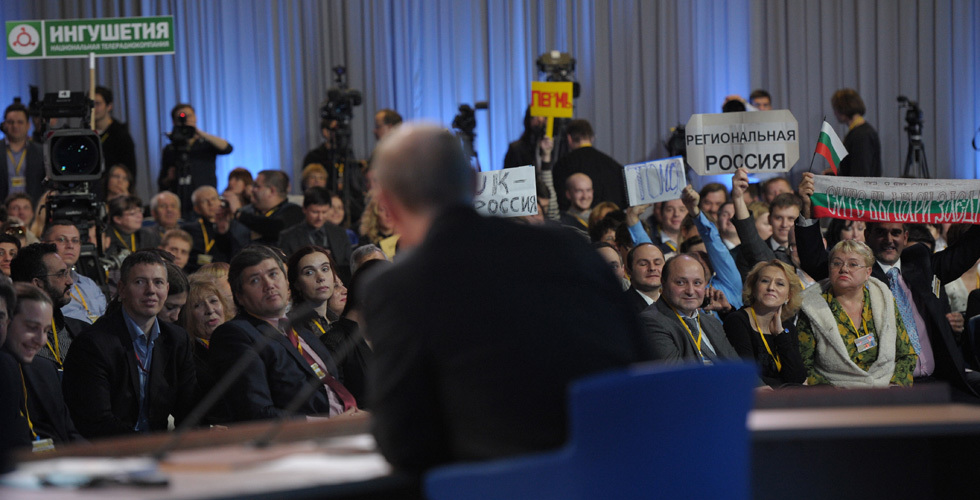
We will not talk about the content of the annual “press conference” of Putin, but about the genre. More than 1300 journalists, 4 hours of communication, about 60 questions. That is 4 minutes on average to the answer. 60 "Lucky" who fell on the Peskov list. Only 5% of participants get the opportunity to "ask their question." Here you have to take all the words in quotation marks-both “press conference” and “ask a question”, and even “communication”. Imagine the traditional genres of modern communication of the heads of state with journalists. This is or a big conversation with the editor -in -chief or a famous political TV presenter one on one. Or - a conversation with a group of chief editors. Putin avoids this for years. The last famous episode of such communication - an attempt to interview the chief editor of the German television company Ard - ended with a scandal. Putin suddenly spoke with Schienborn in the format “I ask questions here!”. Why is the conversation one on one so uncomfortable for Putin? The answer lies on the surface. The conversation implies the opportunity, having received an answer, to ask a question already about what has just been said. Thus, rhetoric (“lies”?) Could be suddenly exposed directly on the air. The success of the “press conference”, turned into a show, is based on the fact that there is no way to ask: “A second! But how did it happen ... ”The journalistic and political communities are recipients of the“ one answer ”. Going out with Megashow, any of its participant can continue to communicate with himself about what has been said. He can be amazed, fragmented. Since the answer to the question half an hour after the end of the megashow is dissolved in the air, like the smile of a Cheshire cat.
This can be shown on a simple example of an answer to the question of Navalny. “If he threatened the system, he would not have participated in the elections,” the leader said. At the time of the answer, millions of people convinced that Navalny would have long been killed for attacks on Putin’s brothers, and if they weren’t killed, then he was somehow built into the Putin system, he heard the answer, sighed joyfully: “We thought so!” After half an hour, the situation returns to the original, because no one can ask: “Sorry, how are you, Vladimir Vladimirovich, explain the sentence and detention in the courtroom? Was it so conceived by you? Like release the next morning? ”
Here you have to take all the words in quotation marks-both “press conference” and “ask a question”, and even “communication”.
Or: "We helped Ukraine, because, speaking without irony, this is a fraternal people." Millions of people dumbfounded this sudden rhetorical move. That is, the people, of course, are "fraternal." But how did it happen that yesterday in the Kremlin rhetoric these were “unreasonable Ukrainians” who themselves do not understand what horror awaits them in the European Union, and suddenly, overnight, they all turned into a “fraternal people”? And it turned out very simple, if we understand that any words said in the format of this megashow exist only at the moment while you are its participants. After its completion, they hire, disappear, dissolve. In this sense, communication itself, called a “press conference”, is typologically similar to public performances in stadiums or in the concert halls of sect leaders. Even visually, these “press conferences” began to resemble such stadium communication with the “guru”. If for a moment you see just a “picture”, then you will find a crowd of people waved by some flags, posters. They are excited - because they expect their turn to be “designated” before the “guru”. These are people from different social groups, as can be seen from their clothes. Among them there are managers with ties, poorly dressed women, luxurious women, young wormwear programmers-that is, the whole spectrum that you can find on a performance of a conditionally Sri Rajnish, who goes around the world with “spiritual concerts”.
The journalistic and political communities are the recipients of the “one answer”.
* * *
More recently, in the middle of the zero, Fidel Castro performed four hours in a row at the congress of the Cuban Communist Party. In the post -war world, this is already a rarity, "political antiques." Only in interwar modes were these forms popular. Yes, and then not everywhere. As Yan-Averner Meller writes correctly in the “experiments of democracy”, for example, Stalin and Salazar did not like public performances and did not know how to do it, and Hitler and Mussolini felt like fish in the water in the elements of public speech. This “public speech” itself in autocracies has a “pedagogical” meaning. It is part of an anthropological experiment on a transcoding of a person. 1300 journalists during such “communication”, as it were, lose their tribal journalistic qualities and turn into members of one of the “corporations”. And this is emphasized in parallelism of two events - a week ago Putin was listened to the highest dignitaries in the St. George Hall. For this corporation, the format of "questions" is not implied. They just just “listen” to them. And for the "Imperial Chamber of Journalists" is implies a ritual "asking questions." Moreover, all the elements of behavior transferred to the context of the “corporate state” turn into ritual ones. For example: imagine a meeting of Putin with the "Imperial Musical Chamber." If 1300 representatives of the musical case are going to listen to Putin, then it can be expected that he will also sit for the piano to play a few beats. And, of course, one of the respected leaders of the corporation will also be able to ritually demonstrate a musical replica.
With any corporations, he talks like with siblings.
* * *
The corporation of journalists, as it is clear from the style of the behavior of V. Putin, is extremely frivolous, stupid and often in vain "jumping out of his pants." Someone wrote in the networks: "He speaks with journalists as with funny, ridiculous animals." Indeed, in Putin’s leadership there is a feature that distinguishes him from other great autocrats. With any corporations, he talks like with siblings. Communication with the journalists corporation reminds of Putin's visit to the roles of seals - there are many of them, they are fought. Speech in the St. George Hall is a scene from the Disney cartoon with the speech of the anthropomorphic “King Leo” in front of the monkeys and other “animals of the forest” in the format “Listen to me, Banderte!”. The postmodern novelty is that Putin does not have a “own audience” (“phalanxes”, “Orders of the Swordsmen”, Camarades ), to which he would turn to his associates. This is the difference from the corporate regimes known to us in the political history of the twentieth century. Putin's communication is a joke. A gross joke - like a genre - not just an obligatory element of this communication. And all Megashow is a big joke. This year it was even specially emphasized by the episode with the “ LifeNews sudden answer” about the pardon of Khodorkovsky. The comedy is over, the final credits go. And suddenly the main character after the credits peers out of the frame: “And here I am!” Ha ha ha. And only after that - the end of the film.