
Translated material
How to write letters to prison
“It’s dark in my soul without you for 3 years”, “Everything will be as before 11 months”, “Our love does not know the distance and lattice for 2 years” - typical signatures to the profiles of wives and friends of convicts. Their men are the 800 thousandth population of colonies and insulators. On forums, where you are unlikely to go by accident, women who are left without a breadwinner are discussing a new life: nuances of sending things, legal aspects of personal meetings and features of correspondence with husbands who sit “in zones”.
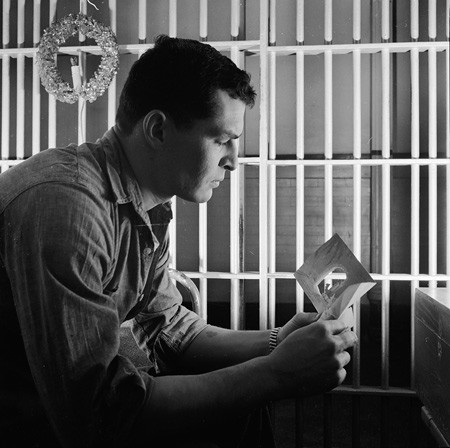 © Getty Images / Fotobank.ru
Conclusion implies a radical break in communications - mobile phones and the Internet are prohibited. Only the “goats” who collaborate with the administration can call home. If the “black” zone, that is, is controlled by “thieves”, then you can get everything through corrupt employees. The only legal way to communicate with relatives is paper correspondence. Since 2008, the situation has been improved the new service of the FSIN , which allows you to quickly send letters through the site for money .
“A person is a social animal, he needs communication with someone else in addition to neighbors in the cell. A letter from will is both protection from disgusting faces, and at the same time a window into the world, ”says Alexei Sutuga. The anti -fascist came under subscription when the matter began to openly fall apart in court.
Despite the strong support from the will, he still cannot recover. After 15 months of stay in Butyrka, the 26-year-old anti-fascist complains that it is difficult to concentrate due to intellectual hunger: "Attention is sprayed all the time." “The same problems have“ swamps ”,” says Sutuga. Alexei often met with them in Avtosak on the way to court.
The fallen snow is already a reason to sit down for a letter.
One way to resist this pressure is correspondence with the outside world. That is why the prisoners are so valuable with correspondence, keeping postcards and re -reading them over and over again.
If you want, without leaving the tablet, psychologically helped with political prisoners, you can easily do this on the Rosuznik website. Initially, the initiators of the project, together with the OVD-Info, quickly pulled out people from the departments. After the detention in the “swamp business”, the volunteers focused on the help of the arrested - along with the “sitting” , “anarchist Black Cross” and the site “For the will” .
Thanks to voluntary contributions, Rosuznik still pays for lawyers and supports the accused. 3600 letters have already been sent, each of which is a gesture of solidarity. Unlike the FSIN website, users of Rosuznik do not need to provide data and pay for a letter. In Russia, both capitals, Kirov, Tula and Yekaterinburg most actively write, from foreigners - Argentines and Czechs.
But the question often arises: what and how to write in prisons? Here are a few simple tips.
How to write letters to prison?
The first letter cannot be a universal way, says the programmer Nikita Kannikov, who will monitor the “Rosuznik” traffic of correspondence and make sure that there are no insults, and letters came to the address. The volunteer says that the first letter should be approached as any other acquaintance - on the street or on a social network. “A person is deprived of the simplest things - he does not walk, he does not follow the weather. There are only gray walls around and the same color sky. The fallen snow is already a reason to sit down for a letter. The main thing is that there is no pity: the guys are not in the coffin, they are not dead. Once Ilya Gushchin even wrote that there is nothing to worry about for us - we also live. ”
Each investigator has a profile on the Rosuznik website - relevant information in court, accusation, hobbies, a brief biography. And vice versa: if you decide to write to the political prisoner, it is reasonably a little tell about yourself. It is not at all necessary to compose an autobiographical novel - it is enough to report your name, a circle of interests, to explain why you decided to write.
The Internet for most of us has become the Internet, but only the “box”-NTV, Muz-TV and Moscow Region remains the same “swamps”. Therefore, the periodicals are read from crust to crust, often asked to sign on a “new newspaper”, New Times and the “Russian reporter”.
One of the friends of the stoop recalls how nice it was to see the famous photograph of the Winter Bolotnaya Square from the helicopter. All the information then went through letters - this pushes people on discussions with cellmates, and during conversations the clock flees faster. By the way, on the "Rosuznik" news and expert assessments can be sent, literally copying them into the form of the letter. In correspondence, political debates often arise: censorship misses such letters quite calmly.
The main thing is that there is no pity: the guys are not in the coffin, they are not dead.
Despite the efforts of the Falanster bookstore , prison libraries are updated only by detectives: they are not given to political literature political. The new bill prohibiting prisoners to read about revolution and war will already worsen their situation. The fantasies of people sitting for months in a closed space are needed.
Of course, in the correspondence with the Politicals, you can talk about anything. But they are really interested in everything new. "Boles" are asked to talk about a recent lecture, exhibition or film. The more human and alive your letter will be, the better, better. Orthodox priests - one of the few who are busy with the prisoners, also give similar tips.
If there is no longer any more respond to the letter of the prisoner, then we can propose to analyze the situation in the country: the Politicals have enough time for this. You can, on the contrary, ask to talk about your life.
The key rule is not harmful, so in any case no dates, nicknames and names. Letters of political prisoners pass not only through the censorship. From careless letters, employees manage to find out the details that will be important to the prosecutor's office. The pre -trial detention center is not convicted, and therefore, everything written can be used against a person.
Correspondence resembles a situation when you are in the same room with an investigator collecting evidence. He is looking for an opportunity to attract new circumstances, witnesses and participants to the prosecution. To understand that it is not worth writing, put yourself in the place of the censor. If your letter is full of puzzles and riddles and you sincerely intended to entertain the prisoner in this way, then such a letter may not go banally: the paranoia of the inspector will work.
The most nervous censorship in Butyrka, where the censors often quit, slowly check the mail, but at the same time manage to respond hard to everything. In the "bear" is better, simpler and in the "vodnik" , where Gaskarov, Zimin, Rukvishnikov, Gushchin, Belousov and Lutskievich are sitting.
It is better not to use the so -called non -normative vocabulary in letters. Too complex foreign words and terms also cause alertness. The criticism of the FSIN and the state in this correspondence is also little appropriate. It depends on the censor whether the prisoner will receive a letter, so the correspondence, as human rights activists advise, should be more likely a “philistine-informational nature”.
In a word, do not hesitate and take up letters: from the will to captivity.
They are very needed there!