Date
Author
Шекспировский сезон Алексея Бартошевича
Source

Preserved copy
Translated material
Confidence and rawness
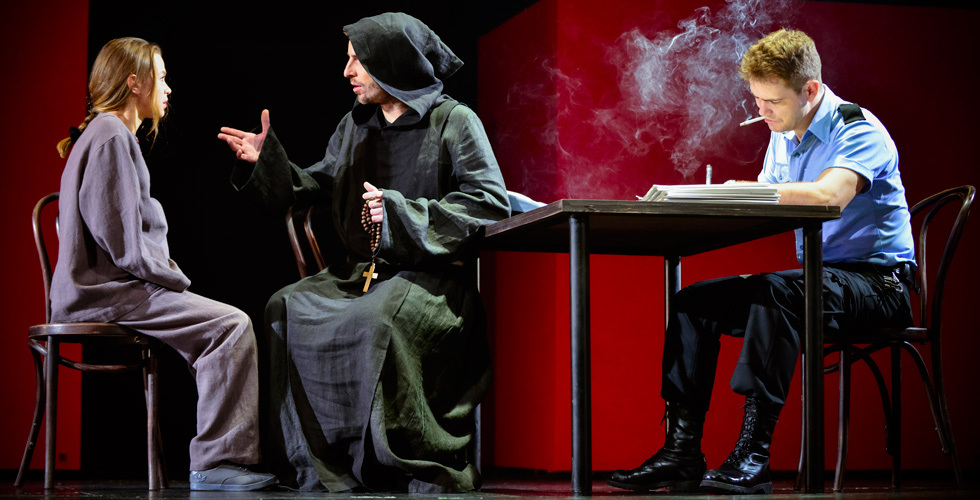
COLTA.RU is launched by the new special project “Shakespeare's season of Alexei Bartoshevich”, dedicated to the 450th anniversary of the Grand Bard of the 450th anniversary of the Grand City of Shakespeare, the Coriah of domestic theater studies, Aleksey Bartoshevich, Lubely agreed to share his thoughts on the premieres of key domestic (and not just) performances staged in the anniversary season on Shakespearean plays. A peculiar prologue for this special project was the text about the “ Othello ” Yuri Butusov, in line - a commentary on the premiere of the Hamlet/Collage theater in the directing of Robert Lepazh and thoughts about the stagnation of tragedy about the prince of Danish. He opens the “Shakespearean season of Alexei Bartoshevich” a text about the performance, already recognized by the capital’s criticism of one of the peaks of the outgoing theater year, - the production of the comedy “Mer for the Mero”, carried out by the outstanding English director Donnellan at the Moscow theater named after Pushkin.
Once the Declan Donnellan had already brought to Moscow the production of Shakespeare's “Measures for the measure” made in his London Cheek by Jowl Theater. It was a strict and hard performance. Nick Ormerod, the everlasting scenographer Donnellan, built a black structure on the stage, which was cut down downwardly with red lightning. With all the action of the rule, explosive passion, chained into a geometrically clear form, but it was this charming that created a strong emotional effect.
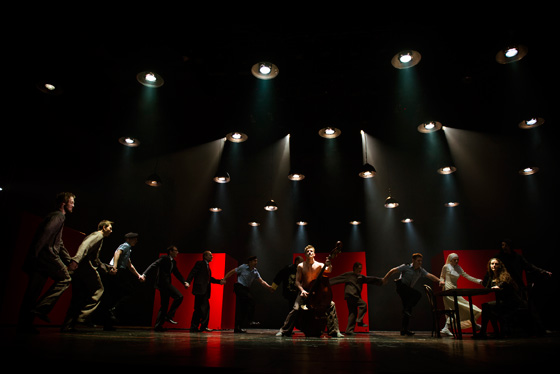 © Sergey Yasir / MDT named after A.S. Pushkin Scene from the play "Measure for measure"
Now the Englishman staged the same play by Shakespeare at the Pushkin Theater with his favorite Russian actors collected from different Moscow theaters (Andrei Kuzichev, Valery Pankov, Alexander Feklistov, Peter Rykov, Anna Khalilulina). The same Ormerod became an artist of the performance. On the stage, geometry reigns again, again - black and red. Lightning, however, as it happened.
“Mer for Meru” is a strange comedy. Yes, and it can only be called a comedy conditionally. This is one of Shakespeare's most uneven plays. Sometimes it seems that its first half is written by one, and the second one with another pen. Some scenes are created by the hand of a great artist, others are just a firm hand of a skilled master of his craft.
The director confidently overcomes the imperfection of the play. However, behind these obvious, simply striking imperfections, the depth of insights in the essence of human nature is hidden. The harmony of the structure of the work does not guarantee its depth.
As Leonid Pinsky noted at one time, the great art is rarely identical in art - breakthroughs of the artist into sincere abysses, in secret areas of being are often adjacent to structural awkwardness, if not even with clumsiness expresses himself with the internal voice of the Creator, struck by his discoveries: he is not up to the chosen smoothness of speech, not up to the harmony of form, he, he was stain Choking with excitement, hurries to immerse us in the abysses opened in front of him.
 © Sergey Yasir / MDT named after A.S. Pushkin Scene from the play "Measure for measure"
In contrast to the performance, as always in Donnellan - an elegant, impeccably built, graphically clear, the play is not only devoid of grace, it dare to say, the order is unsatisfied, and from the point of view of harmony of thought and composition, it is extremely contradictory. The first two acts (if it is allowed to talk about acts: it is known that Shakespeare himself did not divide the plays into acts) are thoughtful and mysterious. They are talking about incomprehensible, unquenchable to the will of the laws of human nature, about the rule of the flesh, before which a weak, vulnerable spirit is powerless. Contrary to the usual interpretation, the main character of the Angelo play by nature is not at all a libertine and a hypocrite. Suddenly mastering his whole being, the force that attracts him to Isabella, pushing him on direct blackmail and other vileness, is so powerful that there is no question of resistance. She seduces him with her very monastic purity. He tries and cannot resist the uncontrollable impulses of his body, becoming a monster of sin almost involuntarily. And therefore, his fault is rather ghostly, and the duke in the finale with strange ease forgives him, who almost destroyed the young heroine and her brother. In the finale of the plays, forgiveness is given to the sinner, and a harmless talker is sternly punished. As someone said: this is anything, but not a measure for a measure.
The laws of moral justice in the world of this play do not really act, they are extremely blurred. Forgiveness in the play is not a sign of the renebaceous faith in the goodness of nature, but the mannerist gesture of hopelessness. There is no sense in the world, humanity cannot be corrected, indignant, glowing with fair anger: you have to put up with sad reality. We must not forget that the comedy “Mer for Meru” is a contemporary of the tragedy about the Prince of Danish. This is the comedy of that world, the tragedy of which is Hamlet. It has as much as you like Elsinor, but do not look for Hamlet in it.
With the main tragedy of Shakespeare, this dubious comedy is united by painful spinning by death, perceived not so much as non -being, the end of life, but as the process of physical decay, rotting of the mortal body. Like Hamlet, this play yells about what it means to be dead, about being-in-death. Claudio, sentenced to execution, is trying to be higher than the fear of death and cannot: a full scream of chilling horror breaks out of his mouth:
But die, go where you do not know
Lie and rot in the freeness of cold,
So that what was warm and alive.
Suddenly turned into a raw land ...
And the most painful life:
Everything is old age, poverty, prison, illness,
Oppressive nature, will be paradise
In comparison with what you are afraid of in death.
Before this dying of the trembling flesh, the impeccable virtue of Isabella, sacredly keeping its purity, may seem like a heartlessness.
It can be assumed that, having plunged into these abysses of the mannerist consciousness, which doubted all the values of the Christian and any other morality and therefore defenseless before the fear of the end, Shakespeare decided to break out of the signs of but dangerous depths and hastened to finish the play, turning to the proven tricks of the traditional comedy with substitutions, changing clothes Goodly dummy plunks and a prosperous ending. Or maybe just the actors of his troupe demanded to hurry with the end: something you, our precious William, were imported with this “measure”, there are three days left before the premiere, and we still have a role to teach.
One part of the play reminds us of Dostoevsky or Camus, the other is about "a lot of noise from nothing." The second is no worse than the first, but these are completely different ways to see and understand the world and people.
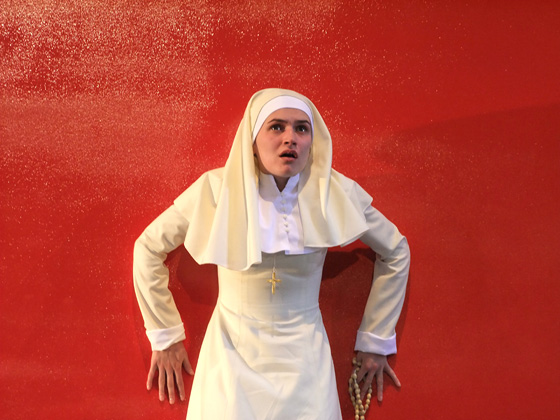 © Victoria Lebedeva / MDT named after A.S. Pushkin Scene from the play "Measure for measure"
The director, who wants to make ends meet and create something integral, has to decide which of the parts to rely on; One way or another, he must choose one of two: it is difficult to find a compromise here. Donnellan preferred a compromise. He put an elegant, strict, britant correct and cold performance. Where it is about tormenting the soul and the lusts of the flesh, it costs light hints, well -thought -out stage signs. When Angelo sniffs for a long time on which Isabella just sat, or when Claudio, in anticipation of the execution of the wolf howls, these are accurate and well-invented external designations of passions moving heroes. It is impossible to blame the actors that they are not trying to penetrate the abyss of the spiritual underground of their characters: the director himself does not want this. It seems that Donnellan prefers not to plunge himself and not immerse the actors (and you and you) into this deeply painful world, fraught with many dangers and mental impasion: this could undermine the whole verified structure of the production. Seeing the inscription “Leave hope that is coming here,” he refuses to follow the conductor. Perhaps the director is not so wrong. In the end, the author of the play did not act in the same way, entering the circles of the underworld, but halfway flew away from there?
There are advantages in this brilliant, confident and raw sliding on the surface that the Englishman offers us. Losing in the depths, the performance wins in integrity. He wants to like and easily achieves his goal, so natural for the theater, getting a noisy and well -deserved success: the voices of critics have already merged in the choir of loud and, no doubt, fair praise.
Nevertheless, the main thing is that Shakespeare’s “gloomy comedy” is addressed to us, the insights contained in it about man and human nature, that in the play screams, crying out about theatrical embodiment, still remains unheated, at least on the Russian stage. Well, we will find patience and we will not lose hope.