
Translated material
Sometimes they return

Cases of a successful return after a long disgrace, link or conclusion are quite rare in Russian history, especially when it comes to an influential figure with a serious political past. How was the fate of those who lost everything overnight, spent many years behind bars or in exile and then nevertheless went free?
Vassian (Vasily Patrikeev)
The son of the influential prince Ivan Patrikeev paid his career due to the fact that his family unsuccessfully chose the side in the dynastic struggle. The young successful commander and diplomat in 1499 was tonsured monks in the Kirillo-Belozersky monastery under the name of Vassian. He remained for the disgraced monk 10 years, until 1509. However, having forever lost the opportunity to make a secular career, Vassian showed himself as an extraordinary spiritual publicist. In 1509, Grand Duke Vasily III not only returned Vassian from exile, but also brought the monk closer to himself, calling him his "mentor in humanity." Now he was "a great and temporary man at the Grand Duke of a neighbor." But he did not have a chance to calmly end his life - if earlier his family participated in the political struggle, now Vassian intervened in the confrontation of supporters of two church movements, “non -possessors” and “Josephles”.
The student of the Nile Sorsky, Vassian opposed the followers of Joseph Volotsky, calling them heretics. It should be noted that, despite the fiery of the accusatory rhetoric, he called for the forgiveness of the fed heretics and defended the disgraced. In 1531, the opponent of Vassian, Metropolitan Daniel, accused his opponent of heresy. Twice the disgraced prince-yon was sharpened in the walls of the Joseph-Volokolamsk Monastery and, according to Prince Kurbsky, "in the near future, bertoled by the present Josephles."
Filaret (Fedor Romanov)
Quite happily for his difficult era, the fate of Fedor Romanov formed - from a disgraced contender to the throne, he became the patriarch of Moscow and all Rus' and the father of the king. In 1600, Tsar Boris Godunov sent Boyarin Romanov to exile and tonsured him, a completely secular man, to the monks, getting rid of a dangerous competitor (Fedor Romanov was the cousin of the deceased Tsar Fedor Ioannovich).
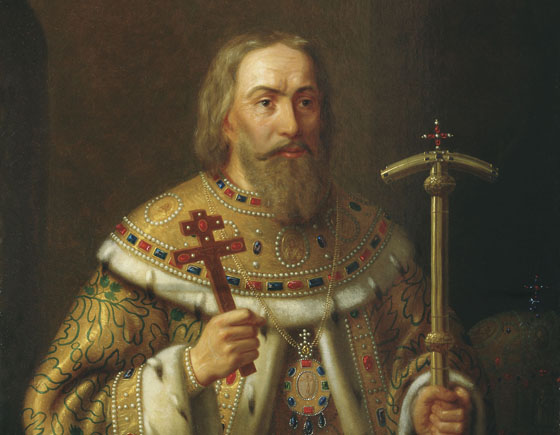 Patriarch Filaret (Fedor Nikitich Romanov), painting by N. Toyjumova
During the Time of Troubles in 1605, False Dmitry I freed Filaret as his “relative”, then the monk involuntarily ended up in the camp of the False Dmitry II (Tushinsky Thief), where he was “named by the Patriarch”, in 1610 he was repelled from Tushins, a year later Filaret refused to sign an agreement during negotiations with the Poles and was again captured. But all these adventures ended surprisingly safely - in 1619 the son of Filaret, King Mikhail, with honors met his father freed from captivity. By the end of his life, Patriarch Filaret remained the official co -ruler of his son, in violation of all the canons he called himself “the Great Sovereign” and combined the “Nikitich” received by the tonsure with his patronymic - in general, he behaved more like a secular man and a state husband than like an other.
Nikon (Nikita Minin)
Like Filaret, Patriarch Nikon added to his title the royal title “Great Sovereign”. The active and imperious native of the Mordovian peasants actively participated in the administration of the state, while opposing the intervention of secular power in church affairs. Gradually, Tsar Alexei Mikhailovich, who had completely trusted Nikon before, stopped supporting the Patriarch, who restored the fair part of the boyars and bishops against himself.
In 1658, Nikon retired to the Resurrection Novo-Jerusalem Monastery founded by him. His enemies did not lose time - in 1660, at the church cathedral convened in Moscow, it was decided not only to deprive Nikon of the bishop, but also to erupt from the dignity. However, then the case was nevertheless transferred to the court of the patriarchs of the eastern churches, which arrived in Moscow only a few years later. In 1666, the Local Council of the Russian Church was opened with the participation of Patriarchs Paisius of Alexandria and Macarius of Antioch. As a result, Nikon was forever erupted from the patriarchate and priesthood, becoming a simple monk. It should be noted that in relation to his opponents, Nikon was also not distinguished by soft -hearted. For example, Pavel Kolomensky, he beaten, tore off a mantle from him, deprived the episcopal department from him without a cathedral court and exiled to the monastery (in 1656, Paul, according to the Old Blessed Tradition, was burned in a log house).
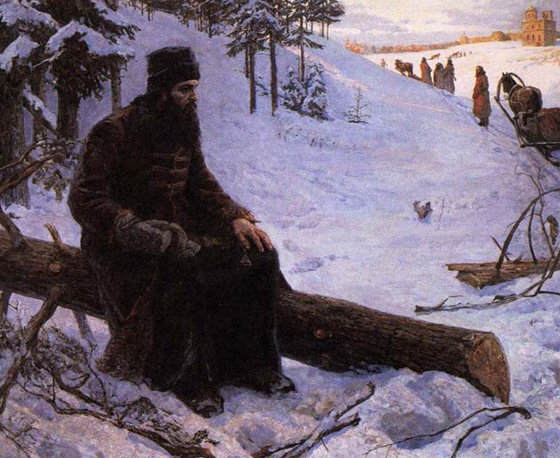 Patriarch Nikon returns from exile to Novo-Jerusalem Monastery, painting by B. Cherushev
The monk of Nikon was sent to the Ferapontov Belozersky Monastery; After the death of the king, he was transferred to more strict supervision to the Kirillo-Belozersky monastery. However, the new king, Fedor Alekseevich, was determined to have mercy on the elderly Nikon. In 1681, the disgraced patriarch was allowed to return to the Voskresensky Novo-Jerusalem Monastery. But a seriously ill Nikon died on the road, never seeing his brainchild for the last time. The king insisted on the funeral service of Nikon as a patriarch, and in 1682, despite the resistance of Patriarch Joachim, he received permissive letters from the eastern patriarchs, in which it was commanded to reckon Nikon to the Patriarchs and to remember in such a rank openly.
Mikhail Speransky
The reformer and supporter of the constitutional system Mikhail Speransky, by origin - the son of a simple accountant, visited a long link when he fell into disgrace. Dissatisfaction with Speransky’s reforms and the active activity of his opponents at court were not immediately able to undermine the influence of the lawmaker. But Speransky behaved somewhat self -confidently, overestimating Alexander I. Meanwhile, the “heavy artillery”, the emperor’s sister, Grand Duchess Ekaterina Pavlovna, entered into business. She presented to Alexander I writer Nikolai Karamzin, who handed over the king “A note about ancient and new Russia”, which defended serfdom and autocracy of the sovereign. In March 1812, the emperor’s conversation with Speransky took place, after which the Secretary of State went “almost in unconsciousness, instead of papers began to put his hat in the portfolio and finally fell on a chair, so Kutuzov ran for water.” Speransky was immediately sent from Moscow, where he returned only nine years later, in March 1821.
The disgraced reformer served a link in Perm. Since 1814, he was allowed to live under police supervision in a small estate in the Great Polish of the Novgorod province. Speransky, clearly stunned by a sharp turn in his fate, did not want to humble himself with reference and constantly petitioned Alexander I through Arakcheev about his complete forgiveness.
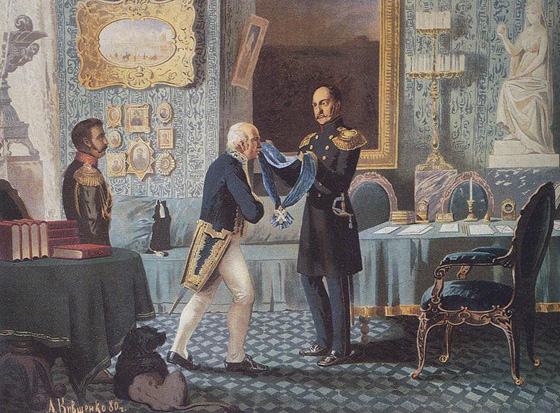 Emperor Nicholas I rewards Speransky for drawing up a set of laws, a picture of A. Kivishenko
In 1816, by decree of Emperor, Speransky was returned to the public service as a Penza governor; In March 1819, he was appointed Governor-General of Siberia. Ironically, Speransky, who himself in exile, became the “legislator of the link”, ordering this type of punishment, and determined the ratio of the link with hard labor in the “Charter about exiles” (1822). The Decembrists saw in Speransky the First President of the Russian Republic in the event of the overthrow of Nicholas I - instead, he was among their judges. True, according to contemporaries, the forced participation in the Supreme Court over the Decembrists Speransky was very difficult.
Sergey Trubetskoy
On the eve of the uprising of 1825, the Decembrists elected Prince Sergei Trubetskoy to the dictator. But the offspring of a noble family and a participant in the war of 1812, who wrote the “Manifesto on the Russian People”, behaved extremely indecisively and did not at all appear on Senate Square on a fatal day on December 14. On the night of December 14-15, Trubetskoy was arrested and brought to the Winter Palace. Emperor Nicholas I came towards Trubetskiy's forehead: “What happened in this head, when you, with your name, with your last name, have entered such a thing? Guard Colonel! Prince Trubetskoy! How are you not ashamed to be with such a rubbish? Your fate will be terrible! ”
The fate of Trubetskoy was better than many of his comrades in the “Union of Blagificness”, but still difficult - especially for the Russian aristocrat. The Supreme Court sentenced Trubetskoy to cut off his head, the emperor replaced the death penalty of eternal hard labor. Together with the failed “dictator”, his selfless wife, Ekaterina Ivanovna Trubetskoy, went to the exile. Initially, Trubetskoy served a sentence in the Nerchinsk mines, then at the Petrovsky factory. In 1839, upon departure of hard labor, the exiled prince settled in the village of Oyok Irkutsk province. Ekaterina Trubetskoy died in Irkutsk in 1854.
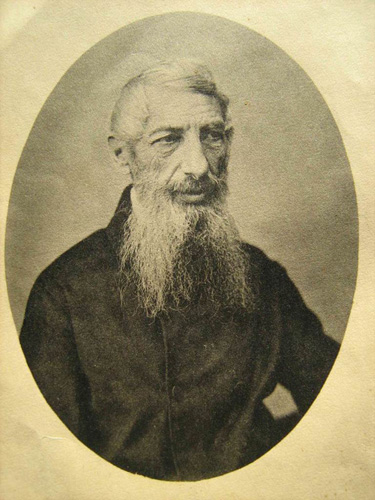 Sergey Trubetskoy. Photo by A. Bergner, Moscow, 1857
Thanks to the amnesty of Emperor Alexander II in 1856, Trubetskoy was restored in the rights of the nobility, the princely title of his father passed to his children. The prince who returned from exile talked only with close relatives and friends, was "good -natured and meek, silent and deeply humble." At the same time, Trubetskoy was not allowed to constantly live in Moscow, he came there only with the permission of the police. The prince died in Moscow in 1860.
Fedor Dostoevsky
In 1849, the military court decided "for the information of the dissemination of the criminal about the religion and the government of the letter of Belinsky’s writer ... to deprive the arches and all the rights of the condition on the basis of the Code of Military Resources and to death the death of Fedor Dostoevsky. The young nobleman, who recently published the story “White Nights”, was arrested in the case of Petrashevtsev, participants in the “free-thinking” meetings with Mikhail Butashevich-Petrashevsky.
Dostoevsky had to survive the dramatization of the execution - they announced the pardon and replacement of the death penalty at the last moment. After this, the shocks of the convict were waiting for four years in hard labor in Omsk. On the way to the place of hard labor, in Tobolsk, the writer met with the wives of the Decembrists, who gave him the gospel.
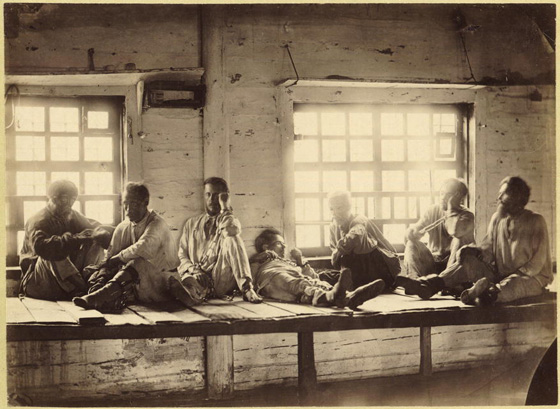 Penalty camera. Photo by Alexei Kuznetsov, 1891
“According to the side of the fence about that world, they imagined as some kind of unrealistic fairy tale. There was its own special world, not like anything, there were its special laws, their costumes, their customs and customs, and a dead house alive, life is nowhere and special people, ”wrote Dostoevsky about the world of a hard labor in“ Notes from a Dead House ”. In 1854, Dostoevsky became an ordinary of the linear Siberian battalion from the convict, then the non-commissioned officer (thanks to the loyal poem written after the death of Nicholas I) and the warrant officer. In 1857, Dostoevsky married Maria Isaeva, in 1859 he was allowed to leave for Tver, and in 1860 Dostoevsky and his wife and adopted son returned to Petersburg. The unspoken observation of the former Petrashevts continued until the mid-1870s.
Nestor Makhno
“With the belief that freedom, free labor, equality and solidarity will triumph over slavery under the yoke of the state and capital, I left on March 2, 1917 from the goal of the Butyrskaya prison ... eight years and 8 months of my seat in prison, when I was chained (like an immortal) hand and foot, seating, accompanied by a serious illness, nor Yota did not wipe me in In the correctness of anarchism, fighting against the state as a form of public organization and as a form of power over this public ” - this is how Nestor Makhno describes in his memoirs a way of free rein after a long -term conclusion. The young "Anarcho-Communist" was arrested in 1908 for the murder of an official of the military council. In 1910, the Odessa court sentenced him to the death penalty, but the gallows were replaced by unlimited hard labor. Makhno was transferred to the hard labor department of the Moscow Butyrskaya prison, where he was until 1917.
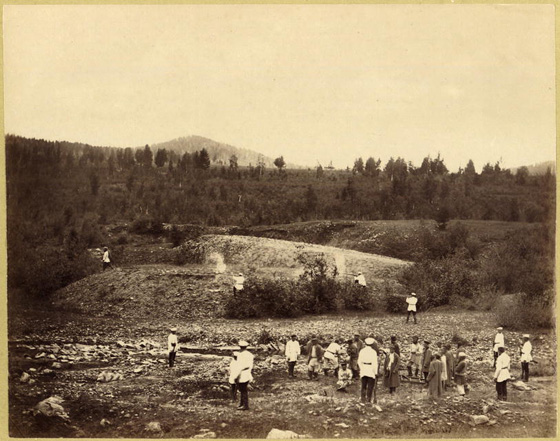 The shooting of the prisoner during work. Photo by Alexei Kuznetsov, 1891
Gulyaipol, the “Committee for the Salvation of the Revolution”, the peasant republic, the war against the whites and the alliances with the Reds, replaced by conflicts ... Having lost in the confrontation with the Red Army, Makhno was forced to emigrate, visited the internal camp, in prison, was under the supervision of the police, miraculously slipped away from the Chekists pursuing him. Nevertheless, he died his death and at large - in 1934 in the Paris hospital from bone tuberculosis.
Maria Spiridonova
The participant of the Socialist -Revolutionar combat organization in 1906 was deadly wounded by the official Lushenovsky, who distinguished himself during the suppression of the 1905 revolution. Spiridonova tried to shoot herself, but she was detained, cruelly beaten. The young revolutionary was sentenced to death and was waiting for sixteen days that now she would be leading to the gallows. To prepare herself for death, she for hours swinging the figure of a man from a bread crumb, hanged in a balance. Finally, Spiridonova was informed of the replacement of the death penalty by unlimited hard labor.
Until the February Revolution of 1917, Spiridonova was in the Nerchinsk hard labor until she was released by order of the Minister of Justice Kerensky. After the liberation of Spiridonov, she became one of the leaders of the Left Wing of the Socialist Revolutionary Party, was the editor of the magazine "Our Way", became the chairman of the emergency and II All -Russian Peasant Congresses, worked in the CEC and the peasant section of the All -Russian Central Executive Committee. Although at first Spiridonova advocated cooperation with the Bolsheviks, by the summer of 1918 she went to the camp of their opponents. “Instead of free, shimmering, like the light, like air, through the folk work, through a shift, the struggle in the councils and at the congresses, you have the appointments, the bailiff and gendarmes from the Communist Party,” Spiridonova said in the open letter of the Central Committee of the Bolsheviks.
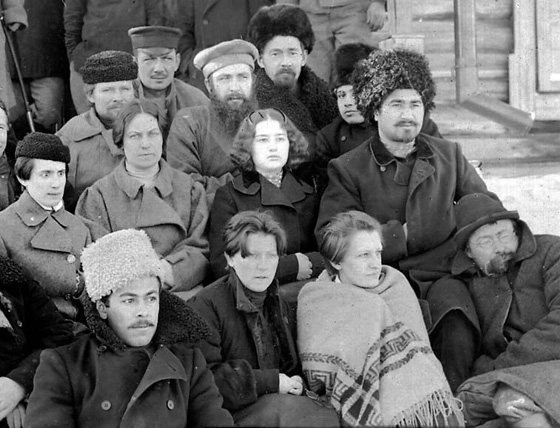 A photograph of political prisoners in the Akatui hard labor prison of the Nerchinsky Mountain District (fragment). Maria Spiridonova - in the front row, to the right of a man in a white papa. 1906.
In July 1918, during the V All -Russian Congress of Councils, Spiridonov was arrested, on November 27, the Supreme Revolutionary Tombunal under the VTSIK examined the case of the "conspiracy of the Central Committee of the Left Socialist Revolutionaries against Soviet power and revolution" and sentenced Spiridonov by the year of the prison, but then freed it for "special merits before the revolution." In 1919 and 1920, Spiridonov was arrested again, she lives under the supervision of the Cheka. After an unsuccessful attempt to escape abroad, a well-deserved revolutionary was sentenced to 3 years to references to the Kaluga state farm-colony. After a whole series of links (Samarkand, Tashkent, Ufa), Spiridonov was again arrested in 1937 and sentenced to 25 years in prison. In September 1941, she was shot in the Medvedevsky forest by the NKVD, along with other political prisoners of the Oryol prison.
Vasily Shulgin
The deputy of the II, III and IV State Duma, the hereditary nobleman, the nationalist and monarchist in views, Shulgin in March 1917 accepted the renunciation of the hands of Emperor Nicholas II. However, instead of the desired constitutional monarchy, he was disappointed. Shulgin refused to join the Provisional Government, became one of the ideologists of the White movement, advocating the restoration of "Russia unified, great and indivisible" and the struggle "with mass insanity called socialism." By the time of emigration, Shulgin lost in the Civil War of the brothers and two sons, his wife remained in Odessa occupied by the Bolsheviks. In emigrant circles, the reputation of Shulgin was undermined by the scandal around the Trust organization, which turned out to be a provocation of the Soviet special services. Schulgin, who sympathized with Italian fascism, did not support the German National Socialists, seeing in them a threat to the national interests of Russia. In 1944, Soviet troops occupied Yugoslavia, where Shulgin lived since 1930, and in December he was taken to Moscow, where he was arrested as an "active member of the White Guard Organization."
Shulgina was sentenced to conclude in a forced labor camp for a period of 25 years (the death penalty was canceled during this period), but the convicted person in any case did not expect such a harsh sentence: “The maximum that I was counting on is for three years.” After twelve years in the Vladimir Central, Shulgin was released in 1956 under an amnesty. After several years of life, Shulgin and his wife received a one -room apartment in Vladimir, where they lived under the supervision of the KGB. Shulgin was allowed to engage in literary activities (even in conclusion, he worked on memoirs), many guests came to him, including Alexander Solzhenitsyn.
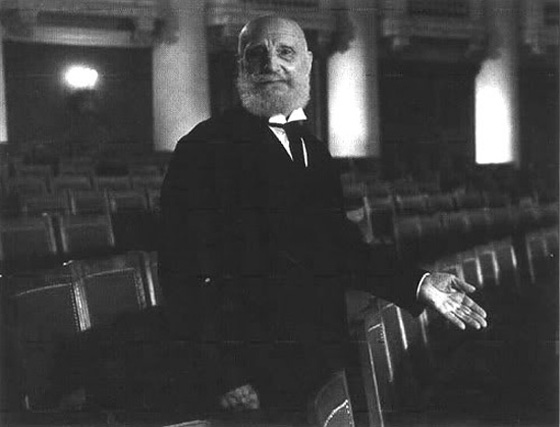 Vasily Shulgin. Frame from the film "Before the Court of History"
Khrushchev tried to use Shulgin as an example of the “overlooking White Guard”, but not too much succeeded in this. About the book “Letters to the Russian Emigrants” (1961), praising the Soviet power, Shulgin said with annoyance: “I was deceived”, and in the film Ermler “Before the Court of History” he did not look at the exposure of white emigration and the singer of communism, as expected, as a result, the film was removed from the rental after three days. Schulgin, who died in 1976, did not accept Soviet citizenship.
Alexander Solzhenitsyn
The letters of Captain Alexander Solzhenitsyn, in which he criticized Stalin, calling him “Pahan”, attracted the attention of military censorship in 1945. Solzhenitsyn was arrested, deprived of a military rank and in absentia was sentenced to 8 years in order and labor camps and an eternal link at the end of the term of imprisonment. From 1945 to 1952, the prisoner visited the "sharashki" and several camps, including Steplas. В феврале 1953 года Солженицына освободили и отправили в ссылку на поселение «навечно». Еще зимой 1952 года в лагере Солженицын перенес операцию, а в конце 1953 года у него обнаружили рак, от которого Солженицыну удалось вылечиться в 1954 году (эти события легли в основу повести «Раковый корпус»). В июне 1956 года решением Верховного суда СССР Солженицына освободили без реабилитации «за отсутствием в его действиях состава преступления». Рассказ Солженицына «Один день Ивана Денисовича» с разрешения Хрущева был напечатан в журнале «Новый мир» (1962). После короткого периода признания Солженицыну фактически запретили печататься, писатель стал распространять в самиздате романы «В круге первом» и «Раковый корпус», в феврале 1967 года тайно закончил «Архипелаг ГУЛАГ». После долгого противостояния с органами госбезопасности в 1974 году Солженицына выслали из СССР в ФРГ. На родину он вернулся только в 1994 году, хотя еще в 1990 году был восстановлен в гражданстве с последующим прекращением уголовного дела и получил Государственную премию РСФСР за «Архипелаг ГУЛАГ».