
Translated material
JSC "Ukraine" and its new shareholder
Yanukovych followed in the footsteps of Tymoshenko
About how, using the financial crisis in Ukraine, Vladimir Putin inexpensively acquired a stake in the Ukrainian Corporation, which allows to block unwanted transactions and insist on decisions that are beneficial to Russian state corporations. How Putin outplayed everyone in the analysis of The New Times
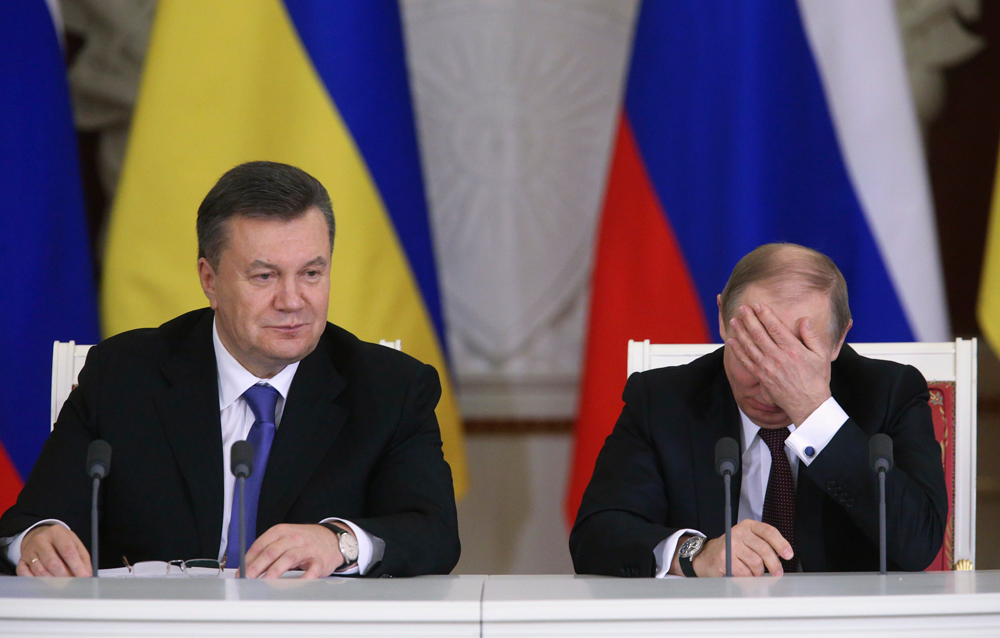
Now Vladimir Putin is thinking about the problems of Ukraine. Moscow, Kremlin, December 17, 2013
What we agreed
Last week, Russia and Ukraine signed almost two dozen agreements. Russia will reduce by a third (from $ 410 to $ 268.5 per thousand cubic meters) the price of gas, which will give Ukraine about $ 4-5 billion a year. It was necessary to reduce the price of gas, regardless of Putin’s sympathy for Vladimir Yanukovych or the desire of Ukraine for partnership with the European Union. The gas agreement concluded by Putin with Yulia Tymoshenko was extremely unfavorable for Ukraine. It was cheaper to supply fuel to Ukraine with reverse from Europe. Insisting on the implementation of the contract, for the signing of which Tymoshenko is in prison, Gazprom would sooner or later lose the Ukrainian market.
A decrease in gas price for Ukraine will not be long -term. The contract does not change, amendments to it reduce the price by only one quarter. Such agreements Ukraine will have to be signed every three months. Putin will be able to manipulate the cost of gas depending on the behavior of Yanukovych.
The second agreement can be canceled by the Ukrainian default: Russia will spend $ 15 billion from the National Welfare Fund for the purchase of Ukrainian Eurobonds. The first tranche, $ 3 billion, will be invested in two -year Ukrainian bonds with a profitability of 5% per annum in December. Part of this money will return to Russia as a gas payment, says Eric Naiman, managing partner of Capital Times. In fact, the Kremlin credits Ukraine with her own money, he continues: for four years, Russia received about $ 5 billion annually due to overstated gas prices.
"
A decrease in gas price for Ukraine will not be long -term. The contract does not change, amendments to it reduce the price by only one quarter
"
Cooperation in the field of shipbuilding is intensified: the Ukrainian Smart-Holding, the Black Sea Shipyard, etc., calculate the growth of orders for the construction of trawlers, gas carriers and other types of vessels. Ukraine will abandon the special delivery of cars. Models of Russian car factories will return to the Ukrainian market. At the same time, Ukraine, apparently, will have to remove duties against cars from the EU. Cooperation in the field of aircraft industry is resumed: Ukraine and Russia are hoping to build 80 An-124 aircraft in the amount of $ 12.9 billion. Russia will allow Ukrainian pipes to the market and Ukrainian producers. In return, Ukraine will not interfere with the supply of Russian coal.
The question of the entry of Ukraine into the Customs Union was not formally discussed.
Reasons for the transaction
The Ukrainian economy is in a brutal recession. In the first half of the year, the recession of GDP amounted to 1.3%. According to the results of the year, the economy will lose at least 1%. The industry drops above 5%, the most - metallurgy and automotive industry. Export decreased by 6.5%, mainly due to falling prices (by about 30%) and demand for metals. A great contribution to the trade deficit of Ukraine makes an ultra -high price of Russian gas. In this quarter, a thousand cubic meters cost $ 410 in Ukraine - more expensive than in East European countries. Belarus receives Russian gas for $ 163.
Over the past three years, the international reserves of the National Bank of Ukraine have almost doubled, from $ 34.6 to $ 18.7 billion. This almost does not leave the National Bank of the opportunity to maintain a stable hryvnia course. The devaluation would be beneficial to the economy: exporters will increase, industrial competitiveness will increase, tourism will come to life.
But Ukraine cannot afford a sharp devaluation: it will reduce the confidence of the population in the hryvnia and the banking system. The possible “raid” of depositors to banks and to meet the demand for currency in case of devaluation has no resources for the confrontation. The weakening of the hryvnia will increase the expenses of the government to pay debt.
A steady budget deficit, a recession, a negative current balance, the need to pay $ 2 billion of Naftogaz debts in December, and the next - about $ 6 billion of external debt turned Ukraine into a debtor standing on the market with an outstretched hand and ready to join the one who gives money. The unpreparedness and slowness of the IMF and the EU pushed Yanukovych into Putin's arms. The rates on foreign currency Ukrainian bonds grew to 8–9%, and by hryvneus - to 14-15%. With zero inflation, it is impossible to serve debt on such conditions. The credit line at least $ 10 billion was needed by Ukraine as air - otherwise it would have to be sharply reduced by the budget deficit. A year before the elections for Yanukovych, this is tantamount to suicide.
What Yanukovych received
Now the Ukrainian president can confidently look into the future. A decrease in gas price and deposit of the threat of default on public debt for one and a half to two years allow him to abandon the early elections, which are insisted by the Ukrainian opposition. The corruption of the West, not confirmed by credit allocations, Yanukovych firmly rejects: "I am categorically against someone to come to our country and taught us to live."
Pulling of the elections is vital for Yanukovych: according to the survey conducted in early December, the “Prospects of the Week” weekly, in the presidential election, Yanukovych would lose to the leaders of the opposition, and the most strongly Vitaly Klitschko: 46.9% versus 28.6%.
The 2014 budget, despite the recession, the President of Ukraine built in the best election traditions. The forecast of GDP in the budget is overestimated by 7-8%, and budget expenditures - about a quarter. It will be possible to fulfill the budget plan only with a devaluation of hryvnia by 15–20%, Eric Nyman notes. Yanukovych gets the opportunity to continue the generous budget policy. In 2014, the provision of all categories of military personnel will double. Like Putin, Yanukovych now pays for the state expense of anti -optical rallies, to which state employees from the regions are taken into account.
Stabilization of the situation with duty will stop the outflow of funds from deposits of the population and an increase in demand for currency. The beginning banking crisis will be delayed.
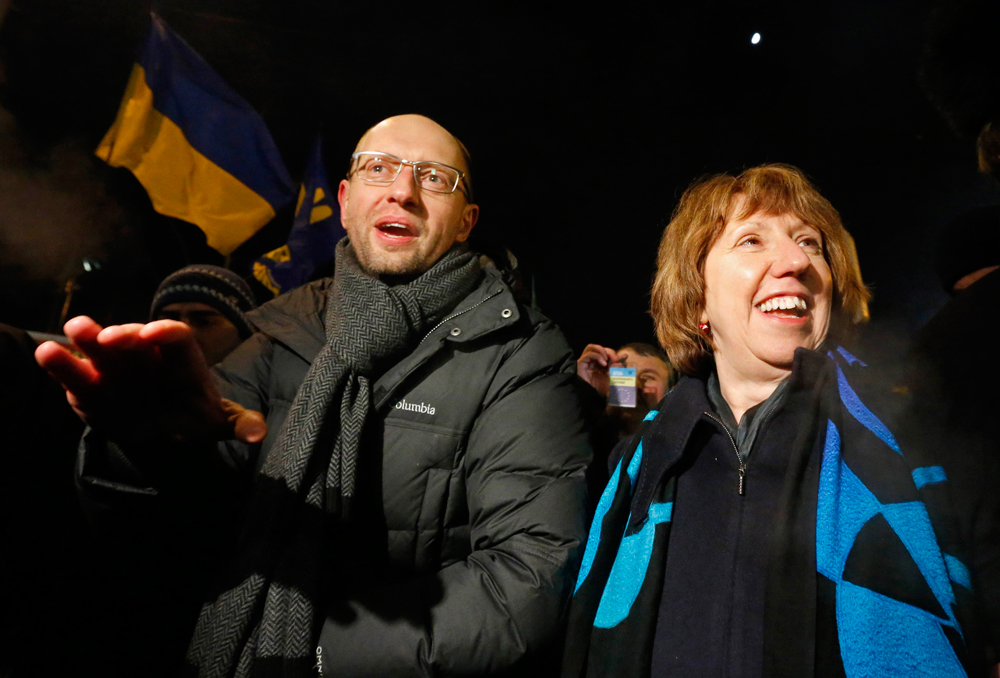
European Commissioner Katherine Ashton and oppositionist Arseniy Yatsenyuk are dissatisfied with the agreements of Russia and Ukraine. Kyiv, Maidan, December 10, 2013
Putin's benefits
The $ 15 billion allocated to Ukraine is not quite a debt, says Vitaliy Vavrishchuk, head of the analytical department of IR SP Advisors: it is more like a share of Ukraine’s capital acquired by a shareholder. If the capital of the country was equal to its annual GDP, $ 15 billion is a small purchase: only 8%. But the share of Russia in the Ukrainian public debt at the end of this transaction will reach 50%. The new creditor, due to which the debt is paid to the old, where it is more desirable to have the same, who has lost faith in the ability of the borrower to pay off debts. It is the new, not the old creditor, decides whether to bankrupt the borrower.
Putin saved Ukraine from default, the Prime Minister of Ukraine Nikolai Azarov frankly says. So now the Russian leader is clearly more than 50% of the voting shares in the government of Yanukovych, the governing body of JSC Ukraine.
Having received such opportunities, Putin secured himself well from losses. Both from the gas agreement and the purchase of Ukrainian Eurobonds, Russia can refuse at any time. It is enough Yanukovych to lose power, giving it to the hands of Putin not indifferent to politicians, or once again change the vector - and the gas will rise in price, and the credit line will close. It is logical and the decision to lend to Ukraine through Eurobonds, and not within the framework of bilateral agreements. The lender will not be able to stop fulfilling obligations only to Russia. Or he pays everyone - or does not pay anyone.
Soft power
Officially without entering the Customs Union (TS), Ukraine is close to doing this in fact. The agreement signed last week will increase trade between the two countries. And in January, Ukraine and TS are consistent with measures leading to a barrier -free movement of a certain nomenclature of goods between the vehicle and Ukraine, said Andrei Slepnev, Minister of the Eurasian Economic Commission for Trade. Slaughterous trade (without additional checks and certificates) can earn no later than 2015, says Slepnev.
Putin saved Ukraine from default. So now the Russian leader is clearly more than 50% of the voting shares in the government of Yanukovych
"
Without formal integration, Ukraine made or promised to do almost everything that Putin wanted from her. Cooperation will grow in sensitive areas for Russia where state-owned companies dominate, and production is credited with state banks: aircraft and space industry, shipbuilding. Barriers to trade in metals, coal and mechanical engineering products are reduced. What else to dream of? Formal membership of Ukraine in the vehicle is an optional condition for countries to increase trade and cooperation.
Ukraine can become simultaneously an observer (not being formally a member) in the TS and the Eurasian Economic Union, having at the same time received the status of an associated EU member, Yanukovych dreams. This is the right approach. The rules of the two trade unions should not contradict each other. Another thing is that Putin has his own opinion on this score:, unlike Yanukovych, he considers membership in one of the trade unions as an obstacle to entry into another. So the EU argues.
Following Israel
Here Israel comes to the aid of Ukraine. “In 2014, an agreement will be developed and signed on the creation of the duty -free trade zone between Israel, Russia and Kazakhstan and Belarus,” says Israeli Foreign Minister Avigdor Liberman. Now the countries of the TS account for only 2% of Israeli exports; The agreement will increase this volume more than half, Israeli officials hope.
The main work on the agreement was completed, the last strokes remained, says Lieberman. However, Israel is part of the free trade association with the European Union, which will be against its agreement with the TS. If Israel manages to overcome the protests of European lawyers and conclude an agreement with the vehicle, why cannot Ukraine do the same?
Depropolitized agreements with the TS and the European Union will serve all countries. The fewer duties, quotas, certificates, any other trade restrictions, the better all countries participating in world trade. Of course, non -competitive national manufacturers, inferior to part of the market to foreigners, lose from such agreements. But the winnings received by consumers outweighs.
Europe was late
The EU will not compete with Russia for Ukraine, the Lithuanian Foreign Minister Linas Linkyavichus emphasizes the EU, “This is not boxing and not a struggle, or even auction, when they compete, who will pay a greater price.” But you have to compete. Putin, like an experienced card player, sharply raised bets.
A couple of days after the signing of the agreements of Russia and Ukraine, FT and WSJ came out with articles in which anonymous European officials claimed that if Ukraine signed an agreement on the Association with the EU, Europe would help Ukraine receive € 20 billion in the IMF.
Is it worth Yanukovych and Azarov to bit your elbows? It is hardly. Firstly, European assistance-if European officials do not joke-will definitely come in handy to Ukraine in a year or two, when the Russian desire to finance integration begins to dry up. Under Yanukovych, who, like Putin, builds a state, or “family” country in the country, capitalism, an economic rise will hardly begin in Ukraine. So, debts will have to be repaid at the expense of new loans.
Secondly, IMF loans are not cheaper than Russian. But if the fulfillment of Russian requirements in Ukraine is associated with the expansion of bilateral trade, then for the sake of obtaining money, the IMF will have to begin a number of reforms unpleasant for the clan-family economy. Yanukovych could go under the threat of default, but now that he found a rich creditor, there is no need for unpleasant changes. Let the unpopular reforms remain to the share of political opponents, Yanukovych argues. This is not the logic of caring for the country, but the logic of concern for political survival. But you can understand it.
It is more difficult to understand Putin. Now he has become for the authoritarian and not able to manage Yanukovych’s economy “older brother”, covering his mistakes at the expense of loans. So far, Russia has money for such experiments. But in Yanukovych, Putin can see his fate - the condition in which Russia will be a couple of years after the start of a long drop in oil prices. To whom then Putin himself can turn to for help? Unless to Chinese authoritarian leaders.
Moscow dejavu
Agreeing with Putin, Yanukovych was very similar to Tymoshenko
Text: Alexey Bluminov, political scientist and publicist (Kyiv)
In Ukraine, in Europe, and in the USA, everyone is trying to understand what Viktor Yanukovych signed in Moscow. I think the most interesting details will begin to emerge a little later. However, now an analogy with a similar demarche, Yulia Tymoshenko in 2009, begs. And then, and now, pro -government propagandists assured the audience that these agreements would bring only benefits to Ukraine. However, in fact, the current “gas discount” is the same scam as the then discount.
Firstly, no gas price has occurred. On the contrary, in the context of the fall of Ukrainian industrial production by almost 5%, the need for industrial consumers in gas is reduced. But the volume of gas procurement, which Ukraine pledged, has increased significantly and amounts to 41.6 billion cubic meters. Let me remind you that in recent years we have observed the reverse process - a systematic reduction in purchases of Russian gas, which led to the release of Ukraine from the first three of Gazprom's clients. This year, Ukraine planned to purchase only 26 billion cubic meters. Given the growth of purchases by almost 15.6 billion cubic meters, a third discount at a price is actually wrapping in its growth. In fact, with this agreement, Ukraine simply credits a gas supplier who has encountered a serious sales problem.
The benefit is not too clear from the promised loan of $ 15 billion. This money cannot become a support for the re -election of Yanukovych: they will not go to social payments or infrastructure development. No, with this money, the Ukrainian government will pay for past loans. Over the next two years, the country will have to pay $ 17 billion on public debt. And a number of Kyiv economists have already predicts the significant twisting of the “tax nuts” for the population, despite the fact that the budget for the so far for 2014 will be much more antisocial than the budget of the current year.
Photos: Reuters, Sergey Karpukhin/Reuters