
Translated material
And swimming
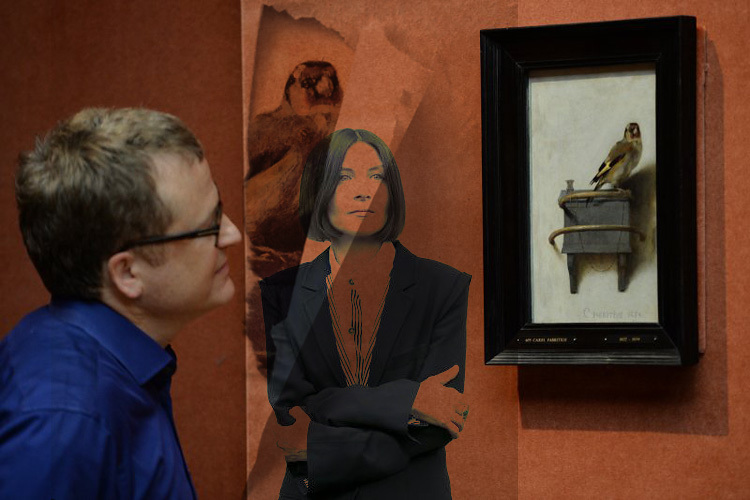
Roman Donna Tartt, the author of two intellectual bestsellers - “Secret History” and “Little Friend”, went out two months ago and became an event in the English -language literary world. The rights to it have already been acquired by the Russian publishing house Corpus. Given the significance of the book, Colta.ru decided, without waiting for a Russian translation, to publish the response to her Alexei Tsvetkov.
From the American writers of southern origin, at least since William Faulkner, we are instinctively waiting for the narrative with a strong ethnographic component - and in this regard, Donna Tartt, a native of the state of Mississippi, completely deceives our expectations. The action of her novel “Sell”, declared by the Amazon chain of the year, proceeds in New York, Las Vegas and Amsterdam-with all the convincing, not characteristic of a tourist, but for an attentive and patient observer. If there is some row where it can be at least approximately enrolled, then these are the so-called encyclopedists-a label, under which some united William Gaddis, Thomas Pinchon and Don Delillo. Like them, Tartt affects the volume of erudition, and in the most unpredictable areas.
But such a classification confuses more than something clarifies. Those of us who regularly read “serious” fiction have long been accustomed to the fact that today it is a sport for resilients, you need to wipe through countless stylistic slingshots and put up with the deliberate lack of the plot - or a postmodern mockery of it. Few people indulge in this occupation for the sake of unknown pleasure, even a kind of snobbery has developed inside out, publicly and not without pride in the fact that, they say, neither Ulysses nor the “rainbow of gravity” did not master. Tartt falls out of this row, and although the return of plot to the upper register of literature is discussing for several years, it clearly reached the front edge of this trend. “Victorian” and “Dickensovsky” are the most common epithets used by criticism of “Shchegla”. Castlessness becomes legitimate.
In the plot in question, there is a lot from thriller, and therefore you have to avoid spoilers, but at least to give the tie is quite kosher. The book is built as the memoirs of the 27-year-old hero, Theodore (Theo) Deer, who had hidden from some circumstances in the hotel room in Amsterdam. For thirteen years old, he, still in New York, goes to school with his mother to understand the troubles in which he is stuck there, and in anticipation of the appointed time they go to the Metropolitan Museum: Mother-art critic and clearly managed to instill part of her taste and horizons. There, his attention is attracted by a red -haired girl with a violin case, accompanied by an elderly companion, and the attention of his mother is a small, slightly larger sheet of scribble paper, a picture of the Dutch artist Karel Fabrice with an image of a chip, chained with a thin chain. Mother leaves for a museum store nearby, a powerful explosion is suddenly heard, a terrorist attack is committed in the museum. Theo, who is only shell -shocked, sees the girl’s dying companion: he manages to convey to him a gold ring with a stone and say mysterious words: “Blackwell and Hobart, a green bell.” In addition, he, clearly having lost orientation in the dying agony, begs theo to “save” the picture of Fabritsius, and the boy is mechanically obeying. Soon he is notified that his mother is among the dead.
This tragedy is relentlessly hanging over his fate throughout the subsequent life path-at first in the house of the rich parents of his classmate who sheltered an orphan, then in Las Vegas, where his father, alcoholic, addict and player, and during subsequent wanderings are taken away. And his fate is also inextricably linked with a red -haired girl and a picture of the factory, with which he at first does not understand how, but in the future he simply cannot part. In Las Vegas, he starts a non-battered and charming friend, a half-Ukrainian half-pool of Boris, adopting all the conceivable bad habits from him, and then, having returned to New York, becomes a dealer in the sale of antiques (Blackwell and Hobart turned out to be an antique fraud), a rather impudent fraudster and an amateur of oxyntin. At the same time, however, the relations of sympathy and participation that have developed with the reader do not weaken at all.
In the case of a “chip,” it is not just about the resurrection of the plot novel, but about one of its once popular forms: this is the so-called educational novel, or rather, its alloy with adventurous.
Here I can’t help myself from a short and non -binding lyrical digression, which adds little to the advantages of the novel, but greatly contributes to the mythological aura that develops around it. If Donna Tartt herself believed, the plot was already in her head as a whole when she found a suitable picture, and she had no idea at that time that Fabriasius himself died during an explosion of a powder warehouse in Delpha, which destroyed a good quarter of the city and destroyed most of the artist’s creative heritage - no more than a dozen works reached us. At the time of the explosion, he worked on the portrait of the deacon of the local church, who died with him and which was called Simon Dexer, the hero’s namesake. To top it off this chain of coincidences, at the time of the publication of the novel and the instant outbreak of its popularity, the “plowing”, which makes up part of the constant exposition of the Gaga museum, was at the exhibition at the New York Museum of Frick, where the unpredictable crowds of curious ones began to flock.
Many of the critics refer us not only to Dickens in general, but specifically to one of his most beloved readership of the novels: “Big Hopes”. There, if anyone does not remember, we are also talking about an orphan, to which someone provides anonymous good deeds. This, in my opinion, is a rather superficial association - I personally have it much stronger with one of the best novels by Sol Bellou “The Adventures of the OGA” with numerous advancements of the hero through different social layers of America and with his unquenchable youthful obsession with an excellent stranger. This novel, also with noticeable echoes of Dickens, unfortunately, overshadowed the later things of Bellou - in my opinion, undeservedly.
It is easy to notice that in the case of a “chipper” it is not just about the resurrection of the plot novel, but about one of its once popular forms: this is the so-called educational novel, or rather, its alloy with adventurous-which, however, is not uncommon, the same thing with Bellow. The Russian name of the genre, tracing paper from German, is fraught with uninvited associations that English escaped by simply borrowing the German word without translation - BildunGSROMAN : no one brings up anyone here, the hero rather serves as a lens through which we see his environment that changing over the years and more precisely understand his own evolution. As a rule, this implies a fair amount of charm in him, otherwise this technique does not work. And the conviction of charm is a certificate of copyright.
Can this be considered a return to realism after many years of disgrace, into which he allegedly fell? On the one hand, realism in American prose did not disappear anywhere for a long time, in the same Delillo, he always clearly shone through the postmodern complexity and ornamental of the author’s language, this can also include many books by Philip Rota. If you closely look at the psychologism and the adventure of the tartt novel, it becomes clear that the realism in its modern hypostasis is perhaps not much less conditional style than all the tricks of postmodernism, this convention easily reveals close reading. Let us distract even from the moment that a person who has hidden for a day or two in the room of the Amsterdam hotel, will never retell fourteen years of his life, moreover, with such visual and psychological persuasiveness, to the last little thing, which is only a professional writer-should it be reminded that Tartt herself worked on the book for 11 years? And this is not only about what we already know from Dickens or Bellou, Tartt goes on. In one of the episodes, Boris sings the Polish song in an alcohol semi -child. How does theo, who does not know Polish, many years later (and even after a couple of days) reproduces her word for word for us, with the complete preservation of the difficult Polish spelling? Here, some feature is clearly crossed-go guess, is it a feature or a bug.
Or here is a mystery: at what time does the action of the novel flow, where to integrate these 14 years? Details help a little - there has never been an explosion in Metropolitan , and the real terrorist attack on September 11 is mentioned in passing only once, you won’t tie anything. Details of life in Las Vegas almost definitely indicate the 2008 crisis. No matter how you count it, it turns out that the novel ends in our still not yet coming, albeit without the slightest science fiction goals, is a funny trick, but it is not very clear how it is justified.
The book sags strongly, sometimes the resistance of the material seems somewhat excessive for an adventurous plot in the theory, it seems that, despite the eleven-year-old incubation period, the book is not fully polished and composed of separate short stories, brought together by optional connecting links, and this epilogue is not in the other way) perplexity. We clearly do not deal with Delillo, in whom each phrase is subjected to a demonstrative filigree cut - at times the style borders on sloppiness. But he immediately comes to mind that the reader who address the review will most likely get acquainted with the novel in a translation that usually does not reflect such errors: here the main concern is not to make new ones. However, the shallows, as a rule, are replaced by deep places, disappointment - satisfaction, and everyone beats the balance for himself. But, perhaps, “plowing” with all the current excitement around him is not the book that will provide Donna Tartt a solid place in the history of literature. Such a book could be the “The Adventures of the OGA Marsh,” but it was not written by it.