
Translated material
Why do we need Ukraine?
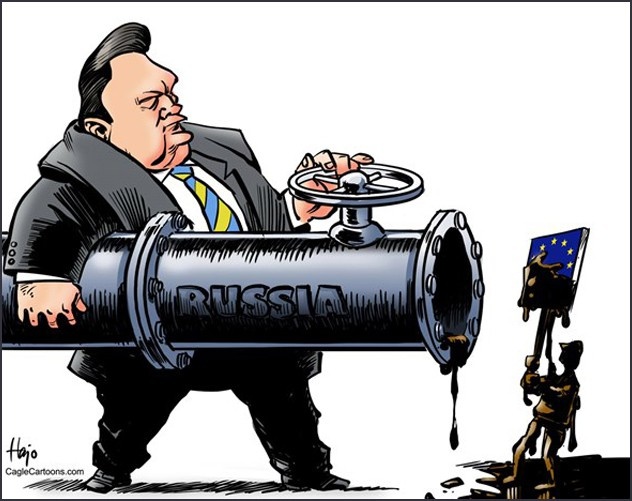
The ability of the Russian government for actions that have rational grounds and at the same time positive consequences for the country, causes some part of the Russian population serious doubts. The reason for doubt is not so much in the actions of the authorities as such as in the obvious problem of communication: the Russian government behaves as sacred, and not as elected - does not explain anything to anyone (and if it explains, then that everything is clear - it is completely different), it acts unexpectedly, most often - converterly, sometimes makes an impression of meaninglessly changing strategy and tactics, categorically denies the possibility of establishing any rules Games, except for one, are the rules of strict follow -up to a little -saved and contradictory signs coming from the Kremlin.
It is not surprising that the “creative class” in Russia, for which the rationality of actions and the level of communication are the main criteria for the quality of any process, has formed a complex of paranoid perception in relation to power: any positive facts are ignored; any negative - multiploted; Russia's assessment is made only in comparison with the Kingdom of God, but not with other real countries; Any action of the authorities causes an unambiguous reaction: I still do not understand what they are doing, but I already know that this is terrible.
In the Syrian question, Russia for the first time since Gorbachev and Early Yeltsin did not act on the principle of “we are friends against the United States”, but as a party capable of proposing reasonable decisions (precisely reasonable, not humane, this is state policy) and seek it (and not as before - they listened with a fig in the pocket). Nevertheless, within Russia, this fact remained “unsaturated”, and the “creative class” is in the conviction that Russia has opposed the United States and supported the bloody regime (we are accustomed to such a position of Russia, isn't it?).
An amnesty affecting a significant number of prisoners, for the first time during Putin’s reign, inclusion in the category of amnesty (well, for the company - exempted by the fact of pardon) those who were reasonably considered personal enemies (offenders) of the president, and before that, demonstrative patronage of the symbol of the intellectual front - Alexei Navalny - this is an unequivocal proposal from the authorities: “Well, let's grasp, let's grab it, let's grab it, let's get it put up. "
You can relate to this proposal as you like (I myself, honestly, do not see any grounds for such a “reconciliation”), but it is difficult not to notice it. And again, a large mass of “intellectual opponents of the regime” is looking for hidden intrigues in their steps - the mythical security forces from Khodorkovsky, who, of course, made him (in fact, forced what?), Talk about the secret conspiracy of Navalny with the authorities, etc. These myths are leveled by the positive meaning of amnesty, especially against the backdrop of the truly fair accusations of the authorities that they could not be planted today, equally. In the "half" of the last steps: why not all "marsh prisoners" were released? Why not free Plato Lebedev? How can a completely medieval law be considered in parallel on the right of the Investigative Committee to initiate tax affairs without submitting the tax service (that is, to actually accuse of a crime in the “absence” of the victim)?
But the most interesting situation is emerging around Ukrainian agreements. For the Russian government, they are in a sense unprecedented-it seems that for the first time in the 21st century, Russia does not cooperate in exchange for vassal citizenship, and the partner is not a state state. Moreover, (which is also a rarity) it is collaborating, and not finances irrevocably or (other extreme) introduces troops. But on both sides of the border, Russia - Ukraine sounds: "We are being deceived, in fact, the authorities act in the interests of a pile of close associates, contrary to the interests of the people."
In Russia, opponents of agreements have two arguments; One - Russia loses significant money; The second is the totalitarian Russian authorities “buys” Ukraine, as a result of which it will also become totalitarian. Both arguments on the immediate consideration turn out to be untruth. Russia, as it were, will lose $ 4 billion a year at a gas discount - “as it were” because the figure is calculated on the basis of the hypothesis that Ukraine will continue to buy Russian gas at any price in the same volumes. But in reality this, of course, would not have happened.
The past agreement with Ukraine is a bondage that does not correspond to either market practice or market pricing. The probability of challenging it in Stockholm has always been high enough, the likelihood that the arbitration will oblige Russia to reimburse the overpayment of past years (for the period since 2009 it was approximately $ 16 billion) was less, but certainly not zero. In order to understand the scale of the 2009 transaction between the “fraternal Slavic peoples” ($ 400 per 1000 cubic meters), it is enough to recall that the Muslim Egypt sells the “Muslim enemy” for Israel of $ 124 per 1000 cubic meters, and the most radical opposition to Israel in Egypt requires this price to ... $ 250 (that is, to the level of the level 90% of the new gas price for Ukraine).
Moreover, the old agreement not only significantly worsened relations between our countries, not only could be challenged with a tangible loss for Russia - Ukraine could simply (and was already actively moving in this direction) to refuse gas supplies from Russia, moving on the purchase of excess Russian gas in Europe (the current capabilities of Ukraine on such a purchase are about 60% of the need for gas). Such a refusal would unleashed the hands of Ukraine and in terms of a significant increase in the cost of gas transit through its territory - Russia would not only lose the market, but would also suffer direct financial losses on supplies to Europe. Moreover, we do not agree with Ukraine, all gas pipelines bypassing Russia from Central Asia, and subsequently - with Cyprus (Cyprus will soon become one of the largest suppliers) would receive an extremely important partner - strategically located, ready to independently consume and transport - and hostile Russia. So on the transaction we not only restored justice and “good name”, but also saved in the future, retaining the market.
And this is only a “direct” benefit. And friendship with Ukraine gives Russia a whole set of purely economic advantages. Ukraine is a cheap transportation of not only gas, but also other cargoes-through the access to the Black Sea (they knew this during the time of Rurik, using the path from the Varangians to the Greeks, and the opponents of the authorities forgot something). This is a direct access to the EU countries.
Ukraine is a majority of our export-import balance. Every year, Ukraine gives us $ 5 billion to the account of current operations. This (according to the forecast of the Central Bank of the Russian Federation) - 27% of the balance of payments of Russia for 2014 and (attention!) - 100% of this balance for 2015!
Ukraine is a significant source of labor for Russia. According to the UTsSI, there are 2 million Ukrainian migrants in Russia, almost half of which has a special education. For comparison: about 600 thousand Ukrainians work in the EU. In the case of the Association of Ukraine with the EU and the facilitating of Ukrainians' access to the European labor market, Russia will lose a very significant part of a highly qualified, Russian -speaking migrant flow, which is very cheap. On the fingers - the average salary of a qualified construction worker in Russia is about 24 thousand dollars a year - if one migrant from Ukraine costs only 25% cheaper, Russia “saves” $ 12 billion per year (it must be taken into account that most of the migrants from Ukraine operate officially, according to permissions, that is, “inside” of the tax space).
The density of the population of Russia - 8.5 people per square meter. km. The density of the population of Ukraine - 75.5 people per square meter. km. For Russia, the labor resources of which are rapidly reduced, the possibility of unhindered attracting Ukrainian migrants is the only way to replenish the deficit that is not related to potential problems of national identity. For the sake of maintaining this opportunity, you should spend money.
But what does it mean - to spend money? The purchase of European -leggings of Ukraine for $ 15 billion in reality is just a profitable investment. 5% per annum - this is 3 times more than the profitability of US debt (in two years it is 1.2 billion “benefits”), this is an “infinite number of times” more than if these funds simply lay on deposits in the Fed.
Since 2006, the Central Bank of the Russian Federation bought more than 500 tons of gold in its reserves, only in 2013 the losses from the revaluation of this asset (and the drop in gold prices was predicted by all) amounted to more than $ 6 billion, total losses for 2010-2013 were greater than the entire loan of Ukraine.
Recently, Russia simply wrote off Cuban debts for $ 29 billion, but with Cuba we have no strategic interests or a significant trade balance. So we can “lose” and “spend”. Meanwhile, it is not necessary to doubt that Ukraine will return the loan. Today, the public debt of Ukraine is only 36% of GDP, and the external debt is already taking into account 15 billion - only 76% (for comparison: in Belgium - 100% and 264%; France has 90% and 188%; Italy has 118% and 101%), the cost of its service per year is approximately equal to saving on the gas discount, and the state budget deficit in 2014 has only 3% of Ukraine in 2014. GDP (Belgium has 3.7%, France has 5.8%, Italy has 4%). And the budget deficit basically occurs due to the need to submit domestic gas consumers: now the amounts of subsidies will be reduced more than doubled.
Apparently, it was precisely such reasoning that lay the basis of the decision of the Russian authorities to “help” to Ukraine. They should also take into account the critics of power in Russia, trying to find a catch in any of its action.
But not only. There is a consequence of “friendship” that the power clearly looked at, and it should seem the most significant to its critics (fearing the export of totalitarianism). The fact is that Ukraine, with all the costs of youth and fair claims to political processes in the country, is democracy. In contrast to Russia, almost accurately reproducing the USSR soft-tetotalitarian system of the late 70s (one leader, one opinion, with an unobtrusive imitation of discussion and an even more unobtrusive imitation of elections), Ukraine has real parties-antagonists, and a real elected process and obviously present conflict of opinions.
Ukraine was lucky to be a heterogeneous country, more or less clearly divided west with a pro -European orientation, Catholic religion, cultural and linguistic identity, and East - with pro -Russian orientation, Orthodox roots and the dialect of the Russian language. This heterogeneity threatens the country with a collapse no more than the presence of Republicans and Democrats in the United States threatens the States of the Civil War. But it is the basis for the formation in the near future of the "bicameral" system and the key to the impossibility of a totalitarian system.
A high level of corruption, the inefficiency of power, the radicalization of the “wings” are temporary phenomena. All this was even in the USA 75 years ago. These are temporary costs, insignificant in comparison with the advantages of democracy for long -term development. And the fact that Ukraine will “be friends” with Russia, and will not “leave” in the near future beyond the wall of the European Union, turning into an “enemy”, which cannot be imitated in anything, can play a significant role in the development of the beginnings of democracy in Russia itself. And it is not a fact that the unexpected mitigation of the Russian authorities in relation to political opponents is not (at least partially) a consequence of rapprochement with Ukraine.
Indeed, the difference between the brutal and causeless acceleration of Bolotnaya with a total ban on really opposition measures and the arrest of their random participants in Russia, and a freely functioning Maidan (after a tough shout to the attempted special services to disperse) and the complete amnesty of all those detained on the Maidan is too large to be friends and not to reduce it.
Today, close friendship with Ukraine will not allow Russia to close the borders and is completely self -invalid from the West. And tomorrow - the power in Russia will change, no eternal power happens (or just the price of oil will fall, and according to the old Russian tradition, our power for lack of oil revenues will suddenly become liberal and pro -Western). It is friendly and democratic Ukraine who can show Xia and a catalyst for irreversible reforms in Russia and a bridge for Russia to join the European Union.