
Translated material
North Front: Arctic
Who are we going to fight in the ice with
Moscow headed to expand the Russian presence in the Arctic: in 2014, it is supposed to deploy a military group in the region with all the necessary infrastructure. For what and what could be the consequences - the New Times sorted out
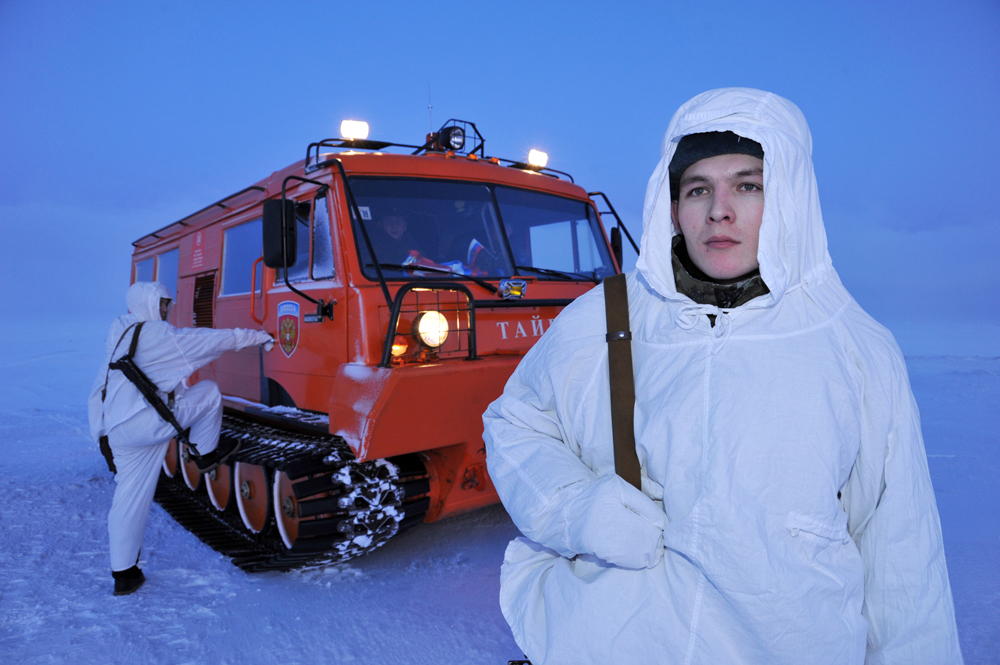
The border outpost "Nagurskaya" in the Arctic. Franz Joseph Earth Archipelago, 2013
| *Most of the Arctic powers so far, according to the distinction between the water waters and the continental shelf based on the 1982 convention on the law of the law. |
Everyone remembers how, after the success of the expedition to the North Pole in 2007 (with immersion in the bathyscaphe to the bottom of the Arctic Ocean), the polar expert and deputy Arthur Chilingarov exclaimed: “Arctic - ours!” And then he was neatly corrected by President Putin: they say, international legal documents do not yet allow us to make such unambiguous statements*.
In 2010, Vladimir Putin, at that moment, the prime minister, speaking at the Arctic Forum in Moscow, again focused on the negotiation partner decision of all issues of the continental shelf, condemning those who are engaged in “futuristic predictions about the upcoming battle for the Arctic”.
But Putin's third term struck - and much has changed.
Not a heel of ice
Speaking on February 27, 2013 at the College of the Ministry of Defense, Vladimir Putin set the task of strengthening Russia's military presence in the Arctic direction. The Arctic, they say, became an arena of a clash of economic interests of competing countries and corporations, and they can be defended only relying on military force.
And already at the end of the year, December 10, Putin sets an even more specific task: to complete the formation of the Arctic grouping of troops in 2014. Moreover, this is not only about military units, but also about the deployment of powerful infrastructure, including the restoration of military airfields abandoned after the collapse of the USSR in the Arctic zone: Tiksi, Severomorsk-1, Temp (Novosibirsk Islands) and others clearly went along the path of promoting rivalry in the Arctic.
In fact, the political discourse in the spirit of “we will repulse external encroachments on the original Russian Arctic” is poorly correlated with conferences and forums under the spiritual slogan “Arctic-the territory of dialogue”, which Russia itself conducts from Moscow to Salekhard. Moreover, with the participation of those very characters who act with the enthusiasts of the new “conquest” of the Arctic-the head of the Ministry of Defense Sergey Shoigu, the Secretary of the Council of People's Commissars Nikolai Patrushev, the main curator of the military-industrial complex in the government, Deputy Prime Minister Dmitry Rogozin, the head of the presidential administration Sergey Ivanov ...
But the point is not only this. The “offensive” in the Arctic inspires alarm for a number of several reasons. In Russia, the vector of the development of ties with the northern neighbors draws the efforts of not only the Foreign Ministry, but also the numerous “business entities” - from fishermen and universities to the Atomflot and Rosneft, which have direct benefits from the international partnership in the region. Over the past few years, the main mechanism of coordination of these connections has been the Arctic Council (in addition to Russia, Denmark/Greenland, Iceland, Canada, Norway, the USA, Finland and Sweden, as well as a group of observer countries). In his work, all the problems, expressed in the expert language, “hard safety” are carried out by brackets. Just because all the partners of Russia in the Council were more convenient not to complicate its activities with military issues. But what will happen now, when in the north -direction of Russia, it is these issues that have gained paramount importance?
The program of the re -equipment of Russian Armed Forces, declared by President Putin, has a direct relationship to the Arctic. Its most expensive element is the renewal of the fleet of nuclear submarines based on the Kola Peninsula. Both superprojects (strategic Pls of the Borea class with Bulava missiles and a multi -purpose Pl “ash class”) are torn by the deadlines and on the results of the tests, but nevertheless, they are launched into the series. So the Northern Fleet will receive new submarines for replacing the resource for the "dolphins" and "pikes" long ago.
The political decision to build up the military presence in the Arctic began to be rapidly embodied in the emergency construction of the base on Fr. The boiler room (Novosibirsk Islands), both in the urgent laying of a series of patrol ships of the ice class, and in the formation of new "cold -resistant" military units - the Arctic group of troops.
A series of illusions
Until recently, the Russian authorities about the Arctic were reduced to the image of a pantry of noble natural resources, primarily oil and gas. Traces of these representations are visible in the estimates of hydrocarbons in the northern shelf flashing in the press - supposedly they are 20–40% of the global. Links to the sources of these marvelous numbers are given very vague - from the “CIA ratings” to the notorious “British scientists”.
In fact, the Great Energy Revolution unfolds in the world. Its main content of the goal is the explosive expansion of the list of sources of vital raw materials (shale revolution), the geography of their extraction and supply routes. The Arctic in this dossier at best can play a secondary role. And even then not now, but in a very distant perspective.
| ** Shtokmanovskoye field is one of the largest gas condensate deposits in the world. Located in the Barents Sea, on the Russian continental shelf. *** In August 2013, Gazprom redeemed the statoil share (24%) in the Shtokman project, after which the project itself was stained. |
In the Russian sector of the Arctic, there are decent gas reserves, but every day the potential profitability of production by the “cost -effectiveness” criterion goes into an increasing minus. The coagulation of the well-worked out Shtokman project **, which was personally supervised by the “supreme gas-commander”-a direct consequence of the same energy (and apparently, permanent) revolution. It was because of it that the Norwegian company Statoil, the ex-participant of the Shtokman project, decided that gas production in Northern Dakot is much more attractive to her than behind the northern polar circle ***.
The embarrassment with Shtokman somewhat sobered the company of the "navigators" in the Kremlin and near it, laying the Arctic course of Russia. But one illusion was replaced by another, indicated by the long -familiar word "Severpot".
The fact that global warming opens up interesting transit prospects for this theoretically shortest path from East Asia to Western Europe for a long time. True, they spoke somehow calmly, without a breath. But as soon as China, in the summer of 2013, the first containers in the Rotterdam was sent to the Severpom, as a revolution occurred in Russian political minds. And after all, what is characteristic: the point of support, to which the “Chinese lever” was applied, became not expected profits from commercial transit along the Severomorput, over which Russian sovereignty is established, and the threat of loss of this very sovereignty.
The catch is that part of the Severmorpois is not passing through Russian waters. Last summer, China purely neatly fulfilled all the formalities requested by Russia. But if the melting of ice continues, then after a few years Russia will have to remind his great oriental neighbor more often (and by that time he will probably build several his own icebreakers) about the “timely submission of an application for the passage”. And it will be more difficult to do every time, especially outside the Russian territorial waters.
But the reaction to the so far a hypothetical “Chinese threat” was immediately followed: the flagship of the Northern Fleet, the atomic cruiser “Peter the Great”, accompanied by four icebreakers, went on a hike along the western “shoulder” (this is almost all that atomoflot has in the region). But the icebreaker is not cheap, you can’t do without subsidies? What, every time to drag from a sequestered budget?
Conflict catalyst
| **** Any Arctic power can claim to expand its borders of the Arctic shelf, if he can convince the UN commission that the bottom of the sea is here is the continuation of the mainland shelf belonging to it |
Another idefix of Putin's foreign policy in the Arctic is the expansion of control over the shelf. In 2001, Russia was the first of the Arctic countries to the UN commission on the borders of the continental shelf an application for expanding the zone of its sovereignty in the Arctic seas. In the same year, the application was returned to revision ****. Despite numerous assurances, the application is never submitted again. Now it became clear that it was not important to serve, in fact, it would have a chance of success only if all the Arctic countries harmonized their territorial claims. But harmonization did not take place (despite the fact that Moscow and Oslo managed to sign a very necessary and important border agreement). First of all, because the volume of hidden contradictions in the Arctic clearly exceeded the readiness to allow them. And today's Russian policy in the region only catalyzes conflicts. In October 2013, the world ran into an prohibitively stiff reaction of the Kremlin to the campaign of Greenpeace activists near the Gazprom platform "Pri conys" in the Pechora Sea. The Russian signal sounded unequivocally: we are ready to reflect any challenges to our sovereignty in the Arctic, despite the international reaction. Well, the challenges will not make themselves wait. But is Russia really ready for them? Indeed, in the eastern part of the Russian sector of the Arctic, where our neighbor is America, there is practically no ability to demonstrate military power. And the clashes of interests in this zone may have much more serious consequences: Russia has not ratified the agreement on borders on the United States, while the US Congress refuses to ratify the UN Convention under the law.
The alienation of Russia from Europe and the USA is already noticeable to everyone. In 2014, the trend will certainly continue growth. Do not forget that the disputes on which the principles of sovereignty and national pride converge with a wedge is an explosive thing.
Photo: Sergey Bertov/ITAR-TASS