
Translated material
A risky refusal
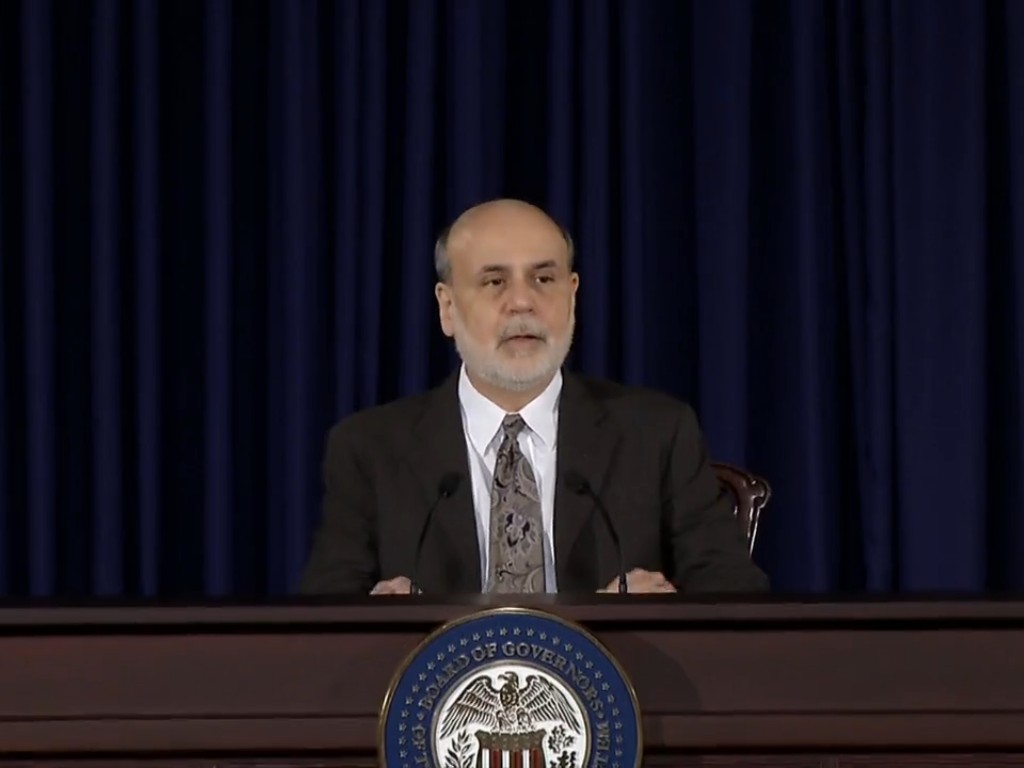
The Federal Reserve Service of the United States decided to gradly terminate the third round of the quantitative softening program that began in September 2012. This round was that the Fed monthly bought bonds of the US government and mortgage bonds, reinvested income in its portfolio of securities in the same bonds and held the basic interest rate at 0.25% per annum.
A gradual reduction means that starting with the new, 2014, the Fed will reduce the reinvestment and purchase of bonds every month. If from the moment of the adoption of this program the Fed has bought and reinvested from bonds by $ 85 billion. Monthly, then from the new year the volume of these operations will decrease by $ 10 billion. It does not reach zero a month yet. After that, the main channel will dry out, through which the money was pumped to the American banking system to support both the American and the world economy.
What could have been caused by such a solution? Judging by the statistical reporting, the US economy shows all signs of recovery: GDP is growing - unemployment is reduced. So, in the II quarter of 2013, GDP grew by 2.8%, and in III - already by 3.6%. At the same time, the unemployment rate decreased to 7%of the economically active population, although at the beginning of the year it was 7.9%, and even 10%in the midst of the crisis, in October 2009.
Based on these data, the Fed could conclude that the American economy seemed to no longer need further support. In addition, the Fed could not but understand that the additional pumping of funds to the US banking system did not bring any positive effect. Yes, American banks now have monetary reserves that will allow them to survive any raid of depositors (if it is, of course), but, unfortunately, banks do not invest these excess reserves (that is, they do not issue new loans), and therefore there is no benefit from these reserves for the “real sector”.
That is, the real sector recovers as if on its own, and the banks stand on the sidelines. In this situation, it would be quite logical to reduce or even completely terminate the monetary issue, since it has already completed its main task - to protect banks from bankruptcy, and it cannot be fulfilled with an additional task - it cannot be fulfilled.
True, despite the seemingly impeccable substantiation of such a solution, he has certain flaws. To begin with, not only unemployment, but also inflation is reduced in the United States. The production price index over the past 12 months (November 2013 by November 2012) amounted to only 0.3%, and during this period the indices became negative several times.
At first glance, this is good, since clearly an excessive money supply does not lead to an increase in prices. But this is only at first glance. The fact is that the drop in price growth to zero, followed by the transition to the zone of negative values means the appearance of deflation. But the deflation of the Fed should not be allowed in any case, since this phenomenon is very destructive.
When economic agents see that prices are not rising or even decreasing, then they have a temptation to postpone the purchase, if they are not the most urgent, and wait a little more: what if prices will decrease even more, and the purchase of some product (especially if it is a product of long-term use) will cost much cheaper. And if economic agents could not overcome this temptation and did not spend all their money immediately, then they put off purchases “for later”. What does this mean for the economy? This means that the volume of sales of goods falls and their stocks begin to grow. After these reserves have reached a critical mark, manufacturers reduce production and dismiss staff. Then the GDP falls, unemployment is growing and the crisis begins again.
This kind of behavior of economic agents is called “deflation expectations”, and with them the Fed (like all other central banks) should fight first.
Looking at the current economic situation in the United States, it is easy to see that deflation and its negative consequences may begin to begin. In any case, the last three months, manufacturers price indices were negative (though not very large). But for some reason the Fed does not want to notice this.
Another flaw of the Fed’s decision on reducing the quantitative mitigation program is that the termination of practically gift financing of the banking system will definitely entail an increase in interest rates in the monetary market. Moreover, this growth has already begun. When in June of this year, the Fed The Chairman of the Federal Reserve Ben Bernanke for the first time mentioned the upcoming termination of the program, the profitability of five-year-old American bonds increased from 0.8% to 1.6%, 10 year old bonds-from 1.9% to 2.7%, 30 years old-from 2.9% to 3.8%; The profitability of American 30 year-old mortgage bonds is from 3.5% to 4.5%. Thus, the period of almost zero rates, which lasted since 2009, came to an end.
Maybe for most American borrowers this growth will not be significant, since many of them already do not take new loans. But there are at least two groups of borrowers for which this rate of bets is very dangerous. The first group is the US government, the second group is developing economies.
The US government is in a difficult situation, since the growth of interest rates means that it should now pay more for new debt obligations. And although the growth of bets on one percentage point looks small, in absolute terms, taking into account the existing budget deficit, the increase in payments will be quite serious. And the US federal budget deficit was very large - an average of $ 1.5 trillion. For each budget year, and it is unlikely to be very reduced in the next few years.
For developing economies that are borrowers in the world capital market, the growth of interest rates can worsen the economic situation quite seriously. Still, they pay much more for external resources than borrowers from the United States, as they carry additional risks and, in particular, foreign exchange. Accordingly, with a reduction in monetary issue, they fall under a double blow: due to its reduction in the capital in the world markets, they will become more expensive than before, and the probability of devaluation of non-enlightened currencies increases. Accordingly, the growth of basic interest rates, and the growth of country risks is immediately laid in interest rates and they grow strongly.
Moreover, they can grow so much that the influx of external resources in these countries (and most of them) will be reduced, and investments, release and employment will decrease after this. And the crisis, which, perhaps, will be able to avoid the United States, has a chance to begin in these countries.
However, the growth of interest rates on capital involved in the world market is only one difficulty that developing economies will encounter. Another difficulty lies in the fact that deflation in the American commodity market means a deterioration in sales conditions for producers, including for manufacturers from developing countries, for many of which the United States is the main market. These manufacturers fall into ticks: the capital that they attract to finance their production will rise in price, and the prices for their products will remain the same or will even decline.
By the way, for the same period (November 2013 by November 2012), the prices for the non -enoven goods imported in the United States decreased by 1.2%.
Of course, we are far from the idea that the change in the Fed’s policy is happening, including in order to somehow ruin the economic life of developing countries and at the same time their own government. But the fact that, due to the termination of the quantitative mitigation program, the risks of deterioration of the general economic situation increase strongly is quite obvious.