
Translated material
Daniil Granin turned 95 years old
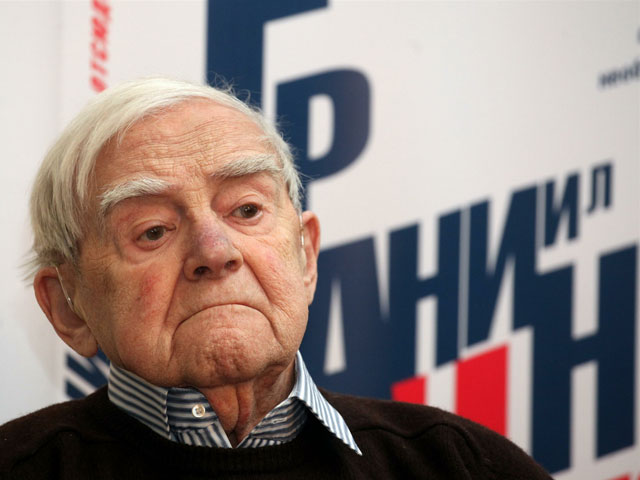
On Wednesday, January 1, the famous writer and public figure Daniil Granin turns 95 years old, RIA Novosti reports.
The writer was congratulated by Russian President Vladimir Putin, noting that Granin enjoys "a high, well-deserved authority as a courageous, strong-strong person who has passed the fiery roads of the Great Patriotic War. As an outstanding writer and publicist, a real Russian intellectual and ascendant," ITAR-TASS reports.
"Your literary works are imbued with sincere love for people, for Russia, its great history and traditions. They raise important moral, worldview problems and fully reflect your life, civil position," the congratulatory telegram says.
Recall that in mid-December it was reported that by his 95th anniversary, Granin published a new book “A Man is not from here”, in which he connected an autobiography, memoirs, thoughts on philosophical topics and simply interesting stories from the life of the writer.
The writer and public figure Daniil Aleksandrovich Granin (real name German) was born on January 1, 1919, the village of Volyn Kursk Region (according to other sources - in Volsk, the Saratov province) in the Forester family. From childhood he lived in Leningrad.
He graduated from the Electromechanical Department of the Polytechnic Institute (1940), worked as an engineer at the Kirov plant. In July 1941 he went into the People’s militia, fought on the Leningrad Front, was wounded. The Patriotic War ended in East Prussia the commander of a company of heavy tanks, awarded military orders. After the war - the head of the district cable network of Lenenergo, graduate student of the Polytechnic Institute, author of a number of articles in electrical engineering.
Granin's early literary experiments dating back to the second half of the 1930s. In 1937, his first stories “Return of Rulyak” and “Homeland” dedicated to the Paris Commune were printed in the magazine “Carpet”. The writer considers the publication in 1949 in the journal "Star of the story" Option of the second in 1949. Then, at the request of the namesake, writer Yuri Herman, he took the pseudonym Granin.
The first books of Daniil Granin were the story “The Spore through the Ocean” (1950), “Yaroslav Dombrovsky” (1951) and a collection of essays on the builders of the Kuibyshev hydroelectric power station “New Friends” (1952). The first novel "Seekers", which brought the writer fame, was published in 1955.
In his prose, Granin skillfully combined two genre structures, socio-everyday fiction and documentary and artistic narrative, with a uniting end-to-end theme: scientists, inventors in the modern world, their moral code and the traditions of civil behavior. Granin sequentially investigated this topic in novels (“Seekers”, 1954; “After the Wedding”, 1958; “I am going to a thunderstorm”, 1962), in stories and stories (“Own opinion”, 1956; “place for the monument”, 1969; “Someone must”, 1970; “Unknown Man”, 1989), in documentary and artistic works, where, along with historical plots (“Reflections in front of the portrait, which is not”, 1968; “The Tale of one Scientist and one Emperor”, 1971) An important place is occupied by biographical novels about the biologist of Alexander Lyubishchev (“This Strange Life”, 1974), about the physics of Igor Kurchatov (“Choice of the goal”, 1975), about the genetics of Nikolai Timofeevsky (“Zubra”, 1987).
The new facets of the writer’s talent were revealed in the novel “Fleet to Russia” (1994), who tells about the life of scientists in the key not only of documentary and philosophical and journalistic, but also an adventurous and detective story.
Another important topic for Granin is war. The most fully anti-war prose was presented in the collection “Another mark” (1985) and “Block Book” (1979, co-authored with Ales Adamovich), telling the documentary about the heroic 900-day resistance of the enemy blockade.
Business for documentary was manifested in numerous essay-diarrhea works by Granin, including in devoted impressions of trips to Germany, England, Australia, Japan, France and other countries of the Unexpected Morning (1962), “Notes to the Guide” (1967), “Garden of Stones” (1972) and others.
Granin owns the essay about Pushkin (“Two Lika”, 1968; “Holy Gift”, 1971; “Father and Daughter”, 1982), Dostoevsky (“Thirteen steps”, 1966), Leo Tolstoy (“Hero, whom he loved with all his might of his soul”, 1978) and other Russian classics.
All works of the writer in recent years have been written in the genre of memoirs - “Bades of my memory” (2009), “Everything was not entirely true” (2010), the novels “My Lieutenant” (2011) and “Conspiracy” (2012).
In January 2013, the “Blockade Book” Daniil Granin was reprinted by the five thousandth circulation. It included photographs from the Assembly of the State Museum of the History of St. Petersburg, photographs from the personal archive of Granin in the Central State Archive of Literature and Art of St. Petersburg. The book also first shows fragments of the layout of the New World magazine with the chapters subjected to censorship.
The heroes of Granin's works found their embodiment in the cinema. According to his scenarios or with his participation, films at Lenfilm were shot: “Seekers” (1957, director Mikhail Shapiro); "After the wedding" (1963, director Mikhail Ershov); "I am going to a thunderstorm" (1965, director Sergei Mikaelyan); "First Visitor" (1966, director Leonid Quinichidze); At Mosfilm - “The Choice of the goal” (1976, director Igor Talankin). Television filmed the "namesake" (1978) and "Rain in a foreign city" (1979).
In December 2001, the premiere of the author’s program of Daniil Granin “alone with Peter the Great” was held on the Culture TV channel. In 2004, in the author’s program "I remember" Daniil Granin talked about his life and work. In 2005, he became the author and presenter of the documentary series "Leningrad Tragedy", in 2006 - the host of the Cool Roads of Dmitry Likhachev.
For a long time, Granin was engaged in social activities (in the Union of Writers, the Supreme and the Presidential Councils), participated in international meetings and symposia dedicated to science, ecology, literature. He published dozens of interviews and journalistic articles, a small part of them is included in the collection "On the Pilled" (1988). Granin created the first society of mercy in the country and contributed to the development of this movement. He was one of the initiators of the creation of a Russian PEN club. He was repeatedly elected to the board of the Union of Writers of Leningrad, then to Russia, he was a deputy of the Leningrad City Council, a member of the regional committee, in the perestroika period - a people's deputy. Currently, Granin is the chairman of the board of the D.S. Likhachev.
Daniil Granin - Hero of Socialist Labor, laureate of the State Prizes of the USSR and the Russian Federation (for the novel "Evenings with Peter the Great", 2001), the holder of the two orders of Lenin, the orders of the Red Banner, the Red Banner of Labor, the Red Star, the two orders of the Patriotic War, the Order "For Merits before the Fatherland, the Order of the Holy Apostle Andrei First -time, awarded the Great Cross for Merit in the Conception (Germany). He is a laureate of the Prize Henry Heine (Germany), a member of the German Academy of Arts, Honorary Doctor of St. Petersburg Humanitarian University, a member of the Academy of Informatics, president of the Menshikov Foundation, laureate of the award of Alexander Me.
On November 27, 2012, Daniil Granin was awarded a special prize of the National annual prize "Big Book" with the wording "For honor and dignity." In addition, he became the main laureate of the Big Book Prize for the novel "My Lieutenant", which tells of the Great Patriotic War.
The name of Granin is named the small planet of the solar system N3120.
By the resolution of the Legislative Assembly of St. Petersburg in 2005, the writer was awarded the title of honorary citizen of St. Petersburg.
Daniil Granin was married, his wife Rimma Mayorov died in 2004. There is a daughter Marina (born in 1945).