
Translated material
The Orthodox believers began Christmas time
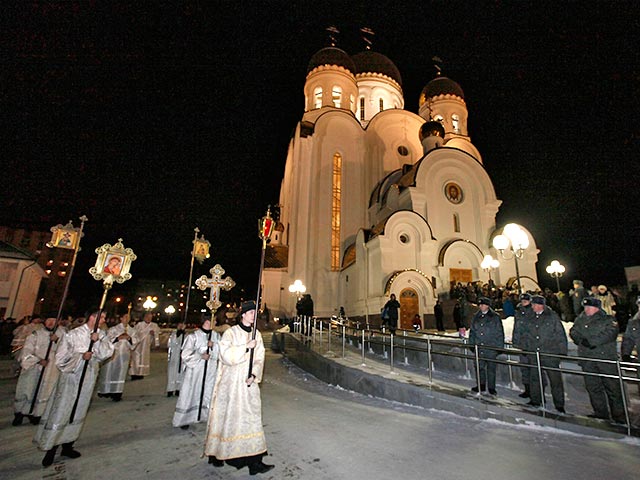
Orthodox believers in Russia and a number of other countries met on the night of January 7 the bright holiday of the Nativity of Christ .
Together with the Russian Orthodox Church, Christmas (according to the Julian calendar , or old style) is met by Georgian , Serbian , Jerusalem churches, Athos monasteries, as well as Catholics of the eastern rite ( Ukrainian Greek Catholic Church ) and some Protestants adhering to the Julian calendar.
The period until the next significant date of the church calendar - the baptism of the Lord is called holy days, or Christmas time. In fact, this is a continuation of the Christmas holiday. The holiday of Christmas, according to the teachings of the Church, symbolizes the reconciliation of man with God. Christmas foreshadows the atoning feat of Christ and the renewal of human nature, amazed by the fall of the ancestors, therefore the Christmas time is the time of special spiritual joy, when believers for 12 days glorify the coming into the world of the Savior. These days - from January 8 to 17 - one -day posts on Wednesdays and Fridays are canceled.
- Patriarch Kirill: "People suffer from loneliness only if they are not to take care of"
- How did the Christmas holiday arise
The news of the birth of Christ spread on the night of January 7 in all temples of the Russian Church. According to ITAR-TASS, at festive services on Monday and on Tuesday night, committed in 362 churches and monasteries of Moscow, about 230 thousand people were present. According to the press service of the metropolitan Ministry of Internal Affairs, the provision of public order and security by the Moscow police was fully fulfilled, no extraordinary incidents were allowed.
Russian President Vladimir Putin and Prime Minister of the Russian Federation Dmitry Medvedev took part in festive services this night. The head of state came to the festive service to the temple of the miraculous image of Christ the Savior, built next to the Olympic Park in the Imereti lowland in Sochi.
The main service was committed in the Moscow Cathedral of Christ the Savior. He was headed by the Patriarch of Moscow and All Rus' Cyril. The Russian Prime Minister Dmitry Medvedev and his wife attended here.
The atmosphere in the temple, where several thousand people came, was especially reverent this time: one of the most revered Christian shrines arrived here from the Holy Mount Athos - the gifts of the Magi - gold, incense and Smyrna, which more than 2 thousand years ago were brought to the newborn baby Jesus.
The relic was met by Patriarch Kirill, who bowed to the shrine. "For the first time, our Christmas worship is accompanied by a prayer to the greatest general Christian shrine. The same gifts were carefully preserved by Virgin Mary," ITAR -TASS quoted the words of the patriarch. “For the first time in history, this relic was brought to Russia,” he added.
The ark with the gifts of the Magi is accompanied by a delegation of Athos monks, led by the famous confessor, Archimandrite Parfenia (Moorelatos). Speaking to the journalists, the Greek priest expressed the hope that the relic "would bring good to the Russian people." “There were a lot of efforts, we were preparing for about two years to make the shrine be here,” he said.
On the eve of the holiday, the Patriarch sent a message to the archpastors, shepherds, monks, and all the faithful children of the Russian Orthodox Church, which emphasizes that "the Christmas is the central event of all human history."
"Today, our temples are filled with people who came to glorify the newborn goddown - Christ the Savior and His Most Holy Mother - Mary Mary ... A man always sought God: but in fullness God himself revealed Himself to humanity only in the embodiment of his only begotent son. With the coming of the Son of God - and the Son of the Human - the world has learned that God is, not just the Higher power, and God is mercy - but God is mercy - but God is mercy. Not only the manifold, God is the source of life and joy - and not only the formidable judge, God is the Holy Trinity, whose internal law is also love, and not the lonely lord of the world, ”the message says.
The Primate of the Russian Church, congratulating the believers, urged them to tirelessly do good and confront sin, fulfilling the law of Christ. "Accepting other people's weaknesses, sharing pain and sorrow, compassion for the unfortunate and destitute, a person fulfills the law of Christ and is likened to the Savior."
Orthodox Russians meet Christmas in dozens of new temples. In total, in the Russian Church there are more than 30 thousand temples and 800 monasteries in 60 countries.
From the main Orthodox Church of Russia, the direct broadcast of the festive worship was federal television channels, as well as the Spas TV channel and the Internet portal of the Moscow Patriarchate.
Patriarch Kirill: "People suffer from loneliness only if they are not to take care of"
The Patriarch of Moscow and All Rus' Kirill gave on the first Christmas day an interview with Russia, in which he stated that people suffer from loneliness only if they do not see the one who can be taken care of.
“Loneliness arises when a person does not have a subject of love. If a subject of love appears, then loneliness disappears. So that such a lack of love is? This is the absence of another person to whom you could convey your inner feeling, your attention, your care, maybe your love. This is all from our individualism, from our egoism,” the ITAR -TASSI cards the head of the Russian Orthodox Church.
"The way out of this tragedy is very simple - we must take a closer look at what around us and how many people today need our care, in our attention," the patriarch believes.
He himself comes to Christmas and Easter to elderly, lonely, homeless people, disabled people. “I go out from there from there. I feel how it became brighter in my soul. This is almost the same thing that you experience after the service,” the Primate of the Russian Church shared.
“Believers know that they come out of the church with a light heart. I leave these people so. They gave me more than, maybe I gave them,” he said.
He offers "to everyone who suffers from loneliness, to go to the world with a kind and open heart to those who need help." “For one such campaign, you can find friends, relatives, and the subject of your care,” said Patriarch Kirill. This afternoon, according to ITAR-TASS, the head of the Russian Orthodox Church will visit prisoners in a pre-trial detention center in the north of Moscow.
Speaking about the celebration of Christmas, Patriarch Kirill called the children's experiences of the meeting of this triumph the brightest. “I was attracted by the flickering of lamps, the early liturgy, the smell of incense, chant. And at some moments the divine grace was especially felt by the childish heart,” he said, remembering how he dreamed of becoming a priest from childhood. “The dream that absorbed my childhood consciousness was connected with the service of the church. I do not remember myself at any age when I did not want to become a priest,” the Patriarch admitted.
He also remembered how, having returned once from the Christmas worship, “he experienced such a spiritual rise that he sat down and wrote a poem - the only thing in life,” ITAR -TASS reports.
According to the patriarch, the crowding out of the true meaning of Christmas from the public space, including its replacement by other names, has dangerous consequences. “This is a political action, a focused action to crowd out Christian values, including Christian oriented holidays from people's lives. This is a spiritual disarmament of the masses. This is an incredibly dangerous tendency,” Interfax quoted the words.
He stated that today in the West, concerned about the protection of human rights and freedoms, a person’s right is violated openly to profess the Christian faith. The Primate of the Russian Orthodox Church mentioned cases when, for example, TV presenters or nurses are prohibited from wearing a cross.
“Of course, the Christian values in Europe are undoubtedly preserved in the life of the people. I have experience of communication, including Western Europeans who keep all this in their hearts. But the general political trend, the general direction of the elites, undoubtedly, bears the anti -Christian and anti -religious character,” he stated.
“We have passed the era of atheism, and I want to scream throughout the world:“ People, stop, we know what kind of life it is, ”Patriarch Kirill added.
About the holiday of Christmas
Christmas of Christ is one of the main holidays on the calendar of the Russian Orthodox Church, the second after Easter .
According to the Gospel of Luke, Jesus Christ was born from the Virgin Mary in the reign of Emperor Augustus (Octavia) in the city of Bethlehem. August ordered to make a popular census in his entire empire, which was then belonging to Palestine. The Jews had the custom of conducting folk censuses on knees, tribes and births, every knee and family had their own certain cities and ancestral places, because the Virgin Mary and the righteous Joseph, which came from the David family, were to go to Bethlehem (the city of David) in order to add their names to the list of subjects of Caesar.
In Bethlehem, in connection with the census, all places in the hotels were occupied, Maria and Joseph were able to find the night only in a limestone cave intended for cattle stall. When they settled there, Mary has time to give birth. Among hay and straw on a cold winter night, a baby Jesus Christ was born. The Most Holy Virgin gave birth to the goddess who gave birth to the goddess and laid it in a nursery - a feeder for livestock.
But among the midnight silence, when all of humanity was embraced by a dream, the news of the birth of the Savior of the world was heard by the shepherds who guarded the herd. The angel appeared to them and said: "Do not be afraid: I am a great joy to you, which will be all people. Today the Savior of the world was born - Christ the Lord! And here you have a sign: you will find a baby in the veils lying in a manger." And suddenly a large army of heaven, glorifying God, appeared with an angel. When the angels disappeared, the shepherds said to each other: let's go to Bethlehem and see what happened there. And, hurrying, they found a cave where Maria, Joseph and Baby, lying in the nursery were located. The shepherds told the holy family about what was announced by him about the baby.
At this time, according to the Gospel of Matthew, the Magi (ancient sages) from the east went with gifts to the goddown. They expected that soon the great king of the world should come to Earth. The Magi, according to legend, called Gaspar, Melchior and Valtasar, went to Jerusalem to ask where to look for the Savior of the world. Having heard about this, King Herod, who ruled at that time Judea, excited and called them to himself. He took out the time of the appearance of the star - the possible age of the future king, whom he feared as an opponent to his reign. Herod hypocritically asked the Magi to be informed of the place of birth of the baby, "in order to go to worship him."
Following the guiding star, the Magi reached Bethlehem, where they bowed to the newborn Savior and brought gifts of the East: gold, incense and Smirna. These gifts had a deep meaning: they brought gold as a king in the form of a tribute, incense as a god, and Smiru as a person who should die (in the distant times anointed the dead). Then, having received a revelation from God not to return to Jerusalem, they retreated to their country in the other way.
The angry Herod, having discovered that the Magi did not obey him, sent a soldier to Bethlehem with an order to betray the death of all men's infants up to two years. The gospel tells that Joseph, having received a warning about danger in a dream, fled with the Blessed Virgin Mary and the Baby in Egypt, where the Holy Family was to the death of Herod.
In the memory of the birth (Christmas) of Jesus Christ and a great holiday is established by the Church. The beginning of this establishment dates back to the time of the apostles. Here is what they wrote to the early Christians: “Keep, brethren, holidays, and, firstly, the day of the Nativity of Christ, which is celebrated by you on the 25th day of a dozen of a dozen” (from March).
In the first three centuries of the new era, during the persecution of Christians in some churches, the holiday of the Nativity of Christ was connected with the festival of baptism on January 19 (January 6 according to the old style) under the common name of the Epiphany. The reason for this was probably the opinion that Christ was baptized on his birthday. The Armenian Apostolic Church today recalls these two events on January 6th .
The date of Christmas - December 25 - adopted by the church from the 4th century. Until the 70s of the 1st century, the vast majority of Christians made up Jews, and among them the question of the date of birth of the Savior did not rise, because the Jews were not accepted for exactly the birthday of birth. The first attempts to establish the date of the Nativity of Christ and celebrate this day as one of the main Christian holidays include the first attempts to establish the first attempts.
In 337, Pope Julius I approved the date of December 25 as the date of the Nativity of Christ. Since then, the whole Christian world has celebrated Christmas on December 25 (the exception is the Armenian Church, which celebrates Christmas and Baptism of the Lord as a single festival of God -earnings). The Russian Orthodox Church also celebrates Christmas on December 25, but according to the old style - according to the Julian calendar (since the Russian Orthodox Church did not accept the reform of the calendar of Pope Gregory XIII), that is, on January 7, according to the new Gregorian style.
The holiday of the Nativity of Christ precedes the Christmas post. He must help ensure that the souls of Christians be cleansed by prayer and repentance, and the body with abstinence in food. The post begins on November 28 (November 15 according to the Julian calendar) and lasts until January 7 (December 25 according to the old style). The last day of the Christmas post is the Nativity of Christmas, Christmas Christmas Eve. On this day, the post according to tradition becomes especially strict, and in the temples the evening (evening worship) of the Nativity of Christ is served. By the Christmas Christmas Eve, temples are decorated with festive - fir branches, garlands with flowers and lights.
Since the festive Vespers were already served, the all -night vigil begins with the joyful exclamation of the prophet Isaiah: "God is with us!". Morning is performed according to the rank of great holidays. For the first time, one of the most beautiful canons in the Orthodox worship is completely sung on it: "Christ is born, praise! Christ in heaven, bring up (meet)! Christ on the earth, ascends! Sing the Lord the whole earth!"
Concludes the celebration of the Nativity of Christ the Divine Liturgy - the worship on which the sacrament of the Eucharist (Communion) is performed.
The next day - January 7, the celebration of the Council of the Blessed Virgin Mary is performed. Connecting Christmas hymns with the chants glorifying the Mother of God, the Church points to Mary as the person, thanks to which the goddess became possible. The holiday of the Council of the Blessed Virgin Mary in the Christian tradition is the most ancient holiday in honor of the Virgin Mary, the beginning of her church veneration.
The period from Christmas to Baptism is called holy days, or Christmas time. In fact, this is a continuation of the holiday of Christmas.
By the Christmas of Christ in many families, there is a custom to decorate a Christmas tree, give each other gifts. Christmas branches are decorated with various sweets and luminous lights.
On a holiday after worship, they were exposed by all kinds of meat and fish appetizers, flooded and baked goose with apples. The fried bird was a decoration of the Christmas table. The chicken was served cold, goose or duck - hot. The cold bird was fixed with salted cucumbers, tomatoes and herbs, hot - fried potatoes. At Christmas, in each house pies, gingerbread, carols (small products from rye fresh dough with various fillings), which were treated to prolip, sing folk songs about the Nativity of Christ, were baked.
Since 1917, in the atheistic Soviet state, the Christmas of Christ not only to celebrate, but it was forbidden to mention. Christmas services were secretly in houses, in camps, prisons and links. Christmas celebrated in the most incredible conditions, risking losing work, freedom and even life.
On December 27, 1990, in connection with the appeal of the Patriarch of Moscow and All Russia, Alexy II and respecting the religious feelings of believers, the Supreme Council of the RSFSR declared Christmas to Christ as a non -working day. The resolution began to operate on January 14, 1991, thus recognizing Christmas to Christ with an official holiday.