
Translated material
FT: Putin is trying to recreate the USSR, but he may not have enough money
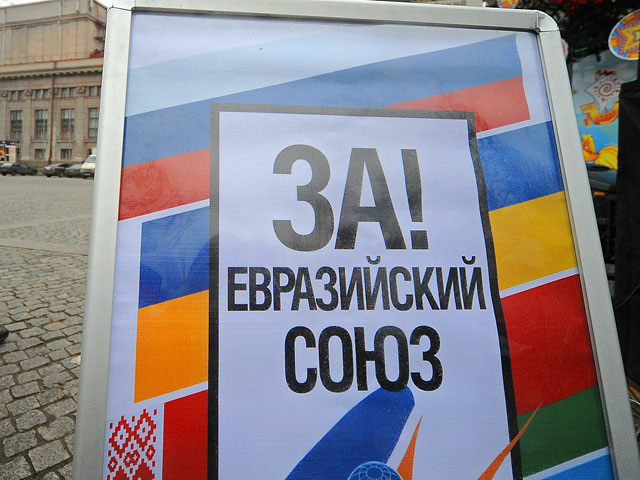
Under the guise of the Eurasian Union (EAS), which is declared as a "family business" of the universal states, Russian President Vladimir Putin is trying to revive the USSR and renew the Cold War, writes the British newspaper The Financial Times .
“Perhaps the successor of Boris Yeltsin, in which the Soviet state was divided, wants to remain in history as a leader who reunite it,” suggests, as Inopressa reports, the author of the article, a senior researcher at the Moscow Center of Carnegie Lilia Shevtsova.
The new interstate structure, which is planned to be created by 2015, will “repeat the mantra about integration and accumulates the contours of European institutions,” says the publication, but the form of the future union has not yet been determined. Moscow would like to create supranational political structures, which will entail a partial loss of independence of the Union members, in Minsk believe that "sovereignty is not an icon that we must pray for," and in Astana they would prefer to do with economic integration.
Another stumbling block, FT believes, is a question about the "courtship" of other countries. According to Shevtsova, the Kremlin prevented Ukraine from signing an association agreement with the EU, since it considers the Eurasian project an alternative to the European Union.
“This is not surprising: Russian Eurasianism, which was leaving at the beginning of the 20th century, has always been hostile to Europe and the West. Today, Russian elites see in the Eurasian idea an excuse for the reconstruction of the Soviet Universe under the auspices of Russia, albeit in a trimmed form and without a communist doctrine,” Shevtsova writes.
The implementation of these plans can be ensured by Russian financial power. So, according to FT, the support of the President of Belarus Alexander Lukashenko has already costs Russia $ 7-12 billion a year, and Ukraine received $ 15 billion for refusing European integration and a promise to reduce gas prices.
However, the Russian budget can only provide a limited number of such “bribes”, and in Ukraine and Belarus, dependence on Russia is fundamentally contradicting wide nationalist sentiments, the publication notes. In addition, the Russians themselves can get bored of "paying their elites for imperial complexes."
"The Eurasian project is a mirage of the post -Soviet archipelago, in which authoritarian leaders use each other to stay in power longer. It will last for some time, but soon the imperial ambitions of Putin will come to an end," Shevtsova predicts.