
Translated material
Mikhail Eremin: "It is hard for me because I really was left alone"
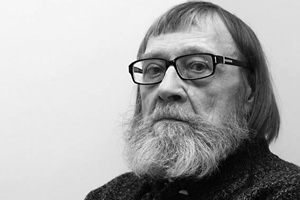
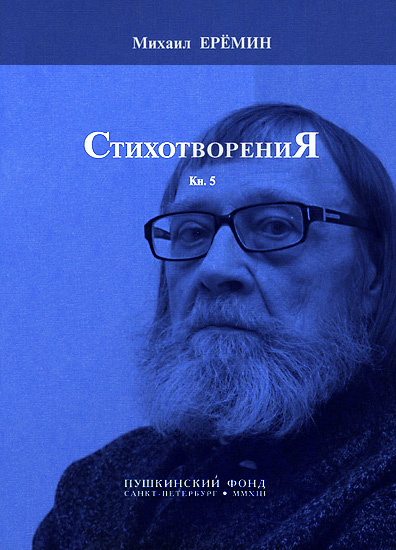
In the fall of 2013, the St. Petersburg poet Mikhail Eremin released the 8th book “Poems. Prince. 5 ". The book was published in the St. Petersburg Pushkin Fund, like the four previous ones. Consisting entirely of the eight -play, it continues the creative strategy that Mikhail Eremin develops over the past half a century. Daria Sukhovy came to talk with Mikhail Eremin about the new book. But instead of comments on the texts, it was just a conversation, if not about everything, then about a lot. Including poetry.
 © Nikolai Simonovsky, "Pushkin Fund"
- What in your childhood or in your youth has moved you to become a poet?
- I cannot determine the beginning. But three of us met at school - [Vladimir] Ufland, [Leonid] Vinogradov and I. We studied in the same class.
- And there they lost their company?
-For a while, for some time we were scattered, after school we met, and here it all started ...
- Didn't you try to write anything at school?
- It's funny, but at school we were already poets.
- That is, they were perceived by others as poets?
- No, only to each other, by yourself.
- Wrote congratulations for school holidays?
- In no case!
- That is, even then there is no participation in the official literary life. Just notebooks that went between you?
- Notebooks that went in a narrow circle. A little later, in the 50s, from the mid-50s ... I will not call them, but we will take three such poetic groups. One, say, was tuned to the publication ...
- In the Soviet press?
- Yes, for publication, albeit with further criticism. In that printing reality, she was configured for it. The second group - guesses, probably, what groups I am talking about - I was configured that, of course, it would be nice to print, but while preserving the face ... And the third group, which I call the Commonwealth, was a completely different attitude: no attention to printing. Everything that was written was to be “realized”. That is, to be recorded on a piece of paper, to sound in the recitation of acquaintances, to go on some lists, settle in someone’s archive, become a quote in a newspaper feuilleton, get into foreign publications or to the KGB archives (not archives, of course, but it is clear that!) All this is already “implementation”. Not printing, but the implementation of the product. This implementation was much more important than any publications.
- Have you read in childhood?
- Yes, sure. And quite early began to read.
- What did you read?
- Much was inaccessible. Therefore, Pushkin ... Everything was inaccessible then, not only books. Blockade.
- And the books flew into the stove ...
- And they flew into the stove, and few at that moment was reading. It was not so that people did not work, but read. As for the children who remained here, the pre-war children's literature, some “Chizh” and “hedgehogs” came across. And adults - Pushkin, Lermontov, Nekrasov.
- How much did you stay here in the blockade?
- Until the spring of 1942.
- And then where were you evacuated?
- On the Kuban, with the mother. Small land.
- There was probably even less cultural situation. There is better food, but there is nothing to read.
- Of course.
- And what year did you go to school?
-In 1944-1945, I already returned. When they removed the blockade, the mother had some acquaintances, it was difficult to get to Leningrad ... but somehow she succeeded ...
- And what did she do?
- My parents finished foxes, they are builders. I remember this very poorly.
-That is, were attached to some enterprise?
- They are builders, worked in construction organizations. Mother at the architectural department. Therefore, I, in fact, was born in the Caucasus, because at the end of the institute they lived in the Caucasus for some time.
- Did you get there by distribution?
- More likely.
- As far as I understand, were you going further around the country?
-Since 1963, I was extremely rare in Leningrad, almost traveling, and returned only in 1991.
- Where were you?
- Many where, from Kaliningrad to the find. For 10 years he mainly lived in Moscow, before that - in Moscow and Central Asia, in the Caucasus, in Siberia.
- And what did you do?
- Not without reason I first lived in Leningrad. My name was much larger than now. And therefore - translations, they gave me poetic translations.
- From the languages of the peoples of the USSR? Were these tanks or did you know any languages?
-No, but I am an honest person, I still have a textbook of the Kyrgyz language, some manuals in Tajik ... I tried to understand. In an interview, Brodsky, as it were, echoes Akhmatova, Akhmatova said to the same [Anatoly] Naiman that translations are bad for the poet, it is harmful to the brain, for talent, etc. In my opinion, this is completely wrong. I translated exactly so much that there was an opportunity to exist, and not, as said at that time, “kilometers”.
- Did you translate poetry or prose too?
- Poetry. And he considered this a wonderful exercise in versioning.
- This is an activity in which you do not need to go to service. With the editorial office, probably, it was possible to communicate by mail, anyway, where to live - why did you leave Leningrad then?
- The fact is that in the Union republics where they invited me, they gave me housing and everything they needed. But the recommendations, of course, came from the center, from Goslit. I worked in three editions-Goslit, "Eastern literature" and some other third. But all Moscow.
- And when did you start translating poetry?
- I have been considered translation experience since 1956. The first publication was a translation from Tajik in 1956. In general, I am in this organization - now it is called the Union of Russian Writers - since 1956. A total working experience is considered from the first entry in the documents, in the metric stamp about work - in 1952. I was 16 years old, but even there was no passport yet. And, unfortunately, in all my travels I lost these unique metrics.
Akhmatova told Naiman that translations are bad for the poet, it is harmful to the brain, for talent, etc. In my opinion, this is completely wrong.
- Did you participate where the fate of the translator brought you in the local literary life?
- No. I was a metropolitan little thing.
- Did you write poetry about these wanderings?
- Probably not.
- It is important for you where the poem is written?
- Not either.
- That is, the reference point is in the poet itself?
- For me there is only a temporary sequence. [Henry] Sapgir wrote by books, and he said about me that I have been writing one book all my life. And I think this is true.
- And how many poems have you written?
- For three hundred.
- Do you write with your hand or on a computer?
- On the computer, I only remake or add.
- It happens that you rule the published poems?
- I would change several poems when reprinting at the level of a line or even half -tall, but not.
- How much time do you write a poem?
-I had several years when one or two poems were a year. And I wrote a new book in four years.
- Forty poems in four years - about ten poems per year, therefore?
- Yes. Slowly I do all this.
- And what is needed in order to write poetry? Silence?
- Don't know. I have no Boldinsky autumn.
- Do strong shocks affect?
-Strong shocks will ever come around, but not according to the trace. Not immediately.
- Which of the modern poets do you read?
- Everything that turns out to be affordable to me.
- And which of this is the most interesting and pretty to you?
- I hardly find mine, there are interesting authors for me ... But not mine ... Here, let's say, the same Joseph Brodsky. A wonderful Russian poet of the second half of the XX century. But all of them written is absolutely not mine. Just like mine - not his. Therefore, he never had attentiveness to my poetry. But at the same time, we were not completely alien to each other, we had warm, friendly relations.
- And other peers and contemporaries? How do you feel about your generation?
- Of the verses of all participants in the Lito Mining Institute, one good poem can be made up. The same can be done with the verses of the participants of the LITO Institute. Of the verses of the participants of the "Philological School" it is impossible to make one poem. Well, do not add up [Sergey] Kulle to the blank, and I can’t stick me there! This is a rather rare phenomenon for literary community.
Joseph Brodsky. A wonderful Russian poet of the second half of the XX century. But all of them written is absolutely not mine. Just like mine - not his.
- I wanted to ask you about your attitude to the Oberiuts. I understand that you love them, but which of them is the most beloved?
-Each of them I like something of my own, something with Harms, something at Vvedensky. The whole "philological school" began with futurism. Mayakovsky, Khlebnikov, who overshadowed Mayakovsky, Pasternak ...
- And the twisted? Or was it not available?
- He was available, I was even familiar with him. Oberiuts, acmeists, Pasternak and Mayakovsky were perceived by us more seriously than twisted. I saw him only once in my life, they introduced me to him, I was with him.
“Did you show him your poems?”
- No.
- And with which of the senior comrades did you still communicate?
- We did not seek to get acquainted with the then living literary elders.
- “Philological School” with the filing of the Ufland is positioned as the first state -owned group. How fair is it?
- I think, yes, it was so. In the performance, when philologists ate Thunda on the steps of the Philfak, the entire composition of the “philological school” participated.
- What performances did you personally participate in the performances?
- Well, for example, in the singing of songs on the go - the Khlebnikovsky “sheepskin coats”, and, by the way, the audience was very good. And there was also lying on Nevsky, at the beginning of Nevsky, near the editorial office of Neva magazine, about which [Lev] Losev writes - it was also a performance - or driving Karavay on the street.
- And people, passers -by connected?
- They did not connect, but looked at it very affectionately, there were no protests from the population.
- And what is it in general - to live and feel like a classic?
- In fact, I am one of many, and it is hard for me because I really was left alone.
- Well, not quite alone - in the circle of friends there is still Vladimir Gerasimov, he did not write poetry, but he was and remains nearby. Tell us about him.
- He is seriously ill, suffered a stroke. But he remained a fantastic memory, an interest in culture, mainly in the visual arts, in some new magazines, in exhibitions, which I have not even heard of. It goes now to the Hermitage with the grandson.
- What did he do?
- He was a walking encyclopedia.
- And he worked, where was he listed?
- Little where. Mainly under the editorial offices - Aurora, Bonfire.
-But if I imagine now that I, sitting at your guest, will disappear somewhere, and suddenly at this table-well, as if everyone is alive-your whole friendly circle, the whole “philological school” will gather ...
- Well, do not disappear, stay here with me and with them. In general, all our communication happened at the time of my departments - not by correspondence and phone calls, and exactly so, directly, when I arrived, at the table. When this communication was - we were. And it was precisely this life consisted of life.