Date
Author
Шекспировский сезон Алексея Бартошевича
Source

Preserved copy
Translated material
Hamlet in the Superflow
In the beginning, we are opening up "the abyss, the stars are full." In it, it does not know what a flat square hangs on. He sets in motion and turns out to be a cube like a spacecraft from a fantasy film or, perhaps, the image of our planet, lost in the infinity of the cosmos. It seems that the cube is not attached to anything, hangs in the void and controlled by some secret force. It rotates, turning in different faces, the doors are swollen in it and with a booming roar, some hatches open, holes, from where different objects crawl up to the mirror or washbasin, standing from which Hamlet tries to cut the veins ...
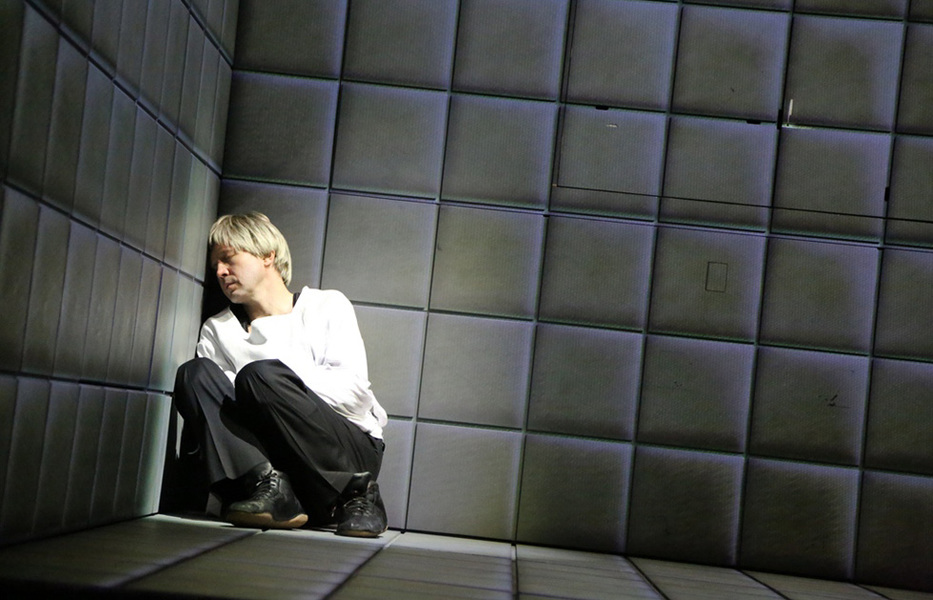
Robert Lepage and his team create overwhelming metamorphoses before our eyes. The most difficult computer technique and at the same time something resembling a children's kaleidoscope, in which the pictures magically change: a non-actual chamber in a psychiatric hospital, similar to a dumb prison camera, where Hamlet is sharpened (it is prudently upholstered with foam tips so that the prisoner does not commit suicide, breaking his head against the wall), the luxurious palace of the Danish kings, the computerized room of the polonium, where it gives it. To his agent Reynaldo, telephone instructions on how to spy on Laertu, and at the same time follow the prince through the ubiquitous surveillance cameras, a TV on which Hamlet watches pieces from the Kozintsev film - it seems that he does not persuade the actors from this film (except, of course, Smoktunovsky, which is not necessary to persuade).
The stage design of the play in the booklet attached to it is called the “Superflow”.
The public instantly masters children's delight before the miracle of computer technology. However, we have not before the latest gadget, not an exhibit of the exhibition of the achievements of the silicone valley, but an extremely compressed, condensed space of the tragedy, where all the action is embedded, and where its characters are crowded. The tragedy does not need physical size: it is tormented by claustrophobia and in cosmic infinity, the volume and scope of tragic art do not depend at all on the number of square and cubic meters, it is focused on essential objects.
... Or maybe Hamlet is no longer alive, and we are faced with painful images of his mortal sleep. The hero now knows, "what dreams in that death dream will dream." His ward, his prison becomes like a crypt, and a prominent shirt worn on him - to a shroud. At the beginning of the performance and in his finale, one mise-en-scene is repeated-Hamlet sits motionlessly, fading his face in the corner of his chamber-scream: the events of the play move between these two points, the first and last scenes, the beginning and the end coincides, the story moves along the closed circle. The first words “two months as he died, there will be no two” he mutters a little audibly through a warning dream, the words of the last monologue sounds quieter, and “further - silence” - in a whisper. Having come from non -existence at the beginning of the performance, he returns to non -existence in the finale.
 © Roman Dolzhansky
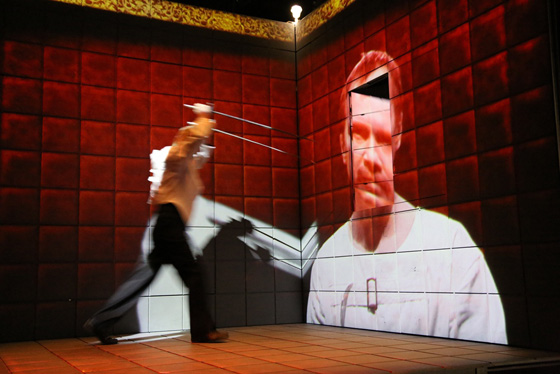
To him, in his cramped loner, are the ghosts of all the inhabitants of Elsinor, who are born to his fever - one after another, or even a witching way - a little at once. As Mironov, who plays at Lepage, as you know, does all the roles of the Shakespearean play, do it is impossible to understand. But, it seems, Hamlet himself is playing in front of himself - and before us - the history of his life. This whole series of visions does not so much appear before his mental gaze - he himself creates it, playing it with chokh, or rather, becoming them: Claudius, Father, Polonia, Laerto, Ophelia, Horatio, Prime Minister of the Capital troupe, gravewoman. A voice changes, a beard sticks out - and in front of you Claudius, a long golden wig is pounced - here is an offelia, lips are smeared with thick paint, a mantle is thrown out - and Gertrude occurs. There is a incorporeal ghost, soaring in the air, and the grotesque clown Ozrik, who performs ridiculous jumps on the longest help. At the same time, all this is the projections of the personality of Hamlet himself. Even the faces of the Rosencranz with Guildenster, a close -up arising in front of him on the wall, is the repetition of his own face, and, therefore, mocking them, he is explained with himself.
In essence, before us Monodram, whose idea Gordon Craig once tried to realize in his Hamlet, and Nikolai Jewish considered the main genre of the modern theater.
Evgeny Mironov plays Hamlet and all other characters in the Shakespearean tragedy with his usual honed virtuosity and almost frightening heat of dedication. They are owed by the fact that the poet just called the actors “rabble rabbit”. He is obsessed with excellent acting: it seems that he himself is ready to turn not only into all the heroes of the play, but in everything in the world, soul and body to transform into a different creature or object, become this chair, this gender or wall, and whatever - the whole world, finally.
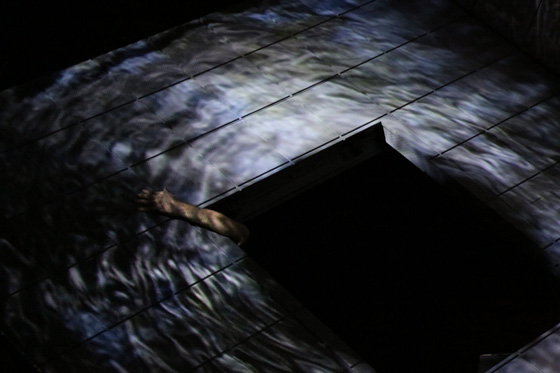
The auditorium every now and then laughs, which, it would seem, is strange: they play a tragedy. But this is a laughter of admiration for the impeccable technique of the actor, his ability to instant transformations and the victorious tricks of the skilled acrobat or prestidizer (who just does not have to be an actor in a modern theater). Just a second ago, we saw the Danish prince on the stage of the Danish - and already in front of us Polonius, and even a moment after - Gertrude or the king, but the already drowning body of Ophelia slowly, smoothly sinks to the bottom (it is impossible to understand what technical means the impression of this terrible smoothness is achieved).
Mironov owns the fact that the poet just called the actors “rabies of risk”.
It is impossible, however, I can’t admit that from time to time the brilliance of these sorcerer metamorphosis begins to slightly squeeze the terrible essence of what is happening in the play. So, as if Mironov, a delicious process of theatrical transformations, lacks the effort and time for Hamlet himself. A noisy crowd of characters (all of them - one Mironov!) In places, obscures the hero, for which the whole story is undertaken. The dizzying run of the performance is almost devoid of breakdowns and pauses in which Hamlet at Shakespeare stops to comprehend himself, the world, himself in the world. Probably, when the actor cools down a little from the premiere excitement of the game, he will see the meaning of pauses in this play more clearly. It is not necessary to follow the famous formulas of Meterlink (“Eternity speaks in silence”; “Hamlet has time to live because he is inactive”) to appreciate the role of silence and real estate in the Shakespearean tragedy. Mironov has these blows (for example, in a monologue about hekube) - and this is perhaps the most powerful points of the performance. They are - but there are, alas, much less than the logic of the tragedy requires ...
Four new Hamlets are now in Moscow, different in meaning and artistic level-from the deafening noisy, choking in its own super-dynamics of the play “Gogol Center”, where the prince, gently aiming, shoots in Polonia from a revolver, to a strongly folded, seriously played, but somewhat sluggish presentation, and somewhat sluggish. shown by Yermolovtsy. Needless to say, among the three productions (the fourth I have not yet seen) the Hamlet of the Theater of Nations is perceived by a real masterpiece of theatrical professionalism.
It seemed to me, however, that all three Moscow Hamlets were different, but equally removed from the usual tradition for the Russian theater to directly correlate the meaning of the Shakespearean tragedy with the torment and reflexes of each moment of our common historical fate, now and then becoming a fate, making this superpowers with an instrument of self-knowledge and self-expression of each generation. This is, of course, not talking about elementary modernization, not about external and most often riotous references to the present (this is precisely in the “Hamlet with a revolver” mentioned above), but about the connections and correspondences of a different, essential level. It seems that the directing of the current Hamlets is not very preoccupied with finding these connections and conformity to find and present to contemporaries.
It for the most part glides past the pain points, open wounds of our days, not wanting to turn the play into an occasion for a self-portrait of her generation-in contrast with how it was once by Alexander Blok (“I am a Hamlet. Colds blood”), Mikhail Chekhov or Vladimir Vysotsky. Today's "Hamlets" are in no hurry to climb out of transcendent heights, setting up world -west goals. Their creators are inclined to see the danger here to fall into the grandfather's high -fired recitation, which they are afraid of more than death. Thus, the content of the “be or not to be” monologue - one of the best, heartfelt moments in Mironov - is nevertheless limited only by the topic of suicide. It is not necessary to remind you that the text is not about how it is more convenient to cut the veins, but about death and immortality. About being-in-death. About "Broofier of a mental impasse."
 © Roman Dolzhansky
I risk asking an old -storey question: what human story does the play of Lepage want to tell us, what message is concluded in this “Hamlet”, what does he tell us about?
According to the director, he discovered in the play a topic that excited him deeply- “the incestuality of events taking place in Elsinor” , or rather, that once, in old times, it could be considered an blood mixing (marriage between the widow and brother of the deceased). I don’t think, however, that for the meaning of Hamlet, this topic was of any serious importance-even in the Shakespearean era, not to mention the times of the later. If Claudius were not a brother’s brother, but a completely stranger uncle, Hamlet would suffer less? The world would not have seemed to him a “wild empty garden” - and the century would not be dislocated? If you really want to, you can find something suspicious in Laerte’s relationship with a sister. But how much will this add to the circle of ideas of the play? The point, of course, is not in the verbal formulas of the director: in the end, he is not a philosopher or Shakespeare's. But somehow the arguments of the great wizard of the stage about the proposed circumstances of the tragedy sound very liquidly.
On the other hand, in the West, there are many directors - masters of thoughtful eloquence, virtuosos of the oral genre who can better state the most thoughtful concept before the affected audience. This is usually limited to their theatrical achievements. Once again: the matter is not in the dubious depths of the directorial declarations of Lepage - they did not prevent him from creating a theater work unheard of structural perfection, at the same time carrying a serious, but not demonstrating human meaning.
I admit, I did not notice in the relationship of Mironov-Laerta and Mironov-Ofelia an absolutely reprehensible score. And in general, for some reason, I did not find any incestability in the play (probably it is for the better-but for fidelity it would be necessary to go to it again). For me, how, I dare to think, and for the whole public, it was a lot more important than that: what Lepage did not talk about. Evgeny Mironov played a tragic story in Hamlet, equally calling for all times, including our own. The history of the terrible loneliness of a man, abandoned into universal infinity, the loneliness of the prisoner in the fussy crowd of ghosts created by the effort of his confused soul, the desperate loneliness of the frightened boy, who, like the young heroes of Dostoevsky, refuses to accept the world created by God.
The tragedy, accustomed to dealing with eternity, with the latest issues of being, today has a hard time - if she does not want to be converted into a black postmodern tragifars. To whom it is now the matter to the fact that the “century is dislocated”, when, look, some important bank will burst, or even the ruble from the euro will collapse. It seems that today's world is very rarely able to remain at the level of moral requirements for the tragic genre.
Be that as it may, Evgeny Mironov is destined to remain in the memory of the theater with the best Hamlet of our Negamletov time.