
Translated material
Sochi: problem with mass shares
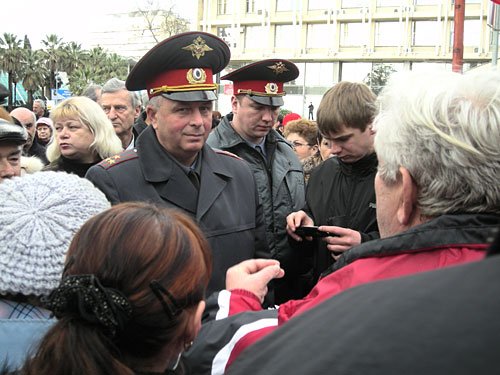
During the Olympics in Sochi, freedom of assembly will be significantly limited. Despite the fact that Putin introduced by decree of mass events during the games was later canceled by another decree, and now the guests and residents of Sochi will be able to protest in a specially designated place - in a village located 20 kilometers from the city center - the validity of restrictions and their compliance with international standards causes serious doubts among lawyers and human rights activists.
On August 19, 2013, Putin signed Decree No. 686 “On the features of the application of enhanced security measures during the XXII Olympic Winter Games and XI Paralympic Winter Games in 2014 in Sochi”, which states that “meetings, rallies, demonstrations, processions and pickets that are not related to the Olympic Games and Paralympic Games and paralympic games, and planned for the period from January 7 to March 21, 2014 “in the territory and in the water area, within which enhanced security measures are introduced” in connection with the organization of the Olympics and the Paralympic Games, “are held at a different period of time.” On January 4, 2014, another decree was signed in decree No. 686. It was clarified that at the indicated time in the mentioned territory and in the mentioned territory and in the mentioned territory and in the mentioned territory The mentioned water area of the Assembly, “not related to the holding of the Olympic and Paralympic Games”, “can be held in places and (or) along the routes of the movement of participants in a public event, with the number of participants and in the temporary interval determined by the administration of the municipality of the city resort city of Sochi in agreement with the relevant territorial body of the Ministry of Internal Affairs of the Russian Federation and the relevant territorial authority of security.”
After signing the second decree, one official place was chosen for the mass political actions in Sochi - a park on the street 50 years of the USSR in the village of Khosta on the Black Sea coast, 20 kilometers from the center of the capital of the Olympics. Here, “in the park, people can freely express their opinion, without violating the rights of other citizens and not violating the Olympic Charter,” quotes the words of Deputy Prime Minister Dmitry Kozak, responsible for holding the Olympics, the R-Sport agency. The Olympic Charter prohibits “any demonstrations or propaganda of a political, religious or racial nature” “at the Olympic facilities, the places of competition and in other Olympic zones.” However, it only follows that these demonstrations or propaganda are possible everywhere, except for a certain territory associated with the professional activities of the participants in the Olympiad, and not only in one specially selected place.
The fact that the president has the right to introduce enhanced security measures, including, in particular, “restriction on public events that are not related to the Olympic Games and Paralympic Games,” says Federal Law No. 310 “On the organization and holding of the XXII Olympic Winter Games and the XI Paralympic Winter Games of 2014 in the city of Sochi, the development of the city of Soch Gorlimatic resort and amendments to certain legislative acts of the Russian Federation. ” However, according to the co -chair of the coordination council of the youth human rights movement Dmitry Makarov, both presidential decrees “have little in common with the right and conflict with the key principles of freedom of assembly”. He noted that the first decree actually prohibits the holding of any collections that are not directly related to games, and the second, although it provides for their theoretical opportunity and was generally submitted as “significant liberalization”, in essence limits them in place, time and numbers. “Instead of notifying order, permissive is established, in addition to the time and place of the authorities, the authority is assigned to regulate the number,” the expert says. “The freedom of assembly in this territory is replaced by a prohibition or permissible above and becomes completely illusory - its key principles for a while are suspended by a by -laws.”
The lawyer, legal adviser to the Ecosocis Foundation, agreed with the fact that the restrictions on mass events in Sochi are an encroachment on the freedom of assembly, the legal adviser to the Ecosocis Foundation Olga Gnezdilova. However, it recalls that, according to Part 2 of Article 11 of the European Convention on the Protection of Human Rights and Fundamental Freedoms, “the exercise of these rights is not subject to any restrictions, except for those provided by law and are necessary in democratic society in the interests of national security and public order, in order to prevent riots and crimes, to protect health and moral rights and freedoms of other persons.” Despite the fact that the decree is a by -laws, Gnezdilova believes that the restrictions contained in the presidential decrees belong to the law provided for by the law: according to her, the European court admits intervention in the rights provided for in Articles 8–11 of the Convention not only on the basis of the act of parliament: “The main thing is that the document is published and gives a clear representation of its rights and obligations.”
However, the document is not quite clear: Gnezdilova notes that on the basis of the text of the presidential decree "it is impossible to outline the territory in which public events will be prohibited." Rachel Denber, Deputy Director of the Department of Europe and Central Asia in the organization of Human Rights Watch, also says about the same thing: “It is not clear what kind of territory it is, it is not listed what places these are, where such measures are introduced in contrast to controlled areas.”
The second classical criterion, which must comply with the restrictions introduced by decree, is the pursuit of a legal goal, namely, security. In this regard, Gnezdilova notes that "it is important to understand whether it will objectively threaten the security of a picket of 1-3 people near the Sochi city administration." Rachel Denber wonders if the presidential decrees should not be from the presidential decrees that, under the pretext of enhanced security measures in Sochi, it will even be possible to prohibit a single picket. According to her, this will mean that the restrictions introduced by decree are disproportionate, and this contradicts the principles of international law and the European Convention.
Finally, the most difficult, according to Gnezdilova, is the question of the need for restrictions in a democratic society (this criterion is also contained in Article 21 of the International Covenant on Civil and Political Rights). “If the organizers (mass shares) will be able to justify that it makes no sense to express an opinion in the village of Khost or after March 21, and it is advisable only“ here and now ”, such shares should not be limited. The issue of proportionality will be resolved in each case. The venue for a public event should allow to realize his goals, that is, the opinion should be heard by the authorities that a person wants to turn to, ”the lawyer believes. (The expert’s opinion can be read here in more detail here .)
It is also worth paying attention to the fuzziness of the formulation of “not related to the conduct of the Olympic Games and the Paralympic Games” in Decree No. 686: it is not clear that the events organized by someone except the Sochi 2014 Organizing Committee, thematically related to the Olympics. Thus, the protest due to the fact that, due to the construction of Olympic facilities, people are evicted from houses, of course, thematically “associated with the holding of the Olympic Games”. However, Rachel Denber recalls that during the Olympic Games in 2008 in Beijing, where restrictions similar to the current Sochi were introduced, citizens 77 times tried to obtain permission to hold a protest campaign, and it was never received. Although Russia, unlike China, ratified the international pact and is a member of the European Council, in a situation where the organization needs to be coordinated not only with the municipal authorities, but also with the units of the Ministry of Internal Affairs and the FSB, the chances of holding such a promotion are very small. The need for the participation of the Ministry of Internal Affairs and the FSB in ensuring security during the Olympics is undeniable, but this should not, according to Denber, "to hinder people who want to speak out for compensation for property that was expropriated due to construction, about the damage that they suffered in connection with the Olympics."