
Translated material
Simple insensibility
An unprecedented process in the "Sailor Silence"
After a series of December amnesties, many started talking about the humanization of the Russian judicial system. The New Times correspondent visited an unprecedented process in "sailor silence": conclusions - directly opposite
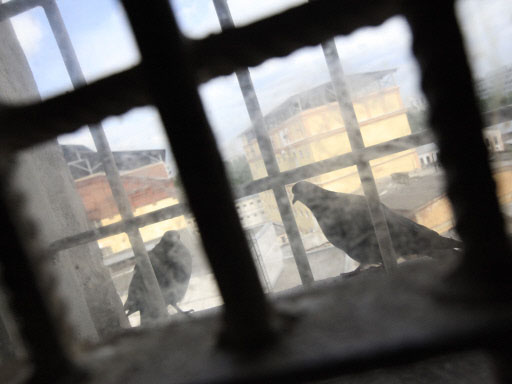
In the pre -trial detention center "Sailor Silence"
The court sessions in the pre -trial detention center take place in exceptional cases - when the prisoner, due to a heavy ailment, cannot be delivered to the court and the prison doctors do not give permission to transport it. And then the judges themselves come to the defendant, as a rule, to let him go home. But on January 13, 2014, the judge of the Tver District Court of Moscow Tatyana Neverova arrived differently. In the early morning, she arrived in the Sailor Silence pre -trial detention center to sentenced the prisoner to six years in prison. The 31-year-old paralyzed Vladimir Topekhin was sentenced.
A judge without a mantle
| *Members of the Moscow Public Supervisory Commission at the places of forced content (PMC) |
When in the pre -trial detention center “Sailor Silence”, the human rights activists Anna Karetnikova and Alla were reduced in the investigative cabinet, the so -called “lawsuit” passed there has already begun. On an iron roller bed lay a large man with a red beard, covered with a gray soldier's blanket. His hands were folded on his chest, like a corpse. In his hands, he held a black Bible. On the contrary, there was a table at which the judge Neverova was sitting, a middle -aged woman in a fashionable black dress with white inserts. The New Times correspondent asked her why she was without a mantle.
“I am at a visiting court hearing,” the judge Neverova explained, wrapping herself in a colorful scarf.
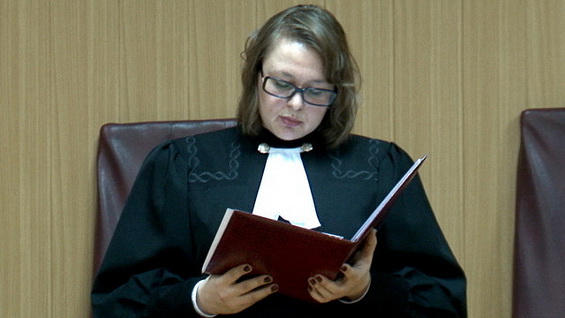
Judge Tatyana Neverova
A short -haired gray -haired woman in a variegated knitted sweater at the next table turned out to be the senior assistant to the Tver interdistrict prosecutor of the city of Moscow, Sergeyeva Larisa Alexandrovna. Therefore, she is a state prosecutor.
Here, probably, it makes sense to remind (specifically for the federal judge of the Nevvyova): according to Art. 40 of the Law “On Courts of General Jurisdiction in the Russian Federation” of February 7, 2011, “in the administration of justice, judges are sitting in mantles”. Nowhere in the law it is indicated that during the exit court hearings, judges may administer justice without a mantle.
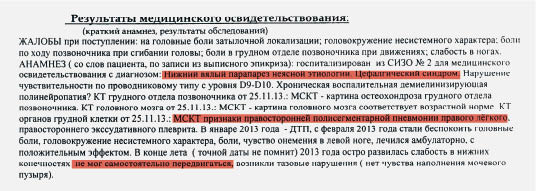

Excerpt from a medical report issued to the accused V.A. Topikhin in the 20th Clinical Hospital in Moscow
But what is stated in Article 41.3 of the Law “On the Prosecutor's Office of the Russian Federation” of 01/17/1992 (this is already for the state prosecutor Sergunayeva): “In the case of the participation of a prosecutor’s employee in the consideration of criminal, civil and arbitration cases in court, as well as in other cases of the official representation of the prosecutor's office, wearing uniform uniforms is mandatory.”
"
The defendant Topekhin can neither sit nor walk. In addition, he has incontinence
"
Naked prisoner
In the investigative office of the Sailor Silence of Paralyzed Vladimir Topkhin, who calls himself a “financier”, they tried that on November 8, 2011 he allegedly stole 10 million rubles from his friend Penza Nikolai Kulagin. Kulagin wrote a statement to him to the prosecutor's office. Topkhin was arrested in the summer of 2013. And in September, in the bottle pre -trial detention center, his legs were taken away.
The prison doctors first considered Topokhin a simulator, and then nevertheless transferred to the prison hospital “sailor silence”, where during one of the checks, the members of the Moscow PPC found a naked, paralyzed man on a mattress without a linen under a prickly blanket. Human rights activists found him a lawyer, raised a noise in the press, and Topokhin was taken to the 20th clinical hospital, where he was diagnosed with: "Lower sluggish paraparesis of an unclear etiology." Topkhin can neither sit nor walk. In addition, he has incontinence, human rights activists and prison staff buy him diapers - his relatives, apparently, are not up to him.
Topkhin told the doctors that his illness is the result of an accident that occurred in January 2013. But in the case file, there are no documents on a car accident with his participation.
| ** "Prison as a diagnosis", The New Times No. 32 of October 4, 2010 |
The medical commission of the 20th hospital found that the prisoner does not have a disease included in the list of severe, preventing the detention **, which means that Topekhin may still be kept in jail. Who should take care of him, change his diapers, treat the faults - doctors do not indicate in this certificate.
In money - misfortune
The trial in the "sailor silence" lasted more than ten hours with small breaks. Judge Neverova was in a hurry to pronounce the verdict, because, in her words, she knew: Topkhina should be transferred to the 20th clinical hospital "for physiotherapy exercises." But the lawyer Svetlana Sidorkina has a different version: the judge was in a hurry, because the European Court of Human Rights (ECHR) had already intervened in the fate of Topekhin. In mid -December, Sidorkina sent a complaint to Strasbourg in his case. And on January 15 it became known: the ECHR is expecting from the Russian government explanations about Topokhin’s treatment in prison.
“I have a head and back hurt, I feel bad,” Topokhin moaned during the process, begging the judge to give him a glass of water and call a doctor. The lawyer Sidorkin asked the judge to postpone the court session due to the poor state of health of her client.
“The court refuses the petition to postpone the court session. We have a certificate from doctors that the defendant can participate in the process - the judge's voice sounded loudly and assertively. - The issue of the beginning of the process in the absence of witnesses that did not appear in court is being resolved. Defendant, do you agree? "
Topekhin was silent. He did not answer the judge’s question and after the lawyer Sidorkina approached him and asked: “Do you understand what we are talking about?”
Sidorkina continued: “I ask you to call a doctor. My client cannot adequately evaluate what is happening here. ”
The prosecutor began the interrogation of the victim Nikolai Kulagin. He said that Topkhina knew 11 years and when he was about to open the center of forensic examinations in Moscow, he asked the defendant to help him. Kulagin, from his words, lent 10 million rubles in Penza, brought to the Topkhin, who promised that he would put them in a bank cell. But he did not find a cell that day, took the money and did not return it.
The judge calls witnesses - two friends of Kulagin. They heard from the victim that on November 8, 2011, Topekhin abducted his money, but they themselves were not present when transferring it.
The story of the relationship of the defendant and the victim is rather dark
"
The next witness is the former investigator of the 6th department of the Investigative of the Main Directorate of the Ministry of Internal Affairs Nikolai Drotyev-a young guy in an elegant suit and a pink tie. According to Kulagin, the name of Drotyev named Topakhin when he explained why he could not return 10 million: supposedly after he took the storage from Penza, he began a search in his office, they took the money, and he was taken to the investigation department on Petrovka. Witness Drotyev says that neither Topokhin nor Kulagin have never seen.
The interrogation of witnesses of the prosecution is completed. The defendant does not admit his guilt and says that Kulagin did not give him any money.
After two or three hours and a girl-doctor from the prison hospital finally comes to Topikhin. True, she forgets the tonometer. To the question of the correspondent of The New Times, whether she examined the patient before signing a certificate of his health, admits: no, she did not have time to examine, simply signed the doctors from the intensive care unit, where the Tophehin lay the last days. Embarrassed, she runs to the hospital for a tonometer. Returns: the pressure of the prisoner is 140 by 80.
“I was washed my face yesterday,” Tophin says The New Times. “I asked me to cut my nails, but they didn’t cut it.”
"Volodya, why did you stole money from me?" - asks for a paralyzed victim Kulagin.
“Kolya, I haven’t stolen money from you. God is your judge. Take money! " - He answers in a weak voice.
"Where will I get them?" - the victim is lamented.
Almost a death sentence
About where he would take 10 million rubles, allegedly stolen by Topokhin from him, the victim Kulagin found out at 10 pm, when Judge Tatyana Neverova read the sentence to a paralyzed prisoner: 6 years in prison in a colony of general regime. ... The arrest imposed on Topepukhin's property is a cash in the amount of 10 million rubles, which are in their personal account on the personal account defendant, - to cancel, turning to repay the civilian claim of Kulagin.
The prosecutor Sergyyaeva asked for Topekhin for 7 years, the judge ate a period of only a year. Although she had the opportunity to give the defendant and a conditional term - the victim Kulagin, it turns out, would still receive 10 million rubles.
“The engaging court,” he groaned when he heard a sentence convicted. The victim Kulagin hardly hid joy. “I want justice,” he admitted to the New Times.
The story of the relationship of the defendant, the victim and pumped up guys from Penza, who acted as witnesses in this strange trial, is quite dark. Topkhin told human rights activists that operatives came to prison and demanded that he give money. He also wrote about the threats to the judge of the unbelief in the appeal. The judge did not react to this. She refused all the petitions of the defense, did not consider it possible to interrogate the brother of Topkhin and other witnesses proposed by the lawyer. “When my client was lying in the hospital, they didn’t let me go to him, the judge did not give permission to pass to the hospital,” the lawyer Sidorkina told The New Times.
During the break, when the doctor changed the defendant of the diaper, the judge Nemova talked sweetly in the neighboring investigative office with the prosecutor, the victim and witnesses of the prosecution.
In the verdict, justifying the sentence of the sentence, the judge wrote: “... the court takes into account that the defendant V. Podkhin We do not judge, for the first time brought to criminal liability, is positively characterized by the place of residence, while the court takes into account the state of health of the defendant and members of his family, the presence of the defendant’s parents - the court recognizes the indicated circumstances to softening the punishment. ”
Did the judge of Neverova hear the defendant’s words that he had a hell of his head and back? I heard, but did not react. During the process, she read out the conclusion of a psychiatrist that the behavior of Topokhin is “installation”, that is, he can simulate his condition. It seems that the judge believed the psychiatrist.
And here is the doctor-therapist of the hospital "Sailor Silence" Raisa Botnev to the question of the correspondent of The New Times, the simulator Lee Topekhin, confidently answered: "No, he cannot simulate paraparesis." In the practice of the judge, there is at least one acquittal. On December 28, 2012, she acquitted the former deputy head of Butyrki for the medical part of the doctor Dmitry Kratov, the only accused in the death of Sergei Magnitsky, who died on November 16, 2009 under unknown circumstances in the SIZO Sailor Silence ...
And in the meantime, on the "Swamp process"
Zamoskvoretsky District Court. Hall No. 410. Big iron cage. There are seven defendants in the “Twelve Affairs” - five defendants dropped out of the process according to the December amnesty.
Denis Lutskievich reads the newspaper “Soviet Sport”, Sergey Krivov waits for his turn to submit another petition, Yaroslav Belousov reads a book, Artem Savelov twists a notebook in his hands, Andrei Barabanov reads a printout from the website of The New Times, an interview with Mikhail Khodorkovsky. Stepan Zimin went deep into reading a book, Alexei Polikhovich looks at his wife, sitting in the second row to the right of the cage. The defendant Alexander Dukhanin - under house arrest. Her place is next to lawyers. The hall is small. It was hard to fit 12 lawyers, more than a dozen spectators: the chairman of the Moscow Helsinki group Lyudmila Alekseev, politician Vladimir Ryzhkov, journalists, relatives. As well as a fluffy red-black shepherd, it lies at the feet of Lyudmila Alekseeva.
The word to the defendant
The interrogation of the defendants lasted two days. They told how they came to Bolotnaya Square on May 6, 2012 and how they were detained there. Here are a few excerpts from their testimony:
Yaroslav Belousov: “We got up, holding hands, because police officers detained everyone. A few minutes later they grabbed me, then they knocked me onto the floor, then grabbed my arms and by the legs and dragged me into a car carrier. ”
Alexey Polikhovich : “I saw the guy ahead of me. He did nothing. OMON flew into him. They dragged him on the floor and beat him with batons, I grabbed him by the belt and tried to close him from the blows of batons. Riot police Tarasov, whom I allegedly hit, if you remember, said that I did not experience physical pain and generally offered to forget everything. In my opinion, this best says that there was nothing. ”
Denis Lutskevich: “Yes, I shouted slogans. I supported the people that they shouted, then I shouted ... When I was trying to leave, several police officers attacked me, they beat me on the back, most of the blows fell on my head. They grabbed my arms and legs and dragged me into a car zaka ”...
Andrei Barabanov: “Police officers divided into groups, wedged into a crowd of people, beat them. It was very scary. Why? Why all this? I had a feeling of fear for my life. I was hit several times before the detention. I was just afraid that I could not leave the rally on my feet. ”
Artem Savelov: “On May 6, a peaceful rally was supposed to pass. I saw people of different ages, everyone was friendly and smiling. Several couples of people with canes were especially remembered. It turned out that this is a society of the blind ”... - Savelov stuttered greatly, it is difficult to understand what he says.
Sergey Krivova: "I am sure that I did not bring any physical pain to anyone ..."
Alexandra Dukhanin: “A few days before May 6, from a newsletter on the social network, I learned that on May 6 a sanctioned rally was planned. Since I have a civil position, I do not agree with the election results, I decided to come to it. ”
Pardon or deadline?
On Wednesday, January 15, lawyers made petitions for the introduction to the case of additional materials, prosecutors, as always, were against it. Judge Natalya Nikishina satisfied some kind of defense, some-no. For example, she refused to lawyer Sergei Krivov in his request to bring to prison to his client-cardiologist.
The audience in the process was divided: those who believe that the “swamps” will be released, and those who believe that they will go to the camps.
On Thursday, the 16th, prosecutors took the word. “They proposed to announce a huge number of documents,” said Dmitry Agranovsky, lawyer Yaroslav Belousov, lawyer Yaroslav Belousov. “None of the documents that the prosecutors are talking about are related to the subject of proof in our process.”
Agravsky says that if on Monday, on the 20th, Judge Nikishin will satisfy the petition of the prosecutors, the process may drag on for a few more months.
And here is the version of the optimists: on Monday, the judge will announce the debate of the parties and pass the verdict until February 7, when the Olympics in Sochi will begin.
*Art. 318 of the Criminal Code of the Russian Federation ("Application of violence in relation to representatives of the authorities"). “There are several legal ways to get out of the situation in which the power fell with the“ swamp process, ”the director of the Institute of Human Rights of Human Rights, Relacements. - If, having evaluated the evidence, the judge in the verdict indicated that there was no crime event under Article 318 of the Criminal Code of the Russian Federation*, then the defendants would fall under an amnesty. There is another way - individual pardon by the President of Russia. And the third option - the judge gives the “swamps” such a period that they have already served.